Latest
Latest News
Latest News
Latest News
Latest News
Blog
Police chief,15 others die in rash of shootings in Mexico
Gunmen killed 16 people,including a police chief,in a spate of separate shootings across Mexico,which is grappling with a spike in drug violence,local officials said Thursday.This article appeared in
Latest News
Blog
The Link Between Sagging Pants Laws and the Drug War
Radley Balko points out that police in Flint, MI have started going after people whose pants sag below their boxer shorts:
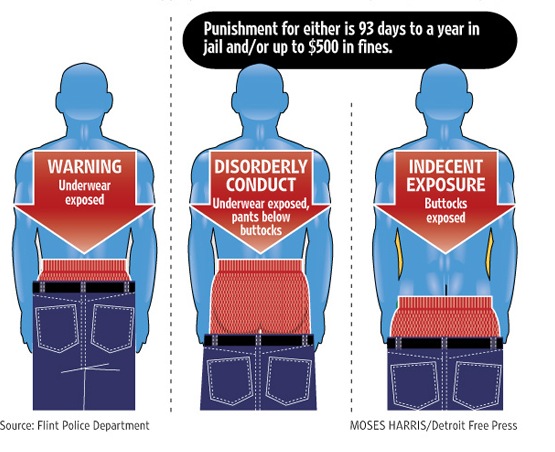
Leaving aside the absurdity of telling people how to wear their pants, just contemplate the ironic path that brought us here. The style itself is an artifact of prison culture, where inmates' belts and shoelaces are confiscated and the standard-issue clothes never fit right. The style made its way back onto the streets where it entered popular culture. Now, in 2008, you can go to jail for 93 days to a year just for dressing like an inmate.
In an urban landscape already ravaged by decades of racial profiling and drug war demolition tactics, police have codified their own authority to stop and frisk people whose style of dress is already stigmatized by presumed criminality. The number of things young people in America can't get arrested for approaches zero at an exponential rate.
Leaving aside the absurdity of telling people how to wear their pants, just contemplate the ironic path that brought us here. The style itself is an artifact of prison culture, where inmates' belts and shoelaces are confiscated and the standard-issue clothes never fit right. The style made its way back onto the streets where it entered popular culture. Now, in 2008, you can go to jail for 93 days to a year just for dressing like an inmate.
In an urban landscape already ravaged by decades of racial profiling and drug war demolition tactics, police have codified their own authority to stop and frisk people whose style of dress is already stigmatized by presumed criminality. The number of things young people in America can't get arrested for approaches zero at an exponential rate.
Latest News
Latest News
Blog
why not?
check this out
another opportunity missed
this type of 'probable cause' was used in my case also
http://www.ajc.com/metro/content/metro/stories/2008/07/11/troopers_marijuana_test.html
Blog
reality check
evidence: 10# commercial Mexican in vehicle confiscated during 'failure' to dim' traffic stop
priors: none
investigation: none
legal counsel: yellow pages, paid
Blog
Prosecutors Spend Confiscated Drug Money on Margarita Machine, Win 'Best Margarita' at County Fair
Drenched in tequila, the brave men who fight the war on drugs will be the first to tell you that our asset forfeiture laws are a vital resource for law-enforcement:
It really more or less speaks for itself. They spent confiscated drug proceeds on booze, won an award for their awesome margaritas, and then lied about it. These are the people that will put you behind bars for smoking marijuana. They are the champions in the fight against drug abuse and they are as good at putting people in jail for drugs as they are at mixing alcoholic beverages.
Literally drunk on their own power, the hypocrites on the front lines of our war on drugs ought to arrest themselves if they ever sober up.
IN 2005 the Montgomery County district attorneyâs office held a party at the county fair in east Texas. They had beer, liquor and a margarita machine. The district attorney, Mike McDougal, at first denied that this had been paid for by drug money. He acknowledged that his office had a margarita machine at the fair. In fact, he said, they won first prize for best margarita. But he insisted they came by it fair and square. In any case, he pointed out, the countyâs drug fund was at his discretion. Under Texas forfeiture law, counties can keep most of the money and property they rustle up.
â¦
Mr. McDougalâ¦fessed up in the end about the margarita machine. [Economist]
It really more or less speaks for itself. They spent confiscated drug proceeds on booze, won an award for their awesome margaritas, and then lied about it. These are the people that will put you behind bars for smoking marijuana. They are the champions in the fight against drug abuse and they are as good at putting people in jail for drugs as they are at mixing alcoholic beverages.
Literally drunk on their own power, the hypocrites on the front lines of our war on drugs ought to arrest themselves if they ever sober up.
Latest News
In The Trenches
Dispatch from Vienna, Day Three: A Global Consensus for Drug Policy Reform
[Courtesy of ACLU]
The first-ever meeting of ordinary people, representing the entire globe and discussing the state of the worldâs drug policy, concluded today in Vienna with a unanimous, united call for a new approach to drug control policy. Here are the highlights of our resolution:
* We recognized "the human rights abuses against people who use drugs"
* We called for "evidence-based" drug policy focused on "mitigation of short-term and long-term harms" and "full respect for human rights and fundamental freedoms"
* We called on the U.N. to report on the collateral consequences of the current criminal justice-based approach to drugs and to provide an "analysis of the unintended consequences of the drug control system"
* We called for comprehensive "reviews of the application of criminal sanctions as a drug control measure"
* We recognized harm reduction as a necessary and worthwhile response to drug abuse (harm reduction is a set of practical strategies that reduce negative consequences of drug use, incorporating a spectrum of strategies from safer use, to managed use to abstinence; harm reduction strategies meet drug users "where theyâre at," addressing conditions of use along with the use itself)
* We called for a shift in primary emphasis from interdiction to treatment and prevention
* We called for alternatives to incarceration
* We called for the provision of development aid to farmers before eradication of coca or opium crops
In other words, we voiced the need for a very significant shift in direction for drug policy at just about every level.
Of course, if the national governments decide to ignore this call from the grassroots, this could just be a grown-up version of the model U.N. club some of us did in high school.
If you read my earlier blog posts , youâll know about the mysterious woman with the yellow badge â she worked hard to wreck the first day, but once she was gone on the second day, the more hard-line U.S. groups became fairly pragmatic and sensible. But the mystery woman showed up again today.
I decided to introduce myself to the woman with the yellow badge. Today, she had a red badge, like the rest of us â meaning that overnight she had become a delegate, not an observer. Scary thought for how the day might go. I offered her my card, and got hers. I asked that she, as an official U.S. representative, please include the ACLU in future delegations. It turns out that June Sivilli is indeed in the drug czarâs office. A quick Google search reveals that sheâs a big proponent of student drug testing, which may explain why she already knew who I was (thanks to the ACLUâs heretical position that, because itâs invasive and ineffective, we shouldnât drug test students.) She didnât offer to include me in future delegations, but was entirely civil.
And then the day started with a bang: obstruction and delay from Drug Free Americaâs Calvina Fay and a couple of her colleagues. What was interesting, though, was that many of her original allies were no longer going along with her tactics. Joined only by the "Drug Free Schools Coalition" and a group called Sundial , she renewed the call to remove any suggestion that current drug policies cause harm. Sivilli seemed to be at work again, mobilizing her dwindling troops. Things quickly became comical: one delegate made a motion for all official government employees (i.e., Sivilli) to reveal themselves. The chair denied the motion, but the point had been made. Then another delegate asked the chair why the Hungarian Civil Liberties Union (love the name!) was no longer filming the meeting. A rumor had spread that Sivilli objected to being caught on camera whispering in the ears of the "drug-free" representatives. And I learned from one colleague that the Drug Free Schools Coalition representative had threatened to sue her for taking his picture and "reported" her to the U.N. (whatever that means), forcing her to erase the picture from her camera. Can anyone think of any other examples of the U.S. government these days trying to do its dirty work with no accountability or scrutiny, especially in the face of overwhelming opposition from ordinary people? (Yes, Drug Free Schools Coalition and Drug Free America are not actually the U.S. government, but they clearly were working hand-in-glove in the one space where the U.S. government representative could not speak for herself.)
But Iâm spending way too much time on the shenanigans and not enough on the tremendous promise that today brings. For almost half a century, world drug policy has focused overwhelmingly on "supply side" tactics â a euphemism for policies based on arrests and imprisonment. The U.S. has largely driven this process, in our name but without our consent and mostly without even our awareness. Other governments were initially dragged into this regime, and many have come to embrace it enthusiastically and viciously. Yet now, in this very official space, the people of the world have responded, and we say with one voice that things must change.
Iâll write one more time with some thoughts about how we can make sure our government listens. And I hope youâll all chime in with your ideas in the comments section. One more thing: thanks for taking the time to read this far. I hope itâs been useful and maybe even a little bit fun.
Latest News