Our March 2026 side event at the UN Commission on Narcotic Drugs meeting discussed extrajudicial drug war killings by the Philippine and US governments, and called for information-gathering to prepare future criminal prosecutions of US officials for the Trump administration's unlawful strikes on alleged "drug boats".
Our side event -- this time online-only -- for the UN Commission on Crime Prevention and Criminal Justice, continues where our March event at the Commission on Narcotics Drugs meeting left off.
A testimonial from leading German reform advocate Georg Wurth.
The Appeals Chamber of the International Criminal Court is set to announce its ruling in a jurisdictional question that will determine whether the Philippines case can continue or not.
When Silicon Valley tech bro culture meets Santa Cruz surfer culture meets Northern California cannabis culture in a time of rapid legal and regulatory change, the results can be explosive.
Lawmakers moved to lengthen the window the hemp industry has to come up with a regulatory scheme before a congressionally-approved ban on most hemp cannabinoids goes into effect.
Cannabis advocates have begun moving to undo restrictions on hemp products and legal marijuana imposed by state lawmakers and the governor.
The move could devastate the state's hemp-derived cannabinoid industry.
Whether to ban or regulate hemp-derived intoxicating cannabinoids is the issue, and if they are to be regulated, how?
Update: We continued this discussion with a similarly-themed event in May, online-only under the auspices of the Commission on Crime Prevention and Criminal Justice.
Dear friends,
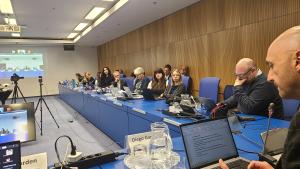
At the United Nations last month, we called for information-gathering to prepare future criminal prosecutions over the lethal US strikes on alleged "drug boats" in the Caribbean and Eastern Pacific. Full footage of our side event at the Commission on Narcotic Drugs in Vienna, "Murder on the Land and the Sea: Extrajudicial Drug war Killings in the 21st Century," is available on our YouTube page, and below.
Speakers included Filipino journalist Carlos Conde, Colombia expert Diego Garcia-Devis of Open Society Foundations, Annie Shiel of the US-based Center for Civilians in Conflict, and our executive director David Borden, with Kat Murti of Students for Sensible Drug Policy moderating. We also had comments from Inez Feria of NoBox Transitions Foundation (Philippines); and were provided a letter from Spirit Cottle of St. Vincent and the Grenadines discussing the impact of the boat strikes on the region. Between in-person and online, the event had nearly 80 attendees.
Thanks for your interest in our work on drug policy and rule of law, in particular the extrajudicial killings in the Philippines drug war, and the criminal boat strikes (also extrajudicial killings) in Latin America by the Trump administration. There is more about this program online at https://stopthedrugwar.org/ruleoflaw.
back to top
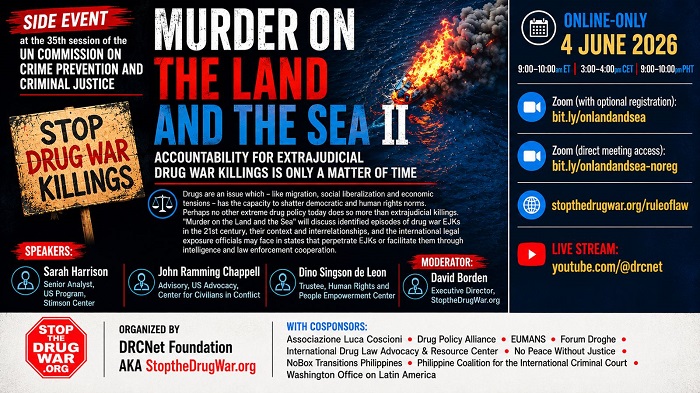
Murder on the Land and the Sea II: Accountability for Extrajudicial Drug War Killings Is Only a Matter of Time
side event for the 35th session of the UN Commission on Crime Prevention and Criminal Justice
online-only, 4 June 2026, 9:00-10:00am ET / 3:00-4:00pm CET / 9:00-10:00pm PHT
Zoom (with optional registration): https://bit.ly/onlandandsea
Zoom (direct meeting access): https://bit.ly/onlandandsea-noreg
https://stopthedrugwar.org/ruleoflaw
Drugs are an issue which – like migration, social liberalization and economic tensions – has the capacity to shatter democratic and human rights norms. Perhaps no other extreme drug policy today does so more than extrajudicial killings (EJKs). As the former president of the Philippines awaits trial later this year, the death toll from US strikes on alleged "drug boats" has raced past 200, making state violence and accountability for it pressing issues in drug policy today.
"Murder on the Land and the Sea" will discuss identified episodes of drug war EJKs in the 21st century, their context and interrelationships, and the international legal exposure officials may face – in some cases are already facing – in states that perpetrate EJKs or facilitate them through intelligence and law enforcement cooperation.
Speakers:
- John Ramming Chappell, Advisory, US Advocacy, Center for Civilians in Conflict
- Dino Singson de Leon, Trustee, Human Rights and People Empowerment Center
- Sarah Harrison, Nonresident Fellow, Conventional Defense Program, Stimson Center
Intro and Moderation: David Borden, Executive Director, StoptheDrugWar.org
Organized by DRCNet Foundation AKA StoptheDrugWar.org, with cosponsors Associazone Luca Coscioni, Drug Policy Alliance, Eumans, Forum Droghe, International Drug Law Advocacy & Resource Center, No Peace Without Justice, NoBox Transitions Philippines, Philippine Coalition for the International Criminal Court, Students for Sensible Drug Policy, Veterans Action Council, Washington Office on Latin America
Please contact David Borden at +1 202-236-8620 or [email protected] for further information. Visit https://stopthedrugwar.org/ruleoflaw and https://stopthedrugwar.org/global to read about our international programs.
Watch footage of the first "Murder on the Land and Sea" event, held in-person at the UN Commission Narcotic Drugs meeting last March, at https://www.youtube.com/watch?v=sgrI83I1Pf4.
– END –
back to top
Dear Friend of Drug Policy Reform,
Leading and longtime German reformer Georg Wurth explains how our newsletter, Drug War Chronicle, has been important to his work:
For more than 25 years, Drug War Chronicle has been my most important source for US and international drug policy news. Through Deutscher Hanfverband, Germany's leading cannabis (marijuana) reform organization, the Chronicle has also had a significant influence on cannabis (marijuana) decrim efforts in our country.
Thanks to the Chronicle, we've always known what was going on in the US – how long things took, problems that came up, other details. And we share important information from the Chronicle with our own substantial audience. For example, I regularly report news I get from the Chronicle in my weekly YouTube News, and list the Chronicle in my sources.
There is nothing else like it. I would miss the Drug War Chronicle very much if it stopped. There is no other source like it, so far as I know.
Georg Wurth
German Cannabis Association
We are pleased to have partially brought back the Chronicle, but still need your help to bring our longtime writer Phillip Smith and the newsletter back to full time. During these last few days of 2025, please make a generous donation for our newsletter -- and our work in cannabis reform, global drug policy, international human rights and an informed drug policy discussion in 2026. Thanks for your help at this very critical time.
- Dave
Sincerely,

David Borden, Executive Director
StoptheDrugWar.org
P.O. Box 9853, Washington, DC 20016
https://stopthedrugwar.org
P.S. If If you've missed them, check out my recent messages on marijuana rescheduling and the Trump administration's murderous strikes on alleged "drug boats" here and here.
back to top
Update: The Chamber did indeed rule in favor of jurisdiction. Duterte's trial is scheduled to begin on November 30, 2026.
Dear Drug Policy Reformer,

initial Duterte hearing
This is a consequential time in so many ways. One is that tomorrow morning (probably before you read this), the Appeals Chamber of the International Criminal Court will decide whether the case against Philippine former president Rodrigo Duterte and maybe others for "crimes against humanity in the war on drugs" can continue.
Specifically, if the chamber upholds a prior ruling by the Pre-Trial Chamber, which found that the Court has the right to exercise jurisdiction in the Philippines despite the country's 2019 withdrawal from the treaty, the case will continue. If they overturn the ruling, the case will end, Duterte will go home, and other perpetrators will be off the hook, or at least the ICC wouldn't try them.
The announcement is scheduled for 11:00am Netherlands time (5:00am here in US Eastern), Wednesday April 22. Information, and links to watch (live or afterward), can be found online here.
I published two editorials about the jurisdictional question last year, in the well-known outlets Rappler and Just Security. I won't summarize all the main tracks of the discussion here, but the central debate is over what the Rome Treaty Article 12 on preconditions to jurisdiction and Article 127 on the terms of a state's withdrawal from the treaty mean in this situation. The whole record on the matter can be found in the "court records" section of the ICC's Philippines web site section.
The Duterte defense team – and two judges who dissented on a previous Appeal Chamber ruling – argue that Article 12's requirement that one or more states in a situation "are parties to this statute" means the Philippines had to still be in the treaty at the time of the ruling, because "are" is present tense. The prosecution and other supporters of the case say that Article 12 readily can refer to other times of relevance, and that Article 127's declaration that "matters already before the court shall not be prejudiced" – the matter in this case being a preliminary examination on the Philippines which prosecutors already had underway before withdrawal – means it refers to the time of the alleged crimes.
In my opinion, supporters of the case are unquestionably right on this point. The error that the defense team and even the two dissenting judges make, is in focusing on the meaning of "are". Whereas it's the words which follow – "Parties to this Statute" – where the temporal variability is found. It is easy to show that "Parties to this Statute" and similar terms refer to different times, depending on the context.
An example I provided in my editorials is that of the (ill-fated) 1955 Treaty of Amity between the US and Iran. After things went bad between the two governments, Iran invoked the treaty at the International Court of Justice, challenging the freezing by the US government of billions of dollars of Iranian funds. Despite the US having withdrawn from the treaty, the two states therefore no longer being "High Contracting Parties" to it, both governments agreed that the terms of the treaty still applied to them. It was clear from the context that "High Contracting Parties" in that context referred to former High Contracting Parties, despite that being nowhere specified in the treaty text. In the same way, "Parties to this Statute" can refer to different times, which means "are Parties to this Statute" can too.
Unfortunately, the Pre-Trial Chamber, while finding in favor of jurisdiction, conceded – incorrectly in my opinion – that Article 12 on its own would refer to the time of the ruling, not the time when the crimes were committed. In a response requested by the Appeals Chamber, prosecutors argued – in fact led with the argument – that the Pre-Trial Chamber was wrong on that specific point, despite agreeing with their ultimate decision. What the Pre-Trial Chamber found is that Article 127 is a "lex specialis" provision that provides the procedure to follow in the special case of state withdrawal, based on fundamental principles from the Vienna Convention on the Law of Treaties providing that a treaty's language should be interpreted in line with the treaty's core purposes.
That tension, and the fact of the Chamber having requested responses on basic questions from the prosecution, defense and victims counsel, have cost me and others some sleep. They will certainly have that effect on me tonight.
After that, assuming the Appeals Chamber upholds jurisdiction, I believe the arguments that I and others have laid out on this question will have continued importance moving forward. We are at a moment in which the ICC is under attack. Its opponents, including but not limited to those in the Philippines, will seize on the anti-jurisdiction arguments to portray the continuation of the Philippines case as evidence that the court is willing to exceed its lawful powers. It will be important for the public to hear why jurisdiction in the Philippines case follows straightforwardly from the treaty's language.
Thank you for reading this far. Hopefully the next update will be good news about this. If not, we'll take a few breaths and talk about alternate next steps like accountability steps within the Philippines and universal jurisdiction cases in third governments' judicial systems.
- Dave
Sincerely,

David Borden, Executive Director
StoptheDrugWar.org
P.O. Box 9853, Washington, DC 20016
https://stopthedrugwar.org
back to top
A Killing in Cannabis: A True Story of Love, Murder, and California Weed by Scott Eden (2026, Spiegel & Grau, 370 pp., $30 HB)
Tushar Atre was a stereotypical Northern California character: A New York-born Indian American Silicon Valley tech bro, a gregarious and well-known Santa Cruz surfer dude, and a man hoping to transform himself into a cutting edge California cannabis entrepreneur as the state sat on the cusp between marijuana prohibition and legalization. His dream ended, however, on October 1, 2019, when Santa Cruz County sheriff's deputies found him bound and blindfolded and dead of gunshot and other wounds on a marijuana-growing property he owned in the hills above the city.
With A Killing in Cannabis: A True Story of Love, Murder, and California Weed, author Scott Eden tells the story of Atre's rise and fatal fall, combining a true crime narrative, a story of true romance, and an extended exposition of the rapidly changing California cannabis industry to artfully crafted page-turner. Blending the gritty details of a real-life murder investigation with the complex human stories behind it, the book delves into themes of ambition, betrayal, and the complicated intersection of legality and illicit enterprise. Eden's work stands out because it offers more than just a recounting of crime -- it taps into the tensions that arise when a once-taboo industry suddenly becomes mainstream, making it timely and resonant for anyone curious about the human cost behind California’s green rush.
Eden offers up detailed reportage -- more than 40 interviews, as well as police and court records -- with emotional nuance, providing intimate portraits of the characters, who range from idealistic pot growers to hardened criminals to fringe drifters to Midwestern venture capitalists. Eden's reportorial skill makes these characters come to life as fully realized people with complex motivations caught in a rapidly shifting legal and business landscape.
Atre himself doesn't come off particularly well. Charismatic and athletic, as well as talented in business, he was also erratic, less than 100 percent honest, and prone to abusing both employees and partners alike. For many from the weed industry, Atre was just another "Chad," their derogatory name for the Silicon Valley hustlers trying to make new fortunes in freshly legal cannabis. Others simply qualified him as an "asshole." When asked by Eden who might have killed Atre, one respondent said the number of suspects could be in the "hundreds."
Even his romantic and business partner Rachel Lynch had reason to be included in that number. Atre met Lynch when she and her cancer-stricken mother booked an Airbnb stay at his beachside home and quickly persuaded her to confess that she made her money growing weed in Northern California. While he had already expressed interest in the cannabis sector, it was her connections and experience that allowed him to try turn his dream into reality.
But even as the couple fell in love (did they really, Rachel sometimes wondered, or was he just using her?) and Atre pushed her to dive deep into the business with him, he repeatedly made vital business decisions without her and blamed her when some of them went sideways. By the time he was killed, both their romantic and their business relationships had soured, and both his family and law enforcement authorities had her down as a possible suspect.
Eden weaves together his investigative reporting with cultural context, providing a deep dive into the evolving legal and social framework of cannabis in California. Some chapters linger on regulatory debates and the nuanced history of marijuana legalization, which may annoy some true crime fans but offers a lens on how profit motives and personal vendettas can collide dangerously.
The book's terrain is marijuana legalization -- not hemp -- but hemp does make an appearance. At one point, Atre has problems obtaining a marijuana grow license for one of his properties, so he instead applies for and receives a permit to grow hemp for research, which he uses as cover for his marijuana crop. Eden also mentions "hot hemp," where growers grow actual low-THC hemp but then spray it with high-THC distillate, creating psychoactive hemp passed off as weed. That is suitable only for the black market, but there is still a huge black market in the US, and even in California.
From Silicon Valley boardrooms to cutting edge extraction labs (a huge percentage of the pot crop is being distilled into psychoactive oils used to fill vapes) to remote mountain grow ops, Eden takes the reader on an eye-opening journey into California's cannabis culture -- the good, the bad, and the ugly. His prose is clear, compelling, and free from the overwrought clichés that often plague true crime writing. At moments, the narrative evokes the tension and atmosphere of classic noir, filtered through the modern reality of a burgeoning, semi-legal cannabis industry.
A Killing in Cannabis is a thoughtful, well-researched exploration of a violent crime set against the backdrop of a transforming industry and culture. It’s at once a human story and a social commentary, making it a compelling read for true crime enthusiasts and those interested in the cannabis legalization movement alike. If you appreciate true crime that goes beyond the whodunit to examine why a crime unfolds within a particular time and place, this book offers fresh insights and real emotional weight.
This review first appeared in the American Hemp Monitor.
back to top
Update: The looming federal ban on intoxicating hemp-derived cannabinoids remains in place. While an effort to include a delay failed in the House Agriculture Committee, the legislation seeking a delay remains alive. If the bill or an alternative regulatory bill is not approved by November 12, the hemp ban will go into effect.
A bipartisan group of representatives on Tuesday filed a bill to delay the ban on most hemp-derived cannabinoids approved by Congress in November by an additional two years. The hemp provision gave the industry one year to convince Congress to instead move toward a regulatory -- not prohibitionist -- approach; the Hemp Planting Predictability Act (House Resolution 7010) would block the ban for an additional two years, giving the industry more time to exercise its persuasive powers.
The lead sponsor on the bill is House Agriculture Committee member Rep. Jim Baird (R-IN), and he is joined by two key congressional players on agricultural policy, former Kentucky agriculture commissioner and hemp supporter Rep. James Comey (R), chair of the House Oversight and Accountability Committee, and House Agriculture Committee Ranking Member Rep. Angie Craig (DFL-M), as well as Reps. Tim Moore (R-NC) and Gabe Evans (R-CO).
"Planting and growing crops requires planning well in advance," Baird said in a statement. "Congress created a regulatory environment in the 2018 Farm Bill that allowed for certain investments, and farmers were operating within this environment. The hemp provision included in the Continuing Resolution and Appropriations bills passed in November 2025 disrupted planting decisions that had already been made."
Baird continued: "Congress should not have passed such a sweeping policy change that upends a growing industry. Instead, Congress should have given farmers more time, creating a more stable environment for farmers to modify their future planting decisions. I am proud to introduce this legislation to ensure farmers have predictability and sufficient time to adjust to new laws that affect their livelihood."
"This common-sense extension gives farmers and America's hemp industry the time they need to adapt while Congress works to establish a clear, reasonable regulatory framework," said Comer. "I have championed the hemp industry since my time as Kentucky’s Commissioner of Agriculture and remain committed to bipartisan solutions in Washington that support our local farmers and provide certainty for this growing industry."
"Recent changes to hemp production and processing regulations pulled the rug out from under Minnesota's hemp producers, craft brewers, and retailers at a time when too many business owners are already dealing with high prices and uncertainty," said Craig. "I'm proud to be introducing this common-sense legislation with my colleague Rep. Baird to fight these ill-thought-out policies and support the farmers and small business owners who make up Minnesota's $200 million hemp industry."
When Congress legalized hemp in the 2018 federal farm bill, it defined hemp by its concentration of delta-9 THC (less than 0.3 percent by dry weight), but did not mention other THC isomers, such as delta-8, delta-10, and THC-A, creating the so-called "hemp loophole." Those substances can be derived from CBD extracted from hemp, leading to an explosion of unregulated intoxicating hemp cannabinoid products, which in turn led Congress to effectively ban hemp cannabinoids.
The industry has been howling ever since, with advocates decrying the ban and saying the one-year delay in implementing it was insufficient either for stakeholders to develop new regulations or for producers to adjust to the prohibitionist regime. It likes what it sees in this bill, though.
"The entire hemp industry is united behind passage of the bill, US Hemp Roundtable general counsel Jonathan Miller told Law360. "A two-year extension of the hemp moratorium is critical to provide farmers certainty concerning their 2026 crops and to provide an appropriate runway to allow for the passage and implementation of a robust regulatory framework for hemp products," he said Tuesday.
This article first appeared in the American Hemp Monitor.
back to top
Update: The proposed initiative to undo SB 56 did not gather enough signatures to qualify for the ballot. The hemp ban remains largely in effect, although lawsuits by hemp companies have carved out a few exceptions.
Late last year, Ohio Gov. Mike DeWine (R) signed into law Senate Bill 56, a marijuana regulation bill that has provisions banning intoxicating hemp products from being sold anywhere other than marijuana dispensaries. The measure also tightens the state's voter-approved marijuana legalization law by making it a crime to possess marijuana purchased outside the state and limiting home grows to six plants. It is set to go into effect in March.

New state-imposed restrictions on hemp products and legal marijuana have sparked a response from cannabis advocates. (Cathryn Murray/Creative Commons)
Last week, a group of hemp and marijuana advocates took the initial step toward overturning that law. Organized as a political action committee, Ohioans for Cannabis Choice, they turned in petitions with more than a thousand signatures to kick off the process of getting a referendum on the November 2026 ballot. The petition calls for the removal of the sections of SB 56 that restrict hemp products and impose new limits on marijuana possession and cultivation.
Secretary of State Frank LaRose (R) and Attorney General Dave Yost (R) each have 10 days to decide whether to certify the petitions. If they do so, the campaign will then have until mid-March to come up with 248,092 valid voter signatures from at least 44 of the state's 88 counties to qualify the measure for November 2026.
While the bill submitted to Gov. DeWine mirrored the recent federal government ban on intoxicating hemp products by delaying it for a year, the governor used his line item veto to strike the section granting an exception to hemp beverages, saying it would only confuse the matter.
"SB 56 forcefully defies the will of the voters of Ohio, who spoke clearly on this issue, and denies the people of Ohio the freedom to use these products for their personal use," Ohioans for Cannabis Choice spokesman Dennis Willard said in a statement accompanying the petitions. "We are launching a referendum campaign to go directly to the voters. We believe voters will say no to government overreach, no to closing 6,000 small businesses and pink-slipping thousands of workers across the state, and no to once again recriminalizing hemp and marijuana," Willard said.
The Columbus company Pilot Canning produces and cans beverages including water, tea, soda, and THC seltzers for both in- and out-of-state businesses. THC drinks make up about 15 percent of his business. Its owner, Michael Capace, said that while he supports regulating such beverages, SB 56 is a bridge too far.
"We were totally on board with the idea of having milligram caps and preventing children and such from getting these beverages," Capace said. "It is really putting a limit on the kind of things we can create and supplying customers with the beverages they really want."
The Ohio Healthy Alternatives Association has also come out in support of the referendum: "We are confident that Ohio voters will stand in support of local businesses and their right to provide safe and regulated hemp products," the group said in a statement last week.
But the Ohio Cannabis Coalition (OHCANN), which represents members of the state's legal marijuana industry, says it stands behind SB 56.
"With Governor DeWine's signature on Senate Bill 56, Ohio is demonstrating leadership as one of the first states in the nation to act following the closure of the Farm Bill loophole," executive director David Bowling said in a statement. "By closing the unregulated, dangerous intoxicating hemp market this law reflects a clear commitment to public safety and reinforces Ohio's responsible, well-regulated cannabis market."
Politics can make for strange bedfellows. Ohio's Republican political establishment has been a staunch foe of cannabis law reforms, with the legislature repeatedly refusing to take up marijuana legalization but eager to try to chip away at the will of the voters once they voted to legalize it in 2023. Yet the state's legal marijuana industry finds itself in bed with the very officials who would do it in if they had their way.
back to top
Update: The bill still awaits action in the House, as of June 24.
The state Senate voted 35-13 Wednesday to approve Senate Bill 250, which would align state law with the federal ban on intoxicating and synthetic hemp products set to go into effect in November. The state's hemp cannabinoid producers are warning the bill would devastate their industry.
In 2018, Congress legalized hemp, defining it as any part of the cannabis plant with less than 0.3 percent delta-9 THC by dry weight. Under that definition, products containing delta-8 THC, THCA, and other intoxicating companies are legal. But in the bill ending the federal shutdown last November, Congress tightened its definition, specifying that all forms of THC count in reaching that 0.3 percent threshold, capping THC products at 0.4 mg per container, and banning synthetic cannabinoids.
"Under the farm bill loophole, Delta-8 and THC products have become too easy for young Hoosiers to obtain," bill sponsor Sen. Aaron Freeman (R) said in a statement. "Senate Bill 250 is about protecting those under 21 by preventing them from obtaining products containing THC."
But it will also prevent adults from obtaining such products and drive a dagger into the state's hemp cannabinoid industry, said Justin Swanson, representing the Midwest Hemp Council and 3Chi, a THC product retailer.
"There is going to be no demand" for products that can meet the low-THC threshold, he said. "It's premature for Indiana to codify federal law that will decimate an entire industry in the state," Swanson said. "The landscape is still not settled."
Swanson is referring to the federal hemp cannabinoids ban, which, while passed by Congress in November, does not go into effect until this coming November. Efforts are already underway in Washington to extend the moratorium on the ban by two or even three years.
Swanson added that the industry supports "a responsible regulatory framework," telling lawmakers that "the status quo is not acceptable for anybody."
Dave Colt, CEO and co-founder of Sun King Brewery told lawmakers his company had spent big-time on developing THC seltzers, which have allowed his company to flourish amidst a downtown in alcohol sales.
"We also make products for at least a dozen small Hoosier businesses as well. Without this additional revenue, we would be forced to lay people off and dramatically downsize our business," Colt testified. "We do believe strongly the industry wants clear regulations that meet consumer demand."
But at least one industry group supports the legislation.
"It is imperative that Indiana act during the 2026 legislative session to harmonize with federal policy," said Cory Harris, representing the American Trade Association for Cannabis and Hemp. "Failure to do so will mean that Indiana's policy will be less stringent than federal law and therefore equate to Indiana being a legal cannabis market."
The voluminous bill spends thousands of word regulating low-THC hemp-derived cannabinoid products, notably CBD, with licensing and permitting regulations, bans on advertising and doing business within 1,000 feet of a school or playground, and more. But the bill would also put a crimp in CBD product sales by banning "full spectrum" CBD products that also contain THC if it exceeds the specified levels.
The bill now goes to the House. If approved, it would go into effect in June.
This article first appeared in the American Hemp Monitor.
back to top
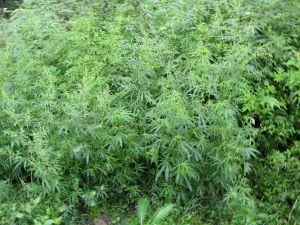
A hemp field. (Creative Commons)
Update: SB 682 died on March 23, but the other bills mentioned in this article remain alive. The legislative session doesn't end until December.
Wisconsin doesn't allow legal marijuana or even medical marijuana, but unregulated intoxicating hemp products are for sale on store shelves across the state. Now, lawmakers in Madison are studying competing bills on how to regulate those products -- or whether to just ban them.
The legislative activity comes just weeks after Congress voted to end the so-called "hemp loophole" that allowed products with hemp-derived cannabinoids to be sold as hemp and not marijuana. Congress must move to regulate such products by next November or that ban then goes into effect.
Wisconsin lawmakers are not waiting for Congress, though. There are at least four bills dealing with hemp before the legislature right now, including a bill with bipartisan support, Senate Bill 682, cosponsored by Sen. Patrick Testin (R-Stevens Point). That bill would tighten the definition of hemp, restrict how cannabinoids can be extracted from raw hemp, and set an age limit of 21 for purchasers.
At a hearing of the Senate Committee on Agriculture and Revenue last week, "clear as mud" was how Testin described the federal regulatory framework around hemp and hemp products.
"Regardless of anyone's thoughts as it relates to cannabis and cannabinoids, it's here," said Testin. "We just want to make sue that we have sensible regulation put in place that isn't heavy-handed and does not put the boot of government on the backs of these very businesses that have sprung up and have thrived here in the state in the last several years."
With the state closely divided politically but with the legislature dominated by Republicans, bipartisanship is a rare commodity in Madison. But Testin's bill also has Democratic sponsors, including Sen. Mark Spreitzer (D-Beloit).
"I haven't felt so aligned with two Republicans in a while," Spreitzer said.
But despite collegial sentiment and support from state hemp operators, SB 682 is not moving very fast, having only had a committee hearing last week, and no vote to advance it out of committee held yet.
Another bill, Assembly Bill 306, is backed by Assembly Republicans and would create a three-tiered system for regulating hemp-derived cannabinoid products. That bill would create different licenses for producers, distributors, and wholesalers. It has already passed out of committee and awaits an Assembly floor vote.
But Sen. Testin, who plays a key role as chair of the Senate Agriculture Committee, doesn't like AB 306, characterizing it as "deader than dead" and complaining that it would create an overly burdensome regulatory process and would hurt small producers because they would not be able to sell direct to the public. The Republican infighting calls into question whether any hemp bill can pass the legislature this year.
Meanwhile, there are two more bills waiting in the wings: A Republican bill that mirrors the federal ban, Assembly Bill 503, and a Democratic bill to impose age limits on intoxicating hemp products, Senate Bill 604. Neither of those bills, introduced last fall, has moved so far.
The legislature has until the end of the year before the session ends, but Wisconsin hemp farmers don't have the luxury of waiting all year. Planting season is now just weeks away.
As hemp farmer and Wisconsin Hemp Farmers and Manufacturers Association representative Phillip Scott told lawmakers: "For too long, hemp farmers in Wisconsin have been forced to operate in uncertainty, never fully sure whether the crop we plant today will still be considered legal by the time we harvest it."
This article originally appeared in the American Hemp Monitor.
back to top