Today we publish our third issue of the Chronicle since it went on hiatus earlier in the year. Our fundraising drive, to help our longtime writer Phillip Smith continue his work and get back to full time, continues.
The MORE Act is back. It would end federal marijuana prohibition -- and more.
The Supreme Court has granted a group of marijuana companies an extension in their bid to be heard by the high court, Trump's "worst of the worst" immigrants apparently include marijuana users, and more.
Oklahoma police chiefs unsurprisingly oppose a marijuana legalization initiative, a drone attack on a helicopter kills eight Colombian anti-drug police, and more.
Massachusetts pot regulators release draft rules for social consumption licenses, comedian Eric Andre scores a victory in a legal fight against Atlanta airport detentions and searches, and more.
Anti-drug, law enforcement, and religious groups seek to block marijuana rescheduling, a Massachusetts permanent resident was detained over a 22-year-old pot possession conviction, and more.
Delaware's governor vetoes a bill that would have easing zoning restrictions on pot shops, the Anchorage, Alaska, Assembly tables a pot social consumption ordinance, and more.
Dear friends,

Phil receiving the Brecher Award for Journalism, 2013 International Drug Policy Reform conference
As you may be aware, the Chronicle was on a bit of a hiatus for much of this year. We are pleased today to publish the third issue of the Chronicle since our longtime writer Phillip Smith resumed his work with us.
Our fundraising drive, to help Phil continue and get him back to part-time. continues. For this to work, we need to raise at least $800/week in tax-deductible grants or donations to our 501(c)(3) nonprofit, DRCNet Foundation. That's not all Phil should be earning for his work, but for now at least it will enable us to complete the restart of the Chronicle and keep it going.
(We also need to raise $900/month in non-deductible donations to our 501(c)(4) public welfare nonprofit, Drug Reform Coordination Network, to continue to afford the our list management service and web site hosting fees. I'll explain why we cover these costs from the non-deductible type of donation in a subsequent email. If you remember this from the past, it's the same reason as before, with the costs somewhat lower now.)
Thank you if you're willing to help us restart Drug War Chronicle. Also, if you were planning to or considering making a gift later in the year, it would make the extra difference if you were to do so now instead. Of course we are grateful for your support, whenever it is provided and in whatever amount.
Note that our online donation system, along with accepting one-time donations of course (via credit card, PayPal or bank ACH), also has a range of recurring donation options that you can use if you wish to make that commitment. People mainly use these for monthly or annual gifts to our organization. But our donation system can also accommodate gifts scheduled weekly, biweekly, every four weeks, quarterly, and twice a year. (Click here if you'd like info on contributing by mail or making a gift of stock.)
Sincerely,

David Borden, Executive Director
StoptheDrugWar.org
P.O. Box 9853, Washington, DC 20016
https://stopthedrugwar.org
back to top

The Capitol. Can marijuana legalization advance in a GOP-controlled Congress? Stay tuned.
Last Friday, Rep. Jerrold Nadler (NY-12), along with Cannabis Caucus Co-Chairs Dina Titus (NV-01) and Ilhan Omar (MN-05), and House Committee on Small Business Ranking Member Nydia Velázquez (NY-07) reintroduced the Marijuana Opportunity Reinvestment and Expungement (MORE) Act, a comprehensive marijuana legalization bill.
Its prospects are uncertain at best in a Republican-controlled Congress, but that is not stopping proponents from continuing to fight for marijuana reform.
The bill's purpose is "to decriminalize and deschedule cannabis, to provide for reinvestment in certain persons adversely impacted by the War on Drugs, to provide for expungement of certain cannabis offenses, and for other purposes," the text states.
"I am proud to reintroduce the MORE Act today," said Rep. Nadler. "As more states continue to legalize marijuana and public support increases, federal laws must catch up and reverse failed policies criminalizing marijuana. "It is long past time to decriminalize marijuana at the federal level, expunge marijuana convictions, and facilitate resentencing, while reinvesting in the communities most adversely impacted by the War on Drugs."
"As co-chair of the Cannabis Caucus, I am proud to support the reintroduction of the MORE Act, comprehensive legislation that is long overdue," said Rep. Titus. "It's time to modernize our laws to reflect the reality of cannabis use in the United States, recognize the legitimate industry that has emerged, and fully embrace the medical benefits of the plant. The federal government must catch up to the states, and this bill provides a framework to end the failed War on Drugs while supporting communities and businesses nationwide."
Passage of the MORE Act would end the discrepancy between federal pot prohibition and the increasingly relaxed attitude toward marijuana in the states. Some 24 states -- constituting more than half the US population -- and the District of Columbia have embraced adult-use legalization, and 40 states allow for the use of medical marijuana.
The bill would end federal marijuana prohibition by removing marijuana from the Controlled Substances Act and requiring federal courts to expunge prior convictions, allow prior offenders to seek expungement, and conduct resentencing hearings for those still incarcerated or on probation or parole.
The bill sets a 5 percent sales tax on marijuana and pot products, the proceeds of which will go into an Opportunity Trust Fund with three grant programs. The Community Investment Grant Program would provide services to those adversely impacted by the drug war, including job training, literacy programs, legal aid, re-entry services, and drug treatment. The Cannabis Opportunity Grant Program would provide loans for small marijuana businesses owned and controlled by disadvantaged people. And the Equitable Licensing Grant Program would fund grants to remove barriers to licensing and employment in the industry of people adversely impacted by the drug war.
The bill would also allow legal marijuana businesses and service providers to seek funding from the Small Business Administration and provide non-discrimination protections for personal use or possession, including prior convictions. That would end the denial of federal public benefits, including housing, based on past or present marijuana use or possession, as well as ending the resort to past marijuana convictions to deport immigrants.
"As Co-Chair of the Congressional Cannabis Caucus, I understand how deeply the War on Drugs has devastated families and fueled racial disparities in arrests and incarceration without making us safer," said Rep. Omar, co-chair of the Cannabis Caucus. "The MORE Act will decriminalize marijuana at the federal level, clear records, and reinvest in the communities most harmed by these failed policies. In Minnesota we have already shown that legalization can deliver both fairness and economic opportunity. It is past time for the federal government to follow our lead and finally end the era of criminalization."
"For too long, communities of color have carried the weight of unfair marijuana laws that fueled incarceration and denied people opportunity," said Rep. Velazquez, ranking member of the House Small Business Committee. "The MORE Act is about justice, about giving people a second chance, and about making sure small businesses and workers in these communities can share in the benefits of legalization. I am proud to stand with my colleagues to reintroduce this bill and keep pushing for fairness and equity."
The bill has more than three dozen co-signers already, as well as the support of a broad coalition of civil rights, criminal justice, drug policy, and immigration groups. Among them are the American Civil Liberties Union, Cannabis Regulators of Color Coalition (CRCC), Center for American Progress, Doctors for Drug Policy Reform, the Drug Policy Alliance, the Last Prisoner Project, the Minority Cannabis Business Association, the National Association of Criminal Defense Lawyers, the National Association of Social Workers, the National Organization for the Reform of Marijuana Laws (NORML), the Service Employees International Union (SEIU), the Southern Poverty Law Center, and Students for Sensible Drug Policy (SSDP), among many others.
"Millions of Americans continue to suffer the consequences of the failed war on drugs -- harms that have disproportionately impacted communities of color and other marginalized groups. The Marijuana Opportunity Reinvestment and Expungement (MORE) Act represents a critical step forward, not only by decriminalizing marijuana at the federal level, but by offering meaningful pathways to justice through expungement and resentencing," said Akua Amaning, Director for Criminal Justice Reform at Center for American Progress. "Its provisions also prioritize reinvestment and economic opportunity for those most affected by decades of criminalization. We urge Congress to pass this long-overdue legislation and take a decisive step towards ensuring equity, justice, and opportunity for all Americans."
"We are proud to again endorse the Marijuana Opportunity, Reinvestment, and Expungement (MORE) Act. For decades, marijuana criminalization has disproportionately targeted people of color and low-income communities," said Maritza Perez Medina, Director of Federal Affairs of the Drug Policy Alliance. "This policy of marijuana criminalization has led to mass incarceration, family separation, deportation, and lost economic opportunities. As long as marijuana remains in the Controlled Substances Act (CSA), it will remain federally criminalized, regardless of which schedule it is placed inIn addition to clearly and unambiguously descheduling marijuana, the MORE Act would address the vast social and economic harms caused by marijuana criminalization. Anything short of descheduling will continue to perpetuate the harms of federal marijuana criminalization, and we urge members of Congress who oppose these harms to cosponsor MORE."
back to top
The Supreme Court has granted a group of marijuana companies an extension in their bid to be heard by the high court, Trump's "worst of the worst" immigrants apparently include pot-smokers, and more.
Marijuana Policy

Trump's mass deportation push is sweeping up pot smokers and other minor offenders. (dhs.gov)
Trump Administration Has Deported More Than 600 People for Pot So Far This Year. The Trump administration has trumpeted its mass deportation campaign as aimed at violent criminals and "the worst of the worst," but according to data from a Marshall Project analysis of Immigration and Customs Enforcement (ICE) data, provided to the Deportation Data Project in response to a FOIA request, only about 12 percent of the 120,000 people deported between January and May were convicted of a violent or potentially violent crime.
The deportees included more than 600 people grabbed, jailed, and expelled for nothing more serious than a marijuana offense, including many that were more than five years old. Another 900 people were deported for drug possession offenses, nearly half of them more than five years ago.
More than 1,800 people were deported for traffic offenses and another 4,800 for DUIs. More than 10,000 people were deported whose only offense was illegal entry into the country.
And people with no criminal convictions whatsoever account for about two-thirds of all deportations.
Deporting marijuana and other drug offenders is not unique to the Trump administration. Since the turn of the century, the US has deported half a million people whose most serious charges were drug offenses. What's different, for those and other deportations by this administration, is the use of mass roundups and detentions on the one hand, together with skirting in many cases of due process rights, and the firing as part of governmental downsizing of immigration judges who are needed to administer the cases, resulting in soaring abuse of detainees but a smaller number of them actually deported.
Supreme Court Gives Marijuana Companies More Time to File Petition in Case Challenging Federal Pot Prohibition. The Supreme Court has granted marijuana companies suing the Justice Department in a bid to overturn federal pot prohibition an extension of the time they need to file their petition to the high court.
The thorny issues raised in the case mean attorneys need more time to prepare, lawyers for the companies in their filing. They also cited the need for more time for state governments and other experts expected to file briefs in the case "carefully craft their arguments."
"This case presents significant and complex constitutional issues concerning both state-regulated marijuana specifically and the authority of Congress to regulate purely intrastate commerce generally," the filing says. "The additional time will permit counsel to prepare a petition that appropriately addresses the questions of nationwide importance raised by this case."
The companies -- Canna Provisions, Gyasi Sellers, Wiseacre Farm and Verano Holdings -- entered a request for a 60-day extension to submit its writ of certiorari last week. Justice Ketanji Brown Jackson approved the proposal last Friday, pushing back the current deadline of August 25 to October 24.
The move comes after a federal appeals court rejected the companies' arguments, clearing the way for plaintiffs to seek Supreme Court review. The Supreme Court has not yet decided whether it will take up the case.
Drug Policy
Kentucky Governor Uses Emergency Powers to Ban "Designer Xanax." Gov. Andy Beshear (D) used his emergency powers to ban bromazolam, a triazolo-benzodiazepine with effects similar to Xanax and nicknamed "designer Xanax." Beshear acted at the behest of state Attorney General Russell Coleman (D), who is leading a coalition of 21 state attorneys general urging the DEA to itself take emergency action to ban the substance.
"This deadly drug has no place in our communities, and now we have the tools needed to get it off the streets and protect more lives," Beshear said.
Although synthesized in the 1970s, bromazolom has never been approved for any medical use. It began appearing in illicit drug markets in the US in 2019. In a letter dated Monday to DEA Administrator Terry Cole (who may be busy with his day job currently running the Metro DC Police), the state attorneys general called the drug a growing public health threat and a contributor to overdose deaths.
The substance appears as counterfeit Xanax or mixed with opioids, including fentanyl.
"There is zero margin of error when it comes to illicit drugs and counterfeit pills," the attorneys general said in their letter to Cole. "As parents and public officials, we must do everything possible to cut off the supply of these deadly substances through vigorous enforcement, while also continuing to promote the prevention, treatment, and recovery efforts that are saving lives across our states."
Beshear's emergency regulation went into effect immediately. It is now illegal to sell or possess bromazolam in the Bluegrass State. Nevada, New Mexico, North Dakota, Virginia, and West Virginia all banned the substance prior to 2023, but Kentucky is the first state to join the club since then.
back to top
Oklahoma police chiefs unsurprisingly oppose a marijuana legalization initiative, a drone attack on a helicopter kills eight Colombian anti-drug police, and more.
Marijuana Policy
Oklahoma Cops Come Out Against Legalization Initiative. A proposed marijuana legalization initiative, State Question 837, is gathering signatures to try to qualify for the November 2026 ballot, and state law enforcement has begun to mobilize against it.

The USS Gravely is headed for Venezuelan waters as part of Trump's war on cartels. (defense.gov)
On Thursday, Todd Gibson, president of the Oklahoma Association of Chiefs of Police, spoke on behalf of the state's more than 300 police chiefs and executives in coming out against the initiative.
"Nowhere in no state have I ever seen marijuana make safer communities or better communities," said Todd Gibson, Oklahoma Association of Chiefs of Police President. "A recreational marijuana will just open the door to further access to young adults and youth, which the data is very clear," Gibson said. "It's not good for brain development. It's not good for mental health. It's not a healthy solution to a successful life."
Gibson warned without specifics that State Question 837 would restrict police and prosecutors: "Some of the things outlined in this state question absolutely tie the hands of not only police officers on the street but prosecutors in a courtroom trying to maintain justice," he said.
But Jed Green, director of Oklahomans for Responsible Cannabis Action, the group behind State Question 837 said law enforcement has not been particularly interested in dealing with marijuana.
"We've been asking as an organization for over three years for the Bureau of Narcotics and Attorney General's Office to do something about unlicensed, untested, unregulated marijuana and marijuana products and synthetic products that are not even marijuana, disguised as marijuana, from being sold online and in gas stations around the state," Green said. "They refuse."
If law enforcement has concerns, he welcomes a public conversation, Green said.
"I think that would be of service to the state of Oklahoma. I believe the state of Oklahoma deserves more of a conversation," he said.
Psychedelics
University of Michigan Denies Permit for 5th Annual Psychedelic Plant and Mushroom Festival. The University of Michigan has denied a permit for the Entheofest psychedelic plant and mushroom festival, citing concerns it promotes illegal substances.
The festival has been held every year for the past four years, with the university routinely granting a permit for the Central Campus Diag, the same spot the annual Hash Bash occurs each April. The Student Association for Psychedelic Studies, which organizes the event, says it is disappointed and will appeal.
"It's incredibly disheartening," said SAPS President Emily Berriman, a UM social work graduate student. "We've worked so hard and so diligently to abide by university policy. We're willing to do whatever they want us to do, and they still denied us and under terms that we think are illegal."
Berriman said Entheofest centers on education, science and therapeutic purpose of psychedelics and expressed frustration at their continued stigmatization and demonization. She said she is interning at a clinic doing ketamine therapy for people with chronic pain, depression, and PTSD.
"It's incredibly safe, it's effective, it's legit," she said. "It's a beautiful space to work in and I see the healing," she said, expressing frustration that psychedelics with therapeutic and medical potential still are demonized and stigmatized.
Entheofast began in September 2021 to mark the anniversary of Ann Arbor's decision to decriminalize entheogenic plants and mushrooms a year earlier.
The student organization did not speculate about whether the current political environment under the Trump administration had an impact on the university's decisions, but the school has taken other steps to appease Trump, including closing its Office of Diversity, Equity, and Inclusion in March.
The university action is reminiscent of its response to Hash Bash, where it refused to issue permits for the rally in the 1990s. But in the end, the ACLU helped Hash Bash organizers sue the university of free speech and assembly grounds, and Hash Bash continues. Entheofest organizers said they believe they have the same rights.
Foreign Policy
US Sends Warships to Venezuelan Waters to Thwart Drug Cartels. The White House confirmed Wednesday that the US is sending three Aegis guided-missile destroyers to waters off the Venezuelan coast as part of his campaign against Latin American drug trafficking organizations.
The USS Gravely, the USS Jason Dunham and the USS Sampson are set to depart for the region over the next few days, a White House official said. Their assignment is to support counternarcotic efforts.
The move is part of a broader aggressive push by the Trump administration against drug trafficking organizations. He has also threatened to use the US military against cartels inside Mexico, a move Mexican President Claudia Sheinbaum has firmly rejected.
Venezuelan President Roberto Maduro has been under indictment for drug trafficking by the US since 2020, and earlier this month, the administration it was doubling the reward for his arrest to $50 million. The administration has also targeted a Venezuelan gang, Tren de Aragua, as a foreign terrorist organization, although it not a major player in drug trafficking.
Venezuela sneered at the Trump administration's drug trafficking accusation against it.
The press office of Venezuela's government did not respond to a request for comment from the AP on the deployment of the US destroyers. But without mentioning the ships, Foreign Minister Yvan Gil, in a statement on Tuesday, dismissed the Trump administration's drug-trafficking accusations against Venezuela.
"Washington's accusing Venezuela of drug trafficking reveals its lack of credibility and the failure of its policies in the region," Foreign Minister Yvan Gil said in a statement on Tuesday. "While Washington threatens, Venezuela steadily advances in peace and sovereignty, demonstrating that true effectiveness against crime is achieved by respecting the independence of its peoples. Every aggressive statement confirms the inability of imperialism to subdue a free and sovereign people."
But just in case, Maduro announced Monday that he planned to deploy more than 4.5 million militia members around the country. "The empire has gone mad and has renewed its threats to Venezuela's peace and tranquility," he said.
The Maduro government is also the subject of an International Criminal Court investigation, for "crimes against humanity, particularly in the context of detention".
International
Colombia Drone Attack on Police Anti-Drug Helicopter Kills Eight. A drone attack by what is believed to be a FARC dissident faction involved in the coca and cocaine trade has killed eight police officers on a coca eradication mission and left another eight wounded.
The helicopter downing took place Thursday near the rural area of Amalfi in Antioquia. A manual cocaine eradication campaign was underway there, and the helicopter was assisting.
Colombian officials were quick to point at dissident faction of the Revolutionary Armed Forces of Colombia (FARC), which laid down its arms in 2016 as part of peace deal after decades of civil war and insurgency. But some FARC factions rejected the accords and carried on with both the insurgency and with involvement in the coca and cocaine trade.
The government of former guerrilla President Gustavo Petro has been pursuing peace negotiations with the dissidents, but talks have collapsed and violence has ramped up in recent months. The same day as the downing of the chopper, a bomb outside a military base in Cali left five dead. FARC dissidents have also exploded bombs near police stations in Cali and Cauca province, and one group has warned civilians to stay clear of military installations.
back to top
Massachusetts pot regulators release draft rules for social consumption licenses, comedian Eric Andre scores a victory in a legal fight against Atlanta airport detentions and searches, and more.
Marijuana Policy

Comedian Eric Andre found his detention and interrogation at the Atlanta airport no laughing matter. (Creative Commons)
Federal Judge Gives Florida Marijuana Legalization Campaign A Win Over State's Ballot Initiative Restriction Law. A US District Court judge in the Northern District of Florida last Thursday granted relief to a marijuana legalization initiative campaign that, with other groups, had challenged a new state law making it more difficult to place initiatives on the state ballot.
Smart & Safe Florida had sought a preliminary injunction against provisions of the new law that barred non-residents and non-citizens from collecting signatures for ballot measures. But ruling that the state's law forces plaintiffs to "choose between curtailing their First Amendment rights" or "risking invalidation of verified petitions, crippling civil penalties, and further enforcement actions," US District Judge Mark Walker granted "complete relief" from those provisions.
Walker had earlier upheld most of the new law, but he held that barring signature-gathering by non-residents created an unacceptably "severe burden on political expression."
The campaign "demonstrated that it is substantially likely to succeed on the merits of its First Amendment claim challenging the State Attorneys' role in enforcing the residency requirement," Walker held.
"The challenged provisions work an unconstitutional restriction as applied to Plaintiffs' speech by prohibiting non-citizen and non-residents from gathering signed petitions by silencing the individual non-citizen petition circulators who are Plaintiffs in this case, and by preventing the organizational Plaintiffs' members or employees who are non-residents or non-citizens from engaging in the core political speech of petition circulation."
The campaign appears on track to qualify for the ballot later this year if it withstands a state Supreme Court challenge. It has already gathered more than three-quarters of the signatures needed to make the ballot next November.
Massachusetts Marijuana Regulators Issues Draft Rules for Social Use. The Bay State appears to be moving toward allowing on-site marijuana use at some businesses. The state Cannabis Control Commission has released draft rules for social consumption licenses and is currently accepting public comment on the proposed regulations.
The Commission envisions three types of licenses for social consumption, two for on-site use at businesses and one for on-site use at one-time events.
"It has the potential to provide spaces like yoga studios or coffee cafes that allow for consumption," said Payton Shubrick, CEO and founder of 6 Brick's.
Ten other legal marijuana states already allow for social consumption in some form or another.
Medical Marijuana
Another Federal Appeals Court Rules in Favor of Medical Marijuana Patients Who Want to Possess Guns. A three-judge panel of the US 11th Circuit Court of Appeals has ruled in favor of medical marijuana patients who want to exercise their right to bear firearms. That is only the latest federal court to cast doubt on the federal government's assertion that marijuana users, including medical marijuana patients, are too uniquely dangerous to be allowed to own guns.
The Trump administration recently asked the US Supreme Court to take up one of the at least five cases tackling the issue of marijuana use and gun ownership after lower court have split on the issue. The court has not yet decided whether it will do so.
In an opinion from Judge Elizabeth Branch, the 11th Circuit panel held that the government's "allegations in the operative complaint do not lead to the inference that the plaintiffs are comparatively similar to either felons or dangerous individuals."
Branch added that "nothing in the [complaint] indicates that [plaintiffs] have committed any felony or been convicted of any crime (felony or misdemeanor), let alone that their medical marijuana use makes them dangerous."
"Thus, the government failed to meet its burden -- at the motion to dismiss stage -- to establish that disarming medical marijuana users is consistent with this Nation’s history and tradition of firearm regulation," the opinion says.
"Nothing in the [complaint] indicates that Cooper and Hansell are engaged in any drug market aside from the Florida medical marijuana market, which is highly regulated and requires dispensaries to comply with State law as enforced by the Florida Department of Agriculture and Consumer Services. Nor is there any indication in the [complaint] that Cooper and Hansell 'pose a credible threat' to the public safety of others based solely on their use of medical marijuana."
The wall separating medical marijuana users from gun ownership appears to be crumbling. But it will take a Supreme Court decision to bring some clarity and finality to the issue.
Search and Seizure
Pair of Comedians Sue over Atlanta Airport Searches. Comedians Eric André and Clayton English have won the right to pursue a lawsuit against Clayton County Police after they were detained and searched at Atlanta's Hartsfield-Jackson International Airport as they attempted to board a flight for Los Angeles.
In separate incidents, both comics were questioned about drugs and had their identification and boarding passes seized without probable cause. The 11th Circuit Court of Appeals has ruled that their claims of unlawful searches and seizures were valid and allowed the case to move forward.
Attorneys for the pair produced evidence showing that Clayton County officers who stopped passengers disproportionately targeted people of color, with minorities accounting for 68 percent of more than 400 stops in a one-year period in 2020-2021. Fewer than one percent of those stops resulted in drug seizures. But cops did manage to seize more than $1 million from 25 different passengers, almost always without any criminal charges being filed.
The appeals court held that there was not sufficient evidence to back the comics' claim of racial discrimination, but allowed the case to move forward based on the claims of unlawful search and seizure.
The case has shown a spotlight on the drug interdiction program at the Atlanta airport, as celebrities, civil rights groups and policy institutes have rallied to the cause.
back to top
Anti-drug, law enforcement, and religious groups seek to block marijuana rescheduling, a Massachusetts permanent resident was detained over a 22-year-old pot possession conviction, and more.

Marijuana. It might be rescheduled soon, but it can still get you grabbed and jailed by ICE. (Creative Commons)
Marijuana Policy
Anti-Drug, Law Enforcement, and Religious Groups Urge Trump to Oppose Marijuana Rescheduling. Led by the anti-legalization lobbying group Smart Approaches to Marijuana (SAM), a coalition of anti-pot, law enforcement, and religious groups sent a letter Monday to President Trump calling on him to oppose the ongoing effort to reschedule marijuana.
We "strongly urge that you reject reclassifying marijuana as a Schedule III drug" under the Controlled Substances Act (CSA), the signatories wrote.
While the letter admitted that the argument against placing marijuana in the same schedule as heroin is "politically salient and easy to understand," it claimed that reformers "fundamentally misunderstand how drug scheduling works."
"Contrary to popular belief, drug scheduling is not a harm index," the letter said. "Rather, it balances the accepted medical use of a substance with its potential for abuse."
Under the Biden administration, which initiated the review, the Department of Health and Human Services weighed accepted medical use and potential for abuse and recommended moving marijuana to Schedule III.
Those signatories included the Drug Enforcement Association of Federal Narcotics Agents, which represents Drug Enforcement Administration (DEA) personnel. The DEA is the agency currently considering the proposed reform. Other signatories included the Family Research Council, National Narcotic Officers' Associations' Coalition, NAADAC the Association for Addiction Professionals, CADCA and the Kansas Bureau of Investigation.
ICE Detained Massachusetts Mom of Four Over Pardoned Marijuana Charge From 22 Years Ago. Horror stories from the Trump administration's mass deportation campaign are coming fast and furious these days, but here is one that demonstrates the lengths to which Immigration and Customs Enforcement (ICE) is going to round up foreigners -- even lawful, long-term residents.
Jemmy Jiminez Rosa, born in Peru but a legal permanent resident of the US for 33 years, was detained at Boston's Logan Airport as she returned from a trip to Peru on August 11. ICE took her into custody as her husband and three children watched. The only justification for her detention was a misdemeanor marijuana conviction from two decades ago, for which she had been pardoned.
Jimenez Rosa was held in ICE detention for ten days before a judge vacated that old pot charge, and she was released. But during her involuntary stay with ICE, she was hospitalized twice after not receiving prescribed medications, moved to multiple locations, and denied access to her legal team.
To add insult to injury, when ICE agents released her, they did not allow her to wait inside the detention facility to be picked up, nor did they notify her husband and attorney she was being released. She was forced to instead walk a half mile in a rainstorm to a mall, where she borrowed a phone from a stranger to let her husband know where she was.
The Trump administration has repeatedly claimed that its mass deportation campaign is aimed at "dangerous criminals" and "the worst of the worst," but Jimenez Rosa hardly seems to qualify. She has no criminal record other than that now-erased possession conviction.
She is hardly unique among those immigrants swept up so far in not being a "dangerous criminal." More than 70 percent of those detained through August 10 have no criminal record, according to Transactional Records Access Clearinghouse, a nonpartisan research organization tracking immigration data.
Her husband, Marcel Rosa, said he felt "ambushed" when the couple and their three young daughters got off the plane after their vacation.
"You would have to be in that room while things were transpiring to really understand how I felt. I came from going on vacation, had a great time with my family, had the greatest vacation that you can ask for," he said. "When you look at my daughters, how they was, when you looked at my wife, how she was sunk into the chair. Her whole soul was gone. And I just looked at the Customs Border Patrol agent that was making the decisions, and he was acting as if this was a nothingburger, and he was literally destroying my family for no reason."
His wife has been traumatized, he said.
"My wife just consistently keeps crying. She doesn't want to talk to anyone. She's paranoid. I mean, everyone's paranoid, to be honest. I think she's permanently damaged," he said.
"We went through a lot in 10 days -- a lot of unnecessary things that happened. And right now is my main concern is just the mental health of my family, my kids. You know everything happened right in front of them," Rosa said. "I really don't know the amount of damage that was done to them."
Harm Reduction
Big Cities Back Away from Harm Reduction. With city governments stung by criticisms that they were enabling drug use and contributing to the spectacle of public drug use, harm reduction programs are in retreat in several cities, including Philadelphia and San Francisco.
A hostile Trump administration is also contributing to the chill.
Public health officials and politicians across the country embraced harm reduction in a bid to save lives during the opioid overdose crisis. More states moved to allow needle exchanges, fentanyl test strips were legalized in states across the land, and authorities flooded the country with the opioid overdose reversal drug naloxone -- all harm reduction strategies. The country even saw its first legal safe consumption spaces, in Rhode Island and New York City.
And harm reduction efforts helped slow and then reverse the fatal drug overdose epidemic of recent years. There were 80,391 fatal ODs last year, down dramatically from the 110,037 in 2023, according to provisional data from the Centers for Disease Control and Prevention.
But now, President Trump has issued an executive order to "end crime and disorder on America's streets" that explicitly targets harm reduction programs, which, the order claims, "only facilitate illegal drug use and its attendant harm."
And the mood seems similar at the municipal level. New San Francisco Mayor Daniel Lurie (D) announced earlier this year that the city would shift from harm reduction to "recovery first" and banned city-funded distribution of safe smoking supplies in public places.
On the East Coast, Philadelphia has quit funding needle exchange programs and restricted mobile medical teams that distribute overdose reversal kits. It has also resorted to increased police sweeps on Kensington, home to the largest open air drug market on the Atlantic seaboard.
It's not just big cities. Santa Ana, California, has ended its needle exchange program, and Pueblo, Colorado, moved to do the same, only to be thwarted by a judge's ruling.
But public health practitioners say some nuance is needed.
"Harm reduction is neither the singular solution to the overdose crisis nor a primary cause of public drug use and disorder," said Dr. Aaron Fox, president of the New York Society of Addiction Medicine. "It's one component of a spectrum of services necessary to prevent overdose deaths and improve the health of people who use drugs. But if communities want long-term solutions to homelessness, they need to work on expanding access to housing."
"I don't think the availability of sterile supplies really makes a difference about whether someone is going to start or continue using drugs," said Chelsea L. Shover, an epidemiologist at the University of California, Los Angeles, who oversees Drug Checking Los Angeles, which tests the contents of drugs for individuals and public health agencies. "But I do think it will make a difference in terms of whether that person is going to be alive in a week or a month or a year, during which time they might get into recovery, whatever that may mean for them."
back to top
Delaware's governor vetoes a bill that would have easing zoning restrictions on pot shops, the Anchorage, Alaska, Assembly tables a pot social consumption ordinance, and more.
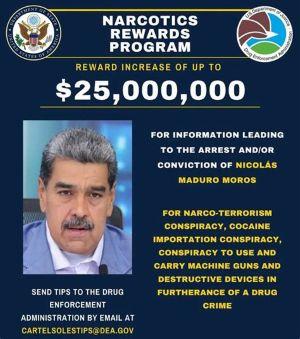
Venezuela and its leader, Nicolas Maduro, are in the crosshairs of Trump's anti-cartel efforts. (DEA.gov)
Marijuana Policy
DE Governor Vetoes Bill to Loosen Pot Shop Zoning. Gov. Matt Meyer (D) on Thursday vetoed a bill that would have loosened constraints on where marijuana retailers can operate, Senate Bill 75. The bill aimed to address complaints from would-be retailers that zoning restrictions are stifling growth in the industry.
The bill would have overruled county governments that created restrictive zoning requirements on retailers. County leaders and Republican legislators had opposed the bill, arguing that it stepped on "home rule" by cities and counties.
"While I fully support the goals of implementing a safe, equitable, and accessible adult-use cannabis market in Delaware, displacing local land use authority without offering any corresponding partnership or support is not how we build durable, effective policy or trust," said Meyer in his veto letter to legislators.
But bill sponsor Sen. Trey Paradee (D-Dover) accused Meyer of breaching trust with his veto.
"If you give someone your word and you later back out or do not deliver as you promised, you will irreparably tarnish your name and reputation. Once that happens, no one will trust you or want to work with you again," he said.
Paradee said he had made a bargain with the governor to support splitting future marijuana revenues with counties in Meyer allowed SB 75 to become law without his signature. Meyers' veto now "will do irreparable harm to dozens of small business owners who successfully won the lottery to open retail marijuana stores and grow facilities," he said.
The state has more than a hundred marijuana business license holders who have yet to open, with restrictions on locations proving a major obstacle. In Sussex County, for example, pot businesses most be more than three miles from schools, parks, and churches.
Anchorage, Alaska, Assembly Votes to Kill On-Site Consumption Measure. The city Assembly voted Tuesday night to kill an ordinance that would have allowed marijuana smoking at businesses holding both city and state on-site consumption licenses ("endorsements"). On-site consumption is legal under state law but requires local approval as well.
At least four cities in the state -- Fairbanks, Seward, Soldotna and Ketchikan -- allow for on-site consumption, but voters in Anchorage rejected authorizing it in a 2020 ballot measure.
Assembly Vice Chair Anna Brawley cited that vote when she moved to effectively kill the ordinance by postponing consideration of it indefinitely. But she held open the possibility of future reconsideration.
"It does leave more opportunity to bring back a new item and potentially take more time with that, if that's desired," Brawley said. "But I don't see how we would go against the will of the voters so soon."
East Anchorage Assembly member George Martinez, who sponsored the ordinance, said that when voters legalized marijuana they meant for it to be regulated like alcohol and while Anchorage voters rejected on-site consumption five years ago, things are different now.
"Five years later, we're in a different place," Martinez said. "Today, the state has fully developed strict rules for on-site consumption, including and all the way separate areas from retail."
Foreign Policy
US Orders More Ships to Southern Caribbean as Trump Eyes Cartels. The US will be sending additional Navy ships to the southern Caribbean as part of President Trump's campaign against drug cartels, sources briefed on the deployment told Reuters on Monday.
The Navy deployed three vessels -- the USS San Antonio, USS Iwo Jima and USS Fort Lauderdale -- to the region last week. They are carrying ore than 4,000 service members, including more than 2,200 Marines. They are now being joined by the USS Lake Erie, a guided missile cruiser, and the USS Newport News, a nuclear-powered fast attack submarine, which are expected to be in southern Caribbean waters by early next week.
The moves appear aimed at the Venezuela, whose leader, President Nicolas Maduro, has been indicted on drug charges in the US, and its cartel de los soles (Suns cartel). The Venezuelan government has said that it is deploying its navy in response.
Reuters' sources did not detail the specific mission of the deployments, but did say they are aimed at addressing national security threats from "narco-terrorist organizations," phrasing the Trump administration has favored as it seeks to portray criminal drug organizations as terrorist groups.
International
Colombia Embarks on Another Marijuana Legalization Push. Colombia came achingly close to legalizing marijuana in 2023. A bill got through seven necessary votes over two years only to fail on a final Senate vote.
Now, a new legalization push is underway. A bill from Rep. Alejandro Ocampo that would legalize marijuana possession and allow for a system of taxed and regulated sales passed the First Committee of the House of Representatives last week and now heads for a House floor vote.
But like last time, that is only the first of eight votes over a two-year period that will be needed to pass the bill. That is because it amends the national constitution.
"It is clear that a constitutional reform allowing medicinal, scientific, and adult uses of cannabis and its derivatives is not only pertinent but also necessary to address the contradictions and inconsistencies that persist in our legal system today," a report on the bill submitted to the First Committee says. "Furthermore, Colombia must join the current global positions that have found, in the decriminalization and legalization of possession and consumption, much more effective strategies for addressing the so far unsuccessful fight against drugs."
Ocampo's bill would give adult Colombians a constitutional right to possess marijuana and grow them own for personal use. It would also allow commercial sales "provided that the licenses and/or authorizations granted by the competent authority are obtained, without prejudice to personal cultivation authorized by law," the text of the legislation says.
President Gustavo Petro, a former guerilla who has championed drug reforms on the national and international stages, supports the bill and has criticized Congress for failing to legalize it two years ago, allowing criminals to profit from marijuana sales.
"If Congress had legalized cannabis, we wouldn't have a thug killing humble Colombians unnecessarily," he said Tuesday, referencing violence in the illicit trade.
back to top