Drug War Issues
Politics & Advocacy
Delaware's governor vetoes a bill that would have easing zoning restrictions on pot shops, the Anchorage, Alaska, Assembly tables a pot social consumption ordinance, and more.
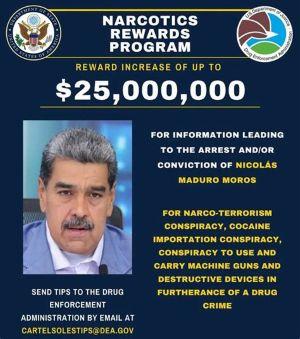
Venezuela and its leader, Nicolas Maduro, are in the crosshairs of Trump's anti-cartel efforts. (DEA.gov)
Marijuana Policy
DE Governor Vetoes Bill to Loosen Pot Shop Zoning. Gov. Matt Meyer (D) on Thursday vetoed a bill that would have loosened constraints on where marijuana retailers can operate, Senate Bill 75. The bill aimed to address complaints from would-be retailers that zoning restrictions are stifling growth in the industry.
The bill would have overruled county governments that created restrictive zoning requirements on retailers. County leaders and Republican legislators had opposed the bill, arguing that it stepped on "home rule" by cities and counties.
"While I fully support the goals of implementing a safe, equitable, and accessible adult-use cannabis market in Delaware, displacing local land use authority without offering any corresponding partnership or support is not how we build durable, effective policy or trust," said Meyer in his veto letter to legislators.
But bill sponsor Sen. Trey Paradee (D-Dover) accused Meyer of breaching trust with his veto.
"If you give someone your word and you later back out or do not deliver as you promised, you will irreparably tarnish your name and reputation. Once that happens, no one will trust you or want to work with you again," he said.
Paradee said he had made a bargain with the governor to support splitting future marijuana revenues with counties in Meyer allowed SB 75 to become law without his signature. Meyers' veto now "will do irreparable harm to dozens of small business owners who successfully won the lottery to open retail marijuana stores and grow facilities," he said.
The state has more than a hundred marijuana business license holders who have yet to open, with restrictions on locations proving a major obstacle. In Sussex County, for example, pot businesses most be more than three miles from schools, parks, and churches.
Anchorage, Alaska, Assembly Votes to Kill On-Site Consumption Measure. The city Assembly voted Tuesday night to kill an ordinance that would have allowed marijuana smoking at businesses holding both city and state on-site consumption licenses ("endorsements"). On-site consumption is legal under state law but requires local approval as well.
At least four cities in the state -- Fairbanks, Seward, Soldotna and Ketchikan -- allow for on-site consumption, but voters in Anchorage rejected authorizing it in a 2020 ballot measure.
Assembly Vice Chair Anna Brawley cited that vote when she moved to effectively kill the ordinance by postponing consideration of it indefinitely. But she held open the possibility of future reconsideration.
"It does leave more opportunity to bring back a new item and potentially take more time with that, if that's desired," Brawley said. "But I don't see how we would go against the will of the voters so soon."
East Anchorage Assembly member George Martinez, who sponsored the ordinance, said that when voters legalized marijuana they meant for it to be regulated like alcohol and while Anchorage voters rejected on-site consumption five years ago, things are different now.
"Five years later, we're in a different place," Martinez said. "Today, the state has fully developed strict rules for on-site consumption, including and all the way separate areas from retail."
Foreign Policy
US Orders More Ships to Southern Caribbean as Trump Eyes Cartels. The US will be sending additional Navy ships to the southern Caribbean as part of President Trump's campaign against drug cartels, sources briefed on the deployment told Reuters on Monday.
The Navy deployed three vessels -- the USS San Antonio, USS Iwo Jima and USS Fort Lauderdale -- to the region last week. They are carrying ore than 4,000 service members, including more than 2,200 Marines. They are now being joined by the USS Lake Erie, a guided missile cruiser, and the USS Newport News, a nuclear-powered fast attack submarine, which are expected to be in southern Caribbean waters by early next week.
The moves appear aimed at the Venezuela, whose leader, President Nicolas Maduro, has been indicted on drug charges in the US, and its cartel de los soles (Suns cartel). The Venezuelan government has said that it is deploying its navy in response.
Reuters' sources did not detail the specific mission of the deployments, but did say they are aimed at addressing national security threats from "narco-terrorist organizations," phrasing the Trump administration has favored as it seeks to portray criminal drug organizations as terrorist groups.
International
Colombia Embarks on Another Marijuana Legalization Push. Colombia came achingly close to legalizing marijuana in 2023. A bill got through seven necessary votes over two years only to fail on a final Senate vote.
Now, a new legalization push is underway. A bill from Rep. Alejandro Ocampo that would legalize marijuana possession and allow for a system of taxed and regulated sales passed the First Committee of the House of Representatives last week and now heads for a House floor vote.
But like last time, that is only the first of eight votes over a two-year period that will be needed to pass the bill. That is because it amends the national constitution.
"It is clear that a constitutional reform allowing medicinal, scientific, and adult uses of cannabis and its derivatives is not only pertinent but also necessary to address the contradictions and inconsistencies that persist in our legal system today," a report on the bill submitted to the First Committee says. "Furthermore, Colombia must join the current global positions that have found, in the decriminalization and legalization of possession and consumption, much more effective strategies for addressing the so far unsuccessful fight against drugs."
Ocampo's bill would give adult Colombians a constitutional right to possess marijuana and grow them own for personal use. It would also allow commercial sales "provided that the licenses and/or authorizations granted by the competent authority are obtained, without prejudice to personal cultivation authorized by law," the text of the legislation says.
President Gustavo Petro, a former guerilla who has championed drug reforms on the national and international stages, supports the bill and has criticized Congress for failing to legalize it two years ago, allowing criminals to profit from marijuana sales.
"If Congress had legalized cannabis, we wouldn't have a thug killing humble Colombians unnecessarily," he said Tuesday, referencing violence in the illicit trade.
This work by StoptheDrugWar.org is licensed under Creative Commons Attribution-ShareAlike 4.0 International


Add new comment