Thank you to those who generously donated last week to help us continue restarting the Drug War Chronicle newsletter. We still need help, and so are reaching out again.
Mexico's president says no US troops will operate in her country, Trump considers marijuana rescheduling after $1 million-a-plate fundraiser with pot investors, more.
Mexico City allows public pot-smoking sites, and now it's relocating some of them; the North Carolina Supreme Court ponders marijuana odor and probable cause for searches, and more.
A new study blames COVID and fentanyl -- not drug decriminalization -- for Oregon overdoses and crime increases, and more.
New York Mayor Eric Adams wants to forcibly remove drug users from city streets, New Mexico Gov. Michelle Lujuan Grisham declares a drugs and crime emergency in Rio Arriba County, and more.
A Massaachusetts sheriff is arrested for extorting a legal marijuana business, a pair of Customs and Border Patrol agents cop to letting dope through their port of entry lanes, and more.
Thank you to those who generously donated last week to help us continue restarting the Drug War Chronicle newsletter. We still need help, and so I'm reaching out here again to ask our new and old friends whether you're able to help.
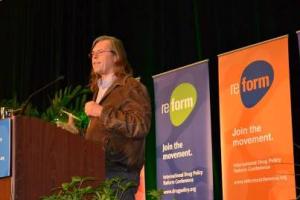
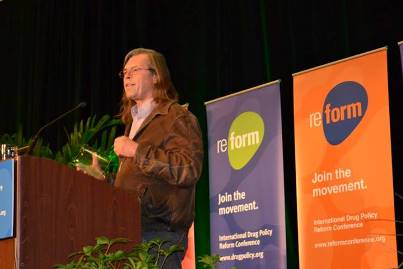
Phil receiving the Brecher Award for Journalism, 2013 International Drug Policy Reform conference
For our longtime writer Phillip S. Smith to continue, and to bring him back to a full schedule as soon as possible, we need to raise at least $800/week in
tax-deductible grants or donations to our 501(c)(3) nonprofit, DRCNet Foundation. That's not all Phil should be earning for his work, but for now at least it will enable us to complete the restart of the Chronicle and keep it going.
(We also need to raise $900/month in non-deductible donations to our 501(c)(4) public welfare nonprofit, Drug Reform Coordination Network, to continue to afford the our list management service and web site hosting fees. I'll explain why we cover these costs from the non-deductible type of donation in a subsequent email. If you remember this from the past, it's the same reason as before, with the costs somewhat lower now.)
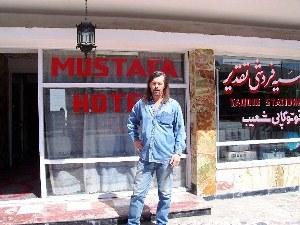
Phil Smith reporting live from Afghanistan, 2005
Thank you if you're willing to help us restart Drug War Chronicle. Also, if you were planning to or considering making a gift later in the year, it would make the extra difference if you were to do so now instead. Of course we are grateful for your support, whenever it is provided and in whatever amount.
Note that our online donation system, along with accepting one-time donations of course (via credit card, PayPal or bank ACH), also has a range of recurring donation options that you can use if you wish to make that commitment. People mainly use these for monthly or annual gifts to our organization. But our donation system can also accommodate gifts scheduled weekly, biweekly, every four weeks, quarterly, and twice a year. (Click here if you'd like info on contributing by mail or making a gift of stock.)
Sincerely,

David Borden, Executive Director
StoptheDrugWar.org
P.O. Box 9853, Washington, DC 20016
https://stopthedrugwar.org
back to top
Mexico's president says no US troops will operate in her country, Trump considers marijuana rescheduling after $1 million-a-plate fundraiser with pot investors, more.
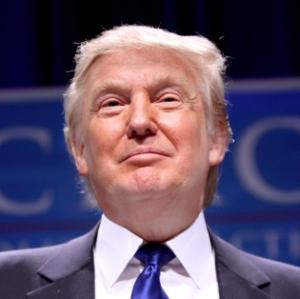
President Trump threatens to sic the US military on drug cartels. (Gage Skidmore/Creative Commons)
Massachusetts Proposed Initiative Would End Commercial Marijuana Sales, Home Cultivation. A group of state citizens who seek to roll back marijuana legalization have filed two versions of an initiative that would end commercial marijuana sales and ban home cultivation, An Act to Restore a Sensible Marijuana Policy.
The initiatives would repeal Chapters 94G and 64N in the Massachusetts general laws. Those are the sections of the state law that governs the use, sale, and taxation of adult-use marijuana. Possession of less than an ounce would remain legal, but possession of between one and two ounces would be a civil offense punishable by a fine of $100. And home cultivation would be criminalized.
The initiatives allow for the continued use and sale of medical marijuana, but would impose limitations on THC content.
The state legalized marijuana in 2016, and legalization maintains strong public support, with an April 2024 poll showing 65 percent in favor of keeping the current system.
Campaigners face a multi-step process to get the measure before the voters in November 2026. They must first gather more than 75,000 valid voter signatures by December 3. If they do, the measure then goes to the legislature next January. If lawmakers do not approve the measure, campaigners would then have to gather an additional 12,429 valid voter signatures by next July1 to qualify for the ballot.
Foreign Policy
Trump Orders Military to Go After Drug Cartels. President Donald Trump recently signed a secret directive to the Department of Defense to use military force against Latin American drug cartels that his administration has designated as terrorist organizations. Those include Mexico's Sinaloa Cartel, the Salvadoran MS-13, and the Venezuelan gang Tren de Aragua, as well as the Cartel de los Soles, which the administration has linked to Venezuelan President Roberto Maduro.
The directive signals that Trump is willing to use military force to carry out what is generally considered a law enforcement responsibility to fight drug criminals and provides an official basis for doing so. But it also raises the question of whether US forces who kill civilians outside specific congressional authorization in an armed conflict would be considered murderers.
"President Trump's top priority is protecting the homeland, which is why he took the bold step to designate several cartels and gangs as foreign terrorist organizations," said White House spokesperson Anna Kelly.
The US military has been involved in counterdrug operations in Latin America in the past, but those operations have been described as providing support for law enforcement.
Although Republicans have embraced the idea of using military force against the cartels, using military force inside another country without its consent would be a major violation of international law. Similarly, Congress authorized the use of force in the war on terror after the September 11, 2001, Al-Qaeda attacks, but that authorization does not automatically include any groups the administration decides to call terrorists.
Mexican President Says Country Will Not Allow US Military Operations on Its Soil. News that President Donald Trump has authorized the US military to go after certain Latin American drug cartels has sparked a quick reaction from Mexico, home to the Sinaloa Cartel, which the administration has designated a terrorist organization.
Mexican President Claudia Sheinbaum said Friday that while Mexico cooperates with the US to fight drug cartels and related criminal activity, it will not let the US military operate on Mexican soil.
"The United States is not going to come to Mexico with the military," Sheinbaum said. "We cooperate, we collaborate, but there is not going to be an invasion," Sheinbaum said. "That is ruled out -- absolutely ruled out."
US military action in Mexico "is not part of any agreement," Sheinbaum said. "When it has been brought up, we have always said 'no,'" she added.
back to top
Marijuana Policy
Mexico City allows public pot-smoking sites, and now it's relocating some of them; the North Carolina Supreme Court ponders marijuana odor and probable cause for searches, and more.
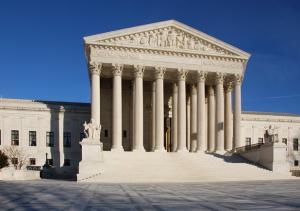
The US Supreme Court. Will it take us the issue of marijuana and gun bans? (Creative Commons)
Trump DOJ Asks Supreme Court to Uphold Ban on Marijuana Users Owning Guns. The Trump Department of Justice (DOJ) is urging the Supreme Court to take up one of several cases around the federal government's ban on firearms possession for users of marijuana and other illicit drugs and use it to uphold that prohibition.
Last week, DOJ requested that the high court review one case in particular out of five that have been differently decided by lower federal courts. That case "presents an important Second Amendment issue that affects hundreds of prosecutions every year: whether the government may disarm individuals who habitually use unlawful drugs but are not necessarily under the influence while possessing a firearm," wrote Solicitor General D. John Sauer.
Sauer argued that even though some recent appeals court decisions have called into question the ban on firearms possession for marijuana users, the ban is indeed constitutional. The solicitor general reiterated his position that, despite recent appeals court decisions calling into question the constitutionality of the firearms ban for people who use cannabis -- even in compliance with state law -- the restriction is nevertheless lawful.
Still, as DOJ conceded in its memo last week, appeals and district court opinions on the subject have differed and "the question presented is the subject of a multi-sided and growing circuit conflict."
The nine Supreme Court justices will meet next month to decide whether to take up any of the gun and marijuana cases.
Psychedelics
Utah Psilocybin Church Wins Injunction Barring Criminal Prosecution of Founder. A nonprofit religious entity that uses psychedelic mushrooms as part of its practice has won a temporary injunction barring any further steps in the state criminal prosecution of its founder, Lee Jensen, who was arrested for his psilocybin use and possession.
The group sued the city of Provo and Utah County in December claiming that the criminal prosecution violated its rights under the US Constitution, the state constitution, and a 2024 state law, the Utah Religious Freedom Restoration Act.
Last week, US District Court Judge Jill Parrish granted the request for a preliminary injunction, writing that the county's actions imposed "a substantial burden" on religious freedom.
"The irreparable injury to Plaintiffs is not merely theoretical," Parrish wrote. "Based on the record in this case, the court notes once again its finding that the prosecution was brought in bad faith as part of a larger effort to harass Plaintiffs for their entheogenic religious practices and in hopes of giving the government a second opportunity to litigate the free-exercise issues presented squarely in this case."
"The prosecution has already caused Singularism to lose many of its practitioners and affiliates, and forcing Plaintiffs to wait until the conclusion of the criminal proceedings to secure their free-exercise rights would be the equivalent of issuing a death warrant for their nascent religion," the judge continued. "For these reasons, the court grants Plaintiffs' motion for an anti-suit injunction pending final judgment in this court enjoining further proceedings in the state criminal case against Mr. Jensen insofar as that case prosecutes him for violating the Utah Controlled Substances Act's prohibitions on psilocybin."
As well as state and federal constitutional protections, the state's Religious Freedom Restoration Act specifically "prohibits a government entity from substantially burdening a person's free exercise of religion, unless the burden is essential to furthering a compelling governmental interest and is the least restrictive means of furthering that interest."
Jensen welcomed the court win on Monday, though the final judgment on the case remains pending.
"The judge has recognized this for what it is. It's retaliatory charges that came in bad faith," Jen said after the ruling. "When you protect the religious freedoms of one religion, you protect the freedoms of all of them."
Search and Seizure
North Carolina Supreme Court to Hear Case on When Marijuana Odor Can Allow Vehicle Searches. The state Supreme Court is set to hear oral arguments September 9 in a case that that could clarify whether the odor of marijuana -- or in this case, marijuana and cologne -- provides probable cause for police to search without a warrant. The appellant in State v. Dobson argues that because hemp is legal in the state and the odors of legal hemp and illegal marijuana are indistinguishable, the odor of marijuana does not provide probable cause for a search.
Greensboro police pulled Tyron Lamont Dobson over in a 2021 traffic stop and reported smelling odor of marijuana and cologne. They used the odor to find probable cause to search the car, and subsequently found drugs in the car and a gun on Dobson. Dobson eventually pleaded guilty to a gun crime, but his attorney wants that conviction thrown out, arguing that the evidence is the fruit of an unlawful search and must be suppressed.
That argument has been a hard-sell in Tarheel courts, though. Neither the trial court nor the state Court of Appeals bought it.
"(C)ontrary to Defendant's arguments, the legalization of industrial hemp did not eliminate the significance of detecting 'the odor of marijuana' for the purposes of a motion to suppress," Judge Valerie Zachary wrote in April 2024 for a unanimous appellate panel. "The legalization of industrial hemp 'has not changed the State's burden of proof to overcome a motion to suppress.'"
The appeals court also rejected Dobson's argument that police use of the presence of both marijuana and cologne odors created a new "double odor" rule to justify searches, calling cologne a "cover scent." But Dobson's attorney, Benjamin Kull, is calling on the state Supreme Court to reverse that ruling.
"Did the Court of Appeals fail to conduct the requisite 'totality of the circumstances' analysis and instead evaluate the existence of probable cause by applying an unconstitutional new 'double odor' rule?" Kull asked in a July 2024 petition. That is no more than a "formulaic box-checking exercise that only asks whether the two smells are present," he added.
International
Mexico City Moves Three "Cannabis Tolerance Zones" in Preparation for 2026 FIFA World Cup. Although the Mexican congress never got its bill legalizing marijuana commerce passed under former President Lopez Obrador, marijuana possession (up to 28 grams) has been legal since a 2021 Supreme Court decision. After pro-marijuana activists organized public pot consumption spaces the following year, Mexico City municipal authorities went along, allowing scenes to develop in several plazas in the central city.
Now, they want to relocate some of them as the city prepares for the premier event in global soccer, next year's FIFA World Cup. That has some pro-marijuana activists concerned and some NIMBY neighbors at the new sites upset.
Acting on orders from Mayor Clara Brugada, authorities cleared out public consumption scenes at the Plaza de la Informacion outside the Hidalgo Metro station, the Estela de Luz monument at the entrance to Chapultepec Park, and outside of the Museum of Memory and Tolerance in the city center. City officials cited complaints about crime, violence, and on-site marijuana sales.
The city is replacing them with officially-sanctioned "420 Zones" in Plaza de la Concepcion in the Historic Center, the Simon Bolivar Monument on Paseo de la Reforma, and the Jose Saramago Reading Hall next to Chapultepec Park.
And there are rules: Marijuana can be consumed only between 8:00am and 8:00pm, no more than the legal amount for personal use (28 grams) is permitted, the use of alcohol or other drugs is barred, buying and selling marijuana is a no-no, and users can only stay 40 minutes per visit. Municipal staff and police will monitor the locations to enforce the rules.
Some neighbors are grumbling, but the city is moving forward with the relocations. City officials said the rules and the strict oversight are subject to modification as the city evaluates the results.
back to top
A new study blames COVID and fentanyl -- not drug decriminalization -- for Oregon overdoses and crime increases, and more.
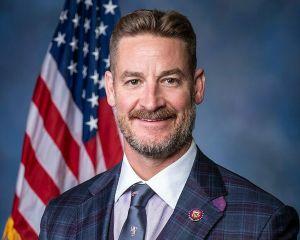
Rep. Greb Steube (R-FL) has again filed a bill to reschedule marijuana legislatively. (congress.gov)
Marijuana Policy
GOP Congressman Files Marijuana Rescheduling Bill. For the fourth session in a row, Rep. Greg Steube (R-FL) has filed a bill to reschedule marijuana, HR 4963. The bill is named the Marijuana 3-to-1 Act because it would move the substance from Schedule I to Schedule III of the Controlled Substances Act.
The bill comes even as the Trump administration is considering a marijuana rescheduling proposal that would take place through executive action. But legislatively-mandated rescheduling could prove less open to legal challenges than administrative rescheduling.
"The Attorney General of the United States shall, by order not later than 60 days after the date of enactment of this section, transfer marijuana… from schedule I of such Act to schedule III" of the CSA," the bill says.
"It makes zero sense that federal law treats marijuana the same as heroin and LSD," Steube said in a social media post. "It is even more ridiculous that cocaine is technically classified as less restrictive than marijuana."
"This week, I'm reintroducing my Marijuana 1-to-3 Act to move marijuana from Schedule I to Schedule III under the Controlled Substances Act. This is a common-sense change that will finally allow real scientific research into its medicinal value and ensure our drug laws reflect reality," he said. "I urge my colleagues and the Trump administration to get it done."
Drug Policy
Florida Bans Kratom Concentrate 7-OH. The state has banned a chemical found in trace amounts in kratom if it is isolated from the plant and concentrated. While concentrated 7-hydroxymitragynine (7-OH) is banned, kratom itself is not.
On Wednesday, Attorney General James Uthmeier (R) filed an emergency rule designated 7-OH a Schedule I controlled substance in the state. The order criminalizes the distribution, sale, or even possession of 7-OH.
"Due to the danger posed to the public, Florida is taking 7-OH off the shelves immediately," Uthmeier said. "This dangerous substance is being marketed to teens and young adults and has a high potential for abuse and death."
7-OH appears only in trace amounts in kratom, its concentrates have been used to manufacture tablets, gummies, drink mixes, and shots. Last month, the federal Food and Drug Administration (FDA) warned consumers, health care professionals, and 7-OH manufacturers about potential risks from the substance.
"Vape stores are popping up in every neighborhood in America, and many are selling addictive products like concentrated 7-OH. After the last wave of the opioid epidemic, we cannot get caught flat-footed again," FDA Commissioner Marty Makary said. "7-OH is an opioid that can be more potent than morphine. We need regulation and public education to prevent another wave of the opioid epidemic."
Under the new emergency rule, law enforcement and regulatory authorities can start removing 7-OH products from retailers in the state.
COVID, Fentanyl -- Not Drug Decriminalization -- Caused Jumps in Oregon Crime and Overdoses, Study Finds. Researchers from Portland State University's Department of Criminology and Criminal Justice have released a final report studying the impact of drug policy reforms in the state since 2008, and found little evidence to support widely made claims that the state's short-lived experiment with drug decriminalization caused higher crime and overdoses.
The report, "Examining the Multifaceted Impacts of Drug Decriminalization on Public Safety, Law Enforcement, and Prosecutorial Discretion," outlines a decade of drug reform beginning in 2013, when the state reducing mandatory minimums for marijuana and diverting more drug users to probation. Four years later, reclassified drug possession felonies as misdemeanors, and in 2020, voters approved Measure 110, which decriminalized possession of small amounts of drugs, such as methamphetamine and fentanyl.
Drug overdose deaths were rising before decriminalization and had already peaked by the time the legislature moved to end decriminalization last year, the study found. The rise in overdoses coincided with the late arrival of fentanyl in Pacific Northwest drug markets. But it was COVID and associated social dislocations that played the key role, the researchers found.
"Of all the events we examined, the COVID-19 pandemic disrupted the justice system the most, more so than any legislation," said Brian Renauer, a lead researcher and university professor.
"What we observed was far from a causal connection to Measure 110," said Christopher Campbell, a lead researcher and associate professor at the university Campbell. "Rather, we saw an unprecedented impact of the COVID-19 pandemic and fentanyl on public health and safety outcomes."
back to top
New York Mayor Eric Adams wants to forcibly remove drug users from city streets, New Mexico Gov. Michelle Lujuan Grisham declares a drugs and crime emergency in Rio Arriba County, and more.
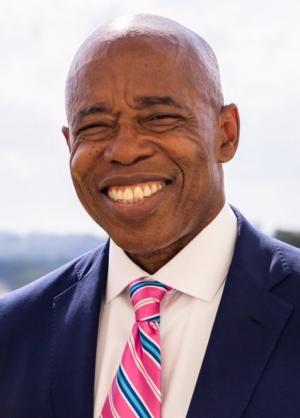
NYC Mayor Adams talks tough on drugs and homelessness in a desperate bid for electoral relevance. (nyc.gov)
Marijuana Policy
Texas Hemp THC Fight Continues in New Legislative Special Session. Texas Republicans continue to be split on whether to ban or regulate hemp THC. Gov. Greg Abbott (R), who favors regulation, vetoed a hemp THC ban bill during the regular session and called on lawmakers in this special session to move a bill regulating hemp THC, but they responded by moving a bill that would again just ban it.
The new special session, called after a walkout by Democratic lawmakers seeking to block a mid-decade legislative redistricting bill sought by President Trump left the first special session without a quorum, opened Friday. That same day, the Senate State Affairs Committee approved a reintroduced Senate Bill 6, which bans hemp products with "any amount" of cannabinoids other the CBD and CBG.
It also makes even possession of a prohibited hemp THC a Class B misdemeanor punishable by up to 180 days in jail.
While lawmakers are advancing the ban, Abbott said in his proclamation that we wanted to sign a bill that would "comprehensively regulate hemp-derived products, including limiting potency, restricting synthetically modified compounds, and establishing enforcement mechanisms, all without banning lawful hemp-derived products."
Meanwhile, a second measure this session, House Bill 36 filed by Rep. Charlie Geren (R) would follow the governor's directive to make it so consumable hemp products could only be purchased by adults 21 and older. That bill has yet to be acted on.
Psychedelics
Alaska Natural Psychedelic Decriminalization Initiative Approved for Signature-Gathering. Lt. Gov. Nancy Dahlstrom (R), who heads the Alaska Division of Elections, said last Thursday that she has approved for signature-gathering a proposed initiative that would allow for the use of psychedelic mushrooms and other natural psychedelics for traditional and therapeutic purposes.
The Alaska Natural Medicine Act would "establish a regulated natural medicine program for mental health treatment and to decriminalize personal use of natural medicine for adults in Alaska," the initiative says.
The campaign is sponsored by Natural Alaska Medicine Inc., a nonprofit organization "dedicated to fostering charitable, educational, and social welfare initiatives that promote the safe and responsible use of natural medicines," according to its website. The president and other members of the group are Indigenous Alaskans and the initiative contains provisions for traditional healers.
The president of Natural Alaska Medicine Inc. and other team members are Indigenous Alaskans. The proposed ballot initiative includes provisions for Alaska Native traditional healers.
The initiative would decriminalize personal use by adults and the home cultivation of natural entheogens. It would also create a Natural Medicine Control Board in the state Department of Commerce, Community, and Economic Development. And it would establish an advisory Traditional Use Council.
Organizers have one year from last Thursday to come up with 34,098 valid voter signatures to qualify for the November 2026 ballot.
Drug Policy
New York City Mayor Calls to Forcibly Remove Drug Users from City Streets. Embattled Mayor Eric Adams, who is running a long-shot third party campaign to be reelected, called last Thursday for forcibly removing drug users from city streets and for allowing health care workers to order drug treatment with a court order.
Adams is courting right-leaning and centrist voters after losing the Democratic Party nomination in the wake of his indictment on corruption charges and their subsequent dismissal in a very peculiar deal with the Trump administration.
He rolled out his new plan at the conservative think tank the Manhattan Institute.
"The evidence is right there in front of us," the mayor said. "People openly using illegal drugs on the streets and in our parks, passed out in doorways and sidewalks, encampments littering with syringes and vials and unsanitary conditions that are a threat to public health and public order. This cannot be allowed to continue."
But Adams' proposal was not all regressive. He also called for a new drop-in center in the Bronx, a new pilot program of "contingency management," where users are paid to not use drugs, and funding for cell phones through a program that provides support to people taken to emergency rooms after overdosing.
The involuntary removal of drug users and court-ordered treatment were "horrible" ideas, said Jasmine Budnella, drug policy director at the low-income advocacy group Vocal-NY, but added that his ideas weren't all bad. "The rest of it continues to build off of the public health data insight that his administration has really been using around the overdose crisis," she said.
New Mexico Governor Declares State of Emergency over Drugs and Crime in Rio Arriba County. Gov. Michelle Lujan Grisham (D) declared a state of emergency last Wednesday in Rio Arriba County, which includes the city of Espanola and two Native American pueblo communities and has historically had high opioid use and overdose rates.
The governor's declaration frees up $750,000 for local governments and tribal officials after they called for reinforcements in their fight against violent and drug-related crime.
"The surge in criminal activity has contributed to increased homelessness, family instability and fatal drug overdoses, placing extraordinary strain on local governments and police departments that have requested immediate state assistance," said Lujan Grisham.
Lujan Grisham declared a similar state of emergency in the state's largest city, Albuquerque, in April, arguing that an increase in crime demanded the help of the state National Guard.
Back in Rio Arriba County, the tribal governor of the Santa Clara Pueblo called on the state to do more.
"The pueblo has expended thousands of dollars trying to address this crisis... and to protect pueblo children who are directly and negatively affected by a parent's or guardian's addiction," said Santa Clara Gov. James Naranjo. "But we are not an isolated community, and the causes and effects of fentanyl/alcohol abuse, increased crime, and increased homelessness extend to the wider community."
back to top
A Massachusetts sheriff is arrested for extorting a legal marijuana business, a pair of Customs and Border Patrol agents cop to letting dope through their port of entry lanes, and more.
In Des Moines, a former Polk County sheriff's deputy was arrested July 28 on meth charges after earlier being arrested on petty theft charges. When sheriff's officers searched Justin Register's patrol car incident to that first arrest -- for stealing money during a traffic stop -- they found 27.7 grams of meth hidden beneath the vehicle. The drugs were not linked to any case Register worked on. He is charged with trafficking methamphetamine and possession of drug paraphernalia.
In Anniston, Alabama, a St. Clair Correctional Facility jail guard was arrested July 31 after narcotics agents raided his home and found more than eight pounds of meth, as well as various other substances, including 19 pounds of marijuana, 340 grams of synthetic cannabinoids, 100 grams of crack cocaine, and 16 grams of powder cocaine, not to mention 156 cell phones and two cellular hotspots. Lt. Calvin Bush is charged with trafficking methamphetamine and trafficking marijuana.
In New York City, a former security staffer at the US embassy in the Dominican Republic was arrested August 6 upon being extradited from the Dominican Republic. Jairo Elizer Arias Caceres is charged with conspiracy to import cocaine into the US. Arias went down amidst an investigation by the Border Enforcement Security Taskforce into what officials described as "a significant narcotics importation conspiracy." He is accused of coordinating couriers who smuggled cocaine into various airports in the New York City area in the packaging of items purchased from the Santo Domingo Airport Duty Free store. He's looking at a minimum of 10 years in federal prison.
In Valparaiso, Indiana, a former Porter County jail guard was arrested August 6 for allegedly smuggling drugs into the jail. Johnny Maynor III had been on the job for just over two years when he was investigated beginning in June and fired at the end of July. He is now charged with felony trafficking of a controlled substance, official misconduct, and misdemeanor trafficking with an inmate. Additional details about the case have not been released.
In Florida, a Massachusetts sheriff was arrested August 7 on charges he pressured a Boston-based marijuana company to sell him stock in the company. Suffolk County Sheriff Steven Tompkins, 67, is set to appear in federal court in Boston later this week. He faces two federal counts of extortion. Tompkins allegedly pressured the company for stock as it considered an initial public offering in 2020. The company agreed, fearing Tompkins could imperil its operating license, and let Tompkins invest $50,000 in November 2020. The stock price initially rose after the public offering, but when it began to fall in 2021, he demanded his money back and received full refund despite the decline in the stock's value. If found guilty on the extortion charges, Tompkins could face a sentence of up to 20 years in prison on each count, three years of supervised release and a fine of $250,000.
In Los Angeles, two Customs and Border Patrol officers pleaded guilty July 28 to allowing vehicles filled with drugs to enter the US from Mexico. Officers Jesse Clark Garcia, 37, and Diego Bonillo, 30, each pleaded guilty to multiple charges, including conspiracy to import controlled substances such as cocaine, methamphetamine and heroin. The pair would text a code to Mexican traffickers to let them know which lanes they were manning at the Otay Mesa and Tecate border crossings and then wave them through when they arrived. Bonillo admitted that he allowed at least 165 pounds of fentanyl to enter the country and both men admitted taking thousands of dollars for their efforts. Both face up to life in federal prison.
In Ocala, Florida, a former federal prison guard was sentenced July 30 to more than three years in federal prison for taking bribes to smuggle drugs and other contraband into the Coleman Federal Correctional Complex in Sumter County. Samuel Brandon Smith, 38, went down after investigators searched him as he arrived for work at the prison and found 668 grams of marijuana and other controlled substances hidden in his vest. Smith admitted to receiving nearly $44,000 dollars in payments for his dope smuggling.
In Raleigh, North Carolina, a former Wayne County jail guard was sentenced August 6 to five years in federal prison for plotting to smuggle 50 grams of meth behind bars. Dawan Dontra McKinzie, 31, went down after federal agents received a tip that he was bringing contraband into the prison. When confronted by investigators, McKinzie turned over a package he had received from the wife of an inmate. In it were 53 grams of meth, 30 grams of psylocibin mushrooms, 2 grams of cocaine, 7 pounds of tobacco, suboxone, a cellphone and nude photographs. McKinzie pleaded guilty to drug possession and conspiracy to distribute charges in May.
back to top