Legalization

RSS Feed for this category

South Dakota Bill to Reduce Marijuana Penalties Killed

A bill that would have lowered the maximum penalty for possession of two ounces of marijuana or less was killed Tuesday in a Senate committee. It died on a 5-2 vote in the Senate Judiciary Committee after law enforcement representatives testified against it.

In the language customarily used in Pierre, it was "deferred to the 41st legislative day." The South Dakota session has only 40 days.

The bill, Senate Bill 221, would have moved marijuana possession from a Class 1 to a Class 2 misdemeanor. That would have lowered the maximum penalty from a year in jail to 30 days in jail.

Both proponents and opponents of the measure agreed that the vast majority of people charged with pot possession serve little or no jail time, with most receiving only fines. Those fines can be significant, though. In east-central Beadle County, for instance, pot possession offenders are typically hit with a fine of $435, with some jail time thrown in for repeat offenders.

Attorney General Marty Jackley (R), the State's Attorney's Association's Paul Bachand, and lobbyists for sheriffs and police chiefs all opposed the bill, saying it would "send the wrong message" about a substance they consider a "gateway drug."

Earlier in the session, legislators defeated a medical marijuana bill (again). The state also criminalizes having gotten high, even if having done so elsewhere. Its "internal possession" law is unique in the country. South Dakota remains one of the most pot-unfriendly places in the country, something that summer vacationers and fans of the annual Sturgis Motorcycle Rally would do well to keep in mind.

Pierre, SD
United States

Marijuana Legalization Bill Coming Soon to Pennsylvania

Pennsylvania will likely be the next state to see a marijuana legalization bill introduced this year, as state Sen. Daylin Leach (D-King of Prussia) announced at a Monday press conference that he would be filing one shortly.

After voters in Colorado and Washington approved marijuana legalization last November, the push is now on at the statehouse. Legalization bills have already been filed in Hawaii, Massachusetts, and New Hampshire, and bills are also expected shortly in Maine and Vermont.

The bill will propose a system of taxation and regulation of marijuana commerce.

"This past November, the people of Washington State and Colorado voted to fully legalize marijuana," said Leach. "It is time for Pennsylvania to be a leader in jettisoning this modern-day prohibition, and ending a policy that has been destructive, costly and anti-scientific."

Supporting the bill were drug reform groups and public health professionals.

"Our nation can acknowledge the dangers of cigarettes, alcohol and marijuana while still permitting their use," said Dr. David Nathan, MD, clinical associate professor at the Robert Wood Johnson Medical School. "The only logically and morally consistent argument for marijuana prohibition necessitates the criminalization of all harmful recreational drugs, including alcohol, nicotine and caffeine. We can agree that such an infringement on personal freedoms is as impractical as it is un-American. The time has come to accept that our nation's attitude toward marijuana has been misguided for generations and that the only rational approach to cannabis is to legalize, regulate and tax it."

"Cops see the ineffectiveness and harms of marijuana prohibition up close, every day," said Neill Franklin, a retired Baltimore narcotics cop and the executive director of Law Enforcement Against Prohibition. "Keeping marijuana illegal doesn't significantly reduce use, but it does give tax-free profits to violent gangs and cartels that control the black market. Now, thanks to Sen. Leach's proposal, Pennsylvania has a chance to join Colorado and Washington in letting police focus on the job we signed up to do -- keeping the public safe -- instead of being distracted by chasing down marijuana users."

"NORML applauds Sen. Leach for taking this important step forward to end the failed policy of marijuana prohibition in his state. Pennsylvania has long been considered a bellwether state that sets the precedent for politics across the country, as such it is both exciting and encouraging to see the Keystone State take up this crucial dialogue," said Erik Altieri, Communications Director for NORML, "Marijuana prohibition costs the state of Pennsylvania over $300 million a year in enforcement costs and tens of millions a year in lost potential tax revenue, while doing little to keep the substance out of the hands of children or lower use rates. It is time for a new policy that works for the state and its people. We encourage all of Sen. Leach’s colleagues in Harrisburg to join him in this call for rational marijuana laws."

It could be an uphill battle. Leach spent the last two sessions trying to get medical marijuana bills passed, to no avail, and that was with strong public support for medical marijuana. A recent Franklin and Marshall College poll had support for medical marijuana at 82%, but support for legalization at only 36%. That's up 14 points from 2006, but still well below majority support.

Harrisburg, PA
United States

Rhode Island Marijuana Legalization Bill Filed

State Rep. Edith Ajello (D-Providence), chair of the House Judiciary Committee, announced Wednesday she had introduced a bill to make marijuana legal for adults 21 and over and to establish a system of taxation and regulation for marijuana commerce.

"It is time for Rhode Island to put the failed policy of marijuana prohibition behind us and adopt a more sensible approach just as our nation did with alcohol 80 years ago," Ajello said. "By keeping marijuana sales in the underground market, we are ensuring they will be uncontrolled and that those selling it are not asking for proof of age. Regulating marijuana like alcohol will take marijuana sales off the street and put them in the hands of legitimate businesses that would face real disincentives for selling to minors. These new businesses will also create jobs and generate much-needed new tax revenue."

Her bill, House Bill 5274, the Marijuana Regulation, Control and Taxation Act, would:

  • remove criminal penalties for the private possession of up to one ounce of marijuana and for the            home-growing of up to three mature marijuana plants in an enclosed, locked space;
  • establish a tightly regulated system of licensed marijuana retail stores, cultivation facilities, and testing facilities;
  • enact an excise tax of up to $50 per ounce on the wholesale sale of marijuana applied at the point of transfer from the cultivation facility to a retail store (sales tax will also be applied at the point of retail sales); and
  • require the Department of Business Regulation to establish rules regulating security, labeling, health and safety requirements, as well as rules requiring advertising of marijuana to be no less restrictive than advertising of tobacco.

The bill has the support of both local and national marijuana reform groups. 

"As a public health researcher, I know that regulation works," said Michelle McKenzie, a spokesperson for the statewide Coalition for Marijuana Regulation. "Over the past 20 years, we have reduced levels of teen cigarette use by nearly 50%, and we have done it through enacting strict regulations and providing comprehensive, evidence-based public education. We can do the same thing when it comes to marijuana. I am confident that regulating marijuana will make Rhode Island a safer and healthier place to live."

"State and federal lawmakers from around the nation are bringing forward proposals to regulate marijuana like alcohol, and they are being met with more public support than ever before," said Mason Tvert, a spokesman for the Marijuana Policy Project. "Most Americans are fed up with laws that punish adults simply for using a product that is objectively less harmful than alcohol. The bill introduced today in Rhode Island presents a smarter, more responsible approach to marijuana."

The bill has been referred to the House Finance Committee.

Rhode Island is the fourth state to see marijuana legalization legislation filed this year. The others are Hawaii, Massachusetts, and New Hampshire. Similar bills are expected to be filed in Maine, Pennsylvania, and Vermont.

Providence, RI
United States

Federal Marijuana Reform Bills Introduced [FEATURE]

Two Democratic congressmen announced Tuesday that they are introducing legislation to reform federal marijuana policy. In a joint press conference that also included representatives of drug reform groups, Reps. Earl Blumenauer (D-OR) and Jared Polis (D-CO) announced two separate bills aimed at addressing the looming clash between intransigent federal marijuana policies and states that have or likely will legalize marijuana. And more bills are pending, they said.

http://stopthedrugwar.org/files/blumenauer-polis-275px.jpg
Earl Blumenauer and Jared Polis
Blumenauer and Polis also released a report entitled "The Path Forward: Rethinking Federal Marijuana Policy," which outlines their perspective on marijuana policy and provides some background on regulation and opportunities for action. The congressmen have also established the Sensible Drug Policy Working Group, which will provide a forum for members of Congress who are working on related issues and hope to advance legislation.

Polis's Ending Federal Marijuana Prohibition Act would remove the DEA's authority over marijuana, end federal marijuana prohibition, and leave it to the states to decide whether to prohibit marijuana or not. Blumenauer's Marijuana Tax Equity Act, House Bill 501, would create a federal excise tax on marijuana similar to those imposed on alcohol and tobacco. Taken together, the two bills would provide for a system of marijuana regulation and taxation in states where it is legal.

More specifically, Polis's bill would:

  • Remove marijuana from the Controlled Substances Act;
  • Transfer the Drug Enforcement Administration’s authority to regulate marijuana to a newly renamed Bureau of Alcohol, Tobacco, Marijuana and Firearms, which will be tasked with regulating marijuana as it currently does alcohol;
  • Require marijuana producers to purchase a permit, as commercial alcohol producers do, of which the proceeds would offset the cost of federal oversight; and
  • Ensure federal law distinguishes between individuals who grow marijuana for personal use and those involved in commercial sale and distribution.

Blumenauer's bill would:

  • Impose a 50% excise tax on the first sale of marijuana, from the producer to the next stage of production, usually the processor;
  • Impose an occupational tax similar to those in the tobacco and alcohol industries on those operating in marijuana, with producers, importers and manufacturers facing an occupation tax of $1,000 per year and any other person engaged in the business facing an annual tax of $500 per year;
  • Impose civil penalties for failure to comply with taxing duties. Criminal penalties will be assessed for intentional efforts to defraud the taxing authorities; and
  • Require the IRS to produce a study of the industry after two years, and every five years after that, and to issue recommendations to Congress to continue improving the administration of the tax.

The time has come for marijuana law reform at the federal level, the two congressmen said.

"There has been an enormous evolution of American opinion on marijuana. Americans are sick and tired of the costs of marijuana prohibition, whether it’s the financial costs or the human costs. Americans are saying enough is enough, let's try a new policy. We need to address drug use as a public health issue, not a criminal justice one," said Polis.

"My bill doesn't affect the legal status of marijuana where it is currently illegal," the Colorado congressman explained, "but it does allow states that have created either a legalized and regulated scheme for sales or that have medical marijuana laws to operate, without the constant fear that the federal government and the DEA and the other agencies will prosecute patients or businesses that are fully legal under state law. This is an idea whose time has come."

"Forty years ago, as a freshman member of the Oregon legislature, I was able to vote to make Oregon the first state to decriminalize the possession of small amounts of marijuana," said Blumenauer. "Since then, 14 states have joined Oregon, and after California legalized medical marijuana in 1996, we now have 19 jurisdictions that have authorized it, and we now have the first two states that have legalized marijuana for recreational use."

The Oregon congressman added that he and Polis are working with a bipartisan group of representatives and that up to eight or 10 marijuana reform bills could be introduced this session.

"We're looking at antiquated and sometimes nonsensical federal laws and policies to try to get us on a path that is less expensive, more productive, more fair, and more in tune with where America is going," Blumenauer said. "We arrested two-thirds of a million people in 2011 for a substance most people think should be legal. The president said he has bigger fish to fry, but there are still people further down the federal food chain frying those fish."

"This is a very exciting day," said Bill Piper, director of national affairs for the Drug Policy Alliance. "Last November, voters in Colorado and Washington made history, and the polling shows that a majority of Americans now support legalizing marijuana. There is no doubt more states will legalize in the years to come. This is the beginning of the end of marijuana prohibition."

"We were a primary backer of Amendment 64 in Colorado, which directed the state to regulate marijuana in a manner similar to alcohol," said Steve Fox, director of government relations for the Marijuana Policy Project. "That's how we believe it should be treated, and we look forward to working with Reps. Polis and Blumenauer to see that this legislation is eventually passed by Congress."

If not this year, then soon, the congressmen said.

"There is growing support for this bill," Polis argued. "There has really been a sea change; we saw test votes in the last Congress for defunding the DEA and other things, and saw very strong support, and that will only increase over time. Congress is frequently a lagging indicator for public opinion; it’s a question of Congress catching up."

"This is the beginning, not the end," said Blumenauer. "My bill is a first step and we anticipate some give and take, but this will be gaining momentum.  We've got legislation here today to get the ball rolling, but there will be more that you will be hearing about in the days ahead."

"It's clear that we've reached a tipping point," said Piper. "Major changes are going to happen and are happening now. The American people are demanding reform, and members of Congress are starting to give it to them."

Washington, DC
United States

Look Out, New York, It's Credico For Mayor! [FEATURE]

New York City has earned itself the sobriquet of Marijuana Arrest Capital of the World, with tens of thousands of minor pot possession arrests every year -- mostly of young men of color -- generated in good part by the city's equally infamous stop-and-frisk policing, again aimed primarily at the city's young and non-white residents. There's a man running an outsider campaign for the mayor's office there this year who wants to end all that.

Randy Credico during 2010 Senate campaign
Veteran Big Apple civil rights, social justice, Occupy Wall Street (OWS), and drug reform activist Randy Credico, who also doubles as a professional comedian, is mounting an insurgent campaign for the Democratic Party mayoral nomination, and he wants to end the city's drug war and a whole lot more, and he wants to do it now.

The inventively funny, yet deadly serious, agitprop artist has an ambitious 17-point program for his first day in office, with promises that range from going after "the biggest criminals in our city" -- the Wall Street bankers -- and reforming the city's tax code to favor the poor to rolling back privatization of city schools and reforming various city agencies.

But just beneath banksters and taxes is a vow to begin reining in the NYPD by firing Police Commissioner Ray Kelly (to be replaced with Frank Serpico) and "abolishing the NYPD’s unconstitutional policies of racial profiling, stop and frisk, domestic spying, entrapment, and its infamous (albeit unadmitted) 'quota system.'"

Central to that policing reform plank, Credico says, is reclassifying the smoking and carrying of marijuana as no longer an arrestable offense. He also vows to fire any officer who lies or perjures himself on the stand, and to bar the use of "no-knock" warrants and stun grenades "except in the case of legitimate terrorist attack."

And he wants to replace the city's Special Narcotics Office with a Harm Reduction Office, whose leadership he has offered to Drug Policy Alliance head Ethan Nadelmann. He also vows to shut down the Rikers Island prison and turn it into a treatment center and education facility with a state of the art library, and to nominate law professor Michelle Alexander, author of The New Jim Crow: Mass Incarceration in the Age of Color-blindness, to run it.

That's quite a tall order for a first day in office, but Credico says he's up for it.

"I plan to stay up for 24 hours and get all that stuff done," he told the Chronicle.

Of course, first he has to win the Democratic Party nomination and then win the general election, and that's a pretty tall order, too. There is a bevy of candidates (polling data at the link as well) running for a shot at the prestigious post, and he is facing stiff establishment opposition in the primary, most notably from Public Advocate Bill de Blasio and the as yet officially undeclared city council Speaker Christine Quinn, who leads the other Democrats in early polls, but is in a close race with "undecided."

The Republican race includes a handful of announced or potential candidates led by former Metropolitan Transit Authority head Joseph Lhota (who still trails "undecided" by a large margin) and NYPD Commissioner Ray Kelly, who is as yet unannounced. The Libertarians may also field a candidate this year, possibly former "Manhattan madam" and gubernatorial candidate Kristin Davis, and we can't forget the Rent Is Too Damn High Party, either.

"The GOP has a rich guy who just jumped in, and the Democrats have a six-pack of hacks, all getting money from the real estate interests and Wall Street and none of whom will talk about the issues," Credico explained. "The Democrats are all doing the Schumer act -- just talking about the middle class, not the poor, the homeless, the division between the rich and poor, not about drug policy. This city is virtually a police state right now."

Credico has a remedy for that: Elect him.

"I will get rid of Police Commissioner Ray Kelly, who is a combination of J. Edgar Hoover and Joseph Fouche, Napoleon's dreaded head of the secret police. Everyone is afraid of him. He's got the Red Squads going; they were infiltrating groups at Occupy Wall Street. Kelly is doing all these joint operations with the feds under the guise of fighting terrorism, and this city is crawling with undercover cops -- FBI, DEA, AFT, all running joint task forces with the NYPD. They've foiled 14 plots, all hatched by the NYPD. Ray Kelly has way too much power," the veteran activist said flatly.

"There is a lot of money not only in the prison industrial complex, but also the police industrial complex," Credico noted. "They have asset forfeiture and lots of new schemes, tons of undercover agents, who are really there to beat up on the black community. They infiltrate, demonize, and destroy lives, and this has to stop."

Credico has been active in the Occupy Wall Street moving, having been arrested five times by the NYPD, but before that, he was active in the city's minority communities for years, working to reform the Rockefeller drug laws with the William Moses Kunstler Fund for Racial Justice (in between stints flying out to Tulia, Texas, to deal with the bogus mass arrests of black men on drug charges there), and fighting stop-and-frisk. He currently is taking time out of his days to attend hearings in the criminal trial of the NYPD officer who shot and killed unarmed 18-year-old Ramarley Graham in his own bathroom as he was flushing a bag of weed down the toilet.

"I go to every one of the court dates and sit right next to his mother," he said. "This cop invaded Ramarley's house and shot him in the head for weed, but it's not an isolated incident. No cops go to jail for killing a black person, but a spit on a cop and you can go to jail for years. This is just one cop -- and he's like the Lt. Calley of the NYPD. [Editor's Note: Calley was the sole US Army officer convicted of a crime in the Vietnam War My Lai massacre.] It's not an isolated incident; it's the policy, the same policy that killed Ramarley Graham and Sean Bell and Amador Diallou. So many people have been killed by the NYPD, and it's not just the guys on the street; it's a brutal force."

Marijuana could also be a wedge issue for him, Credico said.

"I'm a committed pot smoker, and I think it should be legal, and I'm the only candidate saying it should be legal. Of course, it's up to the state legislature to do that, but I would direct the NYPD not to enforce those laws and particularly not to arrest anyone."

Under current state law, pot possession is decriminalized, but beginning with Mayor Rudy Giuliani, the NYPD had a policy of turning what should have been tickets for possession into misdemeanors by either reaching in someone's pocket and removing the baggie or intimidating the person into revealing it himself, thus elevating the offense from an infraction to the misdemeanor of "public possession." Under increasing pressure over the tactic, Commissioner Kelly last year issued an order for it to stop, and arrests have declined somewhat, but still remain at unacceptably high levels.

In 2011, there were some 50,000 marijuana possession arrests in the city, nearly 80% of them of people of color. Nearly one-quarter (12,000) were youth aged 16 to 19, and of those, 94% had no prior criminal records.

And it's not just marijuana, Credico said.

"There should be no more prosecutions for drug possession," he said. "They should be going after the real criminals, the guys on Wall Street. They don't have to go up to Harlem and Washington Heights, the real big barracudas are right down here."

The city's criminal justice system is rotten to the core, he said.

"This is like Tulia, this is like the South," he moaned. "The criminal justice system here is a black box where blacks and Latinos go in and disappear into the penal system. The cops are white, the judges are white, the prosecutors are white -- only the Bronx has a rainbow coalition of prosecutors -- the rest are white, and they're going after black people in this city."

Many of those busted ended up in Rikers Island or the Tombs, often after first spending hours or days crammed into precinct holding cells.

"Rikers Island is like Alcatraz for poor people on minor drug offenses," said Credico. "It's all Mickey Mouse; there's no Hannibal Lectors there. They need to turn it into a university for poor people. And no one is talking about the Tombs. I've been there. There are lots of junkies in there going through withdrawals, filthy toilets, people penned in like cattle. No one will talk about that, or about the hundreds of precincts with their holding cells."

Unsurprisingly, Credico doesn't think much of his establishment opposition.

"Christine Quinn is Bloomberg in drag wearing a red wig," he declared, "and de Blasio supported stop-and-frisk. He was also Hillary's hit man when she was running for the Senate, and derailed Grandpa Munster Al Lewis's campaign then."

Lhota, who has recently made noises about legalizing marijuana, "looks like a weed head," Credico snorted. "But I actually smoke it."

Now, Credico has to go through the process of qualifying as a Democratic candidate, smiting his foes within the party, and then taking on the Republican challenger in the general election. His first official campaign task will be to complete a month-long signature-gathering drive in late spring to qualify for the primary.

"I'll be on talk shows -- people all over the place are asking for interviews -- making some ads and some YouTube videos, and they'll be interesting and funny. It will be a very entertaining campaign. We have buttons coming out soon, we have the web site, there are people who will be putting ads in the Nation," he explained.

"Drug reformers are interested in my campaign, and I've got tons of volunteers from the stop-and-frisk campaigns and people from OWS," he said. "I'm getting a lot of attention right now."

Credico, of course, is a long-shot, but even if he doesn't become the next mayor of New York, to the degree that his campaign shines a light on the problems in the city's criminal justice system and forces other candidates to address them, he will be judged a success.

(This article was published by StoptheDrugWar.org's lobbying arm, the Drug Reform Coordination Network, which also shares the cost of maintaining this web site. DRCNet Foundation takes no positions on candidates for public office, in compliance with section 501(c)(3) of the Internal Revenue Code, and does not pay for reporting that could be interpreted or misinterpreted as doing so.)

New York City, NY
United States

Poll: Feds Should Leave Legal Marijuana States Alone

Strong majorities of Americans believe people should be able to use, grow, and sell marijuana in states where it is legal, according to a new Reason Foundation-Rupe poll. Nearly three out of four (72%) said pot smokers should not be arrested in those states, more than two-thirds (68%) said the federal government should not arrest growers in those states, and nearly two-thirds (64%) said it should not arrest sellers.

The poll comes in the wake of last November's marijuana legalization victories in Colorado and Washington and as the Obama administration contemplates its response. Marijuana remains illegal under federal law.

The poll consisted of a representative sample of 1,000 American adults interviewed by telephone, half by landline and half by cell phone. It has a margin of error of +/- 3.8%.It was conducted between January 17 and 21.

Although it is Republicans who typically make states' rights or federalist arguments, Republicans had the highest level of support for federal interference in states that have legalized marijuana. In all three cases -- using, growing, or selling marijuana -- independents and Democrats were more likely to say the federal government should not interfere.

The poll also asked two questions about marijuana legalization, one about whether it should be treated like alcohol and one about whether it should be legalized for recreational use. While the two questions are essentially identical, they generated slightly different responses, showing yet again that marijuana legalization is on the cusp of majority acceptance (and that the phrasing of polling questions matters).

Some 53% agreed that marijuana should be treated like alcohol, but only 47% agreed that recreational use should be legalized. Majorities of Democrats (57%) and independents (58%), but not Republicans (35%), agreed with "like alcohol," while only a majority of independents (59%) supported legalization for recreational use, with support at only 46% for Democrats and 25% among Republicans.

Gender and age differences also remained. Support for legalization was higher among men (52%) than women (42%), and there was majority support for legalization among all age groups except people over 65, two-thirds of whom opposed it.

Colombia Set to Decriminalize Ecstasy, Meth

Colombian Minister for Justice and Law Ruth Stella Correa said last Wednesday that the government will propose decriminalizing the possession of small amounts of synthetic drugs, such as ecstasy and methamphetamine, according to local press accounts. She added that a drug policy advisory commission would revise the country's drug law and present the proposal to congress.

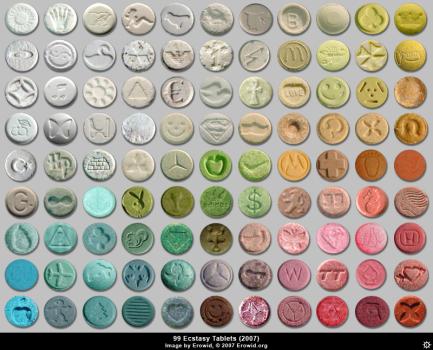
Ecstasy tablets (wikimedia.org)
Correa's remarks came as she announced the formation of the advisory commission.

Currently in Colombia, people are not prosecuted for the possession of small amounts of marijuana and cocaine. She said the proposal would extend that protection to users of synthetic drugs like methamphetamine and ecstasy.

"The proposal aims to standardize the amount of drugs already permitted, while also allowing an equivalent quantity of synthetic drugs," she said. "We have to accept that Colombia is a consumer country -- this is also our reality -- and being a consumer country, we can't just throw drug users in jail, but we must look after them. I don't see the risk in establishing a personal use amount of synthetic drugs, since we are only trying to clarify things to achieve treatment for addicts and users, not to send them to prison."

Colombian constitutional court rulings have established a right to possess personal use amounts of drugs, but the government has not established what those personal use amounts of synthetic drugs are. The advisory commission will do that. The government of President Santos has also embarked on a more than rhetorical shift toward a public health approach to drug use, and Correa emphasized that in her remarks.

"We are convinced that drug policy should be designed with a holistic approach, involving families, the education system, the public health specialists, development practitioners and community leaders," she said.

Not everyone agrees with the move. Former President Alvaro Uribe, who tried repeatedly to undo those Colombian court rulings legalizing drug possession, came out swiftly against including the synthetics.

"With this personal use amount, what they are doing is validating the actions of the dealers and not taking them to prison, nor are they taking the addicts to the hospital," he complained. Decriminalizing the synthetics would only "further enslave the youth and drug more assassins to kill more people," he claimed.

Bogota
Colombia

New Hampshire Marijuana Legalization Bill Filed

A bipartisan group of five legislators has introduced legislation to legalize marijuana possession in New Hampshire.

The bill, House Bill 492, would legalize the possession of up to an ounce by adults 21 and over and allow the cultivation of a limited number of plants by adults. It would also allow for licensed and regulated marijuana commerce.

The measure has majority support in the state, but just barely. A Public Policy Polling survey earlier this month found 53% supported changing state law to regulate marijuana alike alcohol, with 37% opposed.

The Granite State is only one of at least six states where legislators have filed or will file marijuana legalization bills this year. The others are Hawaii, Massachusetts, Rhode Island, Pennsylvania, Rhode Island, and Vermont.

Concord, NH
United States

It Looks Like 2016 for a Marijuana Legalization Bid in California [FEATURE]

If the first day of the California NORML state conference is any indication, most of the major players in Golden State marijuana law reform are lining up behind the idea of waiting until 2016 to try another legalization initiative there. They have some good reasons, but not everybody's happy with that, and some heart-rending reasons why that's the case were also on display as California marijuana activists gathered in San Francisco for day one of the two-day event.

Stephen Gutwillig, Dale Gieringer, Paul Armentano
Richard Lee's groundbreaking Proposition 19 garnered 46.5% of the vote in the 2010 off-year election, and no marijuana legalization initiative campaigns managed to make it onto the ballot last year, although several groups tried. Meanwhile, Colorado and Washington beat California to the Promised Land, becoming the first states to legalize marijuana in last November's election.

Now, California activists are eager to make their state the next to legalize, but crafty movement strategists are counseling patience -- and trying to build their forces in the meantime. The Prop 19 campaign made a strong beginning, bringing in elements of organized labor and the black and Hispanic communities, as well as dissident law enforcement voices, to help form a coalition that came close, but didn't quite make it.

As CANORML deputy director Ellen Komp reminded the audience at a Saturday morning panel on what comes next for marijuana law reform, the people behind the Proposition 19 campaign have formed the core of the California Coalition for Cannabis Policy Reform in a bid to forge unity among the state's diverse, multi-sided, and sometimes fractious marijuana community -- and to encourage new voices to join the struggle.

For the Marijuana Policy Project, California is a big prize, but only part of a broader national strategy, and one that should most likely wait for 2016, said the group's executive director, Rob Kampia, as he explained its plan to push legalization bills in state legislatures in four states (Hawaii, New Hampshire, Rhode Island, Vermont) this year and beyond, but not pushing legalization initiatives anywhere but Alaska in 2014.

MPP is envisioning a big legalization initiative push in 2016 instead, setting its sights on seven states, including California, when the presidential election pumps up the vote. (The others are Arizona, Massachusetts, Maine, Montana, Nevada, and Oregon.)

"There's a big demographic difference between 2014 and 2016," said Kampia. "If we do 2016, it's ours to lose."

The Drug Policy Alliance, another major player with access to the big-time funding that can turn an initiative into a winner, also seemed to be looking to 2016.

"It's up to us how, where, and when marijuana prohibition will end," Steve Gutwillig, a DPA deputy executive director and former California state director told the full house at the Ft. Mason Conference Center, "but the presumption is 2016, more than 2014. We need to run a unified campaign, we need to build the base and do alliance-building among people who are already convinced."

spontaneous fundraiser for Daisy Bram
Those positions are in line with the thinking of long-time CANORML head Dale Gieringer, who has long argued that initiatives fare better in presidential election years.

Even some of the proponents of the competing initiatives from last year are, while not exactly enthusiastic about waiting for 2016, are seemingly resigned to it.

Steve Collette, who was a proponent of the Regulate Marijuana Like Wine initiative, told the Chronicle he would prefer 2014, but could get behind 2016, too, while Sebastopol attorney Omar Figueroa, coauthor of the Repeal Cannabis Prohibition Act initiative, implied in his remarks in a later panel that he, too, was resigned to waiting for 2016.

Noting the confused state of California's medical marijuana laws -- "Nobody knows what the laws are!" -- Figueroa argued for either legislative action or a 2014 medical marijuana initiative "until a legalization initiative in 2016."

Not everyone was as ready to give up on 2014 just yet. Displeased grumblings were heard in the hallways, and an earnest advocate for the Herer-ite California Cannabis Hemp Initiative 2014 took advantage of a post-panel question-and-answer opportunity to declaim in support of it.

The most powerful and visceral opposition to waiting came in the form of Daisy Bram, a mother of three young children and legal medical marijuana grower. Bram became a symbol of the cruelty of pot prohibition last year, when local authorities in rural Butte County raided her grow, seized her children and place them in foster care, and filed criminal charges against her.

Despite being counseled to comply with the demands of Child Protective Services officials in order to secure the return of her children, one of whom was quite literally torn from her arms, Bram fought back and eventually won the return of children. But just this past week, it happened again. Another raid in another county -- although led by the same investigator -- has resulted in new criminal charges and her children once again being taken by the state.

Omar Figueroa, Michael Levinsohn, Daisy Bram
"My kids need you," she told the hushed crowd. "If it were legal, they wouldn't have my kids."

Daisy Bram doesn't want to wait until 2016 for marijuana to be legalized, she wants it yesterday, and she wants justice, and, most of all, she wants her children back in her arms. Her brief presentation at a panel Saturday afternoon was chilling, impassioned, and powerful, and visibly moved many in the audience.

[Update: CANORML reported Wednesday that at a family court appearance the previous day in her Tehama County case, the state authorities who are already seized her children seized her personal vehicle, a 2002 Ford Explorer, which they claim was the proceeds of crime.]

And while California is a state where just about anyone can get a medical marijuana card and possession of under an ounce is decriminalized, the case of Daisy Bram makes the uncomfortable point that marijuana prohibition continues to exact a real toll on real people, including the innocent. It's not just mothers labeled child abusers because the grow pot; it's also fathers denied visitation, patients thrown out of public housing, workers who must choose between their medicine and their jobs.

It's a bit easier to be sanguine about waiting until 2016 when you're not the one being bitten by those lingering vestiges of prohibition. As Komp put it when introducing Bram, until there is legalization, "there is a lot of human rights work to be done."

San Francisco, CA
United States

Is It Time for Another DC Marijuana Initiative? [FEATURE]

In the wake of the legalization victories in Colorado and Washington last November, and medical marijuana in Massachusetts, activists are talking about where the next marijuana reform campaigns should be waged and what they should attempt to do. One document that has gotten some discussion is from the Marijuana Policy Project (MPP), listing seven states where it would be working to legalize marijuana next. The list includes possible tax and regulate initiatives in Alaska, California, Maine, Massachusetts, Nevada and Oregon.

DC's partial diamond (map from census.gov)
Absent from the list is one jurisdiction that would also appear ripe for a legalization initiative: Washington, DC. The nation's capital has several things going for it.

DC has the initiative process, and activists used it to great effect in passing medical marijuana with 69% of the vote in 1998 (even if, thanks to Congressional action and the glacial pace of the DC government it has taken 15 years to implement it). The District is also overwhelmingly liberal; Obama won with 91% of the vote in November.

Unlike large states like California, the District is small in size and population and would not require a huge expenditure of resources to gather enough signatures to make the ballot. Similarly, it is a relatively small media market, meaning TV advertising would be in reach of all but the most ill-funded campaign.

Last, but not least, it is the nation's capital. A successful initiative in Washington, DC, would reverberate not only around the country, but around the world, particularly an initiative that enacted legalization..

MPP may not have included the District in its "to do" list, but that doesn't mean the organization isn't watching, said the organization's director of governmental relations, Steve Fox.

"[DC] is being discussed," said Fox. "When you look at the places where an initiative would be possible, the District stands out. One reason we didn't mention it is that it’s a jurisdiction where we're not necessarily looking at tax and regulate, but there are options to do less, such as a decriminalization initiative."

The problem of congressional interference is cause for concern, though, Fox said.

"DC certainly is ripe for some kind of reform, but we also have to be cognizant of the fact that it is unique in that it has congressional oversight," Fox said. "With the medical marijuana system finally getting off the ground, we don't necessarily want to ruffle any feathers by attempting to do anything too bold. When the medical marijuana initiative passed in 1998 and Congress wanted to mess with it, they ended up having a provision something along the lines of DC not being able to spend any funds to lower or reduce penalties related to any schedule I or II substances. If Congress thought DC was going too far too fast, it could block DC from spending any money for reforms of Schedule I substances."

Doing DC would be tempting, said Fox, but again worried about moving too fast for Congress.

"There would certainly be value in passing something in the District," he mused. "You would be making a statement that a strongly Democratic-leaning jurisdiction thinks marijuana should be regulated like alcohol, but that might not be big news to a lot of people. The real impact and real value would be to actually have a regulated market in operation, and members of Congress could see that the sky isn't falling. We've waited 15 years to show Congress you can have medical marijuana dispensaries up and running and serving patients and the public good, and we want to make sure Congress has a chance to absorb that reality."

"As a longtime DC resident, I've always thought of the District as low-hanging fruit," said Allen St. Pierre, executive director of NORML, who expressed interest in an initiative. "The media market is limited, and there is an overwhelmingly liberal population. But we don't even have a NORML chapter here, and I see little impetus in the reform community."

But things are happening in the District, according to long-time activist Adam Eidinger, co-owner of the Capitol Hemp Emporium until it was forced to close under law enforcement pressure last year. Eidinger told the Chronicle that both legalization and medical marijuana activists were meeting to plot potential courses of action, including either a legalization initiative or an initiative to expand medical marijuana rights.

"We're thinking 2014," said Eidinger, "but while I think this is a no-brainer, it has to be poll tested. We're not going to go for it if it polls less than 65%. "We will poll medical as well as legalization and see what the difference is. I know some of our friends wouldn't support legalization, but would support a patients' rights initiative that would give them the right to grow limited amounts, more rights to use outside the home, and more flexibility on dispensaries. This isn't California; DC is super strict on medical marijuana, and the patients here are going to be AIDS patients and cancer sufferers."

Test polling will happen soon, he said.

Eidinger, who also runs a media consulting firm, also saw the potential for a media coup. "This is a great place to do it for the public relations value," he said.

MPP's Fox said the group was looking for a few good people.

"As MPP did in Colorado and with medical marijuana in Arkansas, what we look for are committed and competent people on the ground who are able to do this kind of work," Fox said. "We're looking to support good people. I coordinate ballot initiatives, and I'm in DC, and so are other activists. I would be happy to work with local activists to craft something."

"The symbolism alone would probably be worth it," said St. Pierre. "It probably wouldn't cost more than $15,000 or $20,000 to get it done. This is a low cost project with a huge potential upside."

If recent comments from DC elected officials are any indication, further marijuana law reform is only going to come through the initiative process. While one city council candidate, Paul Zuckerberg, is running on a platform that includes decriminalization, the mayor and other top officials have made clear they are not interested in going further.

"I'm not prepared at this stage to support the decriminalization of any drugs at this point," Mayor Vincent Gray said earlier this month. "Look at the most abused substance in our society, and it's probably alcohol. People do abuse, irrespective of whether it's legal or not."

Police Chief Cathy Lanier also expressed unease, although her comments did suggest she drew a line between marijuana and other drugs.

"I know the legalization of marijuana is in large debate around the country, whether it be medical marijuana or just straight-out legalization of marijuana. That's one issue," Lanier said. "But I think when you talk about some of these other drugs that are extremely dangerous -- PCP, for example -- to say that we should decriminalize that and just allow people to have that without any penalty in the community would just be devastating."

With the DC council unlikely to advance reform, that leaves the field open to potential initiative campaigns. The District is most likely ripe for the picking, if anyone decides to go that route.

Washington, DC
United States

Drug War Issues

Criminal JusticeAsset Forfeiture, Collateral Sanctions (College Aid, Drug Taxes, Housing, Welfare), Court Rulings, Drug Courts, Due Process, Felony Disenfranchisement, Incarceration, Policing (2011 Drug War Killings, 2012 Drug War Killings, 2013 Drug War Killings, Arrests, Eradication, Informants, Interdiction, Lowest Priority Policies, Police Corruption, Police Raids, Profiling, Search and Seizure, SWAT/Paramilitarization, Task Forces, Undercover Work), Probation or Parole, Prosecution, Reentry/Rehabilitation, Sentencing (Alternatives to Incarceration, Clemency and Pardon, Crack/Powder Cocaine Disparity, Death Penalty, Decriminalization, Drug Free Zones, Mandatory Minimums, Rockefeller Drug Laws, Sentencing Guidelines)CultureArt, Celebrities, Counter-Culture, Music, Poetry/Literature, Television, TheaterDrug UseParaphernalia, ViolenceIntersecting IssuesCollateral Sanctions (College Aid, Drug Taxes, Housing, Welfare), Violence, Border, Budgets/Taxes/Economics, Business, Civil Rights, Driving, Economics, Education (College Aid), Employment, Environment, Families, Free Speech, Gun Policy, Human Rights, Immigration, Militarization, Money Laundering, Pregnancy, Privacy (Search and Seizure, Drug Testing), Race, Religion, Science, Sports, Women's IssuesMarijuana PolicyGateway Theory, Hemp, Marijuana -- Personal Use, Marijuana Industry, Medical MarijuanaMedicineMedical Marijuana, Science of Drugs, Under-treatment of PainPublic HealthAddiction, Addiction Treatment (Science of Drugs), Drug Education, Drug Prevention, Drug-Related AIDS/HIV or Hepatitis C, Harm Reduction (Methadone & Other Opiate Maintenance, Needle Exchange, Overdose Prevention, Safe Injection Sites)Source and Transit CountriesAndean Drug War, Coca, Hashish, Mexican Drug War, Opium ProductionSpecific DrugsAlcohol, Ayahuasca, Cocaine (Crack Cocaine), Ecstasy, Heroin, Ibogaine, ketamine, Khat, Marijuana (Gateway Theory, Marijuana -- Personal Use, Medical Marijuana, Hashish), Methamphetamine, Nicotine, Prescription Opiates (Fentanyl, Oxycontin), Psychedelics (LSD, Mescaline, Peyote, Salvia Divinorum), Synthetic Drugs (Mephedrone, Synthetic Cannabinoids)YouthGrade School, Post-Secondary School, Raves, Secondary School