Federal Prosecutor Drops Medical Marijuana Charges

Some interesting news from New Mexico:

On June 30, 2009 in the Federal District Court of New Mexico, Assistant US Attorney John Anderson agreed, on the record, to Honor the Medical Marijuana Recommendation of Charles Smith of Shasta Lake, California. Federal District Court Magistrate Judge Lorenzo Garcia further agreed to accept the State’s proposed recommendation of a Conditional Discharge upon provision of Mr. Smith’s Medical Marijuana Recommendation to the US Attorney’s office. This historic moment occurred during the federal Government’s prosecution of cases related to the Annual Rainbow Gathering that occurs in different states around the country and involves a large Federal Law Enforcement presence.
…
This is the first time in modern history, in which it is known that the US Attorney and the Federal District Court agreed to accept medical marijuana recommendations and licenses in order to dismiss marijuana possession charges.

And the universe didn’t collapse. Not only that, the story has gotten no press whatsoever. Often, when the government refrains from doing something cruel to someone, there isn't much of a news story left to report. This just goes to show how silly it is to assume that there's a political imperative requiring us to continue aggressively enforcing bad drug laws. There isn’t.

See how easy it is to just leave patients alone? Next time, try not arresting them in the first place.

A Deadly Addiction You Never Saw Coming

BBC News reports on the death of a Chinese teen who was beaten to death in a rehab center for internet addicts. Apparently, addiction to the internet is a major concern in China:

China is increasingly taking action against what it sees as a pandemic of web addiction.

Some estimates suggest up to 10% of the country's 100 million teenage web users could be addicted, and a growing number of rehabilitation services exist.

However, there is little consensus on how to treat the addiction. In July, China's Ministry of Health formally banned the use of electroshock therapy as a treatment option.

Well, that's good. Yeah, giving shock treatment to 10 million youth who spend too much time online definitely sounds kind of insane. Really, the whole idea of widespread internet addiction sounds pretty ridiculous and I'm inclined to assume it has more to do with a cultural paranoia about computers than an actual epidemic of compulsive web surfers.

But as crazy as all this sounds, it's really not all that different from the way our government deals with marijuana users.

Marijuana is Safer Than Viagra

Is there anything it can’t do?

A fifty-five year old man has confessed to using marijuana in order to sexually please his wife.

Bal Birju was charged with possession of thirty grammes of marijuana.

In court he said he preferred to use the marijuana rather than the popular Viagra which can be dangerous. [i995fm]

Makes sense to me. Unfortunately, we're reminded once again of the one indisputable risk associated with using marijuana: they'll put you in jail for it.

"Marijuana Is Safer" authors Tvert and Armentano appear at Oaksterdam University

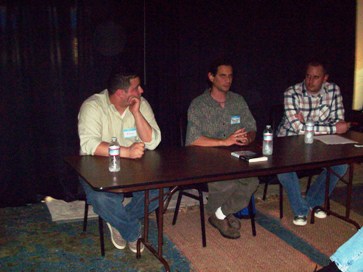
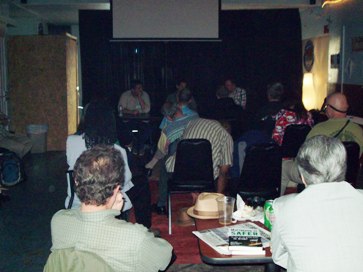
The student union at Oaksterdam University in downtown Oakland was buzzing yesterday afternoon as several dozen people gathered together with Marijuana is Safer authors Paul Armentano of NORML and Mason Tvert of SAFER to celebrate the brand new book's release. (Co-author Steve Fox of MPP was on the East Coast. The book also boasts a foreword by Norm Stamper, the former police chief of Seattle.) After an hour or so of schmoozing, book selling, and signing, Armentano and Tvert were joined by Oaksterdam's Greg Grimala for an informal discussion about the book, whose thesis--that marijuana is safer than alcohol--is an outgrowth of work originally done by Tvert as he organized college campuses around the issue of inequality in punishments for students got smoking pot as opposing to underage drinking. Armentano, who has been keeping a keen eye on marijuana research for years, supplies much of the hard science. "The fact that we're even having this discussion is a measure of marijuana's relative harmlessness," Tvert pointed out, adding that he thought the alcohol vs. marijuana comparison was an excellent tactic. "Parents can understand alcohol, and we can make the comparison between it and marijuana. Within that framework, you get them to start thinking about marijuana the same way they think of alcohol. The discussion of alcohol provides a reference point, and that will only further the debate." Tvert will be hitting the road to promote the book in coming weeks. Armentano said yesterday the book was shipping to bookstores in the East now and would be showing up on the West Coast soon. He also said he had directed that a review copy be sent to StoptheDrugWar.org, so look for a book review here next week. (The Chronicle is on vacation this week.) Tvert, Armentano, Grimala