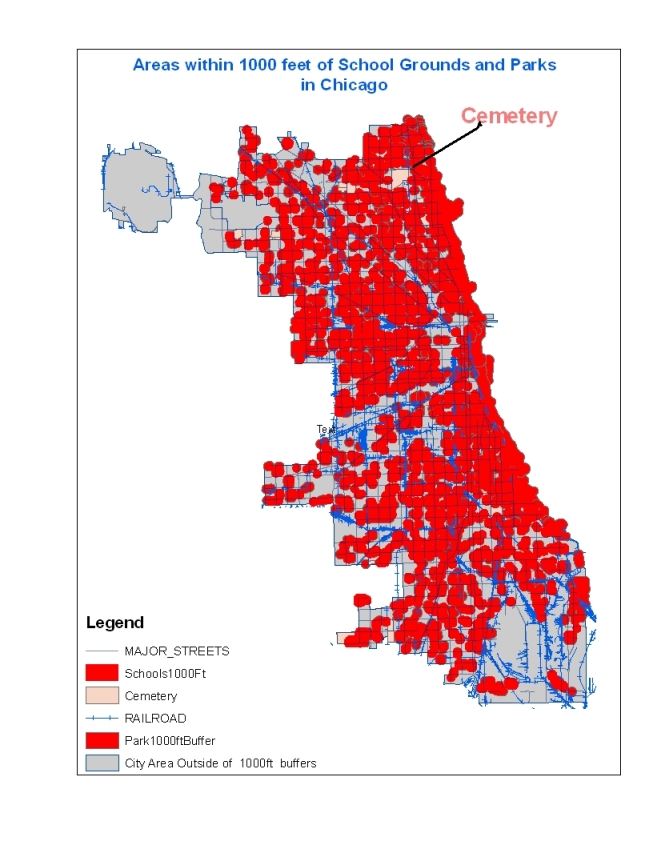
1000 Feet from Everywhere

One of the articles we are finalizing for publication in Drug War Chronicle tonight deals with needle exchange, and the state of legislation in Congress to end the ban on use by states of federal AIDS funds to support needle exchange programs. A bill has passed the House of Representatives -- good news -- but it includes a provision that would render it nearly useless. This provision would require that needle exchange programs receiving federal funds not operate "within 1,000 feet of a public or private day care center, elementary school, vocational school, secondary school, college, junior college, or university, or any public swimming pool, park, playground, video arcade, or youth center, or an event sponsored by any such entity." I'm not sure how any program could track where all the different such entities decide to hold events. More importantly, the rule would basically prevent needle exchanges from operating at all, because the area encompassed is pretty much everywhere inside any city. Dr. Russell Barbour, at Yale School of Medicine's Center for Interdisciplinary Research on AIDS, has produced several charts that advocates are using now on the Hill, illustrating the impact the provision would have on AIDS prevention efforts in Chicago and San Francisco. He graciously provided them to us. Check them out here: (more below the fold)

Drug Czar's Office Re-evaluating Marijuana Policy: "We're trying to base stuff on the facts"

There's a new spokesman at the drug czar's office and I'm kinda liking him so far:

Doug Richardson, a spokesman for the White House's Office of National Drug Control Policy, said the office is in the process of re-evaluating its policies on marijuana and other drugs.

Richardson said the office under Obama was pursuing a "more comprehensive" approach than the previous administration, with emphasis on prevention and treatment as well as law enforcement.

"We're trying to base stuff on the facts, the evidence and the science," he said, "not some particular prejudice somebody brings to the table." [AP]

Yeah, yeah, I know, it's all a bunch of feel-good political pandering that means little if anything in terms of actual meaningful policy change. But think about the fact that the drug czar's office is now constantly and rather blatantly pandering to people who don't like the drug war. That's the target audience for this kind of language and it's awfully refreshing to finally find them on the defensive.

Really, all this talk about basing everything on science from now on is a rather huge rebuke of the people who ran the office during the Bush Administration. The current ONDCP is going around basically suggesting that our drug policy wasn't based on facts before. To even suggest such a thing raises rather fundamental questions surrounding the legitimacy of every drug war strategy that was employed prior to 2009. Surely, that's not what they mean, but I'd love to hear a reporter follow up on this and ask for examples of non-science-based drug policy for the sake of comparison.

No matter how you interpret it, this sort of rhetoric from the drug czar's office is yet another powerful testament to the progress of our movement. We've made the issue so controversial that the new drug warriors are afraid to be associated with the old ones.

Hearings on Massachusetts "Tax and Regulate" Bill in Boston Next Week

On Wednesday, October 14, 2009, at 10:00am in Room B2 at the State House in Boston, the Joint Committee on Revenue in the Massachusetts legislature will hold a public hearing on bill H. 2929, An Act to Regulate and Tax the Cannabis Industry. If passed, the new law would repeal existing marijuana prohibition laws at the state level and replace them with a system of regulation and taxation, similar to how wine is sold. The law, in fact, is largely modeled after the alcohol control laws. According to Northampton attorney Richard M. Evans, a former DRCNet board member and the petitioner whose Representative presented the bill, Wednesday will mark the first time a state legislature has considered a full legalization bill. The moment is also propitious because Massachusetts this year implemented its new, voter-enacted decriminalization law, and because Gov. Deval Patrick, while not prioritizing it, is on the record as being very comfortable with the idea of legalizing marijuana. So while we don't expect that H. 2929 will be enacted this year, it is a rare and important opportunity to forward the debate on alternatives to prohibition. And you can help: by showing up Wednesday if you can; by spreading the word and getting others to come out; by suggesting to your local newspaper that they cover the hearing; and by contacting your state legislators to express your support for H. 2929. Directions to the State House are available here. Please let us know what you're able to do to support H. 2929, and visit http://www.cantaxreg.com for further information about it. Visit http://www.masscann.org to find out about extensive activist opportunities in Massachusetts.