Latest
Latest News
Latest News
Event
Townhall Meeting to Support Clarence Aaron
Townhall Meeting to Support Clarence Aaron, Serving 3 Life Sentences for a First-Time, Non-Violent Drug Law Violation
In The Trenches
Marijuana Policy Projectâs 15th Anniversary Gala to Celebrate â15 States in 15 Yearsâ

FOR IMMEDIATE RELEASEÂ Â Â Â Â Â Â Â Â Â Â Â Â Â Â Â Â Â Â Â Â Â Â Â Â Â Â Â Â Â Â Â Â Â Â Â Â Â Â Â Â Â Â Â Â Â Â Â Â Â Â Â Â Â Â Â Â Â Â Â Â Â Â Â Â Â Â Â Â Â Â Â Â Â Â Â Â Â Â Â Â Â Â Â Â Â Â Â Â Â Â Â Â Â Â Â Â Â Â Â Â Â Â Â Â Â Â Â Â Â Â Â Â Â Â Â Â Â Â Â Â Â Â Â Â Â Â Â Â Â Â
NOVEMBER 19, 2009
Marijuana Policy Projectâs 15th Anniversary Gala to Celebrate â15 States in 15 Yearsâ
Celebrity guests and other prominent figures will help celebrate MPPâs remarkable passage of improved marijuana laws in 15 states in 15 years
CONTACT: Mike Meno, MPP assistant director of communications â¦â¦ 202-905-2030 or [email protected]
WASHINGTON, D.C. â The Marijuana Policy Project, Americaâs largest marijuana policy reform organization, will look back on 15 productive years of improving marijuana laws at a January 13 gala that will feature guest speakers such as talk show host Montel Williams. The star-studded host committee includes Melissa Etheridge, Tom Robbins, Bill Maher, Ben Taylor, Steve Buscemi, Susan Sarandon, Lewis Black, Nicole Atkins, Margaret Cho, Mark Leno, Hal Sparks, Ani DiFranco, Garry Trudeau, and Medeski, Martin and Wood, along with many other prominent supporters. Â Â Â Â
        When MPP was founded in 1995, medical marijuana was illegal in all 50 states. Since then, 13 states have passed medical marijuana laws, with Michigan becoming the 13th state in November 2008, when Michigan voters passed MPP's ballot initiative by a 63% to 37% margin. By the end of 2010, MPP is hopeful that medical marijuana will be legal in 15 states (with passage in New York and New Jersey).
        At the same time, marijuana possession is now decriminalized in 13 states, with Massachusetts becoming the 13th state in November 2008, when Massachusetts voters passed MPP's ballot initiative by a 65% to 35% margin. In 2010, MPP is hopeful that marijuana will be decriminalized in 15 states (with Rhode Island and Vermont becoming the 14th and 15th states).
        WHAT: The Marijuana Policy Projectâs 15th Anniversary Celebration
        WHEN: January 13, 2010. Press Availability from 6:00 to 6:30 p.m.
                       Reception from 6:30 â 7:30 p.m. Dinner from 7:30 to 11:00 p.m.
        WHERE: Hyatt Regency Washington on Capitol Hill, 400 New Jersey Avenue, NW, 20001
        Tickets cost $250 each, or $2,000 for a table.
        With more than 29,000 members and 100,000 e-mail subscribers nationwide, the Marijuana Policy Project is the largest marijuana policy reform organization in the United States. MPP believes that the best way to minimize the harm associated with marijuana is to regulate marijuana in a manner similar to alcohol. For more information, please visit http://MarijuanaPolicy.org.
####
Latest News
Blog
Drug Czar's Website Still Wrong About AMA's Medical Marijuana Stance
Unfortunately, the DEA isnât the only drug war apparatus that's dragging its heels when it comes to acknowledging the American Medical Association's new position on medical marijuana. The drug czar's website still offers a document entitled "What Every American Should Know About Medical Marijuana," (PDF) which includes this passage:
Major public health organizations do not support smoking marijuana as medicine.
The National Multiple Sclerosis Society, the American Medical Association and the American Academy of Ophthalmology all oppose the smoked form of marijuana as medicine...
So, if the drug czar thinks "every American should know" about AMA's position on medical marijuana, will he now inform Americans that the position has changed? Somehow I doubt it, but at the very least, this now-false claim that AMA opposes medical marijuana should be removed immediately.
Let me be clear about this too, because I donât want anyone thinking this is just some smug campaign to rub AMA's new position in the face of drug warriors all over the web. This document, "What Every American Should Know About Medical Marijuana," is a dreadful Bush-era hatefest that positively drips with outrageous & out-of-context propaganda points and should have been tossed from the site back in January, along with all the other rancid garbage John Walters left in the fridge at ONDCP.
This document even contains the unbelievable Steve Kubby smear, in which Kubby's statements about Marinol saving his life in prison were spun as opposition to medical marijuana (I highly recommend revisiting that one if you donât remember it, because it's so much worse than I can even describe in one sentence). And this isn't some dusty artifact I dug up from the cavernous bowels of ONDCP.gov either, it is currently the #1 search result for "medical marijuana" on the drug czar's website.*Â
So please join me in sending the drug czar a note asking that this outdated and offensive document be removed from his site once and for all. Whether it's because the reference to AMA is no longer accurate, or because the rest of the thing in its entirety is just a raging trainwreck of distortion and nastiness, or because the new administration has pledged to respect state medical marijuana laws instead of vilifying doctors and patients, this type of rhetoric has no place in the drug policy debate.
Please contact the drug czar today to ask that the document "What Every American Should Know About Medical Marijuana" be permanently removed from ONDCP.gov. Thanks.
*Update: Interestingly, the document is now much more difficult to find on the ONDCP website. Last night, it came up #1 in a search for "medical marijuana." Now I can only locate it by using more specific search terms. Hopefully, this signals that it's in the process of being removed, although the PDF is currently still being hosted by ONDCP.
Update 2: Our friends at LEAP have created an action alert where you can send a pre-written message to DEA & ONDCP requesting the necessary corrections.
Blog
DEA Website STILL Wrong About AMA's Medical Marijuana Stance
Last week's big news that the American Medical Association reversed its position on medical marijuana struck a huge blow to the reefer madness crowd, which has heavily touted the esteemed organization's past position as a primary excuse for prohibiting medical use. Yesterday, the DEA finally revised its website after LEAP and MPP pointed out that AMA was still listed as an opponent of medical marijuana.
Rarely, if ever, has the DEA responded so quickly and cooperatively when activists complained about the accuracy of government anti-drug propaganda. But, the job isn't done just yet. It seems the clever folks at DEA took our complaints literally, and only fixed the page we mentioned, rather than making all the necessary corrections.
DEA's youth website, JustThinkTwice.com, still contains two separate inaccurate statements about AMA's position on medical marijuana:
Rarely, if ever, has the DEA responded so quickly and cooperatively when activists complained about the accuracy of government anti-drug propaganda. But, the job isn't done just yet. It seems the clever folks at DEA took our complaints literally, and only fixed the page we mentioned, rather than making all the necessary corrections.
DEA's youth website, JustThinkTwice.com, still contains two separate inaccurate statements about AMA's position on medical marijuana:
http://www.justthinktwice.com/factfiction/MarijuanaisMedicine.cfm"The American Medical Association has rejected pleas to endorse marijuana as medicine, and instead has urged that marijuana remain a prohibited, Schedule I drug, at least until more research is done."
http://www.justthinktwice.com/stumbleweed/rx_pot_01.htm
"The American Medical Association rejected marijuana as medicine."
Of course, it's quite likely that similar claims can still be found elsewhere on DEA websites and it's their responsibility to clean up the mess. Hopefully, DEA is more familiar with its own web content than we are, so it shouldnât be too hard to go through there and set everything straight.
Let's all do our part to help DEA with the editing process by copying the links above and clicking here (then scroll down) to send them a reminder that more corrections are needed. When it comes to providing the public with accurate and up-to-date information about drugs, the DEA is in desperate need of our asistance, so please take a few moments to lend them a hand.
Update: Our friends at LEAP have created an action alert where you can send a pre-written message to DEA & ONDCP requesting the necessary corrections.
In The Trenches
Press Release: California Budget Deficit Balloons, While Prisons on Schedule to Overspend by $1.4 Billion
FOR IMMEDIATE RELEASE: November 18, 2009
CONTACT: Margaret Dooley-Sammuli at (213) 291-4190 or Stephen Gutwillig at (323) 542-6510
California Budget Deficit Balloons, While Prisons on Schedule to Overspend by $1.4 Billion
Advocates Condemn Sacramentoâs Priorities: âCaliforniaâs Incarceration Spending Locks Up Our Tax Dollarsâ
SACRAMENTO â The nonpartisan Legislative Analystâs Office announced today that it expects the California state budget deficit to exceed $20 billion by the end of the 2010-11 fiscal year, and that the state will spend $1.4 billion more on prisons than was budgeted in 2009-10. Advocates criticize the state for failing to make real cuts to prison spending, while enacting brutal cuts to important social services.
âCaliforniaâs prison spending is totally out of whack and itâs locking up tax dollars that now arenât available for education and other community services like fire protection and elder care,â said Margaret Dooley-Sammuli, deputy state director for the Drug Policy Alliance in Southern California. âOther states, like New York, have reduced their crime rates and their prison populations at the same time. California should follow their lead.â
The Legislature and governor approved $1.2 billion in unallocated cuts to the California Department of Corrections and Rehabilitation (CDCR) in late July. On September 11, the Legislature sent a bill to the governor that would realize just $200-300 million in cuts. According to the LAOâs report, prison spending will exceed its 2009-10 budgeted level by $1.4 billion.
âSacramento said that it would cut prison spending by $1.2 billion â but that was a lie. That should come as no surprise; the prisons have overspent their budget by hundreds of millions of dollars in each of the past several years,â Dooley-Sammuli continued. âWith the state near fiscal collapse, this just wonât do any longer. Prisons, like other resources, should be used wisely. They simply arenât the right place for people convicted of petty offenses, particularly low-level, non-violent drug law violations.â
According to the CDCR, over 30,000 people are locked up in California state prisons for a non-violent drug offense â at a total cost of $1.5 billion per year. Instead of reducing costs by addressing the number of people incarcerated for petty drug offenses, however, the state recently announced that it would cut by 70% the amount of drug treatment offered behind bars and by 40% the amount of drug treatment offered on parole.
The LAO report is online at: http://www.lao.ca.gov/laoapp/PubDetails.aspx?id=2143
# # #
In The Trenches
Press Release: NJ Senate Comm. to Vote on Reforming Mandatory Minimum Drug Laws
FOR IMMEDIATE RELEASE: November 18, 2009
CONTACT: Tony Newman at 646-335-5384 or Roseanne Scotti at 609-610-8243
NJ Senate Judiciary Committee to Vote Monday on Groundbreaking Sentencing Bill that Would Give Judges the Discretion to Waive Mandatory Minimum Sentences for Some Nonviolent Drug Offenses
Advocates Commend Legislation as Common-Sense and Reasonable Reform that Would Increase Fair and Effective Sentencing and Save Taxpayer Money
On Monday, November 23, the Senate Judiciary Committee will consider Senate Bill 1866, which would give judges the discretion to waive mandatory minimum sentences for some nonviolent drug offenses. The Assembly passed the companion legislation, A2762, last year and Gov. Jon Corzine has said he will sign the bill when it gets to his desk. This critically important legislation would be a groundbreaking first step in reforming New Jerseyâs draconian sentencing laws for nonviolent drug offenses.
Roseanne Scotti, director of Drug Policy Alliance New Jersey, applauded the committeeâs willingness to consider the bill and urged passage.
âTwenty years ago, New Jersey began implementing harsh mandatory minimum sentences for nonviolent drug offenses. These laws have been a spectacular failure. They have done nothing to decrease drug activity and have filled New Jerseyâs prisons with nonviolent drug offenders at great cost to New Jersey taxpayers,â said Scotti.
It costs New Jersey taxpayers more than $46,000 a year to incarcerate an individual and New Jersey spends about $331 million a year just to incarcerate nonviolent drug offenders. Allowing judges some discretion would guarantee that justice is done and that taxpayer dollars are not wasted. At a time when New Jersey is facing serious budget deficits and cutting spending on education, health and other critical programs, advocates say New Jersey needs to take a hard look at policies that have mandated the warehousing of large numbers of nonviolent drug offenders at enormous cost to taxpayers.
S1866/A2762 is supported by a broad coalition of organizations including Volunteers of American Delaware Valley, Corporation for Supportive Housing, New Jersey Association on Correction, New Jersey Institute for Social Justice, Coalition of Community Corrections Providers of New Jersey, Women Who Never Give Up, Families Against Mandatory Minimums, Hispanic Directors Association and Latino Leadership Alliance. Recently, both the Newark and Camden City Councils passed resolutions supporting S1866.
When New Jersey adopted the Comprehensive Drug Reform Act in 1986, the state ushered in a radical era of harsh mandatory minimum sentences for nonviolent drug offenses. This led to unprecedented levels of incarceration and massive taxpayer expenditures. These unfair and ineffective laws have also had an egregiously disproportionate impact on communities of color.
⢠In 1987, only 11 percent of the New Jersey prison population was incarcerated for drug offenses. Today, 29 percent of the prison population is incarcerated for nonviolent drug offenses.
⢠Twenty years ago, only 11 percent of individuals in prison were serving mandatory minimum sentencesâtoday 69 percent are serving mandatory terms.
⢠In the last twenty years, New Jerseyâs Corrections budget has risen from $289 million to $1.3 billion.
⢠New Jersey spends $331 million a year to incarcerate individuals for nonviolent drug offenses.
⢠The budget for corrections has grown by a factor of 13 while the overall budget grew only by a factor of six.
⢠In the 1980s and 1990s, the Corrections budget grew at three times the rate of the budget for education.
⢠Although African Americans and Latinos account for just 27 percent of the population of New Jersey, they represent 81 percent of the prison population.
# # #
Blog
Nice People Take Drugs
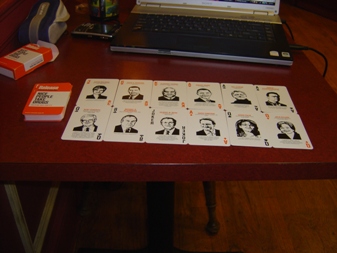
In June we highlighted a bus advertising campaign, "Nice People Take Drugs," conducted by the British drug reform advocacy group Release. Some of the nice people from Release attended the big drug policy conference in Albuquerque last week, and they were nice enough to give us one of their new "Nice People Take Drugs" decks of playing cards, featuring politicians from the US, UK and elsewhere and the quotes they've given about their past drug use. (Whether all of the featured politicians are nice people is a subjective question, of course.) The front of the cards feature the organization's web site and a toll-free helpline, hard to see in the picture (0845 4500 215 if you're in Britain and need the help).
Albuquerque's "British Invasion" also featured the Transform Drug Policy Foundation's new publication, After the War on Drugs: Blueprint for Regulation. Check Drug War Chronicle later this week for a conference report highlighting this and more.
Here's a sampling of the Release cards:
 Last but not least, for now, a picture I snapped during the conference's closing plenary, former New Mexico Governor Gary Johnson delivering the keynote:
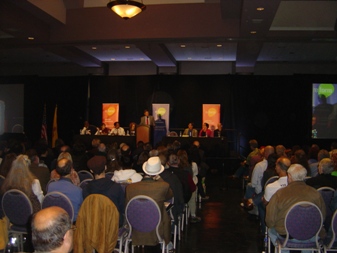
Last but not least, for now, a picture I snapped during the conference's closing plenary, former New Mexico Governor Gary Johnson delivering the keynote:
Latest News
Blog
A burger with bullets
Last night I was sitting at my computer playing a little on line poker when I thought I heard three rapid shots.After about 10 minutes the police arrived with lights but no sirens and were met with th