Happy holidays! As 2026 approaches, this is what we are working on and need your help for.
An executive order by President Trump has directed the US Attorney General to expedite the rescheduling process. He has also signaled his administration is open to regulating -- not banning -- hemp-derived cannabinoids.
Rescheduling is only a start, not the end when it comes to marijuana policy reform.
As of now, there is less than a year until a ban on most hemp cannabinioid products goes into effect, but the industry and Congress are looking at fixes.
Dear friends,
Happy holidays!
As 2025 enters its final week, I am reaching out to seek your financial support for our work for another year. Your donation -- whether before the end of the year, recurring throughout the coming year, pledged for a future time, something you're still thinking about -- will make all the difference.
- We continue to seek support to bring Drug War Chronicle and our longtime writer Phillip S. Smith back to full-time.
- We are seeking donations to do the second-ever study on the characteristics of armed robberies of state-legal marijuana stores (following up on the first-ever study on this topic, which we also did!). The new study will bolster efforts to secure banking and payment services for cannabusinesses under federal law, which we believe will advance the effort to eventually enact legalization federally. (We are also offering sponsorships!)
- Our Rule of Law in Drug Policy program is working to gather evidence to assist future prosecutions for the Trump administration's strikes on alleged "drug boats," and to clarify in the public discussion over the drug strikes that they are indeed extrajudicial killings, e.g. murders.
- Our Rule of Law in Drug Policy program is working with Filipino allies to support the ICC's prosecution of former President Rodrigo Duterte for his extrajudicial drug war killings, while raising awareness of other extrajudicial drug war killing situations, the parallels between the Duterte killings and the Trump drug war killings, and how this fits into the fight to save global democracy.
- We continue to engage with drug policy efforts at the United Nations.
We would be deeply grateful for tax-deductible grants or donations to our 501(c)(3) nonprofit, DRCNet Foundation, or non-deductible donations to our 501(c)(4) public welfare nonprofit, Drug Reform Coordination Network. Thank you if you are willing and able to help at this time. (But if all you can afford to send right now are good wishes for us in the effort, we appreciate those too!)
Note that our online donation system, along with accepting one-time donations of course (via credit card, PayPal or bank ACH), also has a range of recurring donation options that you can use if you wish to make that commitment. People mainly use these for monthly or annual gifts to our organization. But our donation system can also accommodate gifts scheduled weekly, biweekly, every four weeks, quarterly, and twice a year. (Click here if you'd like info on contributing by mail or making a gift of stock.)
Sincerely,

David Borden, Executive Director
StoptheDrugWar.org
P.O. Box 9853, Washington, DC 20016
https://stopthedrugwar.org
back to top
Dear Reformer,
Last February I warned President Trump might attempt Duterte-style extrajudicial drug war killings in the United States. In a different way, Trump is now doing extrajudicial drug war killings.

US military strike on alleged "drug boat" in the Caribbean
I'm referring to the drone strikes on alleged "drug boats," most of them near the coast of Venezuela. Since September, the US military on the president's order has carried out such strikes in
25 separate incidents, killing 95 people without warning. An infamous "second strike" on September 2
nd, which killed survivors who were clinging to the wreckage of a boat, heightened congressional scrutiny. But as Sen. Rand Paul (R-KY) has explained,
the initial strikes are illegal too.
The president and his enablers claim to have authority for this, and that they are blowing up boats in the Caribbean to prevent fentanyl from killing people in the United States. But both of those claims are fictional. The reality is that President Trump is attempting to secure an unchecked right and ability to kill. As he said when asked in October, "we're just going to kill people."
A term for that is extrajudicial killing. In international law, the term is "crimes against humanity." Another word for it is "murder." For the sake of our future – the world's future – the perpetrators of these crimes must eventually face justice. And the killings must be stopped – before Trump feels emboldened enough to take them to the streets of the US itself, and before unprincipled leaders in some other countries decide to follow Trump's example.
You can hear some of my thoughts on these matters in presentations I gave recently for the Human Rights Council and the American Bar Association. You can also find reporting our writer Phillip Smith has done about the boat strikes in our newsletter, Drug War Chronicle.
For now, our jobs are the ones that our Filipino allies fighting Duterte had during the height of his drug war: stopping the killings; explaining what good drug policy is; reminding people that murder is wrong – even if the murderer claims to be fighting drugs; and gathering the evidence needed for future prosecutions.
If you see this message over the next few hours, and if you're a US voter, I hope you will take action on the first of those right now. This afternoon, (Wednesday 12/17), the House of Representatives is expected to debate and vote on H.Con.Res.61, a bill "[d]irecting the President… to remove United States Armed Forces from hostilities with presidentially designated terrorist organizations in the Western Hemisphere" unless Congress authorizes the use of military force.
Please call your US Representative's office, and ask that your Rep. vote yes on H.Con.Res.61. If you agree with our characterization of the boat strikes as murders, please also ask your Rep. to state for the record that the strikes are extrajudicial killings, for which another word is murder. You can call your Representative's office (or find out who your Rep. is) by calling the Congressional Switchboard at (202) 224-3121. Because a vote is expected today, only a phone call will get through in time, unless you happen to be on the Hill to pay a visit.
We are also supporting H.Con.Res.64, bipartisan war powers legislation "[t]o direct the removal of United States Armed Forces from hostilities within or against Venezuela that have not been authorized by Congress." While this resolution is not directly about the boat strikes, the strikes and the possibility of the US initiating a regime change effort using our military are intertwined. If you agree with this legislation, please also ask your Rep. to vote yes on H.Con.Res.64.
Note that our support for H.Con.Res.64 in no way reflects support or approval for the Maduro regime, a repressive and brutal dictatorship that stole the most recent election. Indeed, one of the tragedies of Trump's saber-rattling is it's enabled the regime in Venezuela to further intensify its repressive measures. One of the ways it's done so is coercing their families and community members into taking down social media postings and not speaking out about their loved ones or what people on the boats were doing, which in turn hinders investigative efforts. Despite the need to restore democracy and human rights in Venezuela, it is questionable whether a military-based regime change operation would be the best way to accomplish that, and the Trump administration has not engaged in a serious process of analysis or discussion on this matter.
More about this soon. In the meanwhile, thanks for reading and being here.
- Dave
----------------
We could really use your help at this time for our work on extrajudicial drug war killings, to fully restart our newsletter, for our work on marijuana policy, for evidence-gathering to help future boat strikes trials, and more. You can help by making a tax-deductible grant or donation to our 501(c)(3) nonprofit, DRCNet Foundation; or a non-deductible donation to our 501(c)(4) public welfare nonprofit, Drug Reform Coordination Network.
Note that our online donation system, along with accepting one-time donations (via credit card, PayPal or bank ACH), has a range of recurring donation options. People mainly use those for monthly or annual gifts, but the system can accommodate weekly, biweekly, every four weeks, quarterly, and twice a year too. (Click here if you'd like info on contributing by mail or making a gift of stock.)
Sincerely,

David Borden, Executive Director
StoptheDrugWar.org
P.O. Box 9853, Washington, DC 20016
https://stopthedrugwar.org
back to top
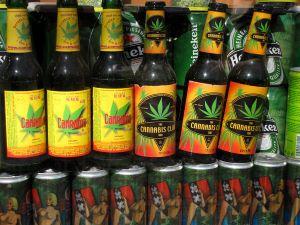
Beverages with hemp-derived cannabinoids. The Trump administration appears open to regulating--not banning--them.
On Thursday, President Trump signed an executive order, Increasing Medical Marijuana and Cannabidiol Research, that expedites the process of moving cannabis from Schedule I to Schedule III of the Controlled Substances Act (CSA). Schedule I drugs are defined as drugs with no currently accepted medical use, a high potential for abuse, and a lack of accepted safety for use of the drug under medical supervision. Schedule III drugs are classified as having a potential for abuse less than the drugs in Schedules I and II, a currently accepted medical use in treatment in the United States, and a potential for moderate or low physical dependence or high psychological dependence.
But as its title indicates, it also opens a door for the hemp industry, which has been on its back foot since Congress last month included a hemp ban in its bill ending the federal government shutdown. That ban threatens to virtually wipe out a multi-billion industry that has grown up around hemp-derived cannabinoids.
The executive order had its genesis in the Biden administration, which ordered a review of medical marijuana's status, leading to a 2023 Food & Drug Administration (FDA) finding that there was scientific support for certain medical uses of the plant. The Department of Health and Human Services (HHS) then recommended to the Drug Enforcement Agency (DEA) that marijuana be controlled under Schedule III of the CSA. DEA had yet to act on that recommendation, but now the president has.
"Decades of Federal drug control policy have neglected marijuana's medical uses," the order says. "That oversight has limited the ability of scientists and manufacturers to complete the necessary research on safety and efficacy to inform doctors and patients… The federal Government’s long delay in recognizing the medical use of marijuana does not serve the Americans who report health benefits from the medical use of marijuana to ease chronic pain and other various medically recognized ailments. Americans who often seek alternative relief from chronic pain symptoms are particularly impacted."
The order also addresses cannabinoids, the phytochemicals that interact with the human body's endocannabinoid system to produce both physical and psychoactive effects. The most prevalent products derived from American hemp crops are the cannabinoids, particularly cannabidiol (CBD) and tetrahydrocannabinol (THC). CBD is widely used in pain relief. "Full-spectrum" CBD products also contain THC derived from the hemp plant.
The order notes that while hemp-derived cannabinoids are currently not controlled substances under the CSA, "some full-spectrum CBD products will once again be controlled as marijuana under the CSA when section 781 of Public Law 119-37 [the hemp ban] goes into effect because they contain THC levels above the per-container threshold set by that law." It also notes that some CBD products have been inaccurately labeled, "posing safety risks for consumers."
"It is the policy of my Administration to increase medical marijuana and CBD research to better inform patients and doctors, the order states. "It is critical to close the gap between current medical marijuana and CBD use and medical knowledge of risks and benefits, including for specific populations and conditions. Research methods and models should include real-world evidence and should facilitate affordable access in order to rapidly assess the health outcomes of medical marijuana and legal CBD products while focusing on long-term health effects in vulnerable populations like adolescents and young adults."
The order mandates that the attorney general complete rulemaking for rescheduling marijuana expeditiously and that White House officials "work with the Congress to update the statutory definition of final hemp-derived cannabinoid products to allow Americans to benefit from access to appropriate full-spectrum CBD products while preserving the Congress's intent to restrict the sale of products that pose serious health risks."
That effort will include developing guidance on an upper limit on milligrams of THC per serving, per container limits, and on CBD to THC ratios. It will be led by the Secretary of Health and Human Services, the Commissioner of Food and Drugs, the Administrator of the Centers for Medicare and Medicaid Services, and the Director of the National Institutes of Health.
In a fact sheet accompanying the order, the administration notes that "President Trump is paving the way for enhanced research and better information on hemp-derived cannabinoid products, helping to inform patients and doctors about their potential role in managing common health conditions."
The fact sheet also says that one in five American adults and nearly 15 percent of seniors have reported using CBD in the past year, but that the recent hemp ban, "including recent changes that affect full-spectrum CBD products, leaves American patients and doctors without adequate guidance or product safeguards." To improve access and inform standards of care, what is needed are "legislative solutions and innovative research methods."
The hemp industry is liking what it is seeing today from the White House.
"The US hemp industry is deeply grateful to President Trump for issuing his strong pro-hemp executive order today," the US Hemp Roundtable said in a statement. "While the headlines of the announcement will focus on marijuana rescheduling -- which is a positive in itself, for any cannabis reform benefits the entire plant -- we are especially pleased to see the provisions that direct the White House staff and urge Congress to ensure access to hemp-derived, full-spectrum CBD products, a lifeblood of the industry," the group continued.
"We consider this executive order to be a direct rebuke to the hemp ban that was malignly attached to legislation that reopened government," the Roundtable added. "This also gives strong impetus to efforts to extend the ban's moratorium an additional 18 months to allow proper time for Congress and the Trump Administration to develop the regulatory framework that ensures the safe provision of hemp products while cracking down on the bad actors peddling the unsafe products that the executive order calls out."
"This executive order provides us the political and PR air cover we need to push Congress for a two-year extension on the existing ban," said Hemp Industry and Farmers of America (HIFA) executive director Brian Swensen in a message to supporters. "It allows us a stronger hand when we lobby and push members of Congress for the extension. The hemp industry has a fighting chance thanks to the Trump administration's executive order. The order is a clear indication for Americans and lawmakers that a ban is not the answer."
As of today, the hemp industry has less than 11 months to get the hemp ban undone and a new regulatory regime in place. But if those calls for a moratorium on enforcement of the ban, whether for 18 months or two years, are heeded, there will be a little more breathing room. The industry will need all the time it can get. The issues are complex, and so is the congressional process.
back to top
Last Thursday, President Trump signed an executive order, Increasing Medical Marijuana and Cannabidiol Research, that sets the stage for moving cannabis from Schedule I to Schedule III of the Controlled Substances Act (CSA). Schedule I drugs are defined as drugs with no currently accepted medical use, a high potential for abuse, and a lack of accepted safety for use of the drug under medical supervision. Schedule III drugs are classified as having a potential for abuse less than the drugs in Schedules I and II, a currently accepted medical use in treatment in the United States, and a potential for moderate or low physical dependence or high psychological dependence.
But as its title indicates, it also opens a door for the hemp industry, which has been on its back foot since Congress last month included a hemp ban in its bill ending the federal government shutdown. That ban threatens to virtually wipe out a multi-billion industry that has grown up around hemp-derived cannabinoids.
The executive order had its genesis in the Biden administration, which ordered a review of medical marijuana's status, leading to a 2023 Food & Drug Administration (FDA) finding that there was scientific support for certain medical uses of the plant. The Department of Health and Human Services (HHS) then recommended to the Drug Enforcement Agency (DEA) that marijuana be controlled under Schedule III of the CSA. DEA had yet to act on that recommendation, but now the president has.
"Decades of Federal drug control policy have neglected marijuana’s medical uses," the order says. "That oversight has limited the ability of scientists and manufacturers to complete the necessary research on safety and efficacy to inform doctors and patients… The federal Government's long delay in recognizing the medical use of marijuana does not serve the Americans who report health benefits from the medical use of marijuana to ease chronic pain and other various medically recognized ailments. Americans who often seek alternative relief from chronic pain symptoms are particularly impacted. "
The order also addresses cannabinoids, the phytochemicals that interact with the human body's endocannabinoid system to produce both physical and psychoactive effects. The most prevalent products derived from American hemp crops are the cannabinoids, particularly cannabidiol (CBD) and tetrahydrocannabinol (THC). CBD is widely used in pain relief. "Full-spectrum" CBD products also contain THC derived from the hemp plant.
The order notes that while hemp-derived cannabinoids are currently not controlled substances under the CSA, "some full-spectrum CBD products will once again be controlled as marijuana under the CSA when section 781 of Public Law 119-37 [the hemp ban] goes into effect because they contain THC levels above the per-container threshold set by that law." It also notes that some CBD products have been inaccurately labeled, "posing safety risks for consumers."
"It is the policy of my Administration to increase medical marijuana and CBD research to better inform patients and doctors, the order states. "It is critical to close the gap between current medical marijuana and CBD use and medical knowledge of risks and benefits, including for specific populations and conditions. Research methods and models should include real-world evidence and should facilitate affordable access in order to rapidly assess the health outcomes of medical marijuana and legal CBD products while focusing on long-term health effects in vulnerable populations like adolescents and young adults."
The order mandates that the attorney general complete rulemaking for rescheduling marijuana expeditiously and that White House officials "work with the Congress to update the statutory definition of final hemp-derived cannabinoid products to allow Americans to benefit from access to appropriate full-spectrum CBD products while preserving the Congress's intent to restrict the sale of products that pose serious health risks."
While the hemp industry has generally responded warmly to the move, the reaction from marijuana advocates has been more nuanced.
"The Executive Order directs several federal agencies to advance research and policy coordination related to medical cannabis and cannabinoid products. However, it does NOT reschedule cannabis, legalize medical use, or create new patient protections," Americans for Safe Access's Steph Sherer wrote in a Saturday blog post. "What makes this moment especially significant is what the Order affirms: recognition that cannabis has a 'currently accepted medical use' has now moved beyond federal health agencies and been acknowledged by the White House."
"The Administration's order calling to remove the cannabis plant from its Schedule I classification validates the experiences of tens of millions of Americans, as well as those of tens of thousands of physicians, who have long recognized that cannabis possesses legitimate medical utility," said Paul Armentano, deputy director of the National Organization for the Reform of Marijuana Laws (NORML). "It wasn't long ago that federal officials were threatening to seize doctors' medical licenses just for discussing medical cannabis with their patients. This directive certainly marks a long overdue change in direction."
He cautioned however: "But while such a move potentially provides some benefits to patients, and veterans especially, it still falls well short of the changes necessary to bring federal marijuana policy into the 21st century. Specifically, rescheduling fails to harmonize federal marijuana policy with the cannabis laws of most states, particularly the 24 states that have legalized its use and sale to adults -- thereby leaving those who produce, dispense, possess, or use marijuana in compliance with state laws in jeopardy of federal prosecution. In order to rectify this state/federal conflict, and in order to provide state governments with the explicit authority to establish their own cannabis regulatory policies -- like they already possess with respect to alcohol -- cannabis must be removed from the Controlled Substances Act altogether. Doing so would affirm America's longstanding principles of federalism and appeal to Americans' deep-rooted desires to be free from undue government intrusion into their daily lives."
Armentano continued: "Nevertheless, as a first step forward, this federal policy change dramatically shifts the political debate surrounding cannabis. Specifically, it delegitimizes many of the tropes historically exploited by opponents of marijuana policy reform. Claims that cannabis poses unique harms to health, or that it's not useful for treating chronic pain and other ailments, have now been rejected by the very federal agencies that formerly perpetuated them. Going forward, these specious allegations should be absent from any serious conversations surrounding legalizing and regulating cannabis."
Finally, he added: "It is anticipated that reclassification will also provide tax fairness to state-licensed businesses -- allowing them, for the first time, to take traditional tax deductions. This change levels the playing field and lowers these entities’ costs of doing business. This change also likely benefits cannabis consumers by resulting in lower overall prices for state-licensed retail products, further incentivizing them to abandon the underground market."
NORML’s Political Director Morgan Fox also weighed in, stating that the Trump Administration's reclassification endorsement reflects bipartisan support in favor of ending marijuana prohibition. "Having a Republican administration backing this effort will likely embolden more Republican lawmakers, many of whom have privately endorsed marijuana policy reform, to now do so publicly. It may also encourage lawmakers in Republican-led states that have yet to move toward a policy of legalization and regulation to take a serious look at doing so," he said.
The Marijuana Policy Project likewise issued a call for descheduling -- not rescheduling.
"While MPP welcomes the President's proposal to move cannabis from Schedule I to Schedule III, neither the plant itself nor its naturally occurring component cannabinoids belong on the schedule at all, said Adam J. Smith, MPP executive director. "We hope this move to Schedule III truly does open up medical research, that it inspires states to guarantee access to safe, regulated cannabinoids for patients who desperately need them, and that the regulated industry might finally be treated more fairly under the federal tax code."
"But a move to Schedule III does nothing to end hundreds of thousands of possession arrests each year, nor does it do anything to fix the untenable, ongoing disconnect between federal prohibition and the regulated state markets under which more than half of American adults live," Smith continued. "We are pleased that the President is taking this important step, but it is only a step. It is long past time to deschedule cannabis entirely and end nearly a century of failed prohibition."
And the Drug Policy Project (DPA) was adamant about the harms that will remain as long as marijuana remains federally illegal -- not just down-scheduled.
"Americans have waited a long time for the US government to acknowledge what the President said today: cannabis has medical value," said Kassandra Frederique, DPA's executive director. "But it's important to be clear about what Schedule III does and does not do. While it may ease some research restrictions, it's still unclear what real relief it will provide to everyday Americans who rely on cannabis to manage pain. The announcement also benefits large corporations without a clear pathway for affordable access for patients and consumers."
"Rescheduling does not end the harms of criminalization," she continued. "Millions of Americans will still face arrest records that limit access to housing, jobs, and opportunity, leaving the long-standing impacts of cannabis criminalization in place. Americans want legalization that works: limited to adults, with accurate labeling, strong public health protections, real opportunities for small businesses and workers, and tax revenue that reinvests in communities. If people still risk arrest, eviction, or a lost job -- and patients still can't afford or legally access the medicine they rely on -- this announcement does not offer enough relief for Americans."
For marijuana and drug policy reformers, rescheduling is a step in the right direction, but by no means the end of the road.
back to top
Faced with a choice between regulation and virtual extinction (or an existence in the black market) in the wake of the looming hemp ban, the hemp industry and its allies are embracing the former. Several industry and legislative proposals for regulation the industry have already appeared. They are discussed below.
And a month after Congress approved the ban -- set to go into effect in November 2026 -- the outlook for the industry is slightly sunnier in the wake of President Trump's executive order rescheduling marijuana, which also included language signaling an openness to working with stakeholders to craft regulations for hemp-derived cannabinoids.
As the executive order states, White House officials "shall work with the Congress to update the statutory definition of final hemp-derived cannabinoid products to allow Americans to benefit from access to appropriate full-spectrum CBD products while preserving the Congress's intent to restrict the sale of products that pose serious health risks. This will include consultation with appropriate executive departments and agencies and authorities to develop a regulatory framework for hemp-derived cannabinoid products, including development of guidance on an upper limit on milligrams of THC per serving with considerations on per container limits and CBD to THC ratio requirements."
Here is what various sectors of the industry are recommending, as well as several legislative vehicles for achieving those aims:
Industry Proposals
The US Hemp Roundtable's Call for an Extended Moratorium on Enforcement of the Hemp Ban
Representing dozens of companies and advocacy groups across the hemp spectrum, the US Hemp Roundtable is calling for an 18-month extension of the hemp ban moratorium, which is scheduled to end in November 2026.
"As part of the backroom deal that reopened government in November," the group notes, "more than 95 percent of hemp products that Americans rely upon for their health and wellness would be treated as Schedule 1 drugs equivalent to heroin. The legislation was crafted to build in a one-year moratorium on its effective date to give time to replace this ban with meaningful regulation of hemp products. Unfortunately, one year is simply not enough time for farmers, state regulators, or the industry to craft a long-term solution that protects consumers. Extending it by an additional 18 months to create a full 2.5-year moratorium is essential."
The Roundtable warns that planting season is coming, "and without clarity from Congress, many will not plant hemp for 2025," putting the entire supply chain at risk. A measure aimed at intoxicating cannabinoids will endanger not only buzzy beverages but also non-intoxicating wellness products, topicals, and industrial materials. And that would endanger thousands of jobs, as well.
"An 18-month extension will provide the time needed for Congress to develop a responsible, bipartisan regulatory framework and for states and farmers to adjust accordingly," the Roundtable concludes.
The Hemp Industry Working Group's Policy Roadmap
The group of industry experts and analysts released a proposed policy roadmap for hemp regulation,Pushing Progress, in October. The authors say their objective in the next farm bill is to "clearly define industrial and floral hemp separately and direct the US Department of Agriculture (USDA) to manage hemp production based on the intended end use of the material. This bifurcation protects agricultural producers growing grain and fiber while establishing a clear regulatory pathway for cannabinoid-producing hemp," they add.
The proposal would require additional language under the Energy & Commerce Committee "to secure a complete solution to the challenges facing today's hemp industry," they note.
The proposed farm bill language would define industrial (fiber, grain) and floral (cannabinoid-producing) hemp and clarify that USDA is in charge of all agricultural hemp production. The farm agency would administer licenses that align crop production with the intended end use. The proposed farm bill language would also raise the total THC threshold for hemp from 0.3 percent to 1.0 percent "to reflect real-world crop variability."
The proposed Energy & Commerce Committee language would divide regulatory authority over hemp products by end use. It would amend the 1994 Dietary Supplement Health and Education Act (DSHEA) to clearly grant the Food & Drug Administration (FDA) authority over non-intoxicating cannabinoids, such as CBD. Intoxicating hemp products would fall under the purview of the Bureau of Alcohol, Tobacco, and Firearms (BATF) Tax and Trade Bureau (TTB). And synthetic cannabinoids -- "compounds not naturally present in the cannabis plant" -- would continue to be under the authority of the DEA as controlled substances.
Rather than set arbitrary ceilings on the amount of THC allowed per package, the proposed language would require the TTB to set limits, manufacturing standards, labeling, and age restrictions in consultation with the FDA.
"The Farm Bill governs agriculture, not chemistry," the authors conclude. "The confusion facing states, manufacturers, and law enforcement stems from regulatory inaction -- not statutory defect. In the wake of Loper Bright [a 2024 Supreme Court decision governing regulatory agencies that shifted power from them to the courts], Congress can no longer rely on vague delegations or agency improvisation. It must now legislate clear, fit-for-purpose authority that distinguishes industrial from floral Hemp and directs oversight based on impairment potential and intended use. A precise, three-lane framework -- assigning jurisdiction among FDA, TTB, and DEA -- restores regulatory clarity, protects public safety, and provides a durable foundation for America’s evolving hemp economy. "
The Hemp Beverage Alliance's Statement of Principles
The Hemp Beverage Alliance, the trade association of the hemp beverage industry, represents more than 280 producers, distributors, and associated enterprises in the burgeoning field. In a statement of regulatory principles, the group lays out its vision of a sustainable, regulated industry. It identifies the key principles as age restrictions, safety, serving size and potency, labeling, regulatory clarity, and marketplace consistency.
The statement calls for sales of cannabis-infused beverages to be limited to people 21 and over. That will require licensed, trained retailers who will check for age verification prior to sales. It will require suppliers to provide tamper-proof packaging and labeling that clearly indicates the product is for adults only. It will also require that wholesale distributors be licensed to ensure that hemp beverages only go to properly licensed retailers who comply with adults-only retail sale requirements. Businesses engaged in direct-to-consumer sales should also be licensed to ensure compliance with adult-only sales and require proof of age prior to sales.
Under the rubric of ensuring consumer safety, the alliance calls for the use of only cannabinoids derived from hemp, not synthetics. "Synthetic cannabinoids or other artificially derived cannabinoids should be prohibited from use in beverages," the statement says, as should the cannabinoids HHC, THC-O, THC O-acetate, or delta-10 THC. All ingredients, except cannabinoid emulsions, must be FDA-approved. Other active ingredients like caffeine, probiotics, and antioxidants should be labeled and dosed to avoid enhancing THC's intoxicating effects. And hemp beverages must not contain any alcohol.
When it comes to production, such facilities must meet the minimum standards of quality control required under federal and, when applicable, state law. But hemp beverages could be produced in facilities that also produce marijuana or alcohol products.
The statement also calls for testing of contaminants, as well as testing finished products for the presence and levels of total delta-9-THC, cannabidiol (CBD), cannabidiolic acid (CBD-A), cannbigerol, (CBG), cannabigerolic acid (CBG-A), cannabinol (CBN), and delta-8 THC.
The alliance recommends serving size and potency limits as follows: For ready-to-drink products: no more than 10 mg of delta-9 THC in a container of at least 150 milliliters. For "spirit analog" products in a large format: no more than 5 mg of THC per serving, with a maximum of 1 serving per 47 milliliters of liquid and a minimum container size of 375 milliliters. That container equals 8 servings of beverage containing a combined 40 mg of THC. Ditto for small format "spirit analog" products: no more than 5 mg of THC per serving, with no more than 1 serving per container. Small format containers must be no less than 50 milliliters and no more than 120 milliliters.
Labeling should include a principal display panel that identifies the product consistent with FDA standards, a statement of alcohol content (or identifying the product as containing no alcohol), a total milligram count of all cannabinoids, and a net quantity statement, including the net volume of the container in fluid ounces and milliliters. It should also include an information panel that lists nutrition facts, ingredients, cannabinoid milligram count, any functional ingredients, and the percentage of juice, if applicable.
Labels must not contain any health claims but should include exhortations for the responsible use of hemp beverages, such as "Start low, go slow," and warning of the possible impacts of drinking them, such as "Consuming this product may result in a positive drug test for THC" or "Keep out of the reach of children and pets."
Lastly, the alliance says that while regulations are necessary, they should be "thoughtful, concise, and support consumer safety and industry growth, and if there is no federal regulation, states should work together to develop guidelines that are consistent across states.
Congress
The Cannabinoid Safety and Regulation Act (S. 5243). Filed by Oregon Democratic Sens. Ron Wyden and Jeff Merkley in December, the measure would cap THC at 5 mg per serving and a maximum of 50 mg per container for gummies and other hemp products besides beverages. Beverages could contain up to 10 mg of THC. The federal limits would only apply in states that do not set their own caps.
The bill would also direct the Food & Drug Administration (FDA) to create a Center for Cannabinoid Products to regulate the industry, including testing hemp-derived products for strength and dangerous adulterants and ensuring they are not marketed to children.
The measure "creates a thorough and strict regulatory regime for hemp-derived consumer products to protect public health and safety and keep these products out of the hands of kids," Wyden said in a fact sheet for the bill. "The CSRA sets a federal age limit at 21, sets manufacturing and testing control processes and truth-in-labeling requirements, and bans dangerous chemicals, excessive levels of THC and untested products from the market. Cannabis prohibition has never kept cannabis out of the hands of kids. Robust regulation can give adult consumers a safe, reliable option while disallowing unsafe products."
The hemp beverage industry likes the sound of that: "Hemp beverages are incredibly popular with adult consumers who are seeking additional beverage choices. This legislation allows them to continue to enjoy these beverages while creating a safe, transparent and thriving category," Hemp Beverage Alliance President Christopher Lackner said.
The bill also has the backing of the US Hemp Roundtable and Wine and Spirits Wholesalers of America.
But this is a bill from two Democrats and is thus unlikely to progress in the Republican-controlled Senate.
The Rep. Morgan Griffith Hemp Bill (Discussion Draft). With support from hemp beverage interests, the Virginia Republican representative is circulating a draft of a bill to amend the federal Food, Drug, and Cosmetic Act (FDCA) to provide for the regulation of cannabinoid hemp products. Under the bill, consumable hemp products, including beverages, will be expressly permitted. Hemp beverages with non-intoxicating cannabinoids can contain up to 10 mg per serving, while hemp beverages with intoxicating cannabinoids are limited to .2 mg per serving.
The bill would bar the addition of alcohol, caffeine, tobacco, nicotine, melatonin, or other substances that could enhance or alter the effects of cannabinoids.
It also would provide labeling requirements and tamper-proof packaging, with child safety in mind. It also would bar packaging attractive to minors. And it would implement manufacturing and testing standards for consumable hemp products.
The Hemp Beverage Association likes what it sees so far in this bill, too: "We are thrilled to see positive regulatory language coming out of DC and forward to continuing to work with Rep. Griffith’s office to further develop this legislation," the group said in a news release announcing the draft bill's circulation.
And because this bill is from a Republican, it stands a better chance of moving next year in the Republican-controlled House.
The HEMP (Hemp Economic Mobilization Plan) Act of 2025 (S.2112). Introduced by libertarian-leaning and hemp-friendly Sen. Rand Paul (R-KY) in June, the measure is "a bill to amend the Agricultural Marketing Act of 1946 to modify the definition of hemp, and for other purposes." The bill would amend the act to raise the allowable dry weight THC limit for cannabis to qualify as hemp from 0.3 percent to 1 percent.
It would also broaden the language around testing for THC from "hemp" to "products derived from hemp plants." And it would specify that people transporting hemp must carry documentation showing a) that the hemp was produced under license and b) that the hemp contains less than 1 percent THC by dry weight.
That bill was referred to the Agriculture Committee upon filing in June. It has not moved since.
Sen. Paul fought successfully earlier this year to have the Senate remove hemp ban language that was included in the House version of the 2025 farm bill (H.R.3944) and tried unsuccessfully to block that language when it was included at the last minute in the bill ending the federal government shutdown. His amendment to strip hemp ban language from that bill failed on a vote of 76-24.
The American Hemp Protection Act of 2025 (H.R. 6209). Introduced by Rep. Nancy Mace (R-SC) a week after the hemp ban passed, the measure aims to undo the ban and is entitled "a bill to repeal section 781 of the Continuing Appropriations, Agriculture, Legislative Branch, Military Construction and Veterans Affairs, and Extensions Act, 2026, relating to amendments to the Agricultural Marketing Act of 1946, with respect to hemp." The text of the bill is equally to the point: "Effective November 12, 2025, section 781 of the Continuing Appropriations, Agriculture, Legislative Branch, Military Construction and Veterans Affairs, and Extensions Act, 2026 (Public Law 119–37) is repealed."
Section 781 is the part of the bill to end the government shutdown that includes the hemp ban.
The Mace bill was referred to the House Committee on Agriculture on November 20.
Mace has long been a proponent of broader cannabis reform, filing the States Reform Act (H.R. 5977) in 2021. That bill would have legalized marijuana. It would also have limited the role of the Food & Drug Administration (FDA) in regulating interstate marijuana commerce to ensure that "the regulatory issues harming the industrial hemp-derived CBD industry will not be repeated in the cannabis space." It would also have left regulation of cannabis agriculture to the Department of Agriculture, "mirror[ing] the treatment of industrial hemp under the 2018 farm bill." And it would have set an age limit of 21 for the consumption of all cannabis products, with an exception for medical use.
That bill passed out of a number of subcommittees but died without a committee vote after being sent to the Senate Judiciary Committee's Subcommittee on Crime, Terrorism, and Homeland Security nearly a year after it was introduced.
Whether any of these bills end up being the final vehicle for enacting regulation of the hemp industry remains to be seen. But the impetus from the White House in favor of regulation and the tendency for congressional Republicans to follow the White House's lead suggests that regulation -- not prohibition -- is coming.
back to top