CHANGING MINDS, LAWS & LIVES CAMPAIGN

About DRCNetStop the Drug War (DRCNet) is an international organization working for an end to drug prohibition worldwide and for interim policy reform in US drug laws and criminal justice system. Read more about DRCNet.

Make a Donation

Want to stop the drug war? One way to help is to make a generous donation -- member support makes up a critical portion of our budget, and we can't do it without you!

some organizations DRCNet played a role in starting:


Poll: 99 Percent Wouldn't Use Hard Drugs If They Were Legalized

EDITORIAL ADVISORY -- December 5, 2007


If Heroin or Cocaine Were Legal, Would You Use Them?

Zogby Poll Suggests Prohibition Doesn't Reduce Hard Drug Use

Washington, DC -- Marking the 74th anniversary of the repeal of national Alcohol Prohibition, StoptheDrugWar.org today released polling results suggesting that drug prohibition's main supporting argument may be simply wrong. Drug policy reformers point to a wide range of demonstrated social harms created by the drug laws -- crime and violence, spread of infectious diseases, official corruption, easy funding for terrorist groups, to name a few -- while prohibitionists argue that use and addiction would explode if drugs were legalized. But is the prohibitionist assumption well-founded?

Zogby polling data released today asked 1,028 likely voters, "If hard drugs such as heroin or cocaine were legalized, would you be likely to use them?" Ninety-ninety percent of respondents answered, "No." Only 0.6 percent said "Yes." The remaining 0.4 percent weren't sure.

While some of the "no" respondents may have been overoptimistic about their future self-discipline -- current use rates under prohibition are slightly higher than that -- the survey nevertheless demonstrates that almost all Americans consider the use of certain drugs to be inadvisable, for reasons other than their legal status. It is therefore unclear that laws are needed to dissuade them from using "hard drugs" or that legalization would result in increased addiction rates. The social implosion predicted by some drug warriors seems especially unlikely.

The results are similar to usage rates occurring under today's "drug war," as measured by the federal government's National Survey on Drug Use and Health (formerly the National Household Survey). The 2006 NSDUH found 0.3 percent of the population had used heroin in the past month and 2.4 percent had used cocaine. Even for cocaine, the numbers are compatible, because Zogby surveyed persons aged 18 years and up, while NSDUH begins with age 12; and because of the poll's statistical margin of error of 3.1 percentage points.

A comparison of drug use rates in countries with criminal penalties for drug use with the drug use rates of countries that have decriminalized personal use also suggests that policy may play only a secondary role in determining use rates. For example, in the Netherlands, where marijuana is sold openly in the famous "coffee shops," 12 percent of young adults age 15-24 reported using marijuana during 2005, as compared with 24 percent in neighboring France, where marijuana is an arrestable offense, according to data compiled by the European Monitoring Center for Drugs and Drug Addiction.In the United States, where police make nearly 800,000 marijuana arrests each year, young adults age 18-25 in the 2004-2005 survey year reported past-year marijuana use at the rate of 27.9 percent.

David Borden, StoptheDrugWar.org's executive director, commented when releasing the Zogby data:

"Prohibition is sending hundreds of billions of dollars per year into the global criminal underground. That money fuels violence and disorder on the streets of our cities, while simultaneously helping to finance international terrorist organizations. Meanwhile, inflation-adjusted cocaine prices are a fifth of what they were 30 years ago, and any kid who wants to join the Mafia can sign up to deal it in his school. Addicts are harmed by the prohibition policy worst of all. It's time to stop shooting ourselves in the feet, and to control and regulate drugs through legalization."

The full Zogby poll results are available online at: http://stopthedrugwar.org/legalization

StoptheDrugWar.org (still known to many of our readers as DRCNet, the Drug Reform Coordination Network), is an international organization working for an end to drug prohibition worldwide and for reform of drug policy and the criminal justice system in the US. Visit http://stopthedrugwar.org/chronicle for the latest issue of our weekly, in-depth newsletter, Drug War Chronicle.

— END —


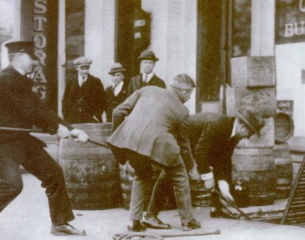
prohibition-era beer raid, Washington, DC
(Library of Congress)

Politics & Advocacy Legalization

Fair Game

There can be no doubt that many people who use recreational drugs are also religious—this is America, after all. But until Pope Benedict XVI, Mormon Church president Gordon B. Hinckley, and any or all Pat Robertson clones come out for drug law reform, I would say their respective religions are fair game.

The religious themselves are irrelevant but for what influence they may have to change their churches’ policies and preferences with respect to any support a specific organized religion maintains for the drug war.

It’s not uncommon for adherents to be way ahead of their church’s policies. But most religions are systems with top-to-bottom hierarchies, so needed change gets addressed very slowly.

One other note; it doesn't matter that the exact words "separation of church and state" don't appear in the Constitution. Separation of church and state is a long recognized part of U.S. common law (legal precedent).

Giordano

Connoisseurs and Regulations

Survey results showing 99-percent would not take hard drugs if such drugs were made legal probably compares favorably to the percentage who would refuse to jump off a bridge with no bungees or parachutes (there’s always one…).

People today have a hugely better understanding of pharmacology than citizens did in 1914 when the Harrison Narcotics Act was enacted. Today’s informed connoisseur of synapse surprises doesn’t want or need a paternalistic government chaperone.

Unfortunately, governments seem to attract the types of people who really do need chaperones, but never receive any. For example, in February, 1998, West Virginia legalized the eating of road kill. Contrast West Virginia’s road kill consumer law with the fact that marijuana remains illegal in W.V. The mind boggles when the government regulates.

Some countries; Thailand is one, don’t require a person to have a prescription to buy legal drugs. Thais are expected to know what they’re doing when they buy and use a pharmaceutical product. Except for purity requirements, etc., the government middle man, whose task in America seems to be to prop up the dozens of different profit schemes that become part of the cost of the drug, is thankfully absent.

Giordano

Post new comment

The content of this field is kept private and will not be shown publicly.
  • Allowed HTML tags: <a> <em> <strong> <cite> <code> <ul> <ol> <li> <dl> <dt> <dd> <img> <i> <blockquote> <p> <address> <pre> <h1> <h2> <h3> <h4> <h5> <h6> <br>
  • Lines and paragraphs break automatically.
  • You may post code using <code>...</code> (generic) or <?php ... ?> (highlighted PHP) tags.
  • Web and e-mail addresses are automatically converted into links.
More information about formatting options