Drug War Issues
Politics & Advocacy
Thirteen states have decriminalized marijuana possession so far; none have legalized it. This year, marijuana legalization bills have been filed in two states -- California and Massachusetts -- and decriminalization bills -- loosely defined -- were introduced in six states and passed in one, Maine. In Virginia, a bid to create a new marijuana offense was defeated.
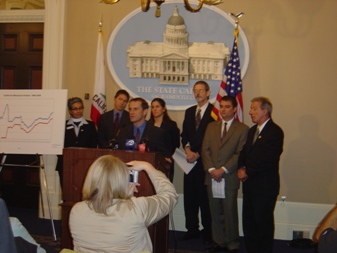
press conference for California AB 390 hearing -- Assemblyman Ammiano at right
California: San Francisco Assemblyman Tom Ammiano (D) introduced a landmark legalization bill, the Marijuana Control, Regulation, and Education Act, AB 390, in March. Under the bill, the state would license producers and distributors, who would pay an excise tax of $50 per ounce, or about $1 per joint. Anyone 21 or over could then purchase marijuana from a licensed distributor. The bill also would allow any adult to grow up to 10 plants for personal, non-commercial use. AB 390 got a hearing before the Assembly Public Safety Committee in October, but has not moved since.
Connecticut: Senators Martin Looney (D-New Haven), the Senate Majority Leader, and Toni Harp (D-New Haven), chair of the Senate Appropriations Committee, introduced a marijuana decriminalization bill, SB 349, in January. It would have made possession of less than half an ounce an unclassified misdemeanor with a maximum $250 fine. The measure passed the Joint Judiciary Committee in March on a 24-14 vote, but it was filibustered to death in the Senate Finance Committee by Sen. Toni Boucher (R-New Canaan) in May.
Maine: The legislature passed in March and Gov. John Baldacci (D) signed in May LD 250, which increases the amount of marijuana decriminalized in the state to 2.5 ounces. Previously, possession of up to 1.25 ounces was a civil offense, punishable by a fine of up to $1,000, but possession of between 1.25 and 2.5 ounces was a misdemeanor that could get one six months in jail. Unfortunately, the bill also increased the penalty for possession of more than eight ounces from six months and a $1,000 fine to one year and a $2,000 fine.
Massachusetts: -- At the request of former StoptheDrugWar.org and NORML board member Richard Evans, Rep. Ellen Story (D-Amherst) introduced another landmark legalization bill, AN ACT TO REGULATE AND TAX THE CANNABIS INDUSTRY -- H 2929, that would remove marijuana offenses from the criminal code and allow for the licensed production and sale of marijuana. The bill was assigned to the Joint Committee on Revenue, where it got a public hearing in October.
Montana: A marijuana decriminalization bill, HB 541, was introduced by Rep. Brady Wiseman (D-Bozeman). It would have made possession of up to 30 grams a civil infraction punishable by only a $50 fine. Under current law, that same amount can get you up to six months in jail and a $500 fine. The bill got a House Judiciary Committee hearing in March, but failed to get out of committee on a straight party-line 9-9 vote.
New Hampshire: In January, Rep. Steven Lindsey (D) introduced a bill that would decriminalize the possession of less than an ounce of marijuana. Under the bill, HB 555, persons over the age of 18 would face no more than a $100 fine. Simple possession would also be decriminalized for minors, but they would be subjected to community service and a drug awareness program at their own expense or face a $1,000 fine. While the House passed a similar measure last year (it died in the Senate), this year the bill never made it out of committee. The House Criminal Justice and Public Safety Committee deemed it "inexpedient to legislate" in February.
Rhode Island: In July, as the General Assembly rushed to adjourn, the Senate approved a resolution introduced that same day to create a nine-member commission to study a broad range of issues around marijuana policy. The resolution, which did not require any further approval, set up a "Special Senate Commission to Study the Prohibition of Marijuana," which is charged with issuing a report by January 31. The panel met for the first time last week.
Tennessee: -- A bill, SB 1942, that would have made possession of less than an eighth of an ounce of marijuana a Class A misdemeanor punishable by a fine of between $250 and $2500 died after being deferred by the Senate Judiciary Committee in May. Companion legislation, HB 1835, met a similar fate in the House Judiciary Committee's Subcommittee on Criminal Practice and Procedure in March.
Vermont: Led by Rep. David Zuckerman (P-Burlington), 19 members of the Vermont legislature introduced in February a bill that would decriminalize the possession of up to an ounce of marijuana. Under the bill, HB 150, small-time possession would have become a civil infraction with a maximum $100 fine. But the bill was assigned to the House Judiciary Committee, where it has languished ever since.
Virginia: It was not decriminalization but increasing marijuana penalties that was on the agenda in the Old Dominion. Delegate Manoli Loupassi (R-Richmond) introduced HB 1807, which would create a new felony offense for people caught transporting more than one ounce but less than five pounds of marijuana into the state. The bill was filed in January and sent to the Committee on Courts of Justice, where it died upon being "Left in Courts of Justice" on February 10.
Washington: A bill, S 5615, that would decriminalize the possession of small amounts of marijuana was introduced in January and approved by the Senate Judiciary Committee a week after a public hearing in February. It then went to the Senate Rules Committee, where it stalled. A companion bill in the House, HB 1177, was referred to the House Committee on Public Safety & Emergency Preparedness, which effectively killed it by refusing to schedule it for a hearing before a legislative deadline in March.
This work by StoptheDrugWar.org is licensed under Creative Commons Attribution-ShareAlike 4.0 International


Comments
A $50 an ounce excise tax, I got your tax, right here.
Pardon my French but, fu*k them asshole, greedy bastards. Already California is embezzling, and extorting money from peoples pay checks, calling the latest scam a "loan". I always thought a "loan", was an agreement between two parties to pay an interest on money loaned. But in California, they just take it, then tell us "oh, it's only a "loan"", "we're just borrowing it, and by the way, we're not giving you any interest on your money. Here's my understanding of the law, that's STEALING, first, I didn't agree to "loan" california anything, I wasn't even asked. Two, I also didn't agree to, not getting interest on my money. Three, taking money without permission is, STEALING, not paying interest, is STEALING, And, they just bumped up the sales tax rate to almost ten percent. Look if California has a spending problem, it's not MY problem, and I don't appreciate paying for someone Else's poor money management. I knew that "just legalize it and tax it", would open the door to abuse.
In reply to A $50 an ounce excise tax, I got your tax, right here. by joebanana (not verified)
You get what you pay for.
Did you vote for prop. 13 in '78? If you did, stop complaining about taxes. If your parents did, blame them. It costs money to operate a society and provide services that people want, except for the rugged individualist D. Boone types who think they can exist without contributing to society. And consider yourself lucky you live in CA. rather than this redneck hellhole known as Arizona which is always behind CA 30 years in anything resembling progressive.
french
Joe,
I have no objection to discussion of the pros and cons of the tax and regulate approach, but I have been trying for awhile now to elevate the language used here in order to elevate and increase the discussion. Language like "f*ck those asshole bastards" or "I've got your tax right here," or "f*ck the government" as you posted elsewhere, undermines that objective.
As a general rule, if you have to say "pardon my french," or if someone could take something you wrote as threatening, even if it was written in jest, then you need to come up with different phrasing if you're going to post it here.
I made an exception today in order to lay this out again and because you raised points that are worthy of discussion. But in general stuff like that is just going to be deleted, along whatever else happens to be in the post with it.
David Borden, Executive Director
StoptheDrugWar.org: the Drug Reform Coordination Network
Washington, DC
http://stopthedrugwar.org
A Question
When they relegalized alcohol, how long did it take to government to figure out how to quantify, regulate, distribute and tax the different potiencys? Were our grandfathers and great grandfathers this screwed up?
Cali taxes and cannabis
I'm so glad I dont live in cali due to this 'loan' thing. I for one feel all taxation is theft. I do realise we need taxes to keep society in general running but, things like this cali'loan' is unjust. Our federal taxes ,I feel, are also unjust. They take more and more and more. How do we as individual families and communities take care of our selves and each other when our leaders take huge chuncks of OUR hard work, just to turn around and WASTE it. I can waste my own money, dont need YOUR(government) help. State and federal goverenments had better stop the waste of OUR hard work or they WILL find themselves on the wrong end of votes and protests.
This brings me to our cannabis laws.
Heres and area we all see is nothing more than more government waste as well as straight up lies. I see it everyday, those against fixing these wasteful laws willfully drag their feet, continually drag out arguments just to delay the inevitable. You people (prohibitionists) see where this is going, why keep wasting not only billions of TAX PAYER dollars but, FURTHER ruining millions of lives? Those who have drug problems already are ruing their OWN lives, why must YOU further ruin their lives with you own moral judgements, if you can actually call futher ruination 'MORAL' .
It seems to me those who waste taxes and lives do so with glee. How many thousands have died at our southern border due to prohibition ?How many lives lost /ruined here in the US? Yet You continue to say what your doing is 'GOOD' . How many around the world are suffering due to our government forcing our laws and 'MORAL' values upon them. Do these people have a good reason to hate US as Americans? I say they do. I say this MUST change. Others around the world should not have to suffer because WE AMERICANS cant deal with OUR drug problems in a better way. Its irresponsible !
So please, those of you in postions of 'POWER' in this country(USA) , see what I am speaking of as true, stop digging into OUR wallets, stop wasting OUR time,for thats what dollars represent to us, OUR TIME. Stop ruing lives not only here but, around the world! Stop your WASTEFUL spending, stop this ruinous law called prohibition!
If at this point you in 'POWER' think your doing 'GOOD' , doing what is right....
Well I say YOU are 'IMMORAL' , you are "IRREPONSIBLE' . You need to be jailed.
the real problem with
the real problem with marijuana reform is the amount of money the government and private organizations are makeing on it being illegal. the only way to fight this is to show them how they will make money from it being legal. if that means taxing the hell out of it, I say go for it, at least the law will stop destroying people and families. You can't go by how much they will save, cause they don't care how much they really save, they only care what they can make, cause if they save money they will just spend it someplace else.
drink, smoke a cig, then die from extended use!
Cigarettes kill, it is legal and taxed, booze also kills and it is also legal and taxed.
My suggestion to our government; get off your lazy asses, stop making the deficit larger, make pot legal with no stipulations,federally legalize it. Stop wasting hard working tax payers money on stupid hearings, committees ect. Start working for the american people.... please!
Add new comment