Consequences of Prohibition
Drug War Issues
Politics & Advocacy
In what is widely viewed as a test case as the Netherlands tilts toward a tougher stance toward cannabis use and sales, the owner of one of the country's biggest cannabis coffee shops went on trial this week on drug trafficking charges. Meddy Willemsen, 58, owned and operated the Checkpoint coffee shop in Terneuzen near the Belgian border until it was shut down in May 2008.
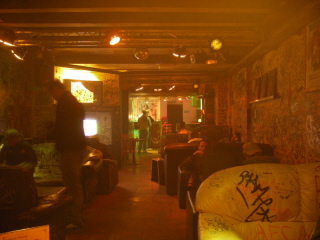
downstairs of a coffee shop (courtesy Wikimedia)
Checkpoint was serving up to 3,000 customers a day, mainly Belgian and French, but was closed after investigators twice found large amounts of cannabis on the premises. They found 120 kilograms on premise in 2007 and 110 kilos in May 2008.
Under Holland's "tolerance" policy toward cannabis, people can purchase up to five grams per day at licensed coffee shops. Coffee shops are limited to having five pounds on hand. That law has been widely, if quietly, flouted. For a high-volume coffee shop like the Checkpoint, for example, five pounds could be going out the door every hour five grams at a time.
Like all Dutch coffee shops, the Checkpoint also suffered from the "back door" problem. While the Netherlands provides for legal sales, it does not provide for a legal cannabis supply to the coffee shops. That leaves the supply, a $4 billion a year black market business, to an ever-responsive criminal underground.
"The question is whether the conditions of the government's tolerance policy have been violated," Judge Saskia Meeuwis said at the start of the trial.
Prosecutors certainly thought so. "This is clearly a contravention of the spirit of the tolerance policy devised by the government to respond to local demand," said Middelburg prosecution spokeswoman Elke Kool. "This is the biggest-ever case of its sort. We are dealing with a real criminal organization here."
But Raymond Dufour of the Netherlands Drug Policy Foundation told Cannazine the case shows that the current system does not work. "Coffee shops are only allowed to have 500 grams of cannabis in stock," he said. "Everybody knows that if you have 2,500 clients a day, you need more than 500 grams. It's just a silly condition. Everybody in Terneuzen must have known this."
The trial comes as the Netherlands moves to tighten the reins on the coffee shops. The national government announced in September that it wanted to reserve coffee shops for local users -- not foreign drug tourists. The city of Amsterdam has moved to cut the number of its coffee shops in half, while other cities are imposing zoning restrictions on them. In southern Limburg province, 30 coffee shops will become members-only clubs next year, while in two border towns, local authorities are shutting down all coffee shops in a bid to defeat drug tourism.
In April last year, Checkpoint introduced a customer card system intended to prevent customers from exceeding the daily five gram limit and prevent minors from entering the shop.
A verdict in the Checkpoint case is expected December 2.
This work by StoptheDrugWar.org is licensed under Creative Commons Attribution-ShareAlike 4.0 International


Add new comment