Drug War Issues
Politics & Advocacy
Drug courts have spread all across the country since the first one was instituted in Miami 20 years ago by then local prosecutor Janet Reno, but now, the nation's largest group of criminal defense attorneys says they have become an obstacle to cost-effective drug treatment and a burden on the criminal justice system. In a report released Tuesday, America's Problem-Solving Courts: The Criminal Costs of Treatment and the Case for Reform, the National Association of Criminal Defense Attorneys (NACDL) argued that drug addiction should be considered a public health problem, outside the criminal justice arena.
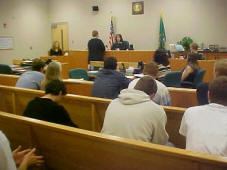
drug court
Minorities, immigrants, and poor people are often underrepresented in drug court programs, leaving them to rot behind bars at taxpayer expense. Drug courts also mean that access to drug treatment comes at the cost of a guilty plea, the group said.
"Today's drug courts have been operating for over 20 years yet have not stymied the rise in both drug abuse or exponentially increasing prison costs to taxpayers," said NACDL president Cynthia Orr. "It is time for both an extensive review of these courts and for the average American to ask themselves: Is our national drug policy working, and perhaps it is a public health concern rather than a criminal justice one?"
In the report, NACDL recommended the following reforms:
- Treating substance abuse as a public health issue rather than a criminal justice one;
- Opening admission criteria to all those who need, want and request treatment;
- Enforcing greater transparency in admission practices and relying on expert assessments, not merely the judgment of prosecutors;
- Prohibiting the requirement of guilty pleas as the price of admission;
- Urging greater involvement of the defense bar to create programs that preserve the rights of the accused;
- Considering the ethical obligations of defense lawyers to their client even if they choose court-directed treatment; and
- Opening a serious national discussion on decriminalizing low-level drug use.
This work by StoptheDrugWar.org is licensed under Creative Commons Attribution-ShareAlike 4.0 International


Comments
Drug Courts
I have for the last 10 years been questioning the efficiy of Drug Courts, the very fact that "Clients"are forced to plead guilty to be addmitted is in direct violation of the United States Constitution.
The fact that Drug Courts are based on Coersion and Punishment goes against every evidenced based model for effective treatment of Substance use Disorders.
And the fact that clients are forced to pay for treatment that in effect is no treatment at all, is again a constitutional question.
And as mentioned in the article, often Judges with no training in Substance abuse often overrule the accesments of train clinicians.
As much as I detest Lawyers, I have to agree with the NACDL, Substance use Disorders is a public health issue, which should be handled by those trained in the field. It would be a benifit to treatment if the monies allocated to drug courts could be funneled into access to treatment, and evidenced based educational programs.
1."drug" scam;2."therapists";3.$cigtaxquidproquo;4.Big pHARMa
1. To paraphrase the previous comment, many defendants plead guilty in order to pass for "easy" and avoid the hard time that "hard cases" get. ("Admission" to the drug court program is a better deal than prison-- you are better protected against gang-rape, persecution etc.) That in turn enables prohibitionists to "prove" marijuana is a problem-causing "drug" by pointing to the large statistical number of marijuana "offenders" admitted to the drug court program.
2. Both in prison and in "drug programs" are to be found well-paid bureaucrat "therapists" punitively pretending to "treat" the marijuana "drug offenders" on the premise that cannabis must be classified as a "drug" rather than as an "herb" or "nutritional supplement" which would place it in a non-punitive category.
3. Police, prosecutors, judges, bailiffs, guards are all benefiting from their share of over $30-bil./yr/US nicotine $igarette tax money, and for that they reward the big tobackgo corporations by suppressing cannabis as an illegal "drug" and thereby suppressing the anti-overdose smoking and vaporizing equipment (which, if cannabis were legal, could become readily available to tobacco users and replace the now entrenched profitable hot burning overdose $igarette marketing format), on the premise that such equipment is related to illegal cannabis and thus also illegal or "evidence". (How would you like your $600 Volcano vaporizer to be confiscated, or used as evidence to convict you of a crime?)
4. Big pHARMa doesn't want unprofitable homegrown cannabis to get a chance to (a) outclass their currently profitable proprietary Stop Smoking remedies at $20, $40, $60 a box and a 10% success rate, and (b) cause an abrupt decline in cigarette smoking, leading to a consequent decline in sales of profitable Statins and other drugs now used to manage chronic tobacco-related degenerative diseases.
addiction
the fact that revenue not only drives but fuels this whole debate is not only desatirous to the community as awhole but goes to show that treatment and recovery comes down to the individuals commitment to not only better themselves but the people they associate with. Real addicts cant be forced into recovery. They have to choose recovery. It has become a feeding frenzy all these businesses fighting over goverment contracts. allocated to fund drug treatment centers in the name of bettering the people . the fact is you have to not only give up your constitional rights but give up the fact that forcing people who really dont have the desise of addiction but the diesese of money. patients are forced to sign blank releases of information upon admmission to these so called department of correction treatment facilities. these release are used to sercumvent are basic constitutional rights. The 12 step meetings of alcholics anonymous and narcotics anonymous have grown to numbers in the millions while not only give people a chance at a new life but doing it with honesty. when will honest become an everyday god given right to the poor and less fourtunate.They make these laws complexe for a reason. so the uneducated cant figure them out. So now we must trust the laws and the people who right them. when will the counstition not be for sale
Courts Drug Program
This Drug Court program is a useless bunch of crap. The judge sits on her or his throne of authority, Treating these people with problems like they are no body's. They are not allowed to say anything. The judge is so noncaring. We were sitting in the court room and the Court appointed lawyer for the defendent did nothing, He gets paid to do nothing. It is discussed what to do with the defendent behind closed doors. You are at the mercy of them.
Where is the treatment??? if you fail a test you get locked up till the judge lets you out. WITH NO BAIL. PEOPLE WHO MURDER CAN GET OUT ON BAIL if they can pay it.
I say this is a way for the State of Florida to make money. It's time we wake up people and see what is going on here. This is unconstitutional all their rights are taken away, This is not helping them.
guy are iDrug Court and Rehabilitation - A Conflict of Interests
Whenever you mix law enforcement with rehabilitation, you get poor results. The costs are horrible, the system is corrupt.
The Drug Court Judge in my small town in upstate NY is a wildcard. My girlfriend and another dude are in the same "class" together. They are due to graduation in 2 weeks. The dude has sanctioned 4 or 5 times while on Drug Court. The worst he has got is a few days in jail...in fact just this week his opiate line was so faint he nearly got nailed again. I know he was dirty because he called earlier in the week all messed up. he is young, single, and got on drug court by being part of a breaking and entering charge.
My girlfriend on the otherhand never sanctioned in drug court, until this week. Her friend..who she met in rehab when forced to go on probation..put cocaine in front of her, and after a year and 3 months of sobriety, she took a taste of it with her finger just to see how it was cut(not condoning her bad decision, just stating a fact). She was given a choice of rehab or jail.
This same judge let a teen male who stabbed and killed a kid free, then the kid left town moved to Florida and killed his girlfriend.
A real wildcard is what I am trying to say.
So today at 10:30 am, my girl was called down to court. Immediately put in jail, no phone call, no lawyer. I wont be able to talk to her for 5 days, and then she will go to a 6 to 12 month residential rehab 3 hours from our town.
Here is the kicker. She is a single mom with 2 kids, which if I didn't happen to go to court to know she would not be coming home, would have been home alone. We had a funeral to attend tomorrow, she will not be there, and I am taking care of her kids for the next year. What if she was still single and alone...how long would these kids have been alone before someone helped them?
This seems like a disturbing malpractice of a county court system. Taking a mother from her children is not appropriate for the "crime", and letting them be abandoned by not having any responsability to ensure they were taken care of is even worse. Thank God I am here for them!
Who was going to let the kids know that thier mother would not be home for the next 6 - 12 months?
Who was going to let the kids know WHERE thier mother is?!!!?
Who is going to feed and shelter these kids?
Shouldnt a county that is forcing jail and rehab upon its citizens have a resposability to have answers to these questions before they throw someone in jail?
I am disgusted with Drug Court, and I was an advocate of it because I thought it could help my girlfriend stay out of jail and with her kids and provide some rehabilitation (she had a DWI and was looking at 1 - 4 years)...thats right her charge was DWI...nothing to do with drugs persay.
So now, after she returns from rehab...next year....she will have to finish drug court, and then she will get 5 years felony probation.
I wonder if the county should be held liable? The same judge is the family court judge....what a joke! He protects familys by removing an only parent from the equation, and not even so much as a drive by from the police or social services is ordered. For all he knows these kids are sitting home alone waiting for thier mom to come home.
In reply to guy are iDrug Court and Rehabilitation - A Conflict of Interests by Victim_Upstate_NY (not verified)
drug court
wow! this story of your girlfriend really is a crazy one! i find myself facing that situation every week when i go before the judge. even though im not using, there is never any telling of a certain thing that was asked of me or some requirement that i didnt complete on time or SOME REASON i have to be scared when i am in court that i may get in trouble for SOMETHING or another! trying sooooooooooooooo hard to do EVERYTHING they ask is a bit overwhelming most of the time! we say in my drug court group the sooner you come to terms with the fact that we as clients are always going to be wrong and them as drug court staff will always, always, ALWAYS BE RIGHT, the better off we will be! good luck to you and cudos for stepping up for those children!
DRUG COURT GRRRRRRR!!!!!!
My boyfriend has been clean for bout 49 days now and is in drug court. I know he hasnt been using cause im always with him but yet he got a false positive yesterday. they told him that if he said he didnt use when he wasnt (which is the truth) than they were going to send him to prison, but if he lied and said he did when he didnt than it would all go easier. so to keep from going to prison he said he did and ended up getting sanctioned. he was supposed to call from booking but never did. It sucks cause now im left with his two kids. which dont get me wrong i love them all but it makes me mad that he would have gotten sent to prison over telling the truth. They sent the test in to get double checked and wont find out if it was a bad cup or not for a few days. grrrrrrrrr makes me mad.
Bergen County NJ Drug Court
Drug court in southern VA is totally corrupt
All the things the above posters have written sound all too familiar. There has to be some oversight into these courts, as they are literally ruining the lives of the participants. The rules are totally arbitratry, and like one poster said, I too go into court every week wondering if I'm gonna get in trouble for something I had no idea about.
Just an FYI, I've been terminated from the program and was held back for 3 months over two mistakes the drug court team made. They threw me in jail when I was terminated, then realized they made a mistake and came and got me out. I didn't even receive an apology. I was told that "now I know what it feels like to be terminated." All because of their mistake that a 10 year old could've caught. I've still had to stay 3 months behind on my graduation because they refuse to give me my time back even though it was obviously their mistake. I've never failed a screen, missed a meeting, or even been one minute late to a meeting. These courts are fueled by incometence and a very real naivete towards addiction. Many participants end up dying while in drug court due to the judge or DA trying to play doctor.
I'm in drug court for DWI and this program has stripped away the things I worked so hard to acquire. I had landed my dream job, graduated from a prestigious university (with 2 degrees) summa cum laude, and had some of the best friends anyone can ask for. Now, all those things are a distant memory and I've never been so depressed or felt so alone. While I don't think I can follow through with suicide, I often wish death upon myself. This has truly ruined the person I once was.
I still cannot believe these courts are allowed to operate without any oversight. They are 100% corrrupt and I've yet to see them help anyone. If I could go back in time, I would certainly not listen to my lawyer and would've taken the two days in jail I was facing.
A word to the wise, do not ever accept this program no matter what anyone says. Everything about it is the opposite of what I was told. Best wishes to all the others having to struggle through this real life nightmare.
All posts above are
Add new comment