Consequences of Prohibition
Drug War Issues
Politics & Advocacy
The Obama administration has shifted gears in Afghanistan, rejecting the Bush administration's emphasis on opium poppy eradication in favor of attacking Taliban-linked drug trafficking networks as it increases the number of US military personnel in the country to nearly 70,000. Along with that increase in American servicemen and women in Afghanistan, the administration is also ramping up the DEA presence in the country.
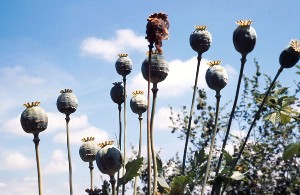
opium poppies (incised papaver specimens)
Afghanistan produces more than 90% of the world's opium poppy supply, from which heroin is derived. One province now in the sights of a 4,000 strong US Marine expeditionary force, Helmand province, by itself produces more than half of all Afghan opium and if it were its own country, would be the world's largest opium supplier.
While all factions in Afghanistan have their fingers in the poppy pie, including numerous officials and warlords linked to the Karzai government, the US and NATO are especially interested in disrupting those portions of the drug trade that help finance the Taliban insurgency. The Taliban is estimated to make hundreds of millions of dollars a year from taxing poppy crops, acting as armed escorts for drug caravans, and running international drug trafficking operations.
In the past, the Taliban has benefitted from eradication campaigns in at least two ways. First, to the extent such campaigns are successful, they drive up the price of opium, which the Taliban has abundantly stockpiled. Second, the eradication campaigns have proven a fertile recruiting tool for the Taliban as farmers angry at seeing their livelihoods destroyed look to join those who ostensibly oppose eradication.
This work by StoptheDrugWar.org is licensed under Creative Commons Attribution-ShareAlike 4.0 International


Comments
bananas?
Before you dismiss Joe's rant (he's gone bananas), consider these indisputable facts about the USA in its first 2+ centuries:
We supplied the planes used by RAF pilots to destroy 80,000 men, women, children, doctors, nurses, hospitals in Dresden 10 miles from the meat warehouse where P.O.W. Private Vonnegut huddled on the night when he was 22 years, 3 months and 2 days of age;
We bombed away even more civilians at Hiroshima and Nagasaki 4-5 weeks before my late Downs Syndrome younger brother was conceived;
We invented the suicide bomber (that's the drunk driver in the next car approaching you around the bend, in your lane; legalized cannabis could have eliminated binge drinking parties from the planet forever);
We built up the worldwide advertising juggernaut known as Big 2Wackgo, now in its diversified forms inflicting a reported (WHO, Feb. 7, 2008) 5.4-million-deaths-per-year genocide on the world (a cigarette helps that binge-drinker "clear his head" and get in the car to start driving your way);
US economic sanctions, military power and aid to specific politicians and parties keep the anti-cannabis laws in force everywhere on the planet, such as in Pakistan (alias TobaccoStand) where 10% of all government revenues are derived from cigarette taxes.
War Crime
Obama is a war criminal for not stopping the wars. Afghan and Iraq. He still puts people in cages for plants what an ass hole he is.
Obama is nothing but shit.
Definitely a 'hazard pay' post
And any DEA Agent who wants to roll the dice on their personal survival by 'serving' there is welcome to do so. I imagine the locals on meeting their first Agents will provide a very warm welcome, indeed. For it won't be disarmed, mellow and easily brutalized 'pot-heads' they'll be chasing, but tribesmen with a several thousand year history of guerilla warfare practically bred into their genes.
By all means, DEA, please, have at it. The more, the merrier. Though, if I were in charge of their life-insurance policy, I'd be tempted to cancel their coverage...
Numbers?
Dont know how accurate this post is: the UK has some 5,000 troops in Helmand, and we are suffering losses daily.... five in one incident last weekend.
Reports of US troops in Helmand give strengthe at 8,000, with 120 helicopters............ Brit forces are allowed only ten or so by Gordon the Moron, and is the reason for our high casualty rate.
Why dont the CIA send in hundreds, grab all the opium, and fund a few new wars for the sake of Capitalism and the Bankers: some may think its a winner............
Add new comment