Consequences of Prohibition
Drug War Issues
Politics & Advocacy

medical marijuana hearings, Minnesota Senate (the uptake.org via mnstories.com)
More broadly, medical marijuana has become part of the legislative landscape. It is now either the law of the land or under consideration in more than 30 states. Most of the states where it is not on the political agenda are in the South. On the West Coast, it's a done deal; in the Rocky Mountain states, half are already there; in the Midwest, progress is slow but ongoing; and in the Northeast, the issue has been red hot in recent years.
Here's what things look like right now, followed by some discussion below. Note that this is the Chronicle's assessment, based on legislative histories and the analyses of the people we talked to below, among others:
States where a bill was introduced and is already dead:
Iowa
Kansas
South Dakota
States where bills have been in play, but are unlikely to pass this year:
Alabama
Connecticut
Massachusetts
Missouri
Ohio
Tennessee
Texas
States with bills either just introduced or not introduced yet, but promised, and thus unlikely to pass this year:
Delaware
Idaho
Pennsylvania
Wisconsin
States with the best chance of passage this year:
Illinois
Minnesota
New Hampshire
New Jersey
New York
Rhode Island
"There are a couple of states where we are very close," said Dan Bernath, assistant communications director for the Marijuana Policy Project, which is involved in all the states most likely to see a bill pass this year. "Medical marijuana activists are used to having their hearts broken in state legislatures, but there's a very good chance we will see something pass this year."
In Illinois, companion House and Senate bills are awaiting floor votes, but MPP reports that "they do not have enough committed 'yes' votes to be sent to the governor for approval." A similar bill was defeated in the Senate two years ago, but the House has never had a floor vote on it.
In Minnesota, the House version of the medical marijuana bill passed its final committee hurdle on Tuesday and heads for a floor vote. The Senate has already approved its version. But Republican Gov. Tim Pawlenty has "concerns" and has threatened a veto.

Jim Miller at Coalition for Medical Marijuana-New Jersey event
In New Jersey, a medical marijuana bill passed the Senate in February, but has languished in the House, where it is stuck in committee. But a hearing will take place later this year, and the bill could move forward after that.
In New York, identical bills have been introduced in both the Assembly and the Senate. The House passed a bill last year, but it went nowhere under then Republican Senate leadership. Now, with both houses under Democratic control and a friendly Democratic governor, the bill has a real chance.
In Rhode Island, which has an existing medical marijuana program, a bill that would establish "compassion centers" for distributing it to qualified patients passed the Senate in April and is awaiting action in the House.
"This is a crucial time for a lot of bills we have in play," said Bernath, citing the far advanced bills in Minnesota and New Hampshire, both of which face reluctant governors. "In New Hampshire, we've passed both the House and Senate, and now the House is working to address some of the governor's concerns while still crafting a bill that will work with patients."
In Minnesota, Bernath noted, Gov. Pawlenty has opposed medical marijuana. "The governor has expressed concerns in the past, and our supporters in Minnesota have been working hard to address those," he said. "The governor has had the opportunity to get educated on medical marijuana over these past few years, but continues to say he sides with law enforcement. But law enforcement's credibility has been eroding, so there's some reason to hope the governor will come around."
In New Jersey, where the Drug Policy Alliance, MPP and NORML have a played a role, it may just be a matter of time. "It's headed for the Assembly Health Committee for a hearing, perhaps in June, but maybe in the fall," said Ken Wolski, director of the Coalition for Medical Marijuana-New Jersey. "It really depends on the chairman of the committee, Dr. Herb Conaway (D-Delran). We've been in contact with him, but the problem is all the assemblymen are up for election in November, and they're nervous about what they consider a controversial medical marijuana bill. If not in June, it could be after the election."
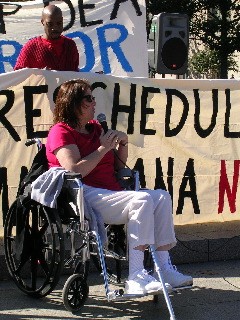
Rhode Island patient activist Rhonda O'Donnell, at DC protest
"New Jersey is going to be a long slog, it could go either way, but it looks like they'll sit on it through September, which gives both sides plenty of time to lobby," said NORML's Allen St. Pierre. "But with Gov. Corzine saying he will sign it; that gives it greater impetus, so I think New Jersey will end up with patient protection laws."
As for New York, the political stars could now be aligning, said St. Pierre. "It's not clear how far this will progress, but as in New Jersey, it's one of those rare times where the governor has effectively said he will sign a medical marijuana bill, and that helps."
Like New Jersey, New York has been the subject of years of work by DPA in Albany, and MPP has a hired lobbyist stalking those halls. "In both cases, there have been people working this for five to seven years," said St. Pierre.
"Things have never looked better in New York," said MPP's Bernath. "In the past, the problem was the Republican-controlled Senate, but now it's the Democrats in charge, and we have a lot of confidence that this will get through the Senate. The Assembly is already very supportive."
The state legislative process is agonizingly and frustratingly slow, but medical marijuana has already proven to be an issue that can win at the statehouse and not just at the ballot box. In 2009, only 13 years after California voters approved the first state medical marijuana law, about a quarter of the population live in medical marijuana states. Chances are that before the year is over, that percentage is going to increase.
This work by StoptheDrugWar.org is licensed under Creative Commons Attribution-ShareAlike 4.0 International


Comments
Iowa has a two year session
Our medical marijuana bill was introduced late in the session for purposes of having a public hearing and making adjustments. To say it is dead in the water is a little premature since it's still pending.
Carl Olsen
Iowans for Medical Marijuana
Post Office Box 4091
Des Moines, Iowa 50333
515-288-5798
http://www.iowamedicalmarijuana.org/
In reply to Iowa has a two year session by Anonymous (not verified)
We don't stop after the legislative session ends in states
Remember that after the legislative session ends in many states, we all need to get our cities to pass resolutions that call for a debate on the benefits legalized marijuana regulation.
Iowa has a civil judgment against it's marijuana laws
I forgot to mention that I won a lawsuit against the Board of Pharmacy on April 1, 2009, for failing to remove marijuana from Schedule I of the state controlled substances act. The Board has still failed to do anything, but they have 30 days to appeal and that time hasn't been exhausted yet. This could force the state to consider our medical marijuana bill.
Carl Olsen
Iowans for Medical Marijuana
Post Office Box 4091
Des Moines, Iowa 50333
515-288-5798
http://www.iowamedicalmarijuana.org/
Legalize Marijuana in California
Californians: Would you like to see marijuana legalized, taxed, and regulated like alcohol? That is exactly what California Assembly Bill 390, introduced in February by Tom Ammiano, would do.
If you support legalization for recreational purposes, YOU can make it happen. E-mail your state legislators to support AB 390. It's easy. Visit yes390.org
wow
Mr. Olsen you are a hero to all!
Hey Minnesotans: Pawlenty is
Hey Minnesotans: Pawlenty is another good reason to vote Democrat next chance you have!! Y'all need a little ganja to take care of that pain in your collective asses... whatcha think??
In reply to Hey Minnesotans: Pawlenty is by Anonymous (not verified)
ive got a feelin he'll sign
ive got a feelin he'll sign it this year so i can stay home instead of going searching some where else that will except me for my medical use
What about North Carolina
I noticed that the NC work isn't on this list of states that could have marijuana for the sick and dying legalized.
Go to,.www.asawnc.org or www.nccpn.org
Tom McMillan
Whittier, NC
kentucky
how about kentucky
Wisconsin not "unlikely to pass"
A bit premature to count WI out before a bill has even been introduced, but then no one even asked. WI is actually in a much better position than some states named sure things, and no veto threat.
Gary Storck
Is My Medicine Legal YET?
WI NORML
In reply to Wisconsin not "unlikely to pass" by Anonymous (not verified)
Wisconsin is a national disgrace
It's hard to believe that the state that for twenty-plus years has hosted the "Harves Festival" for marijuana legalization in its capitol city has barely moved at in over a decade. While all the yuppie kids from Staten Island and "The City" go out of state to have their little hippie experience and take mushrooms in their dorm rooms at Madison, they certainly could give a flying for progressive laws in the state pace Fighting Bob Lafollette.
Government is group of serial murdereres
Who do not have the right to make laws against any person or plant! All the prohibition terrorists should be sentenced to the prisons they built and/or executed in the execution chambers.
Florida Patient Choice Medical Marijuana Ballot Question
People United for Medical Marijuana (www.pufmm.org) is busy working in Florida for medical marijuana. We have been holding organizational meeting throughout the state (we are meeting this weekend in Tampa, stop in!Check it out on Meetup.com), and already have ballot language approved for petition, collecting signed petitions and raising money. We are also preparing a legislative strategy for the fall session. All is not lost in the South.
Scott D.
People United for Medical Marijuana
MN Medical Marijuana Laws
I seriously hope that Minnesota passes this law- it is NEEDED- I watched my mother suffer through Ovarian Cancer for 7yrs & battle brain tumors- her doctor was all for it in her case but couldn't help because its not legal- people are people not numbers & compassion for what they go through with the decision not to give up needs to be commended & they deserve to have a little comfort while they go through hell!
Minnesota Law now unworkable; Thank Pawlenty
Legislators passed an unworkable law in trying to figure out what Gov. Tim Pawlenty would be amenable to signing. They scrapped the language that had passed 6 committee hearings in favor of a law that now requires a person have a terminal illness AND has conditions such as wasting, intractable pain, etc. The fatal flaw here is that the proposed law allows non-profits to be established to provide the meds. How is a business of any kind going to be able to sustain itself with a customer base that is dying? So we now have everything we need to "pass" the medical marijuana bill EXCEPT for qualifying patients and a place for them to get their meds. Absolutely worthless as it is now written. They've essentially made is so restrictive that even cancer patients will have to jump through hoops, be terminal. and have additional symptoms. How does this benefit anyone? Patients will still need to buy on the streets and only those so far gone that there is no turning back will now have legal protection. Pawlenty deferred to law enforcement throughout this process and never intimated what his "concerns" were, other than law enforcement opposed it. Thank You, Governor Pawlenty, for further marginalizing the sick and dying and forcing legislators to try to be mind readers. Excellent leadership yet again.
the concept of medical marijuana baffles me
For the life of me I don't understand the concept of medical marijuana. I understand that it has medicinal properties, but so does alcohol. There was no medical alcohol movement? I suppose any win is a win for the cause, but it seems like the wrong way to go. Full legalization and regulation of marijuana, and for God's sake hemp, should be the only goal. These half steps are absurd and a waste of time IMO.
It's a freak'n plant, ok. Aspirin kills more people than marijuana. Can we please get this done? I'm tired of living in the stupid peoples' republic. There is not one, not one, justifiable reason to have it be illegal. Illegal marijuana/hemp is not only un Constitutional, it is un Biblical.
I want my taxes. I want my unviolent fellow citizens out of prison. I want less cops harassing otherwise peaceful law abiding citizens. I want due process. I want the mafias and gangs to go away. AND I want to light a joint up on by back porch, and grow my own beautiful plants, without worrying if I will have my house raided, my job forfeit, and my child taken by f'ing CPS. OK?
MEDIA CENSORSHIP - NOW FROM SYRACUSE POST
The Syracuse Standard's Online Edition has deleted/dumped/disappeared many of my informative comments and links to credible medical cannabis information from groups like the American College of Physicians, but they continue to print hysterical comments from rabid anti-medical Cannabis people.
It appears I've stumbled across another media outlet (owned by the Newhouse Family) that is deliberately dumping the most credible pro-information that doesn't "jive" with insane "reefer madness." (In all fairness, the reporter did a decent job presenting the facts, but non-inflammatory comments regarding the article should not be dumped).
I have spent 48-hours trying to get to bottom of why/how Syracuse's Post-Standard is dumping large amounts of VITAL MEDICAL INFORMATION. And most of the staff (with the exception of the reporter and R.S.) have been unbelievably rude, antagonistic and obstructive.
Please let Syracuse's Post Standard know that they should NOT be dumping large amounts of positive information about Medical Cannabis, especially when the information comes from groups like the American College of Physicians.
Please help me force the Post to stop their yellow crap. Ask them to print MedicalFacts's (my user name for the online edition) comments, please and thanks.
LEGAL in Jersey
I'll tell you, NJ is one of the toughest states to live in. We're financially fu_kd and every sort of fee or stipulation that could be heard of exists. It's also extremely corrupt which appearantly for once could be to our advantage. To get the governer to agree to sign is a great sign. I share in the same feeling that I'd love to sit on my back porch, or even in my house without pacing around for two hours, looking out my windows to see if my nosy neighbors are watching me and expecting every siren for me, which is unfortunate considering I live off a street where the main road at the bottom leads to the hospital, plus cops in this town are very overzealous about everything. You know the add about the bank and the wife say's It's like someone sits at a table all day and thinks of ways to nickle and dime us. That's NJ. and we get the brunt of late night jokes and many others. That said, thanks, needed to vent, I'm bipolar. I've been put under every medicine under the sun. Risperdal, Geodon, Abilify, Zyprexa, everything. Not only does it make it unable for me to funtion but all of these medicines can have very leathal side affecs. I wet the bed all the time, I'm only 29. If I don't get off it it I will only get worse, something that was supposed to make me feel better. Smoking a bowl after work and when I wake up helps me a lot. It helps me to get up, not be as depressed, I come down from the day and am given an ability to focus more than I'd be able too. It helps me to sleep and eat. I've been anorexic and with thoughts spinning around in my mind, I can't go to sleep without something. Seraquil knocke dme out like a horse and the risperdal was even worse. I am a cigarrete smoker but I believe I could quit while using marajuana. I'm not able to relax though with all these sirens. Make it legal so I can eat sleep try and let me take my medicine. You won't get arrested or even carded from taking an asprin and you won't dye from ODing on Marajuana but have to hide behind your shades.
'Run from the cure': Rick Simpson Youtoube;medical marijuana
See how many people who were terminal now have clean bills of health thanks to common sense,cannabis/hemp natural health,nutrition,hydration,self discipline and determination. Look deeper into the past and present of the cartel who claim to be corporations and government officials that started these prohibitions and you will see that they are exactly what they claim to be against and worse.
Add new comment