Drug War Issues
Politics & Advocacy
The New York Assembly Wednesday passed a bill that would repeal much of the state's draconian Rockefeller drug laws. Enacted in 1973 under Gov. Nelson Rockefeller (R), the laws are some of the toughest in the nation and have served as a model for "tough on crime" legislation across the country in the years since then.
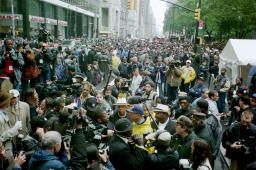
June 2003 ''Countdown to Fairness'' rally against the Rockefeller drug laws, NYC (courtesy 15yearstolife.com)
Now, all eyes turn to the state Senate, where an identical bill has been introduced. Complicating matters is that the New York State Sentencing Commission last month released its own, much less reformist recommendations, which are supposed to be Gov. David Paterson's (D) guide to reform legislation. The governor is not bound by the commission majority's recommendations, but it is not clear yet just what Paterson will do.
Thanks to the Rockefeller laws -- and despite reforms in 2004 and 2005 that had no impact on less serious offenders imprisoned under them -- nearly 12,000 people are currently behind bars for drugs in New York. Even after the 2004-2005 tinkering, the state prison system continues to be flooded with new Rockefeller law victims. More than 5,000 people were sent to prison for nonviolent drug offenses last year.
More than 42% of Rockefeller law prisoners -- more than 5,000 people -- are doing hard time for simple drug possession, many of them convicted of the lowest level drug felonies, which involve only small amounts of drugs. For instance, a half-gram of cocaine can earn a Class D felony charge. As of last month, 1,098 people were imprisoned for that offense.
The mass imprisonment of drug offenders comes at a substantial cost to Empire State taxpayers. According to the Correctional Association of New York, the state spends $525 million a year to incarcerate drug offenders and has spent $1.5 billion on building prisons to house them.
"More than 35 years after the Rockefeller drug laws were enacted, it is clear that these laws mandating imprisonment for even lower-level offenders have failed to effectively combat drug abuse or reduce the incidence of violent crime," said Assembly leader Rep. Sheldon Silver (D-Manhattan) before the vote Wednesday. "This legislation restores humanity to drug policy here in New York. It expands the sentencing options available to judges, without endangering the public. Judges are in the best position to know who is deserving of prison and who is not. State prison and mandatory prison sentences are not the magic bullets to address drug abuse and its attendant problems; restoring judicial discretion is the solution."
"These reforms are long overdue," said Rep. Jeffrion Aubrey (D-Queens), the primary sponsor of the bill. "This legislation provides for a more sensible, comprehensive and cost-effective approach for dealing with lower-level drug offenders and addicts. Think of all the resources that have been spent on locking-up nonviolent drug offenders that could have been invested in the education, rehabilitation and job training that can save lives. Treatment programs in New York City have a ten percent recidivism rate for participants one year after completion, compared to 60 to 70% for those not in programs. Treatment works."
Activists who have spent years trying to make the legislature pay heed to calls for Rockefeller law reform -- or outright repeal -- pronounced themselves pleased with the Assembly vote. But while there was agreement that the bill contained significant reforms, some said it did not go far enough.
"With everyone from the Sentencing Commission to the governor talking about reforming the Rockefeller drug laws, it's critical to examine any proposal and make sure it constitutes real reform," said Gabriel Sayegh, project director with the Drug Policy Alliance. "To be real, meaningful reform, any proposal must include restoration of judicial discretion in drug cases; expansion of alternative-to-incarceration programs and community based drug treatment; fair and equitable sentencing reforms; and retroactive sentencing relief for people serving unjust sentences under the Rockefeller drug laws. The Assembly has included these provisions, and their proposal constitutes real reform."
"New York State is closer to justice today than we were yesterday," said Donna Lieberman, executive director of the New York Civil Liberties Union. "By passing this bill, our state's Assembly is letting go of 36 years of failure and moving toward meaningful reform of the Rockefeller drug laws."
"The Rockefeller drug laws have failed by every measure -- cost, drug use, public safety," added the group's legislative director, Robert Perry. "With the passage of Jeff Aubrey's bill, the Assembly has acted on Governor Paterson's directive to fundamentally reform the state's failed drug policy. The bill shifts the paradigm, away from mass incarceration and toward a public health model."
But the NYCLU also said that "in certain essential respects, the Assembly proposal does not fully realize the reform principles on which the legislation is based." It listed several examples:
- The bill leaves in place a sentencing scheme that permits unreasonably harsh maximum sentences for low-level, nonviolent drug offenses;
- The bill disqualifies from eligibility for treatment and rehabilitation individuals who may be most in need of such programs; and
- The bill creates an unnecessarily burdensome procedure for sealing a criminal record after someone has completed a substance abuse program.
"This is an essential first step, but we encourage Governor Paterson and the state Senate to authorize judicial discretion to divert individuals from prison in all appropriate cases; to expand and improve the quality of alternative to incarceration programs; and to provide long-sought justice to the thousands of families that have been torn apart by the Rockefeller drug laws," Lieberman said.
Randy Credico of the William Moses Kunstler Fund for Racial Justice, which has been part of the Rockefeller reform movement for years, offered a more radical critique. "It's not just the Rockefeller drug laws -- we need to completely overhaul the criminal justice system, from sentencing to the appointment of judges to judge-shopping by prosecutors to racial profiling to banning stop and frisk searches. People need to focus on the overall criminal justice system, or just as many people will be going to prison as we have now," he told the Chronicle last month.
But right now, the focus is on getting Rockefeller reform legislation to the governor's desk. DPA's Sayegh said there were good signs in the Senate. "The Senate bill introduced by Sen. Eric Schneiderman (D-Bronx) is the same bill as was introduced in the Assembly," he pointed out. "We're very hopeful about that."
But Sayegh worried about what Gov. Paterson will propose. "The governor has apparently distributed a proposal to legislative leaders that has not been made public," he said. "We hope it is not a cut and paste from the Sentencing Commission, given that its recommendations do not constitute real reform."
Still, Sayegh predicted fast action in Albany. "This is moving along quickly. We think we may see a negotiated Senate bill within a week or two," he said. "Given the fiscal crisis we're facing, these reforms will save the state millions and millions of dollars. The time is right."
If and when substantial repeal of the Rockefeller drug laws is passed, then perhaps people will start asking why and whether drug users and sellers should be arrested in the first place absent harm to others. Drug treatment and drug courts may be an improvement over years in prison, but in a society that treated its citizens as adults, such authoritarian institutions would be reserved for people who have demonstrated their drug use is harming others.
This work by StoptheDrugWar.org is licensed under Creative Commons Attribution-ShareAlike 4.0 International


Comments
Its about time!
Man o man the name Rockefeller has meant snobby terrorist from 1903 to present time. Unless there any Rockefellers out their who know that pre-emptive war and prohibitions are unconstitutional? Are you there non plundering Rockefellers out there ? If so we would love to hear what you know>
An ok Rockefeller
Lawrence Rockefeller has done some good work on environmental issues and donated land and money to good causes. So he is at least not totally evil.
In reply to An ok Rockefeller by Anonymous (not verified)
Wha?
Who the heck is Lawrence Rockefeller? This article is about Nelson Rockefeller and his drug laws! They all were developed because he thought it might help him get elected president! People don't trust the rich. I wonder why?
But, I am sure the leaders of the drug cartels in Mexico have helped out some poor people. So, by your reasoning, they are not all evil either!
I hope you are not just feeding the troll! He writes more prolifically than, even, me!
They're all evil, selfserving turds!
Americas so called royalty,all they are ,are egotistical,greedy bastards who could care less of you or I...they do what's best for themselves...how much prison time did Joe Kennedy do for smuggling booze!...how about Dupont?? you think Hemp could really help this nation? ask the Duponts and you'll end up in jail..how about the Hearst Empire?....our''royalty of yesteryear,proclaimed that all man was equal, as thier slaves toiled in the fields,....they're now served by the Government ''we'' elect....so anything we win over those pricks is a victory!....however small, little by little,!
Famous for their archaic and brutal sentences
[email protected],Vancouver,B.C.Canada I can remember using these laws as an example of what can happen when a zealot passes laws on an issue he knows nothing about with an attitude that was always cruel,elitist,without mercy and with no thought to the accused.35 years ago there was almost no inmate committees or inmate rights.These laws still received a lot of press as being cruel and unusual.It shows what one petty little man with a lot of political pull can do to those he hates.Now the inmate committees are once again history and prisoners have no rights and prisons are overcrowded and private prisons report to themselves.The end of the Rockerfeller drug laws would be a real victory for sanity in drug legislation.Unfortunately,these are the model for what Stephen Harper has begun to pass here in Canada.Another zealot using a gang war to piggy back drug mandatory minimums to a public that is calling for longer prison times and tougher judges.The latter they have no say over.Thank whomever you thank for small favors.
the rockefellers set up the banks and now this
its too late to do anything about it now because them people in the white house are goin to agree with the bill of the rockefellers because they gone get paid off and these private banks are goin to have us in another recession
Like to learn more about the Rockefellers?
Check out David Blume Alcohol Can Be A gas. 1903 Rockefeller declared American Grange Co-Ops and any other organizations like the grange around the world to be terrorist and terror sponsoring organizations because they made their own fuel. Prior to this wall st propaganda blitz of media and payoffs to local law enforcements around the globe no car in America ran on gasoline. This was to be the launching of alcohol prohibition with cannabis prohibition both unconstitutionally set to plan and installment.
Dr.Ron Paul for Drug Czar
Yes Dr. Ron Paul for Drug Czar ! Instead of Kerlikowske. After all, Dr Ron Paul is a doctor.
New York: Take Action Now!
The Rockefeller Drug Laws create stark racial disparities in prison populations and exact an enormous financial toll on all of New York State. They are the New York State's Jim Crow Laws and have no place in a just society.
New York must reform the Rockefeller Drug Laws!
Click Here to send a free fax to your senators and to Governor Paterson urging them to put 36 years of failed Rockefeller Drug Laws behind us, once and for all. Tell the Senate to pass S.2855, and tell the Governor to sign it into law.
http://www.nyclu.org/rockefellerreform
http://www.NYCLUradio.org
a Cry for Help
I think this law is well over due...I'm a mother of 4 children 27 years of age, my fiance and I are know fighting a criminal case with or our strenght but its hard when the system is not in ur favor...I have never been arrested before my husband has a prior criminal record but no violent offenses...I have graduated high school and have sum college in criminal justice.....6 months ago my house was raided in the raid they retrieved 0.146 of a ounce of crack cocaine....I was arrested. My fiance was arrested nd my children were in the verge of being removed from my care....we both were giving bail ( outrages bail we cudnt afford) we both decided to have me bailed out so I cud go get our kids...first of all. A search warrent was not shown to us until 2 months later...the point is if we had the means to fight this case we wud win but due to the fact that we are basically being screwed I face 5 years probation n my fiance faces 4 and half years if we plead guilty and if we take to trail I face 1 year and my fiance 6 years for a simple possesion charge I loose my fiance, possibly loose my children and could go to jail for a year never been in jail before.....wat do I do to beat this system please help me [email protected]
TOO MUCH TIME
I AM GLAD THIS LAW IS BEING REVIEWED FOR CHANGE---MY BROTHER WAS GIVING 16 YEARS TO LIFE FOR PROCESSION OF COCAINE ATTEMPTING A SALE TO A UNDER COVER COP---I KNOW PEOPLE WHO HAVE ACTUALLY MURDERED SOMEONE AND DID NOT GET AS MUCH TIME AS MY BROTHER. I'M NOT SAYING WHAT HE WAS TRYING TO DO WAS RIGHT, BUT I JUST DON'T UNDERSTAND THE LENGTH OF TIME HE GOT--HE HAVE DONE ABOUT 13 YEARS BUT BECAUSE THAT LIFE IS AT THE END OF HIS SENTENCE HE MIGHT NOT EVER GET OUT. I BELEIVE IN MY HEART AND SOLE THAT SOMETHING IS NOT RIGHT ABOUT THIS WHOLE THING. UNFORTUNATELY I DO NOT HAVE THE MONEY TO PAY FOR THIS TO BE INVESTIGATED ON HIS BEHALF. I AM A SINGLE MOTHER OF TWO DAUGHTERS AND IS BARELY KEEPING A ROOF OVER OUR HEADS. I HAVE AND WILL ALWAYS KEEP MY BROTHER UP IN PRAY AND THE SITUATION SURROUNDING HIS IMPRISONMENT--CAN SOMEONE PLEASE HELP ME TO UNDERSTAND THIS BETTER????
drug laws
alot of the citizens of the United States are sentenced to life imprisonment for selling drugs "king pins". But, I feel that is wrong here we cant even make cocaine or crack and yet noone's got caught bringing it here why punish our citizens when they are the real problem
A letter to Govenor Jim Gibbons; Nevada
Ann Marie Volkel-Palmer
N. Las Vegas, Nevada
March 19, 2009
Dear Governor Jim Gibbons;
Allow me to introduce myself; I am Ann Marie Palmer, a voting tax-paying citizen of Clark County, Nevada, and have been for nearly 20years. Please take the time to read the contents of this letter in the hopes that it will enlighten you and your readers. I am not going to lie to you and say that I am perfect without blemish because I have a past and that is why my message is of the utmost importance to someone in your position.
I have seen all sides of the âwar-on-drugsâ and have witnessed and have experienced the devastations of loss. I speak from an experienced heart when I say that it is time to fix the monster that we, as a society, have created.
1. Allowing sub-stations to get a percentage of the âtakeâ in a forfeiture case gives our âcivil servantsâ, an incentive to be corrupt. It is bad enough that just by a disgruntled neighborâ call to 911 will bring out cops in riot gear! A person I know had his house raided, by this organized gang with a license to kill. They actually repelled off his roof, breaking all of his windows to enter the house, (maybe Metro needed the practice?). It was a ONE-story house and they found nothing! I was wondering if the forfeitureâs where also included within the Audit that the Federal Government had done with the Nevada Department of Prisons. Who accounts for this money? Is it public knowledge? Would this money better serve the communities in which it was confiscated, instead of lining the pockets of the Metropolitan Police Department?
2. How in the world does a grown adult find it a âjustifiable homicideâ to shoot a 15-yearold boy, handcuffed, running away, not once but twice in the back? I say, âPut the doughnut down and give chaseâ! How is it justified when a young man, (a tourist), listening to his music too loud, (for the law enforcement bullies), deserve to be shot to death? Are we not condoning this type of behavior when we, as a society, quietly accept these atrocities? Allowing an out-of-control police department to be judge, jury and executioner? It has been approximately 102 years since an on duty Las Vegas Metropolitan Police officer has been charged with murder.
3. How do we justify taking children away from their parents because they tested positive for a joint they smoked the weekend before. They were not âhighâ at the time of the testing. But yet their children are no less incarcerated and humiliated! How is it justified that a person that takes the drug âmethadoneâ, which is a highly addictive and mind altering substance, can hold down a job and raise a family and still test positive for this synthetic heroine? All they have to do is give the US \Government one hundred and sixty, ($160.00), dollars for a one month supply of this dangerous drug? (Prices may have gone up by now.) I ask you, who is the biggest drug dealer in America?
4. How do we justify putting more cops on the street when we donât have the public defenders to defend those arrested? Our police department will âstack chargesâ just to make sure something sticks. Our public defenders are nothing more than negotiators instead of litigators! Those accused are scared and will do and/or say anything to get out of jail. Our public defenders represent at between 350-400 clients per year when the national average is 150 per public defender. Less than 2% of all cases in Clark County even make it to the bench, they are pled out in the Justice Courts.
5. How do we justify that it makes rational sense to take away the driving privileges of a man that is behind on his child support? Thatâs a good idea, we just put them in jail for a few months and while our taxes are paying for their three squares and a cot, is their child support being paid? Of course not because it is just a growing debt which incurs interest as he/she sits. Some of these so-called âdead-beat-dadsâ never even had a clue that they were fathers and there are others that have no clue where their children are!
You may not have heard my name before but I guarantee that my name will be heard often. I am the voice of all those who cannot speak for themselves, whether for fear of incarceration or if already incarcerated retaliation for speaking out.
Right now in Iraq we are training at least 1% young men and women, with gang affiliations, paramilitary training that they will bring back with them to the states when all is said and done. That works out to be around 10,000 men and women, combat trained and ready.
Stop this nonsensical form of government and try a different approach because obviously the way it is now, is not working! We as a society need to understand that we are a âled peopleâ. We give authority to those who are suppose to guide us and make rational laws to protect and serve, to help and assist, to be a caring society even before disaster strikes. Unfortunate for us, we have forgotten how to live our lives free. Free of being afraid of threats that our own government creates.
Sincerely;
________________________
Ann Marie Volkel-Palmer
Add new comment