Drug War Issues
Politics & Advocacy
Beginning sometime next month, hard core heroin users in Denmark will be able to receive two doses of heroin a day, courtesy of the Danish health system. They will have to go to one of five drug clinics established around the country, where they will be able to inject pharmaceutical grade heroin under a doctor's supervision.
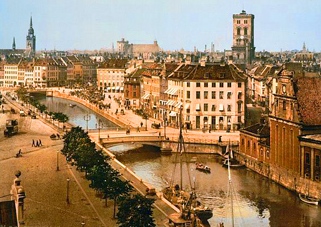
downtown Copenhagen
Denmark thus joins a small but growing number of European countries, including Switzerland, the Netherlands, and Great Britain that have heroin maintenance programs. The goal is harm reduction.
"The aim is to improve their state of health, help them avoid committing crimes and stabilize their lives," Dr. Anne Mette Doms of the Danish Board of Health told the British newspaperThe Guardian. "Quitting altogether is not a realistic option for most of these patients. For them, this will be a chronic treatment, as if you were treating a chronic disease."
Support for such programs is a welcome change, said Preben Brandt, chairman of the Council for Socially Marginalized People. "Five years ago I decided I would not participate in yet another debate on drugs," he told the Guardian. "It was too emotional, with different groups being very aggressive. The counter-argument was always 'you kill people by giving heroin' or 'with this initiative, you are telling people that taking heroin is OK'," he said. "It is very difficult to have a rational debate when you are arguing against beliefs."
But successes in other European countries experimenting with heroin maintenance helped change the atmosphere, said Mads Uffe Pedersen, head of the Center for Alcohol and Drug Research at the University of Aarhus. "The politicians became convinced that it could help those with the most severe drug problems," he said. "You could not argue against the (positive) findings."
"The debate became more practical," agreed Brandt. "It was about what policies worked and which ones did not. It was no longer about morality."
And changing attitudes toward drug users also helped, Brandt said. "Drug addicts in Denmark are less stigmatized. They are no longer perceived as criminals who are a danger to society. They're seen as patients who have a disease they need help with. The new scapegoats in Denmark are the foreigners."
This work by StoptheDrugWar.org is licensed under Creative Commons Attribution-ShareAlike 4.0 International


Comments
2 doses?
I think heroin maintenance is a fantastic idea but I don't know of many addicts that can get by on 2 doses a day, and having to travel far to get them. It's not like methadone. Addicts need to use at least 3 times a day to stave off sickness, and very commonly 4-6 times. I fear this program isn't enough to greatly reduce the criminality associated with an illegal habit, so will be labeled a failure and cited as why heroin maintenance is a bad idea by prohibition zealots.
Getting a prescription to pick up at any pharmacy would do far more to reduce the problems associated with heroin; half steps are sometimes counter-productive in reducing harm.
In reply to 2 doses? by Anonymous (not verified)
2 doses?
Yeah, I agree. I don't know many who can get by on 2 doses a day...especially when if you're talking about hardline-longtime addicts. Maybe once the program gets started, they might be able to change the number of times a patient can visit? Otherwise people are just going to be supplementing the pharmaceutical heroin with the street dope...(much like they do with the methadone programs here in the U.S.)...as most addicts will just end up using these programs out of economic necessity. (granted it will still be a big help to get 2 doses a day for 10 bucks.) But ask anyone familiar with heroin addiction, they'll tell you the same thing...this is not going to be enough for most people.
Treatment centers
These so called treatment centers, all privately owned of course is a joke. Thirty thousand dollars for three months to get treatment is crazy. I told one salesmen, yes they are hard core salesmen, that it would be cheaper to fly to the Netherlands and get treatment. He said well your loved one wouldn't come back if he went over there. I said "hopefully not" because if the drug policies stayed the same in the U.S. I would soon join him.This is a real tragity for anyone that wants to get clean because it is impossable here unless you are rich , what an oxymoron , if you were rich you wouldn't have a problem getting any type of drugs in the first place.The idiots advertise they are real experts at treating drug and alcohol...what? Isn't alcohol a drug? Think about the statement drugs AND alcohol, isn't that like saying fruit and oranges? Just call any of these pushers of the drug treatment centers and ask them if they think drugs should be legal. I've never had one to say yes and if you don't understand why drugs should be legal you wont understand anything! [email protected]
2 doses
Speaking from personal expierience, a longtime addict can easily get by on two doses a day.One dose a day I would question, but two a day at a healthy enough volume per dose is more than enough to stave off dope sick.
Barak Onassis
..2 doses ( one in the morning to get you to work/school and the other to not experience withdrawals at night) would be much appreciated here in Australia.. not sure if you are comparing the strength of pharmaceutical grade diamorphine with the crap ya have been getting off the streets... but i think a lil perspective /view to be maintained medically in order to function socially.. would be wise... these "enough is never enough statements" (pardon me if i'm wrong) are exactly the scaremongering tactics employed by anti-drug/religious mainstreamers in order to keep addicts from accessing basic human rights /civil liberties... so if you are an OP8 addict please be mindful at how easily the uneducated are to manipulate... and assume responsibility .. I think the Danish Govt ( and its intelligent citizens) should be applauded in adopting a policy based on minimizing harm to the drug user and to society in general by making this issue a medical one...we unfortuneately in Australia are privatizing prisons and having religious fanatics dictate laws to politicians who compliantly bend and spread just for the sake of re-election... a tragic waste of human life
In reply to Barak Onassis by Anonymous (not verified)
Austrailia
What do they want to do? Turn Australia back into a prison ?! They would do well to consider the failure of the war against an enemy they can never catch or incarcerate. The US learned it when they ended alcohol prohibition. It took a consortium of republicans, democrats, bankers, and lawyers to get it done!
They just don't want to admit the prohibition of drugs is such a massive failure, in ridding the country of drug abuse, a well! You have to wonder sometimes, if the gomers are not plants to cause us trouble!
history of maintenance programs
There is an interesting article on the history of heroin maintenance programs [See Here: Free Junk for Junkies] Basically, maintenance programs were the norm before all this drug war nonsense started. Before the criminalization of drugs, mid 1800's to early 1900's, doctor's routinely prescribed heroin and morphine to addicted patients...of course these maintenance programs worked perfectly well and most addicts were seen as perfectly respectable members of society, just like any other person most of them worked, made money and were fully functioning. Aside from the benefits to the individual addict, these maintenance programs of course didn't have any of the negative social repercussions that the criminalization of drugs did...it's quite predictable what happened after the prohibition of drugs went into effect and the maintenance programs ended.
An excerpt from the article:
Sorry that was so long, but there's even more interesting history in the article...including discussion about current maintenance programs and the predictable success that they are having.
Monsters Are Terrorizing The City And Country Streets
Yes, it's true. MONSTERS are running about - not only in the city - but just as dangerously if not more in the country as well. They are terrorizing businesses and the homes and private property of the innocent... they are the sole cause of multi-trillion dollar black-market businesses world-wide. Hundreds of thousands of people die world-wide every year as a direct result to these people. The general public spends atrocious amounts of money in taxes every year to keep them in their prisons, learning more about the "art" to their "crafts". How to swindle, handle and hoax. Meeting new partners in crime - free of any rehabilitation whatsoever. They fill the prisons SO much that we the public frequently hears news stories and press releases on how there is NO ROOM for the murders and rapists of our societies. Do you know that these people, the truly innocent drug addicts (not the drug dealers, nor the addicts who sell to support their habits) are forced to live in prison with the murders and join gangs just to stay alive? Do you know that every single prison warden and officer openly admits that every single individual MUST join a gang when they enter prison as a matte or life or death? Ha... then, when they do join up, and are given the choice, kill or hurt THIS person (or get killed or hurt and ostracized, hence eventually killed) they are punished and charged with another crime, than sentenced to MORE time in prison continuing the never-ending cycle.
Ah yes. The monsters. The 10 and 15 year old children with no one better to look up to except the 20 year old drug pusher down the street. The 16 and 18 year old who smokes a joint on the weekend but gets busted with the ounce he bought to last a month or two (as not to have to go to the bad street corners to buy every weekend where young kids with guns will kill you if you don't pay the 5 dollars for a small bag of weed without looking at them wrong) and has to face the long arm of the law now, with a tainted record. How about the guy buying weed for his father who has cancer and can't leave home to get it himself because he hasn't eaten in 4 days from the disease eating away at him. Disease. ha..funny isn't it?
You know, I don't belive scientists when they say the world is actually round, I bet it's still flat. No, seriously... I am NOT kidding!! What do scientists know, anyway! Ha! They are the ones after all who say that addiction is DEFINITELY a disease. (With NO cure). I say we make kemo illegal and arrest anyone with a black market doctors office providing care to the sick. Why pick on just the addicts?
I could go on like this for hours. I could talk about so many more topics and expand on what I've already said 10 fold. And guess what? I am just a 26 year old, 1 yr. 9 month sober addict who used for 13 years. What do I know... but you know what? Maybe if they couldn't just legalize drugs, ALL drugs, then why not at LEAST say that anyone who gets arrested on a drug charge and FAILS a drug test at the time of arrest be put into a TREATMENT CENTER, just like a jail - you can NOT leave for the entirety of your sentence - same length as it would be if you'd be going to prison.
Or just legalize them and get rid of the pushers, killings, deaths, arrests, free the prisons, blah blah blah.
We have a LOT of bright minds out there - if we can come up with a way for me to write this here in Nowhere's-ville Connecticut, USA and anyone, anywhere in the WORLD can read it instantly as I push the SEND button than I think they can figure out a GOOD way, that will improve the QUALITY OF LIFE FOR EVERYONE, Addicts and the General Public to work on the issue of Addiction in modern society.
I read it here first. Alcohol was illegal. Than it wasn't - how'd that work.
Tell me this - anyone who has EVER smoked a join in their lifetime. Say you smoke 1 joint at a "joint bar" and drive home. On the way you come to a yellow light at an intersection, do you A: run it- or B: Slow down and wait for Green?
Tell you what, if I was SOBER I'd go through the light! If I was stoned I'd stop.
Now... same scenario only you didn't smoke pot, you drank 1 beer at a bar and dove home (or whatever the medical equivalent of beers/alcohol would be to 1 joint, you get the point). What do you do at the light? RUN IT. Forget yellow, you;d run it if it was "pink" still.
Why? Alcohol makes you do things you wouldn't normally, even in small doses, POT makes you think twice. Which is legal here in the USA?
What is the crime rate like in Amsterdam? What's that? WAY lower than in any major US city? But WHY? How could that be? There are WAY more crazy monsters there right? After all, they have most drugs legalized there! They are BARBARIC!
Oh, what a wonderful world we live in when a child can have more logic in his mind then the entire United States Governmental system.
- - - - -
I have my reservations about giving heroin to addicts. If it is free. I don't know the facts... but I know many would just use it as "extra". It's a step in a good direction - it's TRYING something new. It's CARING. But legalizing it all together is better. Addicts will be addicts, there will be choices to get off- but the onslaught of problems that come with the drug world - far and wide - could all be diminished instantaneously if we could just legalize them. I will not ever use again. I don't want my family to use. But logically, it just makes sense.
Oh, one more thing... why is it OK to be drafted into the military to fight in a war, use a gun, and die by 18 but not ok to drink until 21?
What's that word? Back-Ass-wards....
Add new comment