Drug War Issues
Politics & Advocacy
Relations between Bolivia and the US, already strained by Bolivia's expulsion of the US ambassador last month for allegedly helping to instigate anti-government protests and the subsequent US "decertification" of Bolivia for failure to comply with US drug war aims, grew even colder over the weekend. Last Thursday, Bolivian President Evo Morales rejected a DEA request to overfly the country, and on Saturday, he launched a rhetorical attack on US anti-drug policy.
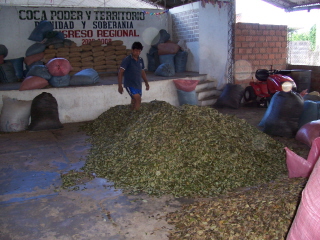
Bolivian coca leaves drying in warehouse -- the sign reads ''Coca Power and Territory, Dignity and Sovereignty, Regional Congress 2006-08'' (photo by Phil Smith, Drug War Chronicle)
Bolivia is the world's third largest producer of coca, from which cocaine is produced. Since his election as president, Morales, who rose to prominence as a coca grower union leader, has embarked on a policy of "zero cocaine, but not zero coca." Under the Morales government, peasants are allowed to grow specified amounts of coca for traditional and industrial uses. In another sign of tension with the US, coca farmers loyal to Morales recently expelled US AID from the Chapare coca-growing region, saying its programs were ineffective.
On Saturday, Morales stepped up the rhetoric, saying Bolivia does not need US help to control its coca crop. He spoke before a crowd of coca growers outside La Paz.
"It's important that the international community knows that here, we don't need control of the United States on coca cultivation. We can control ourselves internally. We don't need any spying from anybody," Morales said in remarks reported by the Associated Press.
A State Department spokesman told the AP that the US had decertified Bolivia in part because it had chosen to follow its own path instead of Washington's lead. "We've certified Bolivia twice before under the Morales government, even though they have taken a very different approach to counter drugs, especially to eradication, than previous governments," said Thomas Shannon, the top US diplomat for Latin America. "But what we've noticed over the past couple of months," he added, "was a declining political willingness to cooperate, and then a very precise attempt by the part of some of the government ministries to begin to lower the level of cooperation and try to break the linkages" between US and Bolivian anti-drug efforts.
Although the Bush administration decertified Bolivia, it did not cut off anti-drug aid. It did, however, suspend Bolivia's exemption from US tariffs under a regional trade agreement. That could cost Bolivia up to 20,000 jobs, according to Bolivian business leaders. [Ed: What kind of jobs do people turn to sometimes when they lose their legal jobs?]
This work by StoptheDrugWar.org is licensed under Creative Commons Attribution-ShareAlike 4.0 International


Comments
The Further Decline of the US
Now, on top of the worldwide financial crisis precipitated by the US lead in "globalization," the US queers relations with Bolivia. Soon we will alienate the entire hemisphere.
So, as if we had to be reminded again, US drug policy is both morally and diplomatically bankrupt.
Madness . . . sheer madness. Is there a chance that a new administration can repair the damage? I doubt it. "Meet the new boss/Same as the old boss."
In reply to The Further Decline of the US by Anonymous (not verified)
I'm not kidding...
I was doing some reading up on ancient Rome and the same things were happening then. Blatant corruption, an over-extended military, tax evasion (mostly by the senators) and a drunken and spoiled populace reminds me that if we are ignorant of history, we are cursed to repeat it.
Indians of Peru Boliva should be able to grow dry and use Herbs
whether these Herbs be Marijuna; Salivia Dorium; Mint; Lobelia; Nutmeg; Morning Glory; Mushrooms or coca leaf;
The afroementiond herbs have medicinal and nutritonal qualities; stop the war on Herb !
Case of Irony
Well, I am gloating a litle over the financial mess. To work for a wall street firm, you must take a drug test, get finger printed, and be from a good school in some casses not smoke cigarettes.
In spite of all their standards, they hired a bunch of guys that were crooks.
This mess is the fault of all those "responsible" people who avidly support the drug war and the welfare for the rich policies that they are now instituting.
Maybe if they just smoked a joint chilled they wouldnt panic so much. Maybe if they hired real people and not grown up kinder gardners this mess would have been averted. I call them kinder gardners because they were so overwilling to please their bosses and stock holders that they did lots of stupid things.
Right now I am in good shape because I dont like scringing to save to have others loose my money. Though I would advise everyone to keep cash.
As in Roma..
..as in Weimar Republic demise, in 1933.Same-same,all over again. The "decider" is the fiddler this time. "Oh what a great (flim-flam) artist, the world is losing".
asdfg
asdfg
Add new comment