Drug War Issues
Politics & Advocacy
The California Supreme Court agreed Wednesday to revisit the question of how many plants and how much marijuana medical marijuana patients may legally possess. It did so by taking up a prosecutor's appeal of a May California Appellate Court decision that found a 2003 law designed to make the state's medical marijuana law operational conflicted with the voter-approved Compassionate Use Act by setting fixed limits on how much marijuana patients may possess.
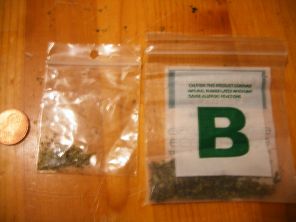
California medical marijuana bags (courtesy Daniel Argo via Wikimedia)
The case, People v. Kelly, began in 2005, when Los Angeles County deputies searched Patrick Kelly's home and found 7 plants in his back yard and 12 ounces of prepared marijuana in the house, along with a doctor's note saying Kelly needed marijuana for back problems, hepatitis c, and other ailments. After prosecutors told jurors Kelly had exceeded the limits of the 2003 law, the jury found him guilty. But the Second District Court of Appeal in Los Angeles overturned the conviction earlier this year, agreeing with Kelly's argument that the 2003 law was invalid because it conflicted with Proposition 215, which did not set any specified limits.
Medical marijuana activists are divided on the case. Some, like Americans for Safe Access, argued that the 2003 only set guidelines for police and that the numbers in the law constituted a minimum, not a maximum. Throwing out the law would remove a statewide standard that "protects qualified patients from unnecessary arrests," ASA attorney Joseph Elford argued in court papers.
But the American Civil Liberties Union argued that the 2003 law's eight-ounce limit applies to the 18,000 people who have registered with the state under that law's voluntary registration program. But Prop 215 still applies to all medical marijuana patients in the state, the ACLU argued. That means doctors may continue to prescribe greater quantities of marijuana and local entities may set higher limits.
This work by StoptheDrugWar.org is licensed under Creative Commons Attribution-ShareAlike 4.0 International


Add new comment