Drug War Issues
Politics & Advocacy
Kenneth Rau, the Bismarck, North Dakota, man who suffers the dubious distinction of being the first person in the United States prosecuted under laws criminalizing the possession of salvia divinorum, has been offered a plea deal under which he would serve five years in state prison, he told the Chronicle this week.
(Update: Charges have been downgraded to possession -- Rau still faces up to five years, but as a charge he can fight, not a plea bargain -- DB via Phil, 8/19.)

Kenneth Rau
But driven by little more than the now infamous YouTube videos of young people under the influence acting strangely and the story of one Delaware youth whose parents blamed his suicide on salvia, state legislators have not waited for the DEA's measured considerations to act. Since Delaware became the first state to ban salvia, at least eight others, including North Dakota, followed suit. Moves are currently afoot in a number of other states to join the club, with Florida and Virginia being the latest states to pass laws criminalizing the plant.
Salvia became illegal in North Dakota on last August 1, after a bill sponsored by three Republican lawmakers, state Sens. Dave Oelke and Randel Christmann and state Rep. Brenda Heller, sailed through the legislature earlier that year. None of the three legislators responded to Chronicle requests for comment this week.
Rau has said he did not know the drug was now illegal when he bid on an eight-ounce bunch of salvia leaves and was pleasantly surprised when his $32 bid came in highest. The local TV station's web site has inadvertently supported Rau's contention. When the Chronicle first wrote about Rau's case in April, that site's online version of the news report about Rau's arrest was still pulling up salvia ads by Google. (From the east coast at least it is still doing so as of this writing.) Rau emailed the link to Drug War Chronicle, proving that the salvia ads are showing up on computers in North Dakota.
Burleigh County States Attorney Cynthia Feland did not respond to Chronicle calls seeking confirmation or denial of the plea deal. Rau said the deal was offered through his attorney, Benjamin Pulkrabek, from just across the Missouri River in Mandan.
"My lawyer told me she offered me five years if I pleaded guilty," said Rau. "He said he didn't think I would take it, but he had to ask. He was right -- I am not going to accept that. I just don't think depriving someone of his freedom for some dried plant leaves is right."
Rau, a bottling plant worker with an interest in herbalism, altered states, and religion and spirituality, was arrested by Bismarck police on April 9 when they searched his home looking for his adult son, who was on probation for drug charges. Police found a marijuana pipe, eight ounces of salvia leaf, a quantity of amanita muscaria mushrooms, and a number of other herbal products.
Although Rau bought the salvia leaf on eBay for $32, he faces a possible 20-year sentence after being charged with possession of the now controlled substance with the intent to distribute, based on prosecutors' assertions that the leaf contained hundreds of possible doses. He also faces a marijuana possession charge for the pipe. Although prosecutors originally charged him with possession of psilocybin because of his amanita muscaria mushrooms, they have since figured out that amanita does not contain psilocybin and have dropped that charge.
Salvia divinorum, a member of the Mexican mint family, has been used by Mazatec shamans for hundreds of years. Smoking or chewing the leaves, or more commonly, concentrated extracts, can produce intense, albeit short-lived hallucinogenic experiences. While the plant has become notorious through YouTube videos of young people smoking it and behaving strangely, it is also of interest to "psychonauts," or people attempting to explore consciousness through herbal means.
Researchers say that while salvia's effects on consciousness may be disquieting, the plant has not been shown to be toxic to humans, its effects are so potent it is unlikely to be used repeatedly, and its active property, salvinorin A, could assist in the development of medicines for mood disorders.
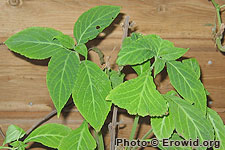
salvia leaves (courtesy erowid.org)
I think salvia should be regulated in the same way we regulate alcohol," he said. "Its effects are quite different, but there are some parallels in terms of the possible dangers from its use. Like alcohol, people can exhibit dangerous behavior if they take excessively high doses. That's why we prohibit driving while intoxicated or allowing minors to drink. But it's obvious that many, many people can enjoy alcohol without getting into trouble with it, and they should not be subjected to harsh penalties. Neither should adults who want to use salvia."
Not that the drug will ever be a popular recreational drug, he said. "Salvia can be very strange and interesting, but it's not something most people consider fun, it's not a recreational kind of experience," he said. "Most people find it bewildering; it's not something most people are motivated to repeat. It won't ever become a popular drug. The main reason people seem interested in it is because the media keeps putting out these sensational stories comparing it to LSD or marijuana. That creates a misleading impression, and people who try salvia expecting something like that are usually disappointed."
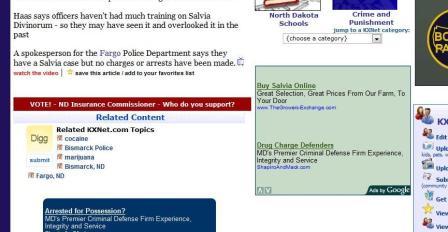
salvia (and criminal defense) ads on web version of ND news station report on Rau's bust
Kenneth Rau now faces a lonely struggle. North Dakota is not noted for its abundance of attorneys skilled in defending cases involving arcane plants, and national organizations have yet to respond to his entreaties for help, Rau said.
Still, Rau is trying to get a defense together. "I'm hoping to take depositions from people like Dr. Andrew Weil or Daniel Siebert or other experts," he said. "I'm looking for attorneys in their vicinities who might be willing to take a deposition."
And he hinted that he may also attempt a jury nullification strategy. "My defense will be to fall back on the fact that the jury is the ultimate judge of the law," he said. "They don't have to listen to the judge; they have the power. Let the jury decide what kind of state they want to live in," he said.
No trial date has been set yet. In the meantime, Rau continues working full-time for a soft drink bottler and subjecting himself to court-ordered humiliations. "I'm trying to live my life," he said. "I've got a full-time time job and another one on the weekends. I also have to take pee tests twice a week and pay them $26 a week for that privilege, on top of trying to pay for lawyers."
This work by StoptheDrugWar.org is licensed under Creative Commons Attribution-ShareAlike 4.0 International


Comments
Plea deals are fascist ploys
Brother Rau, Do not take a plea deal. Plead "Not Guilty", based on the fact that the law is unConstitutional, and demand a jury trial.
The government uses the fascist plea deal approach to get free prison slave labor or extract assets of the drug war victims at minimal cost.
In reply to Plea deals are fascist ploys by Anonymous (not verified)
ignorance
yep, the people around here ARE THAT IGNORANT, overheard in a local bar last night "she was having marijuana withdrawals"--when I mentioned that there is NO SUCH THING, the people sitting there explained to me that some gal had the shakes and sweats and hadta go have a joint, I explained to them that that sounds like ALCOHOL (or some other hard drug) WITHDRAWALS--well, the alcoholics just wouldn't believe me,,,,,,
In reply to Plea deals are fascist ploys by Anonymous (not verified)
I could not agree
I could not agree more.
Courts and prosecutors take full advantage of people either not being able to afford a lawyer, or their lack of awareness of their own rights, and the laws surrounding them.
They do that, and railroad thousands of innocent people every year, all in the name of the Great American Industrial Prison Complex.
Five years for what?
Drug Warriors, are like the Puritans who believe that out there somewhere somebody (or "...bodies") are enjoying themselves. They also believe and there ought to be a law against it. Oh yes, each new prohibition increases their job security.
Take Names & We'll Hunt Them Down Later...
Anyone with a 3 digit I.Q., not currently suffering from cognitive dissonance disorder, knows the Dumb Evil Assholes (DEA) are the real criminals in the drug war... rabid dogs eager to follow the dictates of their puppet masters... the liarticians who have blatantly usurped u.s. law in order to perpetuate it's lunacy.
Marijuana prohibition under the guise of regulation continues to be waged by extremely fundamentalist christians, the real crackheads of christianity, as part of their modern temperance movement.
And worse yet, since prohibition is a radical religious movement, it's foundation is firmly grounded in delusion and mass mental masturbation. These wankers have been spanking their common-sense so long they have made themselves blissfully blind, ignorant, and worst yet... infinitely intolerant!
For now keep taking names and documenting their crimes... from the prohibitionists, and the stools that love them, to the prosecutors & judges.
When the war is over, and eventually it will be, we'll then be able to hunt down and round up these treasonous assholes, seize their properties to help pay for their war crimes, and remove them permanently from society.
Just Say No to the Schism Gism... of the Purveyors of Gods & Gov'ts!
Billy B. Blunt
Tacoma, WA
God is Pro Drug (He Created Herbs)- Lucifer is the Real Problem
The above letter confuses God with Lucifer- the churches that support drug prohibition are NOT Christian, anymore then say the Luciferian Roman Catholic Church!
HE is correct though about the need to take down the names of the criminals (politicians, police, prosecutors, judges, etc), as there will be a need to address them and to have them compensate the victims of this travesty of a pharmacratic inquisition.
In reply to God is Pro Drug (He Created Herbs)- Lucifer is the Real Problem by Anonymous (not verified)
ancient religious bigotry
A major factor contributing to the modern crusade called the drug war are ancient prejudices and bigotry passed down from generation to generation. Nothing has staying power among the human species like hate. Love is occasional and fleeting but hate is forever. Paganism continues to be a focus of derision. Herbs and plants and anything derived from nature is viewed as Pagan. If it is Pagan it is bad.
The ridiculousness of this view is that Paganism was never a religion until recently. Pagan literally means people of the dirt or dirt people. They incurred the ire of both king and church alike because these Pagans lived in remote areas off the land and did not come into cities and associate with society. Paganism refers to a type of people and a loose set of nature based practices. Paganism could never have been a religion because by definition these people were rural and isolated. Pagans were viewed with suspicion and the church and king fueled the contempt and suspicion in every way they could. Why did king and church hate the pagan people so much. The hatred was simply because these rural people did not engage in trade or come into the cities and hence did not pay tax or tithe. A large focus of the inquisition was riding the land of these non payers. These wars continue in different forms to this day.
The church and king associated every practice they disagreed with these pagans. There has developed through history a mythological association of uses of plants and herbs with the fictitiously created pagan persona. Unfortunately this knee jerk reactionary mindset has become a fundamental and deep seated aspect of many people's being. Their hatred is instilled and instinctive and without any merit or foundation in reality. For many people critical thinking is impossible and they only know what they have been told.
[email protected]
I thought Salvia was a flower? In the herb family?
I am a non-smoker, of cigarettes, or drugs.
I can not believe someone is being prosecuted for having Salvia in their home.
In our area, Salvia is a flowering plant, in the herb family.
Does that mean the ones I have in my yard are illegal?
I bought them at a lawn and garden center years ago.
They scent my yard and are not used in food, pulled or cut for any reason. The same with Sage. I also heard it is no longer allowed to be used. Is that correct?
Sage is used in cooking, poultry and turkey. I used to be able to get it in seasoning section of store. You can also use the salvia, sage, lavendar, marigolds, geraniums, roses in potpourri's. Not for burning but to sit in potpourri bowls and satchets.
Are we talking the same Salvia and Sage?
I also read that Sage can be dried and then burnt to be used to clean crystals. Also to air a room out of negativity, when using the crystals. Are all those sites on the web wrong too?
Exactly what is Mr. Rau using the Salvia for?
It also doesn't make sense to me for LE to watch You Tube" and because of few stupid kids are trying to use something in an illegal way, to make it a crime to have in your gardens.
By the way. Did the person selling the Salvia get arrested too?
In reply to I thought Salvia was a flower? In the herb family? by Anonymous (not verified)
it's a specific type of
it's a specific type of sage, salvia divinorum. it's not the same sage you cook with. it has a psychoactive effect if you smoke it or eat it.
another political and social manipulation tool
like the rest of the long-since-failed drug war, the new attack on salvia is just another way for douche-bag prosecutors to scare ignorant believe-what-you-tell-them voters to get elected and provide unethically high proportional income for law enforcement agencies.
unfortunately, the last generation of americans who believe their government wants what's best for them is just entering their 60's and historically more likely to vote based on these issues, and their life expectancies are higher than any generation before. unless younger citizens take the responsibility of becoming involved in educating and dispelling the myths the scare-mongers spew, the lowest common denominator will prevail.
ironically, a large number of these drug prohibition advocates were themselves involved with psychedelics and cannabis in their younger days as young adults in the late 1960's and early 70's. apparently the "baby-boomers" still- as always- want to have their cake already eaten, too; the difference is that when they were getting high most did not face the brutal force that drug law enforcement brings under the drug war industrial complex. after all, it is easier to blame "evil drugs" for their childrens "failures" that are in reality evidence of their own poor parenting and parental absence. especially when their drug of choice is now alcohol (and of course the rich will always get their blow)- numbing them to the harshness of reality. it's no surprise then when the boomers largely see the use of illegal drugs as an escape mechanism when they were too full of themselves to realize the transcendental spiritual benefits of the psychedelics and other dissociative substances.
i should emphasize that these are generalizations and are unfair to some in that age group- former hippies- that have remained acutely aware that Dr. Leary among other psychedelic advocates in their cultural revolution were right, indeed. and there are those- like my parents- who once strongly supported and even professionally enforced drug prohibition only to see their once-successful-yet-druggie children's futures ruined when the statistically inevitable "drug conviction" tags us as "criminals" for life.
either way the profits generated by corporate interests in drug enforcement and incarceration and the systematic racism and cultural discrimination that are the base of drug prohibition (in this age of "technological revolution") still are monsterous obstacles to overcome. those who oppose this unfounded prohibition are either stripped of their voting rights unconstitutionally after conviction of nonviolent controlled substance felonies, or they are dismissed by those who claim some unique higher insight into what's good for all of us based on their own personal opinions- the faith of ignorance.
Mr. Rau's example further solidifies the position for those pushing for reform- this man has done no harm yet he faces such serious legal and financial destruction. It shows that after 40 years of the full force of federal and state governments, this drug war is not only a failure in solving the social problem of substance abuse- this ignorant approach has failed to stop the evolution of additional drugs of abuse (methamphetamine abuse was far less prominent in 1970 than today despite such bold efforts.) It shows that no social benefit is gained from making it a crime to possess the leaves or flowers of plants that grow naturally. the attack on salvia is this decade's version of the mentality that has declared such disasters as the "crack baby," "reefer madness," and the "date rape drug." it is another social commercial used to sell newspapers and generate media revenue, in absence of any real evidence that any such problem really exists.
This is one more illustration of the urgency for those of you interested enough to be reading this comment to educate other potential voters who may not be so socially responsible, to show solid evidence of the prohibition's abuse of our justice system and emphasize the seriousness of this issue. it is not about "getting high-" the essence of this issue is "who owns you?" who has the right to control what you can and cannot do with your own body without causing harm? we advertise the health problems caused by tobacco use, yet the legality of tobacco possession has yet to be subject to the condemning over-extended arm of the law.
at its core, the issue at hand is the basis of personal liberty itself; should a government "of the people, by the people, and for the people" overwhelm the will of the people?
s.a. from nc
myspace.com/strange_trpp
Salvia is a Sage and many are allowed.
I went to wikipedia.org and searched for Salvia. It is part of the Sage family and the ones I have in my garden are okay to have. Interesting site about it, with links.
Salvia Divinorum Mint Herb
e-bay should be fined for selling the herb;posting the ad;
In reply to Salvia Divinorum Mint Herb by Anonymous (not verified)
Please get off this website
Please get off this website you fascist drug-warrior.
Rapists and child molesters
Rapists and child molesters are getting early parole, drunk drivers spend a night in custody before the police let them go and tell him to "be careful next time, have a nice day!" and they want to lock up some guy who bought plant material over the internet for five years?! FIVE YEARS?! Well done guys. I think I'll just go get wasted at the bar, get in a car and go rape a homeless child. Apparently that is more socially acceptable than using an introspective "drug" like Salvia.
BAN ALL DRUGS
As reinstitution of the draft would quickly end the criminal war in Iraq perhaps illegalization of ALL recreational drugs, alcohol, coffee, tobacco, etc. might bring freedom despising America to its senses.
In reply to BAN ALL DRUGS by Anonymous (not verified)
Ban all Drugs???
Ban All Drugs. That idea has worked so well. The reason we have most of the problems we have, is that kind of foreward thinking. That will only make it worse, and at this point I'm a couple of seconds from calling names. So after a deep breath, I will ask, IS IT WORKING??? After all these years of failing at controlling drugs, you want to make all drugs illegal? Why not demand that our failing government do its job? When its easier for our youth to buy pot than a pack of Camels, we are in deep doo doo.
In reply to Ban all Drugs??? by Anonymous (not verified)
BAN ALL DRUGS AGAIN
My statement "BAN ALL DRUGS" was at least in part tongue in cheek. As I am a huge fan of opium (since 1971). My point being that if the recreational drugs favored by the the majority were banned, the majority would react against drug prohibition as they did 80 years ago when alcohol using was illegal. While opium (and opiates) has never done me serious harm, the drug laws certainly have. Extremely serious harm. And my sweetheart died from hep C 16 weeks ago, a victim of drug paraphanalia law. You ask, "Is it working?" I believe it is working and very well for those in control. As control is precisely what they want. Just follow the money!!! You say that we should demand the government do its job? F*** the government! It's run by whitebread morons basically. And oh,
you say we are in deep doo doo when our children can acquire cannibas more easily than cigarettes, the world's deadliest drug? And by the way, a heroin habit is much easier to successfully break in spite of the prolonged period of agony and misery it takes to do so than is a cigarette habit.
In reply to Ban all Drugs??? by Anonymous (not verified)
Yes the Drug War is working Marvelously!!!!
It keeps people divided and afraid instead of engaged and organized, it gives the bosses license to break into our homes, brandishing weapons and taking our love ones to slave labour camps, it provides cover for a system of inequality and exploitation blaming the atrocities that such a system engenders on the very victims it exploits. Ad infinitim. Now tell me if you were a beneficiary of such a system, a ruler, a boss, would you not do every thing possible to enhance and expand those powers? From this prespective the war on drugs is perfectly rational. You legalizers are the fruitcakes and nuts who want it legal. Heck, You gotta be nuts to advocate such a policy.
Cheers,
RockyRacoon
Dont tell South Dakota!!
My mother has salvia growing in her flower garden. Dont tell South Dakota!! They will charge me for that too! (Knowing sombody in posession) -Eric Sage
The Great Deception
The U.S. drug laws sure are a sick abuse of human rights.
Consider this. Remember when Robert F. Kennedy was shot, the sure winner of the democratic primaries in 1968, the liberal humanitarian as next president? Remember Sirhan Sirhan, the supposed only shooter who can't even remember shooting Robert Kennedy? Well Sirhan was standing in front of Kennedy several feet away and shot at him several times with a .22 caliber before being incapacitated. The fatal shot to Kennedy was taken from behind, upwards into his head from 0-1 inch away. Sirhan Sirhan was feet away shooting horizontally. The bodyguard behind Kennedy owned a .22 caliber that he claimed to have sold earlier. There were far too many bullet holes at the crime scene for Sirhan to have been the only shooter, but for some reason numerous evidence was burned by LAPD including any surrounding material, including door frames, doors, and ceiling panels that showed that there were more bullet holes that Sirhan could have shot. Not only was LAPD involved, bu the CIA and FBI. We all know how trustworthy J. Edgar Hoover was, dont we? And didn't he...hate Kennedy?
Well, Nixon was obviously elected and the DEA was formed two years latter. What a surprise!
The pharmaceutical industry has interests in keeping marijuana and other drugs illegal. Marijuana can't be patented like prozac can. Neither can a lot of other useful non-patentable drugs. The alcohol industry has interests in keeping other drugs illegal. Who would buy alcohol if you could grow your own weed? The cigarette industry has interests in keeping other drugs illegal. Why get cancer smoking cigarettes when you could prevent it smoking marijuana? The logging industry, well, huh, ever wonder why industrial hemp is targeted and illegal by the DEA?
Makes sense that these industries may have been a little unhappy losing the entire customer base of young people who were smoking weed and dropping LSD instead.
Amazing how in the mid nineties ADHD sprung up and Pfizer, or whatever damn pharamceutical company bought the patent from the German company who invented it, had psychiatrists nation wide telling parents to tell their children to "take these adderal." Has anyone ever gotten the feeling the people prescribing them prescriptions jump on the gun to give you whatever prescriptions possible? Ever feel that they are answerable to someone else?
Funny thing, from Sirhan Sirhan's broken memories of his involvement in the entire ordeal he remembers the quote "Pay to the order of 100,000 dollars." I sure wonder why he can't remember anything? A woman fleeing the hotel in a polka dot dress at which Kennedy was shot was heard saying by three or four witnesses "We shot him, we shot him." That same woman was seen by a shooting range owner as well as other shooting range tenants with Sirhan Sirhan saying along the lines of "Are you crazy, theyll see you with us." That shooting range owner was fired shortly after...by a CIA official.
People are being payed off and the wool is being pulled over our eyes, and no one would be happier than the pharmaceutical industry, with as many people as possible taking their barbituate and benzodiazepine prescriptions for the past four decades.
Some of the above
Some of the above information regarding amphetamine is inaccurate, I realized.
People have been using amphetamines since the 30's to treat "ADHD." Pharmaceutical industries jumped on patents of amphetamine combinations that they marketed vigorously.
I extend my sympathies to Kenneth Rau, and all the other victims of the useless drug war. It was never about our safety or our childrens safety, but about a lot of money filling the pockets of the people in power.
Salvia Divinorum North Dakota
Here is a direct quote from one of the North Dakota sponsors of the Salvia prohibition "we felt there was no good reason to allow that to continue lawfully". http://bismarcktribune.com/articles/2008/08/03/news/topnews/161483.txt The link is to the full article. The founders of the United States of America set up a Constitution under which to deny a personal of fundamental rights of speech religion and freedom from imprisonment required the government to have a very strong or compelling reason. The question the legislature should address is whether there is a good reason to prohibit Salvia Divinorum and more significantly to imprison people for years. The legislation proposed putting Salvia on Schedule I which prohibits any medical research. Why did not one question arise in either the North Dakota House or Senate committees or on the House or Senate floor as to why Salvia had to have the highest scheduling and as a felony? Why not an infraction or a misdemeanor? I suggest Salvia Divinorum is being placed on Schedule I precisely because of the great potential for medical uses it presents. There are numerous independent and university researchers investigating Salvia right now. When it goes on Schedule I their research will stop forever. Only the largest members of the Pharmaceutical Cartel will be able to develop Salvia's medical potential when it suits them.
My name is kenneth Rau and i can be contacted at [email protected]
Mellow yellow
Remember banana peel smoking,circa 1966? Certainly the evil banana should be a scheduled substance, and banned as soon as possible.A safer,controlled ,drug free world, is possible without the dreaded banana plant. The idiocracy is real. Goodluck Kenneth.
Laws of Unintended Results
Now that several state and municipal governments are banning salvia, theyâre generating so much unsolicited publicity for salvia that interest in the plant will likely increase, thereby leading to even more arrests for an herb that might otherwise have remained an idle and harmless curiosity in the drug world.
Next, a salvia trial will take place in North Dakota, a state where making a U-turn with your car within city limits is also illegal.
More publicity. More hysteria. More laws. More victims. What more could the drug warriors want?
Giordano
Stephen W.
This guy was obviously a drug user, and is using the guise of being "spiritually enlightened", yada, yada, yada, as his reason for using a psychotropic drug that can cause huge problems for users. He's a drug user, plain and simple. The drugs the police found when searching his home pretty much spell that out. Sadly his son sounds as if he's a drug user as well.
Salvia is one of the most potent drugs, more so than LSD, in the arsenal that users now partake of. It should be regulated nationwide and everyone needs to wake up now and realize that. The only people getting upset about a ban is the users and sellers, who are making tons of $$$$ off this drug. Where are the parents and other law abiding citizens. Too few and far between. Glad the legislators finally woke up.
In reply to Stephen W. by Anonymous (not verified)
"W"
Another genius "W" huh? I have never used this "drug that can cause huge problems for users" (like alcohol?). I do have a best friend who has. You say "salvia is one of the most potent drugs, more so than LSD". Is this knowledge of yours empirical? My friend tried salvia on a few occasions several years ago. He told me its effects were intense and interesting and lasted but a few minutes and without any discernable aftereffect when it wore off. He told me that darkness was a necessity to experience salvias psychotropic properties and that its effects could be ended simply by flicking on the light switch. Hardly something that could be compared to LSD. He told me salvia could not be considered "pleasurable" or "fun" and that it has no value as a recreational drug. Though he plans on using it again (he has plenty left) five or six years have now passed and he "hasn't gotten around to it". To your credit, at least you didn't claim that salvia was more habit forming than tobacco or smokable cocaine. Mr. Rau's painful and unfortunate circumstance only illustrates the hypocrisy, hysteria and absurdity of U.S drug policy, a policy best measured by the persecution, suffering, poverty, disease and death it inflicts on millions of people worldwide. As miserable as conditions and circumstances are for non mainstream drug users here, The effects of U.S drug policy are far more pernicious in countries like Colombia or in Laos where whole minority cultures have been essentially destroyed.
Make safe smoking equipment the issue
1. Salvia divinorum and Salvia officinalis
It occurred to me one way to show solidarity with Mr. Rau is to do what a writer above suggested, more precisely go get some regular garden sage (officinalis), rub it through a 1/16" screen, and serve 25-mg. single tokes through a screened single-toke one-hitter (1/4" diameter crater-- most easily made out of a quarter-inch socket wrench with screen in one end and quarter-inch-diameter, long extension tube crammed in the other and taped around to seal air leak). No state or principality has yet passed any law against toking Salvia officinalis.
2. Single toke utensil
I am aware that Mr. Rau got into trouble for possessing a pipe of some kind which he used instead of a cigaret (dimensions not given). If the crater diameter is of the minimal size described above (1/4") suited for 25-mg. servings, a utensil might fit the standard now proposed in Representative Frank's cannabis decriminalization bill, i.e. "responsible (or prudent etc.) use" should not result in arrest. By contrast, a prosecutor interviewed about Salvia divinorum said that the use pattern was "similar" to that observed with marijuana-- about .25 to .5 gram per dose. This suggests a typical hand-rolled paper joint or a relatively big-bowl pipe. May I suggest limiting one's smoking device inventory to 25-mg. serving size might now get some respect (especially if, perhaps due to this letter raising some support for the concept, harm reduction utensils finally get somewhere in the public arena).
3. Better than a single toke utensil is, of course, the vaporizer. The top-rated model, Volcano, costs around $600 and there are others in the $200 range. Understandably, many persons interested in ingesting herb spirits, including cannabis and tobacco, are either reluctant to spend the money or fear that, having done so, their device will attract harmful attention or be confiscated. BIG TOBACKGO has much to lose if nicotine addicts succeed in converting from, say 20 cigarets a day ($2000 a year habit) to a tiny fraction as much purchase of tobacco, with an initial $600 or $200 one-time expenditure for the vaporizer. I hope Mr. Borden can work with Mr. St. Pierre (who endorsed the vaporizer idea) and Rep. Frank and others to achieve a climate of official toleration for vaporizer possession and use.
4. E-cigarette
I have examined some websites about this product (developed in China, where they really do have a worsening hot burning overdose nicotine cigaret problem). A rechargeable battery drives a heating element which vaporizes liquid nicotine (in most brands) out of an insertable cartridge.
What if, instead of nicotine, the cartridge is loaded with cannabinol or menthol or thymol or-- uh oh-- the active ingredient in Salvia divinorum? Certainly any health risks associated with smoking are eliminated, just as with the vaporizer, but brands of e-cigarette are offered for sale starting around $60. One advantage, if you want to go low profile, is that the e-cigarette is easier to hide than a vaporizer or a long-stemmed one-hitter.
What about urging researchers and the private sector to develop a way of providing THC, etc. in liquid form for use in an e-cigarette cartridge?
5. Root-- or leaf-- of the problem: BIG TOBACKGO
Conspiracies which seek to change the established order attract attention, and resistance. Conspiracies which seek to "preserve disorder" (thanks, Mr. Mayor)-- i.e. in this case to maintain "bizness as usual" in the form of 440,000 deaths per year (US) and 5.4 million deaths per year (world)-- somehow pass for normal and fly under the radar so to speak. Since the famous and beloved Caspian War (1853) the paper roll hot burning overdose cigaret, originally billed as something Turkish, has been the "normal" way to smoke. The industry which makes money propagandizing children into getting hooked on the 700-mg. serving size also pays cops (the taxes, remember?)to scare them away from using a 25-mg. serving size utensil, for obvious reasons.
6. Gates & Bloomberg money
Bill Gates and New York Mayor Michael R. Bloomberg have now pledged $500 million to the campaign to head off the tobacco genocide. I have looked at the WHO six-point MPOWER anti-cigaret campaign agenda and do not find any recognition there as yet of the equipment issue. Health issues related to cigaret smoking are said to cost the US alone $180 bil. a year (Patrick Petit, WHO); with 1.2 billion addicts worldwide the total cost could be over a trillion dollars a year. Pro-cannabis forces and WHO, Gates, Bloomberg with their anti-tobacco drive have a common interest in promoting a universal shift of all smokers away from the hot burning overdose cigaret and joint and blunt toward vaporizer, e-cigarette or (failing the money) a single-toke one-hitter you made in your garage. Let's form an Anti-Overdose Coalition.
I have a question --
These police, who were searching for Mr. Rau's adult son -- where were they looking, in his underwear drawer? In a shoebox in the kitchen cabinet, perhaps?
Don't Let McCain Become President
Restricting peoples rights is not how to make anything work. It causes more problems.
McCain is supports the death sentence for drug dealers. Is that right to you? Killing someone who does not explicitly deny anyone their rights? He explicitly and non-chalantly supports KILLING someone, the ultimate denial of human rights, who explicitly denies no one their rights. That is blatantly wrong.
McCain has strong ties to alcohol companies. He is in their pockets for the profit they pay him to continue the drug war.
McCain is for offshore drilling of oil. There is less than two years worth of oil to be had in offshore drilling and oil drilling in ANWR. There is no reason for this to happen. Oil prices won't decrease. He does not support renewable energy at all.
If you don't want the United States of America to become a morally bankrupt, corrupt, police state with a dying economy and a dead enironment DONT VOTE FOR McCAIN!
McCain is against abortion,
McCain is against abortion, sex education, and birth control. Do you want your children to have no access to abortion, sex education, and birth control?
McCains idea for offshore drilling will not help our economy. He doesnt support renewable energy at all. It will doom the U.S. to an energy shortage.
What happens when a nation has a severe economic crisis is that is turns into a police state as a last resort of controlling it's citizens.
Don't let this happen.
Craziness
Eventually, it's going to get to a point where we're not even going to be able to take a shit unless we have filled out the proper paperwork in triplicate and filed it with our local municipalities. The water companies will install tamper-proof turd detectors in our toilet bowls that use a WiFi signal to alert some governing body of unauthorized dumping. SWAT teams will bust down your bathroom door just as you're about to squeeze out that trumpeting finale and throw you to the floor as they fix some sort of restraining device to your ass.
It's not like the guy was speeding down a residential going 80mph tripping balls with an infant in the back seat and a dead hooker in the trunk...
It's Time!!!
It's time for a fire sale. Hit reset!
Time to start again.
Catholic priests get about this much time
Catholic priests have gotten about this much time in prison for fondling and porking little children.
So raping and screwing little children is about the same as buying some dried plant leaves on the in internet!? WTF!?
Add new comment