Drug War Issues
Politics & Advocacy
Phillip S. Smith, Writer/Editor
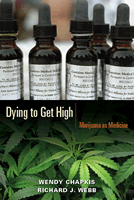
As sociologists, Chapkis and Webb have a keen eye for the broader social, cultural, and political forces surrounding the issue of medical marijuana, from the rise of the pharmaceutical and medical establishments to the "culture war" contempt for marijuana and users among many Americans. But as much as middle America may disdain pot-smoking hippies, it seems that it is marijuana's location on the wrong side of the modern scientific and pharmaceutical discourse that most hinders its acceptance as a medicine.
Pot is a plant, not a pill. It is an herbal medication, not a chemical compound. It is a "crude plant material," not a "pure drug." All of this, Chapkis and Webb suggest, make it difficult indeed for the medical and scientific establishment to wrap its head around medical marijuana. And when scientific bias is coupled with cultural disdain and fear of widespread "abuse," that the federal government remains resistant to medical marijuana is hardly a surprise.
Chapkis and Webb deliver a resounding, well-reasoned indictment of the political and (pseudo) scientific opposition to medical marijuana, and their succinct discussion of the issues surrounding the controversy is worth the price of admission.
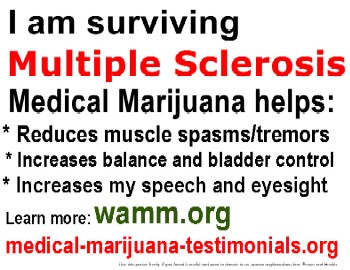
Their account of the emergence and permanence of WAMM is both moving and enlightening. Rooted in the fertile soil of Santa Cruz, already well-tilled by previous social movements such as feminism, gay rights, and AIDS activism, WAMM may only have been possible in a place that friendly to radical movements and that familiar with activism around issues of medical care and social justice. Chapkis and Webb chart its formation, its growth, its conflicts and problems, and the humanity of its suffering members.
They also tell the story of the 2002 DEA raid on the WAMM garden and its devastating impact on members. But that raid and its aftermath were not just a blow to the sick and dying, they were a call to arms, impelling WAMM into ever more overtly political action to protect itself and the broader movement.
More broadly, Chapkis and Webb do a great service by dissecting WAMM, looking at how it works, how it handles dysfunction, and how it provides a service far beyond mere medical marijuana to its members. WAMM is perhaps the model medical marijuana collective, and it has many lessons to offer the interested reader.
Would a WAMM-style collective work elsewhere? Chapkis and Webb emphasize the importance of the cultural and political backdrop in Santa Cruz in making WAMM possible, but I think the very emergence of WAMM as a successful collective makes the possibility of similar collectives coming into being elsewhere all the more likely. After all, even California as a whole is not as radicalized as Santa Cruz or San Francisco, but similar collectives are popping up in Santa Rosa and the San Fernando Valley, among other places.
In any case, Chapkis and Webb provide plenty to chew on, for those who want to pick up some historical knowledge and debating points, for those interested in the genesis of the contemporary marijuana movement, and for those who are pondering the viability of similarly radical approaches to health and self-organizing.
This work by StoptheDrugWar.org is licensed under Creative Commons Attribution-ShareAlike 4.0 International


Comments
Book review
Thanks Phillip.
MS and MEDICAL MARIJUANA
I am fighting Multiple Sclerosis and its invisible demons for many years now.
I am one of the many that --Look Normal--or Look So Good-since I lost 30 pounds===from my inability to feel hunger over a 6 mo period of time.
When extremely stressed. I must have 3 days of IV steroids and then I am not allowed my infusion appts for another month.
The lesions are in my brain. I lose short term memory, I cannot process my words or conversations to use when I talk. I stutter and lose vision when stressed.I forget drs appts. I lose keys, phones, and everything else. I misplace things.
I have 3 calenders..Often all 3 are missing.
I am 52yo and have a young son.
I suffer from "extreme fatigue", insomnia, gastroparesis, rectal prolapse, and also degenerative discs.in my neck which causes frequent migraines. Now recently I have shingles on my face and scalp.
None of the MS injection therapies have worked..
For nearly 2 yrs I have been on a FDA infusionTysabri-re=released for MS== It is often referred to as a 'last chance' med- it was last on the market and pulled 2 yrs ago when it caused brain infection and inflammation, causing death for 2 women when it was combined with other MS drugs.
The head pain,fatigue, inability to have an appetite, inability to have a normal BM, inability to fall asleep, inability to stay awake. I have leg spasms and tremors constantly.
I have been approved and receive SS Disability.
I give myself shots for migraines.I take pills for::: depression,energy, sleep, for focus and attention, and now must take Valtrex everyday for any further outbreaks of shingles-this is for as long as I am on Tysabri.
The Medicinal marijuana-when I am fortunate to get it-it has a threat of jail time and more---it has helped me to have an appetite, also to have a normal bathroom habit. It allows me to focus and actually do some household tasks. It allows the depression to ease up so I can relax and enjoy my young son and life in general.
It is not the drug of the 70's. I do not get giggly and spacey on it. I take it so I can continue to enjoy life as I knew it.
I take it so I can be fully functional. I use a vaporiser so that I do not have trbl with the toxins that make me cough.
I take it so I can sit and stand at church for an hour to enjoy the message that is given.
I take it so I can enjoy my son and not feel tired, cranky or out of focus.
It is a herb that was legal up til recently in our time.
It is not like alcohol in any sense.
Alcohol can turn to a poison in the wrong persons body.
Marijuana has not proved to be a harmful drug.
It has benefits far too many for me to mention here.
It is good for so many.
Please look beyond the stops on this herb and give it to those of us that need it to survive.
I do not want to become so disabled that I need a caregiver or a wheeelchair or a nursing home.
Please hear the pleas of the sick and help them be comforted and aided by this green plant that was God Given.
Bless you for reading this and passing it on.
My story is like a hundred others.
MS is a disease that is not easily diagnosed, or easily treated.
It happens to teenagers and those entering the retirement of life as well as those in their prime.
Please help make this available to me so I can be a mom and a wife and a contributing member of my community.
All in God's name and doing His work.
Thank You for hearing me..
In reply to MS and MEDICAL MARIJUANA by Anonymous (not verified)
Please share your story
First let me say that my heart goes out to you for all the challenges you have had to meet. Having shingles by itself is enough to lay one low (I speak from experience!). To have shingles compounding the symptoms and difficulties of MS . . . well, I just cannot imaging how you cope. Your strength is amazing.
My friend, I want to encourage you to please, please, please put this story that you have shared with us in this forum into letters to your two Senators, and Congressional representative. Also, to you state senator and assembly member. Hearing this story directly from you will make a huge difference in shifting their consciousness, and ultimately changing the laws of this country.
I have told my own story to my representatives, and I encourage everyone reading this to do the same. Please also write 'letters to the editors,' whenever you see an appropriate story in newspaper and magazines about pot busts, or the awfulness of cannabis, etc, combating claims and voicing your skepticism about the drug war. I was surprised that as soon as I did this in my local newspaper, someone else wrote expressing the same sentiments on the next story. Please encourage all your like minded friends to do so as well.
Our rational point of view has been suppressed in the mainstream media, but this is changing. And the change will accelerate as more and more of us make our voices heard -- we must all speak up until this ridiculous and mean-spirited so called war on drugs is finally ended.
As I have previously pointed
As I have previously pointed out,
"It's not about the drug. It's about money and power."
The fact that it is medicinally helpful is irrelevant to those who oppose its use. So sad...
MMJ, Prohibition and it's real cost.
Between the drug raiders killing innocents by using paramilitary swat teams serving faulty warrants and PhARMA/FDA/DEA saying if there were "medicine" in marijuana we'd know about it. What they are really saying is until we can control the world crop and take the high out of it we will allow only Marinol because we only have your best interests at heart and don't want you to get hurt by the big bad drug that is found in cannabis.
The "War on Drugs" is a failure and our policy makers need to readdress the Controlled Substances Act by looking at it with the eyes of a scientist not the eyes of a Puritan. Punishment and faulty education of our youth with lies about all drugs being bad hasn't stopped the flow or use of drugs, legal or illegal, and it never will, human nature being what it is. When America wants to take politics out of medicine and social engineering, it will allow science to experiment and research freely with all variety of herbs, plants and other organisms that may hold many more secrets to the health of the Human race and our home, the Earth and Solar System.
Richard Nixon's CSA and his placement of cannabis in level 1 because he hated "pot smokin' hippies and their stifling his War in SE Asia" must change and our Representatives are the ones to do it. So come election time be sure your vote goes to a rational thinker that won't be fooled by the rhetoric currently in use. That 80% of Americans have tried it and are still functional humans belies the "fact" that it will sap your will and make you a raving lunatic bent on rape and violence. Cannabis in and of itself has not killed anyone and is safer therapeutically than virtually everything in the medicine cabinet or on the store shelves of America. We must change all of our thinking to move into the Future instead of staying in the Past.
A Medical User from the 70s - A Semi Opponent Today
In my early 20s I contracted a chronic disease that left me in excruciating pain. I was prescribed Quaaludes, and when I found out how addictive they were I asked my physician if I could use marijuana instead. This was back in the early 70s when marijuana was easy to get and wasn't thought to be addicting. Although my doctor couldn't prescribe marijuana, he sanctioned its use. What a difference it made in the quality of my day to day life. I could walk normally, sit and have a conversation without focusing on the pain, sleep at night, and I even remember my excitement at being able to reach for a book on a higher shelf that I couldn't have done before. Not liking its smell, I cooked with it instead - using it like Oregano in spaghetti sauces, or hiding it in brownies, etc.
All worked wonderfully well for several months. But without medical grade marijuana being available, I was at the mercy of dealers when it came to consistency in quality. Eventually I bought some marijuana which heightened the pain, instead of enabling me to handle it. After that I was too afraid to continue using it. Fortunately for me by that time over the counter pain killers taken in larger quantities worked for me until the medical issues causing such severe pain could ultimately be reduced.
My personal experience has led me to be a huge supporter of medical marijuana. My professional experience, as a mental health professional working on the front lines of addiction and drug abuse, had led me to support tightening the reins of marijuana use for purely recreational reasons.
While the debate rages on whether marijuana is truly, physically, addicting I've gotten to the point where that's no longer the pertinent issue. Whether addicting or not it remains the largest single gateway substance to other powerful and highly addictive drugs. With virtually no exception its recreational use is to alter consciousness and reality. The greater the use of marijuana as a recreational substance, the greater the desire to escape to an altered reality and/or to use additional substances to achieve that escape.
The problems this creates don't exist in a vacuum. It leads to reality shows that aren't in the world of reality, unrealistic expectations in the workforce, decisions on candidates based on whether they make us feel good, and poorer relationships within our families. We should start thinking instead about we need to do to enjoy the world of reality and dedicate ourselves to reversing the current trend.
In reply to A Medical User from the 70s - A Semi Opponent Today by Anonymous (not verified)
Tightening the reins on marijuana use
Friend,
Thank you for a honest report.
Would tightening the reins mean putting more marijuana users in prison?
Or could "tightening the reins" mean regulation of distribution in various ways? Assume for argument that all the problems you see in altered reality are true. Do they justify imprisoning the users?
Surely marijuana and other drugs, too, is not the only factor in the belief of absurd ideas or non-reality, as you put it. How would you tighten the reins on spreading powerful and persuasive ideas about romance, work, luck at gambling, politics, aliens, the economy, power, God, gods, creation, science, evolution, and so forth that are false and lead to poorer decision making?
I like reality, I love it. I also like movies, novels, plays, and my own imagination. If a person stimulates his or her imagination in ways that you don't think are good or safe, what are the appropriate reins to pull, what are the circumstances for determining when to pull the reins, and who gets to decide?
I think you have latched onto the category of substances in all of this, and marijuana in particular, in a way that seems to me missing some principles.
Marijuana cultivation and distribution need to be legally controlled to prevent the criminal involvement and profits that are part of prohibition. Demand needs a measure of legal supply, because demand cannot be suppressed. Warnings such as yours, from the heart, are believable and important, but are undermined by the inherent falsehoods of the prohibition approach.
There are moral dimensions in how you choose to live your life, and what it means to throw it away living it in dreamland. Teachers and preachers have their work cut out for them -- as they always have.
But it is immoral for the government to punish people for such choices.
We all need to speak more clearly when we speak of tightening the reins on marijuana use.
In reply to A Medical User from the 70s - A Semi Opponent Today by Anonymous (not verified)
Gateway Drugs?
It's depressing to still see someone referring to marijuana as a "gateway drug" forty or so years after that theory was thoroughly discredited. It is true that the vast majority of "hard drug" users tried pot before going on to the other stuff. Well, duh! Of course they did. Compared with the harder drugs marijuana is cheaper and far more readily available. It's also perceived--correctly--to be less dangerous, and, if you are a young person in the US today, it's the drug that more than half of your friends are using.
The other relevant fact to note is that the vast majority of marijuana users tried alcohol and tobacco before going on to pot. So even if there is such a thing as a gateway drug, marijuana is not the culprit. If you want a label to slap on marijuana, "terminus drug" would be more appropriate because most users never go on to something else.
In reply to A Medical User from the 70s - A Semi Opponent Today by Anonymous (not verified)
gateway etc..
{>>Whether addicting or not it remains the largest single gateway substance to other powerful and highly addictive drugs.<<}... so tired of this specious, poorly supported claim when truth is , as far as substance goes,... most addicts started with tobacco then alcohol, both things common found in many homes. truth is.. it's the black market, created by our prohibitionistic approach, that exposes users to black market capitalists. capitalists, who then offer other drugs. its the very misinformation (and thus, lack of credibility), that you seem so accept so easily, that may encourage the cannabis only user to accept the offer. other words, aint cannabis that did it, it was the B.S.
{>>With virtually no exception its recreational use is to alter consciousness and reality. The greater the use of marijuana as a recreational substance, the greater the desire to escape to an altered reality and/or to use additional substances to achieve that escape.<<} ... WHY IS THIS WRONG??... THE PROCESS OF ALTERING PERCEPTION IS INTRINSIC IN THE EVOLUTIONARY PROCESS.. personally ,i reject the obvious puritanistic premise on which this statement is based.
puritanism is evil.had enough of it thank you.
maybe you can understand this.. we deserve personal souverinity.. we deserve the power to determine how our spirit intereacts with our physical selves. damn your mytholgy based opinions that imply otherwise. keep your mythologys and legislations out of my personal choices.
leaglize choice. ...oops, sorry bout the rant..peace n light. vote the path where freedoms lies.
Altering consciousness and reality.
While I can understand your position vis a vis cannabis and recreation, I would just like to put this thought out for your consideration: while it is true, as you say, that the main impetus behind recreational use of cannabis is the alteration of consciousness, Reality can never be altered. Reality is what is true, changeless, solid, unmodifiable. If it were not all of that, it would simple not be Reality.
Consciousness, on the other hand, is always being altered. Its very nature is change. It is constantly effected and altered by our experience, memory, family, culture, perceptions, programs we watch, food we eat, language, mood, company, etc. So, if you feel there is some kind of unaltered consciousness, that is 'true' consciousness, I wonder where in fact you find it?
I do not, in any way, mean to belittle your experience. You say that you work in the mental health field, with drug addicts and abusers, who use their drugs to alter consciousness, and you suggest that they came to the state they were in because they used cannabis first. That they used cannabis first may be so, and I suspect someone who works with alcoholics on a day to day basis, might also believe that beer should be made illegal.
I do suggest, however, that we are talking about a very small percentage of the population that finds life so painful, and are so bereft of strategies for dealing with that pain, that they resort to drugs to numb themselves. And I suspect that someone in such a state would try all the available options: cigarettes, coffee, alcohol, cannabis, television, sex, drugs, etc, in order to lessen the pain.
But, to make something criminal for the whole population, based on the sad experiences of the few, that is where the problem arises. Yes, make smoking illegal in public places, for second hand tobacco smoke has been known to kill. Make drinking on public streets illegal, because public drinking often leads to violence. Make impaired driving a crime, for two and a half tons of out of control automobile is deadly. Smoking cannabis in your own home, harming no other, or growing a plant, harming no other, is not a criminal act -- though it has been deemed such by our arcane and thoughtless laws.
Legalize, regulate, educate. It worked with alcohol, with tobacco, it will work with cannabis and drugs. Driving the consumption and distribution of these substances into an underworld of crime and gangs, neither addresses the situation effectively, nor protects the rights of a free people.
escapes from reality
I'm thoroughly enjoying this thread: many of the points I agree with; some I do not; which is a result of different perspectives. It is true that the recreational use of marijuana is motivated by the desire to escape reality and alter consciousness. But the same can be said for watching tv, movies, going dancing, dressing up and going to dinner. etc. All of these things are done to improve the enjoyment of life, and all of these things are a form of recreation, to reduce stress, and balance out oneself in a society that values keeping busy in the body but idle in the mind. Sometimes it's helpful to take a vacation from the body and explore the mind, that is so marvelous and expansive that no man has ever been able to explore all of it.
To justify marijuana being illegal for recreational reasons would mean also banning anything else that is recreational, i.e. distractions from the daily "realities" of life...work, school, house repairs, etc.
Thank God if you need medical cannabis and live in Canada
For any and all medical cannabis info visit www.thecompassionclub.org
Add new comment