Drug War Issues
Politics & Advocacy
Last week, the UN-affiliated International Narcotics Control Board (INCB) called on Bolivia and Peru to ban the growing and chewing of the coca plant, but both governments have rejected that call. The government of Bolivian President Evo Morales is going a step further: Instead of banning the plant, it announced that it plans to spend $300,000 this year in an effort to develop legal markets for coca products.
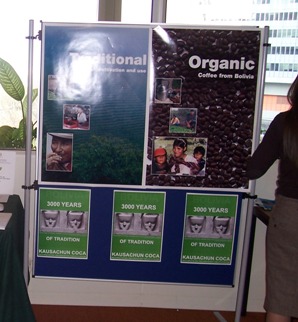
Bolivian display at UN drug summit featuring coca-3000 years posters
While Morales, a former coca grower union leader, first announced the funding last month, his government decided to publicize it in the wake of the INCB call last week. Vice Ministry of Social Defense spokesman Ilder Cejas told the Associated Press Tuesday the money would go to promote the "industrialization" of the coca leaf. The Bolivian government hopes that by broadening legal markets for coca products, such as tea, toothpaste, flour, and herbal medicines, it can rescue the leaf from the drug trade.
Although use of coca preparations is common in the Andes, the 1961 United Nations Single Convention on Drugs, which, along with its successor treaties, forms the legal backbone of the global prohibition regime, lists the coca plant as a banned drug, like cocaine, heroin, and opium. Under the 1961 treaty, coca chewing was to be "abolished" by 1987. That hasn't happened.
This work by StoptheDrugWar.org is licensed under Creative Commons Attribution-ShareAlike 4.0 International


Comments
I commend Bolivia
Congratulations to Morales and the Bolivian government on standing up to the globalist, anti-drug, authoritarians. Too bad more nations aren't immediately following in the footsteps of Bolivia.
Add new comment