Drug War Issues
Politics & Advocacy
In a position paper, a leading American medical association has endorsed the medicinal use of marijuana, called for more studies of its medical uses, and urged the US government to get out of the way. The position paper from the American College of Physicians was released last Friday after being approved by the group's governing body.
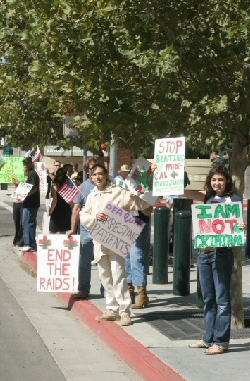
protest in CA against medical marijuana raids (photo courtesy ASA)
The college pointed to strong evidence that marijuana has proven useful in treating AIDS wasting syndrome, glaucoma, and the nausea and vomiting associated with cancer chemotherapy treatments. The college also noted that there is anecdotal evidence for many other medical uses of marijuana, but that research had been stymied by "a complicated federal approval process, limited availability of research grade marijuana, and the debate over legalization." The science of medical marijuana should not be "hindered or obscured" by the controversy over legalizing the plant for personal, non-medical use, the group said.
"This is a historic statement by one of the world's most respected physician groups, and shows the growing scientific consensus that marijuana is a safe, effective medicine for some patients, including many battling life-threatening illnesses like cancer and AIDS," said former US Surgeon General Dr. Joycelyn Elders in a press release from the Marijuana Policy Project. "Large medical associations move cautiously, and for the American College of Physicians to note 'a clear discord' between scientific opinion and government policy on medical marijuana is a stinging rebuke to our government. It's time for politicians and bureaucrats to get out of the way of good medicine and solid research."
"This statement by the American College of Physicians recognizes what clinicians and researchers have been seeing for years, that for some patients medical marijuana works when conventional drugs fail," said Dr. Michael Saag, director of the Center for AIDS Research at the University of Alabama-Birmingham. "One of the challenges in HIV/AIDS treatment is helping patients to adhere to drug regimens that may cause nausea and other noxious side effects. The relief of these side effects that marijuana provides can help patients stay on life-extending therapies."
"This statement by America's second largest doctors' group demolishes the myth that the medical community doesn't support medical marijuana," said Marijuana Policy Project executive director Rob Kampia. "The ACP's statement smashes a number of other myths, including the claims that adequate substitutes are available or that marijuana is unsafe for medical use. 124,000 doctors have just said what our government refuses to hear, that it makes no medical or moral sense to arrest the sick and suffering for using medical marijuana."
While the ACP position paper consists of 13 closely reasoned pages, the group summarizes its medical marijuana positions thusly:
Position 1: ACP supports programs and funding for rigorous scientific evaluation of the potential therapeutic benefits of medical marijuana and the publication of such findings.
Position 1a: ACP supports increased research for conditions where the efficacy of marijuana has been established to determine optimal dosage and route of delivery.
Position 1b: Medical marijuana research should not only focus on determining drug efficacy and safety but also on determining efficacy in comparison with other available treatments.
Position 2: ACP encourages the use of non-smoked forms of THC that have proven therapeutic value.
Position 3: ACP supports the current process for obtaining federal research-grade cannabis.
Position 4: ACP urges review of marijuana's status as a schedule I controlled substance and its reclassification into a more appropriate schedule, given the scientific evidence regarding marijuana's safety and efficacy in some clinical conditions.
Position 5: ACP strongly supports exemption from federal criminal prosecution; civil liability; or professional sanctioning, such as loss of licensure or credentialing, for physicians who prescribe or dispense medical marijuana in accordance with state law.
Similarly, ACP strongly urges protection from criminal or civil penalties for patients who use medical marijuana as permitted under state laws.
"The richness of modern medicine is to carefully evaluate new treatments. Marijuana has been in a special category because of, I suppose, its abuses and other concerns," Dr. David Dale, the group's president and a University of Washington professor of medicine, told Reuters in a phone interview.
An uncharacteristically terse David Murray, chief scientist for the White House Office of National Drug Control Policy, could only appeal to science in an interview with Reuters. "The science should be kept open. There should be more research. We should continue to investigate," he said.
Dale Gieringer, executive director of California NORML had a few nits to pick with the ACP's statement, but approved overall. "This is an important step," he said. "But when they say they support the existing federal supply system, it suggests they are unaware of all the systematic blockage of independent research caused by the NIDA monopoly and DEA interference."
Similarly, said Gieringer, while government licensing and regulation of medical marijuana makes sense, that doesn't mean we have to maintain the existing NIDA monopoly. "It just doesn't make sense to do that," he said.
Where Gieringer was pleasantly surprised was with the ACP's call to end the criminal persecution of medical marijuana patients, providers, and doctors. "They came out really forcefully against criminalization," he noted. "That's very impressive. No one else has been willing to address that. All of these apologists for the government run around saying you can't have unregulated medical marijuana, but that doesn't mean you need to throw patients and doctors in jail."
The medical community's embrace of medical marijuana has been timid and hesitant, with a number of important organizations, including the American Medical Association, lagging behind. This policy statement by the nation's second largest medical association should give that process an important boost.
This work by StoptheDrugWar.org is licensed under Creative Commons Attribution-ShareAlike 4.0 International


Comments
Forfeitures or Science?
Two primary reasons the United States Government refuses to update marijuana beyond the 1937 "reefer madness" research are: (1) a lot of cops are employed to fight marijuana, and cops don't give up their jobs or resources easily; and (2) decriminalizing marijuana also means there will be SUBSTANTIALLY less property seized through criminal and civil forfeitures, the bankroll of the drug war. The Government relies on 70-year-old research because, if its policy-makers were honest about marijuana's usefulness, it would take far less citizen property, and would be able to employ far fewer fear-mongers (let's call them "terrorists," making the uninformed terrified so they get their way).
Note also -- I have had occasion to ask a lot of police officers whether they would rather bust a marijuana smoker or a whiskey drunk. In over ten years, not a single cop has said (s)he would rather take on the whiskey drunk.
EJ ("Jay") Hurst II, Attorney at Law
Severna Park, Maryland
In reply to Forfeitures or Science? by Anonymous (not verified)
Your statement makes ALOT of
Your statement makes ALOT of sense. I agree with it whole heartedly. I do think another reason is FEAR tho also. Some conservatives are just afraid of it because of the people and lifestyle attached to it. They can't relate. At the risk of sounding like an old fuddy duddy - marijuana has a slight "cool" stigma attached to it. "Cool" people can hang with getting totally baked and still remain together and functional - but there are always the freak cases of peolep not understanding food dosage, potency, etc - and then they do dumb stuff like call 911 on themselves or freak out and run down the street naked. But I also believe marijuana has been saved for "the end" by a divine God, for the alleviation of fear and stress when shit gets really bad. Marijuana will be legal world wide very soon.
In reply to Your statement makes ALOT of by Siren23 (not verified)
I seriously doubt if anyone
I seriously doubt if anyone has ever gotten "naked and ran down the street" from smoking herb. Really, that's just ridiculous. So-called bathsalts and "synthetic smoke products", yes....I'm sure it happens all the time.
In reply to I seriously doubt if anyone by Anonymous23 (not verified)
wrong drug, Howl says:
In reply to Forfeitures or Science? by Anonymous (not verified)
Medical Marijuana
I urge you to sin the petition- One day your life may depend on it! https://petitions.whitehouse.gov/petition/decriminalize-medicinal-marijuana-nationwide-all-terminally-ill-patients/1ZgnG5nZ also please visit www.bigdenny.com to learn his story!
Mr. Hurst, I fully agree,
Mr. Hurst, I fully agree, save with one caveat: there never was any bona fide peer-reviewed research to back up governmental claims of cannabis being 'dangerous'. What was offered was a tirade by a purported doctor who tried it and said on the witness stand that he grew fangs that dripped blood. Why that didn't immediately disqualify him - and make him a candidate for a rubber room - is history's guess.
The rest of what was offered as 'evidence' was clearly 'hearsay', of what we would today term 'tabloid journalism' with sensational stories about (often, curiously unidentified) perps accused of heinous crimes. William Randolph Hearst may never have been a government agent, but he may as well have been on the payroll of government drug prohibitionists, thanks to his chain of newspapers making such stories - and often, making such stories up - in order to scare the largely ignorant public.
No research. Literally unbelievable stories...that betrayed no small degree of racism, as many of them claimed that minorities were especially susceptible to cannabis's mythical violence-inducing effects (in the same way that First Nation's Peoples were supposed to be with alcohol, hence the proscription of selling 'firewater' to Injuns')
That's all the drug laws are based upon, and little more than that. It's a sad reminder that the people back then - as many do today - believed themselves sophisticated enough not to fall for propaganda. That the exact opposite is true is part of the reason why cannabis remains illegal today. The lies have changed, but they are still being told by professional liars...
In reply to Mr. Hurst, I fully agree, by Anonymous (not verified)
William Hurst
AM????
The AMA membership has dwindled over the past three decades. Is there any wonder why? If a group does not represent its members, then the members jump boat! Simple as that!
What's medical, what's nutritional?
The Cannabis plant produces several therapeutic substances besides THC. Although discussion of THC dominates the legal definition of "medical marijuana," there is much more to Cannabis therapeutics than just THC.
Nutritionally, hemp seed is simply the best food there is for effective, affordable, prevention, treatment, and in some cases, the curing of diseases caused by cellular fat-degeneration. Nutriceutical science blurs the lines between medical and nutritional sufficiently to allow for the farming of hemp this Spring, under the protection of several existing Constitutional laws.
Perhaps the greatest potential benefit from Cannabis is the possibility it affords mankind to detoxify our environment through the use of plant-based fuels, cloth, paper, building materials, etc. while reconditioning the soil and the atmosphere.
Article One, freedom of religion is the most potent existing law protecting our right to grow "every herb bearing seed." It's time to stand up for that right, first by recognizing the true value of Cannabis, then by reclaiming our rights and obligations to farm it.
In reply to What's medical, what's nutritional? by Anonymous (not verified)
please dont go around giving
ACP too polite to say directly that gov't has blood on its hands
People have died because they did not have access to medical marijuana and people have died because research has been suppressed for generations.
In reply to ACP too polite to say directly that gov't has blood on its hands by Anonymous (not verified)
Peter McWilliams
When ten-times, New York Times Best Seller author, Peter McWilliams, was arrested and told that if he tested positive for cannabis while on pre-trial probation, his bond would be revoked, his mother's house confiscated, and he would be jailed. At this time Peter had been smoking to help him keep his HIV medication down. It was working, and his viral load was undetectable.
As the federal judge ordered, Peter stopped smoking, started throwing-up; his viral load sky rocketed. One evening while sitting in a hot bath tub, Peter threw-up, strangled on his medications, and died. The Libertarian Party ran a full page ad in the New York Times calling the current drug czar, John Walters, a murder. There's blood all over our government's hands, and it needs to stop.
AMA should follow lead of ACP
Really, it is illogical and irresponsible for physicians not to support immediate safe and legal access to marijuana. Thousands of physicians are recommending marijuana for their patients, and these patients face the risk of arrest and imprisonment simply for following the advice of these physicians. I urged the American Medical Association to follow the lead of the ACP on this issue. With over 100,000 Americans using medical marijuana by the recommendation of licensed physicians, marijuana therapy has gone beyond 'anecdotal evidence' and has become accepted medical practice.
Ken Wolski, RN, MPA
Executive Director
Coalition for Medical Marijuana New Jersey, Inc.
844 Spruce St.
Trenton, NJ 08648
609.394.2137
www.cmmnj.org
[email protected]
Medical Marijuana
I fully support the legalization of medical marijuana. I have lupus, fibromyalgia,chronic lymphocetic leukemia and I have had breast cancer. If anyone had taken cheomtherapy, they would most certainly see the importance of legalizing medical marijuana. I have had people tell me to take a pill. I have had pain pills so strong that I actually thought they were moving and leaking oil. Now ask yourself, wouldn't it make more sense to legalize marijuana than be freaked out on some pain pill sold by a drug company?
ElleJ28
Best Health & Health Education
WORLD & CORRUPTION
Education gets from all types of criminals or all bad habits of animals if you adopt or educator gives education which is reverse to the society and criminals gives you the education of
Crime as per shastra / ethics available.
The technology of crime / death.
Social education as always given in schools which is for best of the world or you can think onwards then above to save people by having the good things / habits of animals & others where you have one way of thinking for betterment of everybody and the best way of best life as education in schools or gets from agriculture farmers, teachers, doctors , scientists etc.
Save animals and also save children by truth / good education from all directions as they are not cow, goat, houseflies etc. Ask everybody mainly Guru / Educators called as GOD BRAMHAâ¦â¦..BISHNUâ¦â¦â¦.MAHESHâ¦â¦â¦etcâ¦..& Move from good world to best world and forget the past good world (Satyug) to Bad world (Kalyug) which is 100% possible by thinking on above & remove the words of impossible / no (negative) as difficult may be there .
Page no.24 (18th line) To-day the Education given to females is not good. We should give
Progressive and truth education and it is not only from the books.
Page no.68 (12th line) If we think & ask them (Females), they have nine lives in INDIA like
Cats and boys are dying like houseflies.
Above written in Hindi Book -----Bhartiya Nari
Written by SWAMI VIVEKANANDA
Page no.64 (last five lines) No proofs are required for those females who are thirsty for
Blood of Males.
Above written in Hindi Book-----Vedanta In Practical Life
Written by SWAMI VIVEKANANDA
This is the reason INDIAN SAINTS don't marry. Wife is so kind to her Criminal Guru (Wrong Educator) who is thirsty for blood of males & are slaughtered in remote areas.
KISHAN JALANâ0651-2200166 / 033-22597321 or 7429 / Mobile-0-98318-22701
TRUE LOVE & LOVEâ¦â¦â¦â¦â¦
To save a child from crime / death technology
Everybody can think / ask-spread to think / discuss
By competitions or may be debate to reach on competitions for best society / world
We have some answers to know directly
And some questions to know the truth by answers
To save children (Male / Female) of World, We should explain
& give the definition of criminals as well as GOD
As criminals and GOD was always there in World
As in INDIA so many words are there parallel to GOD to confuse the children & are slaughtered in remote areas. We can think to save a child by automatic / simple law, children should be known in schools, after marriage the death of anyone the other person should be shifted where development work for the society / country / World is going on & maintained by government, where male / female would work separately and think to save children / everybody from crime truly if they love children. No links should be established with outsiders because Criminal Guru / Educator (who is involved in separation / death) have such photos / documents & women are compelled to do work for Criminal Guru / Women (Educator) who is thirsty for blood of males (death). Think more better way and reach to the best for everybody to save people from wrong education.
Teach them by photos as they are guided / taught in nursery classes
And think always to save a child & educate them in schools
All religions like Hindu, Muslims, Christens etc.
And females are there in all religions,
How we differentiate of caste should be explained in schools or everywhere
To save children a fund by donations or by one / two rupees extra adding in school fees to work to save children
Inventions / teaching for betterment of everybody
Doctors, Scientists are working on animals or dead bodies
As no harm should be there to alive persons
Women who is thirsty for blood of males working as Guru / God gives wrong education to females
are like who take out the fishes
& All fishes will kill / eat whether male / female
Please give advantages in all sectors to females
& by simple law a child may be saved
100% Literacy to save a child from technology of crime / death
True Educators are best for life
TRUE EDUCATORS / GUIDES are best for life
Page No.18 (tenth line) If you think like Christ, you will be Christ or if you think
Like Buddha you will be Buddha.
Page No.47 (tenth line) The pride of man is due to his thinking and man are
different from animals due to his thinking power only.
Above written in Hindi Book-----Vedanta In Practical Life
Written by SWAMI VIVEKANANDA
This means everybody can be also become anything like others if you think like them i.e. Swami Vivekananda, Christ, Buddha, Shiva or more like anything etc. Mainly adopt all good things / habits of even animals like doctors, scientists etc. are working on animals or study on dead persons for the benefit of the world. Your thinking should be like that then by way of simple work or inspire / insist others on your goal to continue the good work always. A good work to save children may be done regularly by donations / adding one rupee in schools fee everywhere. The day when you think for whole world / children, the knowledge of all shastra / ethics will automatically come to your mind & Children (male / female) may be saved by true education / simple & automatic law known by everybody.
We have some answers to know directly
And some questions to know the truth by answers
Give the definition of criminals as well as GOD
Why criminals and GOD was always there as per shastra / ethics in World
As in INDIA so many words are there parallel to GOD
to confuse the children & are slaughtered in remote areas.
Page no.24 (18th line) To-day the Education given to females is not good. We should give
Progressive and truth education and it is not only from the books.
Page no.68 (12th line) If we think & ask them (Females), they have nine lives in INDIA like
Cats and boys are dying like houseflies.
Above written in Hindi Book -----Bhartiya Nari
Written by SWAMI VIVEKANANDA
Page no.64 (last five lines) No proofs are required for those females who are thirsty for
Blood of Males.
Above written in Hindi Book-----Vedanta In Practical Life
Written by SWAMI VIVEKANANDA
Only think to save people from wrong education given to females
& their educators who is thirsty for blood of males & think to save a child from
The technology of crime & death as per Shastra / Ethics
THINK TO SAVE A CHILD, IT IS NOT IMPOSSIABLE MAY BE DIFFICULT
FEMALES ARE THERE IN ALL RELIGIONS, EVEN HOW TO IDENTIFY THE MAN BY RELIGION
This is the reason INDIAN SAINTS don't marry. Wife is so kind to her Criminal Guru (Wrong Educator) who is thirsty for blood of males & are slaughtered in remote areas.
KISHAN JALAN, INDIA 0651-2200166 / 033-2259 7321 & 7429 / Mobile-0-98318-22701
From:
KISHAN JALAN
C/o, Hiralal Bhagwati Prasad
Upper Bazar, Ranchi-834 001
(Jharkhand)
12/2, Shobharam Baisakh Street
Kolkata-700 007, West Bengal
INDIA
Legalize pot
Overall, marijuana has more good than it does harm compared to the other stuff like heroin, cocaine, meth and so forth. Even prescription drugs are more harmful than marijuana; that's FACT. It can help people with diseases like cancer, MS, heart disease and so forth. Even women with bad morning sickness can use it to help them eat. I've read post forums where women said they used marijuana while pregnant because they tried everything else that the doctors and parenting sites said for them to do, but it didn't work. There were other people who just sided with what the doctors said about marijuana causing brain damage to the baby and other unproven facts. These people condemn the women for doing it and saying they're hurting their baby not even bothering to do their own research. My point is that you should do your own research about pot and not go by what these doctors say or what these dumb parenting magazines say. If I were to get pregnant, I wouldn't listen to a single word these parenting or pregnant magazines say. And if your own doctor bullshits you, then you should stop listening.
Add new comment