Drug War Issues
Politics & Advocacy
The Minnesota Supreme Court ruled May 24 that police need only articulable suspicion -- not the higher standard of probable cause -- to be able to use a drug sniffing dog to sniff the outside door of a person's residence. The 5-2 decision sparked a bitter dissent.
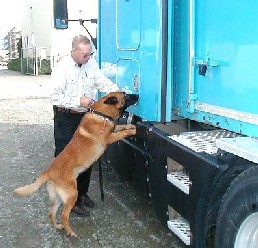
drug dog
At trial, Davis moved to suppress the evidence, arguing that police needed probable cause to sic a drug dog on his apartment door because the drug dog sniff of his door exterior actually amounted to a "search" of his apartment, thus requiring probable cause. He lost at the trial court, which concluded that police needed only articulable suspicion and had met that standard. The Minnesota Court of Appeals affirmed that decision, and now the state Supreme Court has reaffirmed it.
While the state constitution requires the courts to balance individuals' privacy interest against the public interest in effective law enforcement, the state Supreme Court held that the intrusion into Davis's privacy was so minimal as to not require the higher standard of probable cause. The only intrusion into Davis's privacy occurred because the dog could sniff what the public could not. "This intrusion, however, is minimal," Justice Gildea wrote for the majority.
"When we balance the minimal intrusion on [the defendant's] privacy interests inside his residence against the governmental interest in the use of narcotics-detection dogs as an investigative tool to combat drug crime, we conclude that the police needed a reasonable, articulable suspicion to walk a narcotics-detection dog down the common hallway outside [the defendant's] apartment," Gildea wrote. The report from maintenance workers rose to the level of articulable suspicion, the opinion added.
Justice Alan Page, joined by Justice Helen Meyer, strongly dissented from the majority's opinion. "This case marks a significant departure from our constitutional jurisprudence because it is the first time the court has authorized the search of a private residence based on anything less than probable cause in the absence of exigent circumstances," Page wrote. "It is a departure that takes us down a road that erodes Fourth Amendment protections in one's home. That is a road I am unwilling to go down." Unfortunately, Page was in the minority.
This work by StoptheDrugWar.org is licensed under Creative Commons Attribution-ShareAlike 4.0 International


Comments
One more mile down the road
One more mile down the road to our perfect police state...
TYPICAL REACTIONARY RULING BY MINNESOTA SUPREME BUFFOONS
This is only the latest example of reactionary rulings by the black robbed buffoons on the Minnesota Supreme Court. After the Minnesota Legislature passed a statute outlawing discrimination on the basis of sexual orientation and gender self image, a Twin Cities suburban fertility clinic refused to provide artificial insemination to a Lesbian couple on the grounds that it was the purpose of the clinic to promote the family. It seemed like an open and shut case until the Minnesota Supreme Bastards ruled against the couple on the grounds that the statute included language about the Minnesota Legislature's intent was to promote the family. A members of the Gay community remarked afterwards that he wondered what other specific rights we should of had explicitly mentioned. I assumed at the time the statute was passed that this language was merely to salve some legislators homophobia and provide a cover for them from them from their yahoo, bigot constituency. And regardless of the included language, the statute still forbade discrimination on the basis of sexual orientation, which is what the suburban fertility clinic did.
Still later,after an employer ordered a male to female sex change to walk to another building to use a special bathroom. the Minnesota Supreme Injustices overturned the Appeals Court and ruled against her discrimination case on the grounds that it was not known whether her genitals had been sexually altered and that she would have to submit to a genital inspection to determine that and that the law stated that the intent of the Legislature was to promote the family. Surgeons who perform sex change surgery require the candidate for surgery to live in the clothing of and live as the opposite gender for a year before performing the operation. This requirement is intended to minimize the chances of a patient deciding they made a mistake after the surgery. But the Supreme Bastards decision would make candidates for sex change surgery subject to discrimination and genital inspection during the year they were living as the opposite gender.
Earlier, the Minnesota Supreme Buffoons disbared a judge after he had been convicted of sodomy, although there is no record of their ever disbaring a heterosexual judge convicted of adultery. Although Appeal Courts are legally supposed to make their decision soley on whether the lower court decsion correctly applied the law and are not supposed to consider new factual matters that were not considered by the lower court, Supreme Injustice Rosalie Wahl brought in the new fact that two of the young men the judge had had sex with were a few months short of their 18th birthdays. The Minnesota Supreme Injustices, as usual, strained at every possible reason to avoid making a pro Gay ruling. And since when a member of one discriminated groups participates in discrimination against another discriminated group, they deserve no sympathy for their own discrimination, I still regret that the Gay Liberation Movement did not have a heterosexual male auxilliary so that a gang of such auxilliaries were not available to inflict on Ms. Wahl the type of oppression that some gangs of heterosexual men typically inflict on members of her gender!
The Minnesota Legisture once had a series of hearings about what could be done when they pass good laws and the courts don't uphold them.
This is not a drug issue but it is still another example of how the Minnesota Supreme Court typically issues reactionary rulings against citizens rights. Hopefully, the federal courts will slap down the Minnesota Supreme Court. But with Roberts and another Bush appointee on the U.S. Supreme Court, we can no longer be certain of that.
The various rights movements are going to have to return to the pickets, sit ins and other civil disobedience tactics of the 1960's to reverse the present reactionary trend. The suburban fertility clinic and the employer of the transsexual should have been subjected to mass pickets and sit ins. And the Minnesota Supreme Court should have been faced with the same massive pickets and sit ins every time it made one of its reactionary decisions.
Robert Halfhill Minneapolis
Drugs
It's a shame that our society has an small segment of narrow minded fools who make our decisions for us. Why can't these idiots just grow up and treat others like adults? These ignoramasses make me sick!
The governments role
If citizens are allowed to use grow or deal in drugs then the government does not make the money they currently require. Now I am not talking about some kind of tax on dope or anything of that nature, what I am referring to is the CIA's invovlement in the world drug trade. Let me point out as many others like Alex Jones of Prison Planet have, that just because the CIA hit a little bump in the road called the Iran Contra Affair doesn't mean they aborted the single best budget enhancemnet ever available to them. The enormous profits from the drug trade finance all kinds of covert operations around the world. http://www.prisonplanet.com/
Add new comment