Drug War Issues
Politics & Advocacy
Middlebury, Vermont, this week declared a public health emergency to prevent a local business from selling it. It's already illegal in five states -- Louisiana, Missouri, Tennessee, Oklahoma and Delaware -- and a number of towns and cities across the country, and now politicians in at least seven other states have filed bills to make it illegal there. For the DEA, it is a "drug of concern."
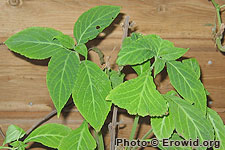
salvia leaves (photo courtesy Erowid)
As law enforcement and politicians stumble across it and the phenomenon of its recreational use, they are reacting in the classic fashion with moves to outlaw it. In Delaware, grieving parents of a teenager who committed suicide after using salvia managed to push a bill through the legislature. In Ohio, police who stumbled across it while investigating counterfeit goods raised the alarm, even though they had never had any problem with it. The cops responded predictably. "It's something we feel should be outlawed," Lorain County Drug Task Force Capt. Dennis Cavanaugh told the Cleveland Plain Dealer.
But researchers say the while salvia's effects on consciousness may be disquieting, the plant has not been shown to be toxic to humans, that its effects are so potent is unlikely to be used repeatedly, and its active property, salvinorin A, could assist in the development of medicines for mood disorders. While action at the state level would unlikely affect research, a move by the DEA to put it on the controlled substances list could.
Salvia is a popular item at the Urban Shaman Ethnobotanicals in downtown Vancouver, and media attention only spurs sales, according to proprietor Chris Bennett. "We're selling about 50 grams of the 10x every couple of weeks," he told Drug War Chronicle. "It's mainly young people -- although we don't sell to anyone under 18 -- but it's not limited to them. Whenever I get quoted in the media about salvia, I get a slew of new middle-aged customers who want to try it."
Once or twice is usually enough, said Bennett. "It's very powerful -- you can forget you even smoked it -- very intense, and the onset is very rapid," he explained. "There is also a lot of variation from person to person. Four people can be sitting in a room taking it, and one would be laughing, one would be afraid the world was ending, one would feel like he was two-dimensional, and one would say that everything seems to be made out of Legos. I hear a lot of people say that one."
Like many other purveyors of salvia, Urban Shaman provides an information sheet with each purchase. "We tell people they should have a sitter. If you're on salvia and end up on the balcony, you might think you can get downstairs by jumping," said Bennett. "You want to have someone there with you; it's irresponsible to use it by yourself," he said. "We also recommend a quiet environment. The experience can be influenced by background noise, which can be distorted or misinterpreted. Setting is important."
There are hazards to messing with hallucinogens, one expert was quick to point out. "It's an hallucinogen and while its hallucinogenic actions are different from those induced by LSD and other hallucinogens, it has the liabilities that hallucinogens do," said Bryan Roth, a professor of pharmacology at University of North Carolina's School of Medicine, the man who isolated salvinorin A. "When people take it, they are disoriented. If you don't know where you are and you're driving a car, that would be a bad experience."
Still, said Roth, while it may make you freak out, it isn't going to kill you. "There is no evidence of any overt toxicity, there are no reports in the medical literature that anyone has died from it. The caveat is that there have been no formal studies done on humans, but the animal data suggests that it doesn't kill animals given massive doses, and that's usually -- but not always -- predictive for human pharmacology."
"I'm unaware of any studies suggesting that salvia is toxic," said Thomas Prisinzano, assistant professor of medicinal and natural products chemistry at the University of Iowa. "Unlike other hallucinogens, it acts by stimulating opioid receptors, and basically produces an hallucinogenic experience that peaks in less than 15 minutes. It produces a subpopulation that finds it very unpleasant and never wants to do it again."
Nor, because of its intense effects, are you likely to get strung out on it. "There doesn't appear to be much potential for dependence or addiction, although no one has investigated this in any detail," Roth said. "The typical person I talked to didn't like the experience; it is too intense for someone looking for a mini-LSD-like experience. It's very rapid in onset and very intense, so it's not normally considered a party drug."
Even Bennett, whose clientele could be expected to contain some serious psychedelic adventurers, confirmed that it is not a drug that most people come back to again and again. "Even those who are interested in it don't use it very often, maybe once a week to explore head space, but those salvianauts are few and far between," he reported. "Most people try it once or twice and have no desire to try it again. It is the ones who use it with a purpose or for a spiritual quest or vision that seem to find it most useful," he said.
"There is a subpopulation using it for spiritual rather than recreational purposes," agreed Roth. "That seems to be the cohort that is using it more than once or twice."
While the DEA did not return Chronicle calls for comment on the current status of salvia, it has moved slowly. It has classified the plant as a "drug of concern" for several years now, but has yet to act to place it under the Controlled Substances Act. The plant's limited potential dependence could be one reason. Another could be that it is still relatively rare and unlikely to ever develop into a drug with a mass following.
That's fine with the scientists, who could see regulating salvia, but not prohibiting it. "The distribution of salvia should be regulated," Roth said. "We regulate nicotine and alcohol, and the effects of those compounds on human consciousness and perception is quite modest compared with salvia. That this is available over the Internet to young children is a bit irresponsible. They could engage in some dangerous behavior while taking it. We don't sell alcohol over the Internet."
But while Roth called for salvia to be regulated, he didn't want to see it added to the list of drugs proscribed by the Controlled Substances Act. "I'm against making it a Schedule I compound," he said. "Once you schedule something, it makes scientific research more difficult, and there is considerable potential for derivatives of the active ingredient to have great medical utility. Scheduling it makes it more difficult for those of us trying to relieve human suffering."
If salvia were prohibited, his work would suffer, said Prisinzano. "This would hurt clinical researchers more than me, and there is an effort underway to do clinical trials on humans before a review board now," he said. "But it would make it more difficult for me to get leaves. Right now we get them from head shops on the Internet."
Perhaps legislators in states like Iowa, Illinois, New Jersey, Oregon, and Texas, where prohibition bills are on the table, should calmly reassess the scope of the salvia menace and place such legislation on the back burner where it belongs. Or replace them with reasonable regulatory measures. But that's probably asking too much.
This work by StoptheDrugWar.org is licensed under Creative Commons Attribution-ShareAlike 4.0 International


Comments
What really bugs me is the
What really bugs me is the typical media response to salvia. "Are your children smoking a new drug that some say IS MORE DANGEROUS THAN LSD?" I've seen that one more than a few times. Salvia is not at all like lsd. Not only that, but this sort of statement reveals a complete ignorance about lsd as well. Practically every drug, recreational or medical, is more dangerous than lsd! Sometimes I wish genuine drug education was required for journalists before they spout off about something they know little about and add to the unwarranted hysteria. Also, I really want to see how they plan on controlling a plant that resembles every other plant in the mint family.
In reply to What really bugs me is the by Anonymous (not verified)
The Government's Propoganda.
The only reason why the government tries to ban mind altering products is because they do not want us thinking and choosing for our selves.
It works like this everywhere:
Grade School
College
The Media
Even the Internet
even if it was terrible to use it, banning it would take away our natural right to choose for ourselves.
Seriously, the Bill of Rights grants rights but they are controlled by the Government not our own desire to be who we want to be.
It has nothing to fucking do with putting others in danger by its use and getting in a vehicle. That is why alcohol is legal.
In reply to What really bugs me is the by Anonymous (not verified)
Yeah, I completely agree
Yeah, I completely agree with you. The media can say lady bugs are dangerous, and people would believe it because it's some big bolded title. I personally havn't done salvia, but I would like to try it. With all the research I've done on it, I truly don't see how they still sell alcohol or tobacco over Salvia. I think it would be a good thing for some sort of drug addict to switch over to. I mean with an effect time on average of 15 minutes, I think things would be under more control. And one other thing I've noticed that this lacks, is anger issues. I've seen people go crazy on TV after cocain and crack, but atleast if your seeing something horrible from the effects of salvia, it stays inside of you and you don't go leashing it out to the public.
Truly a shame
Outlawing Salvia will only add to the needless siphoning off of law enforcement resources that could be better spent on violent crime and theft. It is not toxic, is unlikely to cause any physical danger, and does not lend itself to being addictive. Out-of-control parents who rely on legislators to provide a safer environment for their children will likely be great catalysts in the criminalization of salvia. What a waste of time and energy it will be if salvia is added to the list!
A crusade based on lies
The government and their partners in the mass media are at it again. Criminalization of salvia will only make it into a bigger problem, and lead to general misinformation of the public as it has already happened with all the other "controlled" substances.
P.S. Those who draw a parallel between LSD and Salvia should be obligated to sample them both, or shut their mouths.
LOSING CONTROL
It seems to me that we are surely losing our rights. Making legislation because of paranoia is leading this nation to a police-state. We are losing America.
In reply to LOSING CONTROL by Anonymous (not verified)
Ohio Shaman Will not comply
I like the added business, but that is exactly what the media wants. If they boast about is being a concern, then they should not be making everybody who dont care aware of it. They do it to drive more reason to outlaw it,
As far as America being lost, its already gone, you can not vote against the terroristic leaders of our country.
The fact is, that now that they might make it illegal, makes me want to take a stand and say they will have to kill me to give up my salvia, what are they going to do, prescribe it? ya right.
Im glad i have done enough to learn the ultimate truth, that the Corporate Government machine we call America can not profit from its people/mind slaves when they learn what really matters in life, which is what salvia really does. Salvia goes against every rule of a corporation, makes you know the truth, even though you may take some time to understand it, but its the entire truth for you to decide.
It lets you know that we are all connected, and that is a big no no for corporate america, because when you feel connected with everything around you , you are content and happy. Corporate America wants you to not be content, so you will constantly buy the products they want you to have to keep you forgetting what we are really here to do. I can tell you one thing, its not selling stuff.
Ya i sell stuff, i sell truth only.
But ya America was lost to prepped elections and whatnot.
I have only one word, PARADIGM.
If we would have only listened to what the indians were saying about giving, instead of always taking. They eventually took all the truth out of everyday life and now use it against us in a war on drugs that they started and supplied both sides with enough ammunition to accomplish their goals, controlling us, because afterall, they know what is best for us right, thats why they let us have our cigarettes and booze right? If they can control the deaths of humans and the rights of men, then they won. There is no point in standing up against it, YOU WILL EVENTUALLY BE LABELED A TERRORIST AND KILLED FOR THE GREATER GOOD OF, you guessed it, THE LAW DISMANTLING CORPORATION WE CALL AMERICA.
USA = UNITED SLAVE ASSOCIATION INC.
WANT TO KNOW SOME TRUTH, GOTO WWW.OHIOSHAMAN.COM AND GET THE 45x
In reply to LOSING CONTROL by Anonymous (not verified)
we already lost america
many people are doing other things like mulesting children and raping them. thats when we first lost it.... america is losing its grip on things like children going to school, many dont even know what the hell they are doing. i think its dumb and with the economy going bad and losing money it is all retarded. people just need to no how to run the country. i dont even want kids because i am afraid to bring them into this world with the economy and the gags and krap like that....
What if they find out maple
What if they find out maple syrup mixed with sulphuric acid produces the sweetest hallucinations. Then the meatheads will want to outlaw maple trees!
In reply to What if they find out maple by Anonymous (not verified)
Maple syrup..
Really????
:-)
Jim
In reply to What if they find out maple by Anonymous (not verified)
re:
hey ! then we can move up to Canada
Salvia !!!
I lived in the Gulf Islands of B.C for a number of years. YES, I've hear of people smoking SALVIA and YES, I've smoked it aswell, so let me tell you, LSD it is not,Is it a sudstance that needs to be controlled I'm not SURE !!!
the issue here is whether
the issue here is whether people can have responsible relationships with plants. it's not an issue that could be or should be defined by governments.
i've smoked salvia on several different occasions, in different contexts. how it effected me individually is irrelavant. i had plenty of oppurtunities to do a litlle research (on the web and conversations with other salvia argonauts) before i ingested/smoked the plant. we can't ban all plants. let's be real, jimson weed is a prolific weed that grows in ditches behind barns and sheds across america should we ban it, could we ban it? people have to accept responsibility for their own actions. period. if a person is unwilling to have any awareness of what their doing or why their doing it, it seems absurd to judge the rest of us (psychonauts, whatever terminolgy one wishes to ascribe to people interested in psychoactive plants) for educated decisions.Ultimately it doesn't matter, the black market will provide a solution as it always does...................
Salvia Divinorum
I'm a seventy-year old head who was introduced to Salvia by my son. I have have experimented with just about every hallicugen available but salvia was a singular experience. Somewhat scary and I am glad that it doesn't last very long. To my mind ALL substances, from chocolate to morphine, to quote a very fine book on the subject, change a persons apprehension of reality. I consider these as neutral and will never place a moral value on them. We bring our own experiences to the table; they are information. I love beer but it would never enter my mind to operate heavy (or light) machinery under the influence.
"Hey, mommy, I just want to sit her and look at the stars until bedtime."
Modern law
It seems lawmaking in the last century has slowly changed its purpose. Originaly laws were made to protect. Keeping up with the recent legislative actions that have been taken on account of salvia divinorum has shown me that lawmakers are no longer making laws to protect but to prevent. All action that has been taken on salvia divinorum has been self proclaimed by the legislative sponsors that they are trying to prevent "a tragedy waiting to happen."
Using this sort of logic when making laws is completely backwards. Laws cannot be made to prevent problems otherwise there will never be and end to the amount of liberties that will be taken away in hopes of preventing forseen tragedies. Using that sort of logic the FDA should have been shut down in order to PREVENT another Vioxx incident.
where's the best deal on salvia?
I have dial-up, so I would appreciate it if one of you DSL dudes can save me some search time...
Where's the best place to get salvia on the internet? I was thinking about experimenting with MIXING just a wee bit of salvia with pot.... to give it a little kick...
Any comments on that?
In reply to where's the best deal on salvia? by Anonymous (not verified)
herbalfire.com
this site has provided me with good slavia numerous, times and the strong extracts too. mixing it with pot is all the more trip, if you enjoy the experience of salvia then sure do it, as with most any drug, THC will intensify it
In reply to where's the best deal on salvia? by Anonymous (not verified)
hey did u find a good place
hey did u find a good place i want to get it so let me know
In reply to where's the best deal on salvia? by Anonymous (not verified)
don't mix
don't be an idiot. salvia needs no "little kick"... if done correctly, the experience should be intense enough as is.
if anything, use the cannibis to calm down afterwards... mixing is a waste.
salvia
martin holsinger
i think the best way to control salvia would be to allow those who want to use it to grow it and share it with their friends and prohibit its commercial distribution...its traditional use involves levels of initiation and guidance that get lost when it is available to anyone with cash in their hand or an internet connection, and i think it is best kept out of those kinds of channels...same with all other strong psychedelics...maybe even marijuana
In reply to salvia by martin holsinger (not verified)
Dear Martin, I don't think I could agree with you more.
Herbs are medicine. If you missuse them it's no different than some clown grinding up his grandma's oxycontins and snorting them. All things in moderation....Buster.
In reply to salvia by martin holsinger (not verified)
I'm sorry, what? Are you
I'm sorry, what? Are you honestly claiming that you have the inside scoop on what constitutes "traditional use?" That you have such an elevated sense of the importance of your concept of "traditional use" that you'd advocate restricting the sacrement to just those people who respect "traditional use" (as you define it)? By "traditional use" are you claiming some spiritual equivalence between your new age ritual and the original native use of plants?
In reply to I'm sorry, what? Are you by Anonymous (not verified)
i dont think you understand what he's saying.
i think he means that it should be used in friendly environments with people that have some experience. that would happen more if we alowed people to grow and share rather than selling it on the internet or at stores, that way they will better know what they are getting into and will be less likely to try it alone. that is how i interpereted it at least.
pot to give salvia a kick?
First of all, if your planning on using pot to give salvia a kick you have no idea what salvia is all about. Salvia is plenty potent enough for some very long distance tripping if you get my drift. Just try the salvia alone first, because believe me, salvia doesnt need anything to give it a kick.
-M-
In reply to pot to give salvia a kick? by Anonymous (not verified)
or salvia to give pot a kick
i thought he meant using salvia to give pot a kick. it might dull down the effects of the salivia and string it out a little longer. i think its a good idea.
WOW is That What I've Been Smoking?
I have been tramping the woods for nearly half a century looking for plants that will heal, make me feel funny or change my outlook. I generally stay away from fungi as the wrong one of those can kill a fellow. I've run across a lot of interesting smoking herbs..But I reserve use of S. Divinorum for religious purposes. A few time a year when I feel the need to purge myself of the evil thoughts dwelling deep in the gray matter... More often is scary.
Uncle Buster, Clermont PA. [email protected]
PS: Sulphuric Acid and Maple syrup... that's a new one on me.....
Maple syrup and sulphuric acid - just kidding.
I'm kidding!! I just meant this in a sarcastic ' what if ' sense to illustrate the idiocy of making a plant illegal because we've learned to use it in mind altering ways.
It would sure make for interesting pancakes though.
J.
In reply to Maple syrup and sulphuric acid - just kidding. by Anonymous (not verified)
Nutmeg
For a real scary trip you can always eat a spoonful of freshly ground nutmeg. Seriously..... so when are they going to outlaw that?
In reply to Nutmeg by Anonymous (not verified)
nutmeg
nutmeg whats that does it really give u a high explain where can i get it .thank you
In reply to nutmeg by Anonymous (not verified)
nutmeg
its a seasoning sometimes people put it in egg nog or use it for baking.
In reply to Nutmeg by Anonymous (not verified)
nutmeg
are you serious, or are you just kidding? if you are serious what should i expect?
In reply to nutmeg by Anonymous (not verified)
nutmeg
This isn't the same person replying, but yes, nutmeg is a HUGELY available and commonly used spice, usually used in cookies and pies.. About a tablespoon can make you feel high or weird, two or three give you hallucinations BUT you can also get nausea, vomiting, sweating, flushing, and constipation. Myricistin is what does it. Nutmeg is better when you grind it yourself from an actual nutmeg fruit instead of bought pre-ground in a container, but it's hard to find nutmeg fruit.
In reply to nutmeg by Anonymous (not verified)
nutmeg
Oh, and by the way, you also get REALLY dry mouth, like so dry that you can't eat at all, but NEVER take an MAOI with nutmeg, such as chocolate coffee, antidepressants, or some other foods and medicines. It usually isn't a problem anyhow since it's hard to eat. And drink lots and lots and lots of water, because you can get dehydrated from nutmeg too.
In reply to Maple syrup and sulphuric acid - just kidding. by Anonymous (not verified)
ruh roh - NO Maple/Acid Mix
I'm interested to see how many people got their hands on sulfuric acid and mixed it with maple syrup in the last week. Hospitals around the country are wondering why this new craze to ingest acid is spreading so rapidly...
OUCH.
You have to be careful with your wording, especially when you're discussing matters with people who are already "experiementing" with psychoactive substances.
So yeah, Just say NO to maple syrup and sulfuric acid going well together.
NO.
Salvia Divinorum
I am a gardener and Salvia is a beautiful plant that comes in many gorgeous colors and varieties. I am wondering if this particular strain of Salvia also produces flowers?
In reply to Salvia Divinorum by Anonymous (not verified)
divinorum flowers
Salvia produced flowers only rarely and it generally propagates itself in nature by growing very tall, breaking off at the stem, and growing roots where it fell. How neat! Most of the Salvia that is being marketed today came from only two orginal strains (the same plant cloned over and over): the hoffman, and the blosser strains...
However, a couple years back it seems alot of Salvia's went to flower and then seed in Hawaii (i'm assuming because of the climate) and have created several new strains that are available today.
Here is a link to a picture of a divinorum flower
http://www.geocities.com/salviacrusaders/images/salvia_flower_03.jpg
What an amazing plant!
The Sam Harris approach
I'm still surprised that the US haven't prohibited Salvia Divinorum, considering how aggressive drug policies are there. In my country, Denmark, it's prohibited.
I've tried to make sense of it all, but recently I've arrived at a conclusion, partially helped by Sam Harris, author of "The End of Faith".
In almost all aspects of normal life people use mostly their rational faculties and explanation models. However, there's always a competing model: the religious one where you have the fine luxury of believing in anything without ANY proof, and you don't even have to display some sort of consistency with any other assumption of the world you may be holding..
Drugs are, IMO, evaluated using a religious paradigm. Drugs are simply "bad", or "evil" or "of the Devil". They simply cannot be "good" according to the prevailing theory. It's really pretty silly, but this skizoid outlook of even moderately religious people is the root cause of the whole drug controversy.
In reply to The Sam Harris approach by Anonymous (not verified)
Nicely said
Salvia Divinorum would become illegal because of profiling. You assume that because of it's affects that Salvia is exactly like everything else people use to get high (The comparisons to LSD are what especially irks me). Salvia has an opposite acidity of other drugs, and fails to stimulate any of the regions of the brain that are affected by hallucinogens and other psychoactive substances. Not much is known about Salvorin-A, but it's potency is often mistaken as toxicity. (I have heard that it would take more Salvorin-A to kill a person then caffeine, although I can not guaranty the validity of that statement.) Unlike other drugs, there is little known attraction to salvia (can I call it a drug?), and people who are not interested in experiencing its psychoactive properties are very unlikely to be affected by its presence in the legal world in any way. If people think that Salvia Divinorum is evil, then it is up to them to not order it over the internet or to buy it. It's as simple as that... If people are too incapable to govern themselves, they will give up all the rights that they hoped to protect...
In reply to Nicely said by Anonymous (not verified)
To Protect the value of the Divinorum.
The best thing we can do is to buy, buy,buy. Stockpile ,stockpile ,stockpile. And finally , Grow,grow,grow.
WE all know this is on it's way to becoming a schedule one. Just like some other things I will not mention thanks to surprised under-agers and complete morons whom have posted Youtube videos for Reps to present to Congress in attempts to "protect society from themselves.".
People with Potagers, beware!
You know, every now and again something makes the news where DEA agents armed with search warrants burst through the door looking for marijuana, shoot the family dog, handcuff everyone and break everything in the house only to find some tomato plants.
Now imagine that these Salvia bans get pushed through. Everyone who is growing any of the number of varieties of basil, mint, oregano or sage on the patio is now going to be in very real danger of having their possessions broken, their dogs shot, and their faces clubbed with a nightstick.
Screw that. Why don't these self-satisfied pious "Salvia is dangerous" jerks focus on a real problem like date-rape drugs?
Where to get Salvia
I have heard great reviews of the S. divinorum products carried at "www.celestialsource.com" ...
They have live plants and 9X Extract for very reasonable prices.. :)
Sally D.
La Salvia es un alucinogeno sumamente poderoso
nada parecido al LSD, es algo que te saca del planeta
en instantes por unos 10-15 Minutos, la experiencia es extremadamente intensa, no hay palabras para definirlo, pero si la pruebas, dudo que intentes repetir la experiencia.
No la pruebes por curiosidad, solo te vas a pegar un buen susto... eso te lo puedo asegurar, no es nada divertido y la experiencia varia de sumamente extraña
a totalmente aterradora.
Los politicos como siempre prohiben lo que no deben,
porque no pueden estar callados la boca si solo saben hablar basura ??
Porque no dicen nada contra el alcohol ?
o contra la guerra ??
Prohibir algo solo hace que sea más deseable, o es que no entienden ?
pedazo de ignorantes.
In reply to Sally D. by Anonymous (not verified)
WRONG LANGUAGE
This forum is in English, so post in English. If you want to post in Spanish, post in a Spanish forum. It's as simple as that. Otherwise you're just wasting the server's space.
In reply to Sally D. by Anonymous (not verified)
SPEAK ENGLISH IN THE USA PLEASE!!!!
Using a foriegn language to post in an English speaking forum about such a matter as this is damaging to our case.
Please speak the language of American culture.
In reply to SPEAK ENGLISH IN THE USA PLEASE!!!! by Anonymous (not verified)
wtf you dont know spanish
i thought you were american? fuck i am from canada and i even understand.
In reply to Sally D. by Anonymous (not verified)
Let the man speak.
Don't get angry because you can't understand the man. Simply skip reading his Spanish if you can't understand Spanish. I'm surprised at how many advocates of a "live-and-let-live" philosophy can't handle someone else's linguistic preference.
I, for one, like Spanish much better than English. It makes sense. Now, I don't claim to speak it well, but it's a beautiful language nonetheless.
So, Sally:
Los politicos son basura porque nosotros, la gente, no podemos cambiar el tipo de persona que esta querido por el gobierno para ser un politico. No tenemos opcio'nes muy buenos cuando votamos. Mierda o mierda: cual quieren?
Y alcohol?! No! Alcohol le GUSTA a los politicos. Lo beben.
Pero drogas? Si, debemos prohibirlos! Porque los politicos no los usan, y asi' no los entienden, y asi' no les gustan a los politicos.
Y en los tiempos de guerra, el pinche gobierno puede hacer todo que quiere. Asi la guerra le gusta.
Por favor, perdona el cinismo a mi'. jaja.
and again, for the English-only crowd:
Politicians are garbage because we, the people, can't change the type of person that is wanted by the government to be politicians. We don't have good options when we vote. Shit or shit: which do you want?
And alcohol?! No! Politicians LIKE alcohol. They drink it.
But drugs? Yes, we should ban them! Because the politicians don't use them, thus they don't understand them, thus they don't like them.
And in wartime, the fucking government can do whatever it wants. So it likes war.
Por favor, perdona el cinismo a mi'. jaja.
Salvia is good for me ...
... it help me deal with my depression. I do not use it recklessly, just a bit now and then. The effect is better than the SSRI I take. Scanning the Internet, I know others also benefit from Salvia in this manner also. If Salvia were to outlawed, what would we do?
Who do we have to blame??
While most comments here raise valid points, at the end of the day (some) Salvia users themselves are largely to blame. Go to youtube, and type in salvia.
Watch what all the smart people are doing posting videos of this amazing drug. IDIOTS.
Its no wonder the drug will soon be scheduled everywhere with people publicly posting videos of it and acting like morons on the internet.
Its not a recreational drug, and its trade does not attract unpleasant elements. Please stop hurting salvia people!
In reply to Who do we have to blame?? by Anonymous (not verified)
Is it againt the law to act a fool?
I know its not right for people to post videos, but its not right to outlaw something because it make some act a fool. I can hold my breath for 2 minutes and gulp water fast thereafter and get a buzz, and act stupid, but no one cares about that.
Its just the pure fact of human enslavement.
It seems true to me that when someone can control you mind, then they have a good little 9-5 slave working for what, dollars that wont be worth anything but to wipe with and heat our homes. Oh ya, buy land, it a REAL investment until you can't pay the taxes, even if you can, its still not yours, there is no more owning anything in this world anymore, not even your kids are your anymore. Schools do well at teaching commerce . Therefore we produce a generation of brainwashed kids that dont even see the value of the dollar slipping, all they see is the price of everything is going up.
So many aliens want to come to america, so they can be salves, I guess being a slave is cool. Nobody small has success these days.
Get out and Vote, and watch it not ever count. That is real. What if Iraq accused America as possessing WMD, would they be justified into comming over here and doing what wee are doing over there? I think not.
The shamans fo the old should come back and teach america a lesson, weather good or bad, real true lessons are not to be forgotten like you are supposed to do.
Didn't do naything to me
I had a friend who grew these plants and after a few casual tries where it had no effect on me, he finally sat me down and I did bong hit after bong hit bong hit of the stuff and I became completely....sort of nervous with a headache......Hardly the super-psychedelic experiences described by many. Anyway, I guess it effects people different.
Add new comment