Consequences of Prohibition
Drug War Issues
A federal judge Tuesday gave final approval to a landmark settlement in the case of the heavy-handed 2003 police drug raid on students at Stratford High School in Goose Creek, South Carolina. Under the terms of the settlement, the Goose Creek Police Department, the City of Goose Creek, and the Berkeley County School District will pay $1.6 million for violating the rights of nearly 150 students caught in the raid. The trio also signed a consent decree barring police from conducting law enforcement activities on school grounds absent a warrant, probable cause, or voluntary consent.
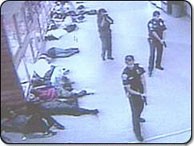
early morning high school raid: no drugs or guns found
"They hit that school like it was a crack house, like they knew that there were crack dealers in there armed with guns," said 14-year-old Le'Quan Simpson, who was one of the students forced to kneel at gunpoint in the school hallway and whose father served on a SWAT team.
Simpson's father, Elijah Simpson, a local deputy sheriff who has served on SWAT teams, said, "This was clearly a no-shoot situation no matter how you look at it. A school drug raid is not a SWAT situation, but that's how the Goose Creek police handled it." The police raid was unnecessarily dangerous, the older Simpson added. "It was crossfire just waiting to happen. If one door slammed, one student dropped a book or screamed, and then those guns would have gone off all over the place. Did you see the way they were swinging those guns around? That's not how you do it."
Following the raid, the ACLU brought a lawsuit on behalf of students' families charging police and school officials with violating the students' right to be free from unlawful search and seizure and use of excessive force. The lawsuit demanded a court order declaring the raid unconstitutional and blocking the future use of such tactics, as well as damages on behalf of the students. Joined by local attorneys, the lawsuit grew to include 53 of the affected students.
The American Civil Liberties Union represented 20 of them, including Simpson. "Goose Creek students now have a unique place in our nation," said Graham Boyd, Director of the
ACLU Drug Law Reform Project. "They are the only students in the nation who have complete protection of their Fourth Amendment rights of search and seizure."
Marlon Kimpson, a lawyer with Motley Rice LLC, the firm that represented most of the students, said students involved in the drug sweep must file claims by July 28. A claims administrator appointed by the court will then evaluate each student's claim and determine which students are eligible for the funds, Kimpson said.
"Any student who was searched and seized on Nov. 5, 2003, is now eligible for compensation and they have received notice of that," Kimpson told the Charleston Post & Courier. "It is now incumbent on the students to take action and have their claim considered."
Under the terms of the settlement, the affected students will divide $1.2 million among themselves, while the lawyers will pocket $400,000. Depending on the number of students who agree to the settlement, each could walk away with between $6,000 and $12,000.
The powers that be have learned a lesson, said Kimpson. "McCrackin is no longer in charge, the police have agreed to additional training and school district has vowed to change its policies with respect to the way they conduct drug raids," Kimpson said. "You must conduct drug searches according to the US Constitution. This settlement and this class-action lawsuit is notice to police officers and school officials across the nation that students don't shed their constitutional rights merely by entering a schoolhouse door."
This work by StoptheDrugWar.org is licensed under Creative Commons Attribution-ShareAlike 4.0 International


Add new comment