Everyone Loves to Read About Marijuana Legalization
Popular political blogger/statistician Nate Silver says that this post about marijuana legalization was his second most-read piece ever. He became famous for his presidential election polling, but the success of that one marijuana post just shows the intense public interest in reform, especially on the web.
Everywhere you look, even the mainstream press is picking up on the fact that people want to talk about this. Just look at NPR's The New Marijuana series, which has churned out more marijuana stories this week than I have time to read. CBS has been doing the same thing with Marijuana Nation, CNBC had a big hit with Marijuana Inc., and even Fox News has recruited John Stossel and Judge Napolitano to trash the drug war on Rupert Murdoch's dime.
If you think I'm exaggerating what's going on here, just look at the Google Trends results for the search term "marijuana legalization":
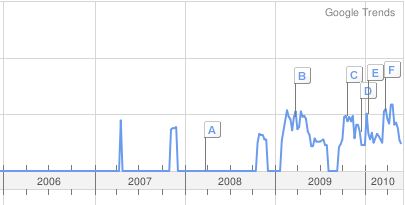
It's incredible to see our progress displayed so vividly, and anyone who doesn’t want legal marijuana in America should think twice about wasting their time trying to stop it. More people are scanning the web for news about marijuana legalization than ever before, and the media is working hard to give them exactly what they want, which results in yet more people reading and searching for news about marijuana legalization.
The whole process cascades and feeds on itself, spontaneously turning longtime observers into voices for reform, and literally creating more news by emboldening activists to launch new campaigns. It's awesome, and it absolutely won't stop until our marijuana laws are fixed forever.
Drugged Driving: Michigan Supreme Overturns ItselfâDriving With Pot Metabolites Not a Crime
The Michigan Supreme Court Tuesday ruled that it is not illegal to drive while having marijuana metabolites in the body, reversing a 2006 decision by a more conservative version of the court. Marijuana metabolites are not a controlled substance under state law, and their mere presence thus cannot be the basis of a conviction under the state's drugged driving law, the court held.
The ruling came in People v. Feezel, in which the court overturned the conviction of a driver in the death of a severely drunk pedestrian walking in the middle of a five-lane road at night. The driver, George Feezel, was himself borderline intoxicated on alcohol, blowing a 0.009, and also tested positive for marijuana metabolites, which can linger in the system for days or weeks after the pot high is gone. Feezle was not convicted of drunk driving causing a death, but was found guilty of second-offense drunk driving, leaving the scene of a fatal accident, and driving under the influence of marijuana, although there was no testimony to the effect that he had used marijuana that evening and there was testimony to the contrary.
The court ruled that a Washtenaw County jury should have been allowed to hear evidence the victim was drunk, remanding the case back to circuit court. But in ruling that marijuana metabolites are not a controlled substance, the court invalidated what was in effect a per se zero tolerance drugged driving law that allowed for people to be convicted of driving while impaired when they were not actually shown to be impaired.
"We hold that 11-carboxy-THC is not a schedule 1 controlled substance under MCL 333.7212 [controlled substances act] and, therefore, a person cannot be prosecuted under MCL 257.625(8) [drugged driving act] for operating a motor vehicle with any amount of 11-carboxy-THC in his or her system," read the opinion.
The opinion, largely a demolition of the previous Supreme Court's 2006 ruling in People v. Derror that marijuana metabolites are a controlled substance, thus allowing for drugged driving convictions based solely on their presence, noted that Michigan is now a medical marijuana state and that allowing Derror to stand would unfairly impact medical marijuana patients.
Under Derror, Justice Corrigan wrote for the majority, "individuals who use marijuana for medicinal purposes will be prohibited from driving long after the person is no longer impaired. Indeed, in this case, experts testified that, on average, the metabolite could remain in a personâs blood for 18 hours and in a personâs urine for up to 4 weeks."
It's not just about medical marijuana patients, the opinion suggested: "Thus, under Derror, an individual who only has 11-carboxy-THC in his or her system is prohibited from driving and, at the whim of police and prosecutors, can be criminally
responsible for choosing to do so even if the person has a minuscule amount of the substance in his or her system. Therefore, the Derror majorityâs interpretation of the statute defies practicable workability given its tremendous potential for arbitrary and discriminatory enforcement."
It is neither fair nor just nor in the interest of public safety to charge people with drugged driving who arenât impaired. Finally, there is a Michigan Supreme Court that recognizes that.