Consequences of Prohibition
Drug War Issues
Politics & Advocacy
Maybe the fifth time will be the charm for a Nebraska marijuana legalization initiative, a bill in the House would charge fentanyl sales as attempted murder -- even with no overdose -- and more.
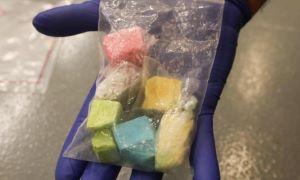
Fentanyl seized in Portland, OR. A new federal bill would impose harsh penalties for fentanyl offenses. (Multnomah County Sheriff)
Nebraska Marijuana Legalization Initiative Filed. For the fifth time since 2018, a state activist has filed a marijuana legalization initiative, this one aimed at the November 2026 ballot. None of the four previous efforts managed to obtain enough valid voter signatures to qualify for the ballot.
Bill Hawkins of the Nebraska Hemp Company filed all five ballot initiatives since 2018.
The Nebraska Cannabis Initiative is short and sweet. It takes the form of a constitutional amendment which says in its entirety "All persons twenty-one years of age or older have the right to use all plants of the genus Cannabis."
Any taxation or regulation of a legal market would presumably require action by the state legislature.
To qualify for the ballot, a state constitutional amendment requires signatures from 10 percent of registered voters. The number of registered voters is not known until signatures are handed in, but in the 2024 election cycle, it took 123,465 valid voter signatures to qualify. Under state election law, campaigners must also obtain signatures from five percent of registered voters in at least 38 of the state's 93 counties. They have until next July to do so.
Cornhuskers voters approved a pair of medical marijuana initiatives in 2024, one legalizing its use and one setting up a regulatory apparatus.
North Carolina Marijuana Legalization Bill Filed. State Rep. Jordan Lopez (D) has filed a bill to legalize marijuana in the states, House Bill 413. Titled the "Marijuana Legalization and Reinvestment Act," the bill would legalize the use and possession of specified amounts of marijuana and created a system of taxed and regulated legal marijuana commerce.
The bill would allow people 21 and over to possess up to two ounces of pot, 15 grams of cannabis concentrates, and two grams of THC. People would also be able to grow up to six plants for personal use, but they would face penalties for growing in public view or in an unsecured fashion.
The bill would also create a new state Office of Community Reinvestment within the Department of Public Safety. That office would create and administer three new funds, the Community Reinvestment and Repair Fund, the Cannabis Enterprise Opportunity Fund, and the Cannabis Education and Technical Assistance Fund.
The bill faces an uncertain future in the GOP-dominated state legislature.
Drug Policy
GOP Bill Would Let Prosecutors Charge Fentanyl Sellers with Attempted Murder, Even if There is No Overdose. Rep. Mike Lawler (R-NY) and three Republican cosponsors have filed the Fentanyl Kills Act in the House. The proposed bill would allow federal prosecutors to charge anyone selling fentanyl with attempted murder, even if no one overdosed on the drug.
"Any individual who has been found to have trafficked fentanyl shall be deemed to have attempted to perpetrate murder," the bill says, "and shall be subject to the penalty pursuant to [that]."
The penalty for attempted murder under federal law is up to 20 years in prison, but this bill cites the US code section for first-degree murder, which is "punished by death or by imprisonment for life."
The bill would define fentanyl trafficking as any federal fentanyl offense other than simple possession, and specifically mentions production, manufacture, distribution, sale, financing, transport, dispensing and "possession with intent to manufacture, distribute or dispense." The heavy federal charge would apply to aiding and abetting such offenses or even attempting them.
Including "dispensing" within the punishable activities means the new law could apply even in cases of sharing among friends with no money changing hands.
Current federal law punishes fentanyl trafficking with between five and 40 years in prison for a first offense. Larger quantities could bring between 10 years and life in prison.
"The Fentanyl Kills Act is about accountability," Lawler stated. "It's about making sure that those who profit off the destruction of our children, our neighbors, and our communities pay a price equal to the devastation they cause."
Lawler sponsored an identical bill last session, but it went nowhere. This session, a Senate bill introduced by Sen. Joni Ernst (R-IA), S. 1502, would also punish fentanyl distribution as felony murder, but only if an overdose death had actually occurred. That bill has been sitting in the Senate Judiciary Committee since it was filed in April.
This work by StoptheDrugWar.org is licensed under Creative Commons Attribution-ShareAlike 4.0 International


Add new comment