Congressional Democrats are not the only ones raising serious concerns about a policy that allows the US military to kill criminal suspects on the high seas.
We are pleased to continue with the restarted Drug War Chronicle newsletter. This continuing fundraising drive is vital to bringing the newsletter and our longtime writer Phillip Smith back to full time.
A San Francisco narc gets fired for having a sexual relationship with a snitch, a DHS officer heads for federal prison after getting stung, and more. Let's get to it:
Colombia has responded to US drug decertification by vowing an end to forced coca eradication and pausing the purchase of US military equipment, and more.
The State Department adds Barrio 18 to its list of foreign "narco-terrorist" organizations, Singapore prepares to hang a Malaysian over less than two ounces of heroin, and more.
The US Virgin Islands ends vehicle searches based on the smell of weed, the drug czar's office is reviewing Drug Free Community grants to ensure they don't promote "the radical left's agenda," and more.
A Florida appeals court is the latest to rule that the odor of marijuana is no longer grounds for a vehicle search, Wisconsin Republicans take on their own party as they try again to pass a medical marijuana bill, and more.
The Trump administration continues to claim the right to kill drug suspects on the high seas, yet another poll has strong support for marijuana legalization, and more.
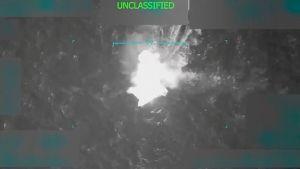
The Pentagon blows an alleged Venezuelan drug boat out of the water. (DOD)
As the Trump administration continues its murderous attacks against Venezuelan boats it accuses of being involved in drug trafficking -- the death toll now stands at 14 dead in three separate attacks this month -- legal experts have condemned the attacks as experts as "murder" and "extrajudicial executions." Now, congressional Democrats are moving to rein in what is widely seen as a lawless presidency.
Sens. Tim Kaine (D-VA) and Adam Schiff (D-CA) on Friday introduced a joint War Powers resolution (S.J.Res.59) "to direct the removal of US armed forces from hostilities that have not been authorized by Congress." The resolution echoes similar resolution filed in the House by Rep. Ilhan Omar (D-MN) on September 11.
War powers resolutions are privileged, meaning that the House and Senate will be required to promptly consider and vote upon the resolutions.
The Trump administration has claimed the right to kill what it describes as "narco-terrorists" who are importing drugs into the US but it has provided little evidence to back its contentions that the boats were actually carrying drugs, that they were operated by the middling Venezuelan criminal gang Tren de Aragua (which the administration has designated a narco-terrorist organization), or that their cargoes were destined for the United States, creating a "national security threat" for Americans.
While the US has indicted Venezuelan President Nicholas Maduro on drug trafficking charges, Venezuela is not a drug producing country and Tren de Aragua is more a criminal gang than a drug cartel. Nonetheless, the administration is aiming its ire at Venezuela more than Colombia -- the worlds leading coca and cocaine producer -- or Mexico -- by far the largest source of illicit drugs entering the US.
Secretary of State Marco Rubio said earlier this month that the United Nations Office on Drugs and Crime's assessment that Venezuela is also not a major source of cocaine was of no importance to the administration. "I don't care what the UN says," Rubio told reporters after the military killed 11 Venezuelans in its first strike earlier this month.
In the past, the US has treated drug trafficking as a criminal offense. Ships suspected of carrying drugs would be boarded and searched, and if drugs were found, they would be seized and the crew arrested. But under the leadership of Secretary of State Marco Rubio, who has long been hostile to the regime in Venezuela, and Defense Secretary Pete Hegseth, he of the warrior ethos, the administration is now claiming the right to just blow suspected drug boats out of the water and kill whoever is on board.
That is not right, say the congressional Democrats.
"There was no legal justification for the Trump Administration's military escalation in the Caribbean,” Omar said in a statement. "It was not self-defense or authorized by Congress. That is why I am introducing a resolution to terminate hostilities against Venezuela, and against the transnational criminal organizations that the administration has designated as terrorists this year. All of us should agree that the separation of powers is crucial to our democracy, and that only Congress has the power to declare war."
"President Trump has no legal authority to launch strikes or use military force in the Caribbean or elsewhere in the Western Hemisphere. The Administration has refused to provide Congress with basic information about the multiple strikes it has carried out, including who was killed, why it was necessary to put servicemembers' lives at risk, and why a standard interdiction operation wasn't conducted," said Kaine in a statement. "Congress simply cannot let itself be stiff-armed as this administration continues to flout the law. That's why we're introducing this legislation to require a debate and vote on whether the US should be conducting these strikes without congressional approval."
"Congress alone holds the power to declare war. And while we share with the executive branch the imperative of preventing and deterring drugs from reaching our shores, blowing up boats without any legal justification risks dragging the United States into another war and provoking unjustified hostilities against our own citizens. Congress must be fully briefed on these operations and if the administration believes there is a case to make for a war authorization -- it should make it. But this unauthorized and illegal use of our military must stop," said Schiff.
Congressional Democrats are not the only ones challenging the Trump administration's use of lethal force against suspected criminals.
"US officials cannot summarily kill people they accuse of smuggling drugs, said Sarah Yager, Washington director at Human Rights Watch. "The problem of narcotics entering the United States is not an armed conflict, and US officials cannot circumvent their human rights obligations by pretending otherwise," Yager said Thursday.
Yager called on Congress to also "open a prompt and transparent investigation into the decision-making process behind these attacks, including the legal rationale and chain of command."
"The US military should immediately halt any plans for future unlawful strikes," she said, "and ensure that all military operations comply with international human rights and humanitarian law."
While the administration has largely ignored human rights and domestic and international law criticisms of its aggressive actions, moves it made last week suggest it is looking to blunt them. There is a draft bill circulating in the White House and among congressional Republicans that would authorize Trump to kill people he deems "narco-terrorists." The draft foresees a five-year window for such authority, which would cover attacks not only on groups the administration has designated as "narco-terrorists" but also any countries that harbor those groups.
The authority would last for five years, and longer if renewed by Congress, and would cover groups that the administration has designated terrorist organizations as well as nations that harbor those groups.
That is crazy talk, said Jack Goldsmith, a former George W. Bush administration official and a Harvard Law School professor. Such legislation is "insanely broad," he said. "This is an open-ended war authorization against an untold number of countries, organizations, and persons that the president could deem within its scope," said Goldsmith.
back to top
Dear friends,

Phil receiving the Brecher Award for Journalism, 2013 International Drug Policy Reform conference
As you may be aware, the Chronicle was on a bit of a hiatus for much of this year. We are pleased today to publish the fifth issue of the Chronicle since our longtime writer Phillip Smith resumed his work with us.
Our fundraising drive, to help Phil continue and get him back to full-time continues. For this to work, we need to raise at least $800/week in tax-deductible grants or donations to our 501(c)(3) nonprofit, DRCNet Foundation. That's not all Phil should be earning for his work, but for now at least it will enable us to complete the restart of the Chronicle and keep it going.
(We also need to raise $900/month in non-deductible donations to our 501(c)(4) public welfare nonprofit, Drug Reform Coordination Network, to continue to afford the our list management service and web site hosting fees. I'll explain why we cover these costs from the non-deductible type of donation in a subsequent email. If you remember this from the past, it's the same reason as before, with the costs somewhat lower now.)
Thank you if you're willing to help us restart Drug War Chronicle. Also, if you were planning to or considering making a gift later in the year, it would make the extra difference if you were to do so now instead. Of course we are grateful for your support, whenever it is provided and in whatever amount.
Note that our online donation system, along with accepting one-time donations of course (via credit card, PayPal or bank ACH), also has a range of recurring donation options that you can use if you wish to make that commitment. People mainly use these for monthly or annual gifts to our organization. But our donation system can also accommodate gifts scheduled weekly, biweekly, every four weeks, quarterly, and twice a year. (Click here if you'd like info on contributing by mail or making a gift of stock.)
Sincerely,

David Borden, Executive Director
StoptheDrugWar.org
P.O. Box 9853, Washington, DC 20016
https://stopthedrugwar.org
back to top
A San Francisco narc gets fired for having a sexual relationship with a snitch, a DHS officer heads for federal prison after getting stung, and more.

In San Francisco, a veteran narcotics detective was fired September 11 for having a sexual relationship with one of her snitches. Christina Hayes had been under investigation since 2023, when her snitch was arrested by another law enforcement agency in the East Bay. Police found sexually explicit photos of Hayes on the snitch's phone. The woman told officers she was Hayes' snitch, and when those cops contacted Hayes, she tried to get favorable treatment for the woman. Hayes was suspended in June 2023, and federal court records allege she divulged confidential information and impeded an active criminal investigation. It's unclear to whom Hayes allegedly divulged information; details on that case have not been released. More than 100 cases, mostly drug-related, were dismissed in San Francisco Superior Court due to Hayes' link to them. Cases were also dismissed in Alameda County in relation to her misconduct case. Several more cases were dismissed in federal court.
In Auburn, Alabama, a state prison senior correctional officer was arrested September 12 after a late night traffic stop resulted in a search that turned up two pounds of weed. A subsequent search of Joshua Isaiah Joyner's home turned up four more pounds. He is charged with possession of marijuana and possession of drug paraphernalia, but state Department of Corrections officials said more charges could be pending. There is no indication the marijuana was going to prisoners. Joyner immediately resigned from his position.
In Prince George, Virginia, a Riverside Regional Jail officer was arrested September 13 for plotting to smuggle drugs to inmates. Officer Akiylah Taylor was taken into custody for conspiring to deliver drugs to an inmate, according to the jail. She went down after an investigation by the Prince George Police Department. She is now former-officer Taylor.
In Cincinnati, a Hamilton County jail deputy was sentenced September 15 to 18 months in prison after being convicted of smuggling xylazine and a cellphone into the county jail. Richard Sampson, 46, had been charged with two counts of illegal conveyance, a felony count for the xylazine and a misdemeanor count for the cellphone. He has been on unpaid administrative leave since being arrested last year and now will presumably be fired.
In Houston, a former Department of Homeland Security deportation officer was sentenced September 16 to 70 months in federal prison for laundering drug proceeds. Christopher Washington Toral, 49, has pleaded guilty in February.Toral began working with Immigration and Customs Enforcement in 2008 and was assigned to a processing center in Conroe. Over a two-month period in 2023, he was the subject of a sting, using his position as a federal law enforcement officer to transport $700,000 in drug proceeds under the guise of official duties. As part of an undercover operation, Toral agreed to transport a black bag containing $200,000 in cash from Dallas to Houston in February 2023, believing the money was from illegal narcotics sales. He made the same trip later that month delivering an additional $200,000. In March, Toral flew from Newark, New Jersey, to Houston with $300,000 in suspected drug money, bypassing airport security and Transportation Security Administration by exploiting his law enforcement position. He did this in return for cash payments.
In Knox, Indiana, a former Starke County sheriff's deputy was sentenced September 23 to 60 days in jail for filing a false police report in a case that began five years ago with reports of cash and drugs missing from the department's evidence room. The state police began investigating the missing goodies in January 2020, and then-Deputy Don Ferguson was indicted in September 2022 on multiple charges, including four counts of official misconduct (Level 6 felonies), theft of a firearm (Level 6 felony), theft (Class A misdemeanor), false reporting (Class B misdemeanor), and conversion (Class A misdemeanor). But a jury trial in August resulted in Ferguson being found not guilty on four of the counts, with the jury hung on the other four. In return for the dismissal of the remaining charges, Ferguson pleaded guilty to that single charge.
back to top
Colombia has responded to US drug decertification by vowing an end to forced coca eradication and pausing the purchase of US military equipment, and more.

Colombian President Gustavo Petro reacts angrily to US drug decertification. (Creative Commons)
Foreign Policy
Bolivia Reject US Drug Certification Report. The government of Bolivia has rejected its inclusion on this year's version of the US State Department's annual report naming major illicit drug producing or transit countries that are not cooperating with prohibitionist US drug policy demands.
Deputy Minister for Social Defense and Controlled Substances Jaime Mamani told Bolivia TV that the US is not a recognized body for evaluating other countries' drug policies and he questioned Washington's role as a "unilateral judge."
Mamani said Bolivia has a "comprehensive and sovereign" anti-drug strategy which includes eradication of illicit crops and cooperation with UN agencies such as the Office on Drugs and Crime and the International Narcotics Control Board.
The Ministry of Government also criticized the report, releasing a statement saying that "drug trafficking is a global problem with shared responsibilities, and the fight against it must be the result of multilateral cooperation as established by international organizations, not unilateral accusations."
It also noted that with the US as a leading consumer of illicit drugs maybe it should not be telling other countries how to run their drug policies.
Colombia Vows No More Forced Coca Eradication in Face of US Report Decertifying Country as Drug War Cooperator. Stung by Washington's decertification of the country in the State Department's annual report naming major illicit drug producing or transit countries that are not cooperating with prohibitionist US drug policy demands, President Gustavo Petro said in a televised address that his security forces would never again forcibly eradicate coca crops.
Colombia has long been a major partner with the US in the fight against drug trafficking, but tensions have risen between the leftist, pro-drug reform government of Petro and the Trump administration. The US said that decertification was solely due to Petro's leadership, a claim Petro said he found insulting.
The US move was "an injustice, a profound insult to the country that has shed the most blood so that society in the United States and Europe does not consume so much cocaine," Petro said. "If any political leader since [late presidential candidate Luis Carlos] Galan has fought against drug trafficking, it's been me, at the cost of living in constant insecurity, facing assassination attempts, and enduring constant persecution against me and my family."
Petro said that Trump ignored facts and instead listened to members of a "far-right ideological alliance" between "drug traffickers and Colombian politicians" with great influence in Florida. "They preferred this ideology over the truth," he said.
What the US political elite calls a drug policy or a war on drugs is in fact "a war against the peoples of the Third World," according to Petro.
He also lambasted US drug policies over the decades: "You have done nothing to reduce consumption, but instead allowed it to transform into something worse, from cocaine to fentanyl," he said. "This is why you now have 3,000 deaths from cocaine overdoses and what you get is 100,000 deaths a year from fentanyl… What does this show, Mr. Trump? That your entire 50-year anti-drug policy has failed, failed, and I repeat again, failed. Your war has been defeated by the mafia and drug trafficking.
Petro added that he had only agreed to forced eradication of coca because of a "stupid obligation" and despite evidence that the tactic is ineffective and comes at the cost of human lives. Not any more, he said.
"Shamefully, there were 13 deaths [among police] in 2025 for agreeing to the request to begin forced eradication, which was a mistake and I will not do it again. Forced eradication kills police in Colombia… Thirteen deaths for taking US policy seriously."
"The president obeys to Colombian law, not the orders of foreign governments," Petro said earlier on social media platform X. "In the end," it's the United Nations where the most important decisions are made about counternarcotics policy," not in the US, "the world's biggest cocaine consumer and the world's biggest fentanyl consumer," he added.
Colombia Suspends US Military Equipment Purchases Amid Diplomatic Dispute. In response to being named for the first time in decades on the State Department's annual report naming major illicit drug producing or transit countries that are not cooperating with prohibitionist US drug policy demands, the Colombian government announced last week that it is suspending military equipment purchases from the US.
The US accused the government of former guerrilla President Gustavo Petro of not acting forcefully enough against cocaine production and coca cultivation. That leaves Colombia in the company of nations such as Bolivia, Myanmar, and Venezuela in the eyes of the US.
Petro responded that Colombia will not submit to "blackmail" nor rely on "handouts" from Washington. He also pointed a finger back at Washington, noting that the US is a major illicit drug consumer.
Tensions between governments that have traditionally been drug war allies have mounted since the election of Petro two years ago and have ratcheted even higher since Trump was reelected last year. To signal its antipathy toward Petro's policies, earlier this year, the Trump administration halted logistical support for Black Hawk helicopters the Colombians use for anti-drug operations and suspended the delivery of M1117 armored vehicles.
Last year, Petro suspended military purchases from Israel to protest its war in Gaza. But it later had to reinstate technical cooperation with Israel to keep its Israeli-made fighter bomber maintained. Colombia may have to reinstate military purchases from the US for similar reasons. But in the meantime, it is signaling that it will go its own way on defense partnerships and seeking to diversify its supply lines.
International
New Zealand Approves Therapeutic Magic Mushrooms for Depression. Auckland has granted limited approval for the therapeutic use of psilocybin, the psychedelic compound in magic mushrooms, for the treatment of otherwise treatment-resistant depression, the government announced last Wednesday.
"Psilocybin remains an unapproved medicine, but a highly experienced psychiatrist has been authorized to prescribe it to patients who have not responded to other treatments," said Deputy Prime Minister David Seymour in a statement. He called it a "major step forward" for people suffering despite having exhausted all conventional options.
Regulations will limit prescription ability only to psychiatrists who have participated in clinical trials involving psilocybin.
In 2023, neighboring Australia became the first country to allow for the therapeutic use of psilocybin, as well as MDMA. It has also been approved for therapeutic use in several US states, including Colorado and Oregon.
back to top
The State Department adds Barrio 18 to its list of foreign "narco-terrorist" organizations, Singapore prepares to hang a Malaysian over less than two ounces of heroin, and more.

Former Philippine president Rodrigo Duterte faces justice at The Hague. (Creative Commons)
Marijuana Policy
California Governor Signs Marijuana Tax Rollback Into Law. Gov. Gavin Newsom (D) on Monday signed into law a bill that will roll back a marijuana excise tax, Assembly Bill 564. Although lawmakers voted earlier this year to increase the tax to 28 percent, after protests from the industry and activists, they then voted to undo that move.
"We're rolling back this cannabis tax hike so the legal market can continue to grow, consumers can access safe products, and our local communities see the benefits," said Newsom.
"California's cannabis economy can bring enormous benefits to our state, but only if our legal industry is given a fair chance to compete against the untaxed and unregulated illegal market," said bill sponsor Assemblymember Matt Haney (D–San Francisco). "AB 564 helps level the playing field. It protects California jobs, keeps small businesses open, and ensures that our legal cannabis market can grow and thrive the way voters intended."
Foreign Policy
US Designates Salvadoran Gang Barrio 18 as Foreign Terrorist Organization. Barrio 18, a Central American gang originally based in El Salvador, is the latest drug trafficking organization to be designated as a foreign terrorist organization by the State Department. More than a dozen groups have been so designated as "narco-terrorist" organizations since the Trump administration took office in January, including the Sinaloa Cartel and the Jalisco New Generation Cartel.
The State Department accused the gang of carrying out violent attacks against public officials, security personnel, and civilians in El Salvador, Guatemala, and Honduras and said the move "further demonstrates the Trump administration's unwavering commitment to dismantling cartels and gangs and ensuring the safety of the American people."
The foreign terrorist designation has historically been bestowed on groups that use violence for political ends, such as Al Qaeda and ISIS, not organizations such as gangs and drug cartels, which are motivated by profit, not politics. But the Trump administration has used that designation to justify its lethal attacks on Venezuelan boats it accuses of carrying drugs.
"The United States will continue to protect our nation by keeping illicit drugs off our streets and disrupting the revenue streams funding the violent and criminal activity of vicious gangs and drug cartels," the State Department said Tuesday.
International
ICC Prosecutors Seek Crimes Against Humanity Charges for Duterte Drug War Killings. In a move that occurred in July but was only made public Monday, the Office of the Prosecutor (OTP) of the International Criminal Court (ICC) has formally sought to charge former Philippine president Rodrigo Duterte with crimes against humanity for directing a bloody war on drugs and drug users that saw thousands killed, either by police or by shadowy death squads connected to the repressive apparatus of the state. He was also charged with the killings in Davao City a decade ago when he was mayor there.
Duterte was an "indirect co-perpetrator" of the killings, said ICC deputy prosecutor Mame Mandiaye Niang.
In addition to 19 counts for the Davao City murders, Duterte faces two categories from the time he was serving as president and unleashed his brutal drug war. One includes 14 counts for the killing of "high value" targets across the country, while the third count is in relation to the murder and attempted murder of 45 people during a village clearing operation. [Ed: The numbers reflect cases prosecutors have enumerated, not the total number of killings in the Philippine drug war, which NGOs estimate is around 30,000 and of which the government acknowledges more than 6,000.]
Duterte and his alleged co-conspirators "shared a common plan or agreement to 'neutralise' alleged criminals in the Philippines (including those perceived or alleged to be associated with drug use, sale or production) through violent crimes including murder," prosecutors said.
Duterte remains unrepentant, saying he organized the crackdown to rid the country of street crime.
Duterte is the first Asian former head of state to be charged by the ICC. He has been in custody at The Hague since March.
Singapore Set to Do Another Drug War Hanging This Week. Anti-death penalty activists in the Southeast Asian city-state warned Monday that a Malaysian man on death row for trafficking heroin is set to be executed this week. Datchinamurthy Kataiah, 39, will become the third Malaysian national and the eleventh person to be hanged this year in Singapore.
Activists said his family got notice Sunday that he will be hung Thursday at Changi Prison. He was arrested in 2011 and convicted of trafficking less than two ounces of heroin into Singapore. He had a 2022 date with hangman but won a reprieve pending a legal challenge to his execution. That challenge was dismissed by the Singapore court last month.
Under Singapore's harsh drug laws, anyone carrying more than 15 grams of heroin gets the death penalty, as does anyone caught with as little as a pound of marijuana. Activists have criticized the law as disproportionately targeting low-level traffickers and couriers.
Human rights groups including Amnesty International Malaysia and the Anti-Death Penalty Asia Network, as well as more than two dozen other civil society groups issued a joint statement calling for an end to executions. Four other men, including three Malaysians, also face looming executions after their latest appeals were rejected.
back to top
The US Virgin Islands ends vehicle searches based on the smell of weed, the drug czar's office is reviewing Drug Free Community grants to ensure they don't promote "the radical left's agenda," and more.

Alaska could become the third state to decriminalize and allow therapeutic use of natural psychedelics, after Colorado and Oregon. (Greenoid/Flickr)
Marijuana Policy
US Virgin Islands Court Decision Ends Use of Marijuana Smell as Basis for Vehicle Searches. The US territory has become the latest jurisdiction to end the odor of marijuana as probable cause for a vehicle search after Superior Court Judge Ernest Morris Jr. ruled that the islands' Cannabis Use Act, which legalized marijuana, meant the smell of weed was no longer evidence that a crime had been committed.
The ruling came in the case of three men charged with firearms offenses after a March 2024 traffic stop in Christiansted. An officer reportedly smelled marijuana from within the vehicle and used that as an excuse to search the vehicle, resulting in the seizure of the guns. No marijuana was recovered.
The men's attorneys filed a motion to suppress the evidence, arguing that no probable cause to search the vehicle existed. Judge Morris granted the motion to suppress. In doing so, he noted that the Cannabis Use Act was already in effect at the time of the traffic stop and that because marijuana is legal "it is not inherent that the marijuana in a person’s possession is illegally acquired or is being illegally used."
With their evidence suppressed, prosecutors moved to dismiss the case -- a request Judge Morris promptly granted.
Psychedelics
Alaska Psychedelics Campaign Launches Signature Drive to Put Legalization Measure On 2026 Ballot. State activists have launched a signature-gathering campaign to qualify an initiative that would legalize certain psychedelics on the 2026 ballot.
The Alaska Natural Medicine Act "would establish a comprehensive framework for the legal access, cultivation, and use of natural medicines -- including psilocybin, dimethyltryptamine (DMT), mescaline (excluding peyote), and ibogaine -- for adults aged 21 and older. It also recognizes and protects traditional and indigenous uses of these substances," according to the office of Lieutenant Governor Nancy Dahlstrom, which certified the measure for circulation last month.
If approved by voters next year, the initiative would create a Natural Medicine Control Board to oversee licensing, regulation, and public education; establish a Traditional Use Council to support cultural and spiritual practices; decriminalized personal possession, cultivation, and non-commercial sharing of certain natural medicines; authorize licensed facilities and facilitators to provide therapeutic services; and protect certified traditional practitioners and their clients from criminal penalties.
While "building off of" Colorado's 2022 Natural Medicine Health Act, a campaign policy outline says the measure "shifts away from a restrictive healing center model, allowing individual practitioners to provide [natural medicine] in their offices and at-home facilitation, increasing accessibility in rural communities" that are common in Alaska.
A 2024 poll found that less than half (49.4 percent) of Alaskans would support such a measure, but support rose to nearly two-thirds (65 percent) when participants were told that Alaska has high rates of mental illnesses that could potentially be treated with psychedelics.
Organizers need some 34,098 valid voter signatures to qualify for the ballot. They have one year to come up with them.
Drug Policy
ONDCP To Recompete Drug-Free Communities (DFC) Grants to Ensure Compliance with President Trump’s Executive Orders. The drug czar's office last Friday issued the following statement saying it will review all Drug Free Community grants to ensure they do not further "the radical left's agenda":
"The White House Office of National Drug Control Policy has decided to recompete the Awards for the 2025 DFC Support Program to ensure that applicants are in compliance with the President's Executive Orders. DFC Awards are granted every year to drug-free youth coalition organizations across the nation that have applied for federal funding through ONDCP's DFC Support Program.
"It is imperative that ONDCP protects American taxpayer dollars. Our team is working aggressively to put safeguards in place towards advancing President Trump's America-First policy agenda and mission. We are performing due diligence to ensure that absolutely no taxpayer dollars go to furthering the radical left's agenda.
"The money remains available for awards. We want to ensure that the money entrusted to our office is being responsibly allocated to the communities that are actually working to protect our youth from drugs."
(And not for harm reduction.)
International
Urgent Call for Continued WHO Leadership on Harm Reduction. Global advocates for harm reduction earlier this month sent an open letter to the World Health Organization (WHO) Director-General, Dr Tedros Adhanom Ghebreyesus, "urging WHO to maintain and resource its strong presence, expert capacity, normative guidance and diplomatic voice within the harm reduction, human rights and drug policy spaces, to ensure the continuation of its crucial work in support of harm reduction and people who use drugs, and also through ensuring meaningful involvement of people who use drugs at all levels."
Led by the International Drug Policy Consortium, 177 civil society and community-led organizations joined in saying they "recognize that this is a time of unprecedented challenges for the WHO, as it is for health and human rights movements and stakeholders across the globe. However, we urge you to ensure that current funding cuts and other geopolitical pressures are not allowed to weaken the WHO's role, its political will and its position as the normative leader for harm reduction and programs for people who use drugs."
"Even before the recent pushback and defunding of human rights, health and development agendas, harm reduction was already facing a crisis of funding and political leadership -- despite the overwhelming evidence for its effectiveness," the letter continued. "People who inject drugs were already 14 times more likely to acquire HIV than the rest of the adult population. The funding for harm reduction in low- and middle-income countries was already just 6 percent of the estimated annual resource needs. Service delivery was hampered by disinformation and political resistance. Sweeping cuts to foreign aid this year have had an additional, immediate and devastating effect on programs and those who access them, as well as on the available support for civil society and community-led advocacy, including community networking and empowerment."
"Now more than ever, we need the World Health Organization to lead, protect and promote harm reduction and champion evidence-based, rights-based policies and programs for people who use drugs. A weakened WHO role would inevitably translate into setbacks not only for harm reduction, but for the broader fight against infectious diseases."
One area where the WHO could demonstrate leadership, the letter suggested, is by nominating a panelist on Commission on Narcotic Drugs panel reviewing the implementation of drug policy commitments and considering changes in the international drug control machinery who is "someone with specific expertise in, and an active champion of, harm reduction and human rights, and particularly someone who has a strong connection and relationship with the community of people who use drugs."
Singapore Executes Malay Drug Offender, 11th Execution of the Year. Singapore authorities hanged Malaysian citizen Datchinamurthy Kataiah, 39, last Thursday. He had been convicted of trafficking about 1.6 ounces of heroin into the city-state back in 2011.
His execution marked the 11th so far this year in Singapore, despite rising calls for the abolition of the death penalty.
"Capital punishment is imposed only for the most serious crimes, such as the trafficking of significant quantities of drugs which cause very serious harm, not just to individual drug abusers, but also to their families and the wider society," the Singapore Central Narcotics Bureau said in a statement announcing the killing.
Under Singapore's draconian drug laws, there is a mandatory death sentence for possession of more than 15 grams of heroin or 500 grams of marijuana. Critics say that law has mostly sent low-level mules to the gallows and has done little to stop drug trafficking.
Dozens of human rights and civil society groups last week reiterated calls for an end to the executions. They warned that four other drug offenders are on death row and could killed soon after losing their latest appeals.
back to top
A Florida appeals court is the latest to rule that the odor of marijuana is no longer grounds for a vehicle search, Wisconsin Republicans take on their own party as they try again to pass a medical marijuana bill, and more.

DEA agents have been diverted to chasing migrants, and federal drug prosecutions are dropping. (Creative Commons)
Marijuana Policy
Florida Court Blocks Police from Using the Smell of Marijuana Alone to Search Vehicles. A Florida appeals court has ruled that it no longer makes sense to allow police to search a person's vehicle based solely on the odor of marijuana. Second District Court of Appeals Judge Nelly Khouzam authored the opinion overturning a lower court ruling last Wednesday.
Under state law, "plain smell doctrine" long allowed for the smell of marijuana to be used as probable cause for vehicle searches. But with hemp and medical marijuana both now legal in the state, the state's laws have "fundamentally" changed, the appeals court held.
"For generations, cannabis was illegal in all forms -- thereby rendering its distinct odor immediately indicative of criminal activity. But several legislative amendments over the years have fundamentally changed its definition and regulation," Khouzam wrote. "The cumulative result is that cannabis is now legal to possess in multiple forms, depending on discrete characteristics such as where it was procured or its chemical concentration by weight."
"We are obligated under well-established constitutional principles to give meaning and effect to the legislature's significant amendments to cannabis regulation," the opinion continued. "In light of significant legislative amendments to the definition and regulation of cannabis, its mere odor can no longer establish that it is ‘immediately apparent’ that the substance is contraband. Accordingly, the plain smell doctrine can no longer establish probable cause based solely on the odor of cannabis. Rather, we now align the Fourth Amendment analysis for cannabis with the test that applies to other suspected contraband, such that its odor is a valid factor to be considered along with all others under the totality of the circumstances."
Medical Marijuana
Wisconsin Republicans Introduce Medical Marijuana Bill. A trio of GOP lawmakers have filed the latest legislation seeking to legalize medical marijuana in the Badger State. They include the powerful Senate President, Mary Felzkowski (R-Tomahawk), who is the lead sponsor of the bill, as well as Senator Patrick Testin (R-Stevens Point) and Assemblyman Patrick Snyder (R-Weston).
"Someone who suffers from a serious health condition should not have to make the choice to travel to another state or break the law so they can try an alternative medicine for relief," said Felzkowski in a statement. "This legislation is about giving our friends, family members, and neighbors suffering from a chronic illness the freedom to explore another option with their doctor. This is also a chance for small businesses in our state to take part in this market with reasonable regulations on making and selling these products, all while still protecting public safety."
This is the second time in as many years that Republicans, who control both chambers of the legislature, have tried to pass a medical marijuana bill. Last year, a bill that would have allowed medical marijuana only for severely ill people with specified chronic diseases was stalled by Senate Republicans, who objected to its provision for state-run dispensaries.
This year's bill would license dispensaries, growers, processors, and labs. It also includes measures "to ensure that medical cannabis is not abused or accessed by those without a medical need."
Wisconsin is one of only a handful of states that have yet to approve medical marijuana. That even as a 2024 Marquette University poll found that 86 percent of state respondents believe it should be legal.
The bill is not yet available on the state legislative web site.
Drug Policy
Federal Drug Prosecutions at Lowest Level in Decades as Trump Emphasizes Deportations. With the Trump administration pulling federal law enforcement agents, including DEA agents, away from their normal tasks to focus on its mass deportation campaign, the number of federal drug prosecutions has hit the lowest level in decades.
A Reuters examination of more than two million federal court records found that so far this year about 10 percent fewer people faced prosecution on drug charges than during the same period last year, a drop of about 1,200 cases. That is the lowest rate of federal drug prosecutions since the late 1990s.
The decline in prosecutions was even more dramatic for complex conspiracy and money-laundering cases that are typically used against high level traffickers. Those prosecutions declined by 24 percent year-over-year.
In January, President Trump ordered thousands of federal agents to focus on what he called an "invasion" of illegal immigrants. That has led to the slowdown in those complex prosecutions long seen as central to combating sophisticated criminal networks, including drug cartels.
"We’re seeing a reduced amount of time on long-term investigations so agents can go out in their raid gear and be seen supporting immigration raids," a senior Justice Department official involved in those investigations told Reuters.
One prosecutors told the press agency a fentanyl investigation he was supervising was stalled because the agents working it had been forced to work on deportations instead. Another said drug ring investigations had been delayed.
But White House spokeswoman Abigail Jackson defended the move, saying that Trump's "highly successful efforts at closing the border and removing dangerous criminal illegal aliens from our communities, along with prosecuting violent drug traffickers and targeting transnational cartels, means less illegal drugs are circulating in American communities."
But the professional drug fighters disagreed.
"You cannot conduct thorough, multi-agency drug investigations if you're running around doing this other stuff," said a former DEA official who supervised its shift to immigration enforcement.
Foreign Policy
US Attacks Another Venezuelan "Drug Boat," Killing Four. For the fourth time in as many weeks, the US military has attacked a Venezuelan boat it accused of carrying drugs, sinking the boat and killing all four people aboard. The attack came last Friday, according to Defense Secretary Pete Hegseth.
"The strike was conducted in international waters just off the coast of Venezuela while the vessel was transporting substantial amounts of narcotics -- headed to America to poison our people," Hegseth wrote in a post on X. "Our intelligence, without a doubt, confirmed that this vessel was trafficking narcotics, the people onboard were narco-terrorists, and they were operating on a known narco-trafficking transit route."
But the US has supplied paltry evidence to support its claims, and some experts on international law say the lethal attacks are unlawful. They note that if people are suspected of criminal conduct, they should be arrested and prosecuted, not summarily executed.
"These strikes will continue until the attacks on the American people are over!!!!" Hegseth added. But he and the administration are stretching the meaning of words as well as the letter of the law in attempting to justify their actions. Being a low-level operator in a drug smuggling operation is not the same thing as being an Al Qaeda or ISIS militant, and transporting illicit drugs in waters more than a thousand miles from any US coastline is not an "attack" in any normal sense of the term.
The campaign of lethal military assaults on Venezuelan "drug boats" also exposes US servicemembers to potential liability under US and international law. Look for a Chronicle feature article on this issue coming soon.
back to top
The Trump administration continues to claim the right to kill drug suspects on the high seas, yet another poll has strong support for marijuana legalization, and more.

Jarred Shaw uses cannabis gummies to treat Crohn's Disease. Now, the Indonesians could execute him. (Screengrab/News on 6)
Marijuana Policy
Market Research Firm Poll Has Support for Legalization at a Solid 62 Percent. The market research and data analytic firm MRI-Simmons has released the MRI-Simmons' 2025 National Cannabis Study, which, in line with a decade-long list of polls, finds solid majority support for marijuana legalization.
The study, which employs "probabilistic and address-based sampling," according to the company website, had support for legalization at 62 percent, with 64 percent saying they expected pot to be legal in all 50 states within five years.
The public views legalization not as beneficial, with 70 percent agreeing it reduces illicit drug trafficking and 63 percent supporting erasing the criminal records of past marijuana offenses. And a majority (52 percent) of adults favored giving convicted pot-sellers priority for legal marijuana business licenses.
There was also strong support (67 percent) for allowing banks to serve legal pot businesses without penalty, and 59 percent said they would be more likely to vote for candidates who ran on legalization.
"For advertisers and media companies, this signals a growing opportunity to align with progressive values and tap into a politically engaged audience. Cannabis isn't just a product. It's a platform for change," MRI-Simmons noted.
Foreign Policy
DOJ Tries to Justify Blowing "Drug Boats" Out of the Water. The Justice Department's Office of Legal Counsel (OLC) has produced a classified legal opinion that seeks to make the case for the US military to conduct lethal strikes not just on Venezuelan "drug boats" but against a secret list of cartels and suspected drug traffickers, CNN reported Monday. The list of potential target organizations and individuals goes beyond those the administration has publicly identified as terrorist organizations.
The OLC opinion formed the foundation for the Defense Department's memo to Congress last week that argued the lethal boat attacks were legal because the US is in an "armed conflict" with the cartels and President Trump has determined that drug smugglers are "unlawful combatants." Although lawmakers have repeatedly asked DOJ and DoD for a copy of the OLC opinion, the agencies have not made it available.
Designating low-level drug smugglers as enemy combatants and giving the president the power to order their summary execution is a radical break with both US and international law and domestic practice. Traditionally, the Coast Guard has treated smugglers as criminals -- not terrorists and enemy combatants -- and arrested them to face the criminal justice system.
"If the OLC opinion authorizing strikes on cartels is as broad as it seems, it would mean DOJ has interpreted the president to have such extraordinary powers that he alone can decide to prosecute a war far broader than what Congress authorized after the attacks on 9/11," said Sarah Harrison, a former associate general counsel at the Defense Department who now works as a senior analyst at the Crisis Group." By this logic, any small, medium or big group that is trafficking drugs into the US -- the administration could claim it amounts to an attack against the United States and respond with lethal force," said Harrison, who had the outlines of the legal opinion described to her by CNN.
As recently as this week, both DOJ and DoD have stonewalled requests they produce the opinion. At a combative Tuesday hearing, Attorney General Pam Bondi told the Senate Judiciary Committee she would not discuss any DOJ opinions on the legality of strikes against civilian vessels in the Caribbean.
"I’m not going to discuss any legal advice that my department may, or may not, have given or issued at the direction of the president on this matter," she demurred. (She also refused to answer almost all other questions from Democratic senators, preferring instead to engage in ad hominem attacks against her questioners.)
International
American Basketball Player Faces Potential Death Penalty Over Medical Marijuana After Arrest in Indonesia. American basketball player Jarred Shaw faces a possible death sentence after being busted with more than 100 cannabis gummies in Indonesia. The 35-year-old Texan played internationally in the Indonesian Basketball League and says he used the gummies to treat Crohn's disease.
But Indonesia has draconian drug laws that include the possibility of the death penalty for his offense. The combined weight of the gummies was 869 grams, allowing a charge of possessing marijuana with the presumption of distribution, even though most of the weight of the gummies was from non-marijuana components.
"I use cannabis as a medicine," he said in an interview with the Guardian while in pre-trial detention in Jakarta. "I have an inflammatory condition called Crohn’s disease that’s incurable. There's no medicine apart from cannabis that stops my stomach from aching. "I made a stupid mistake," he said. "There's people telling me I'm about to spend the rest of my life in prison over some edibles."
"I've never been through anything like this," he said, adding that during his first two months after being arrested, he was at "the lowest point in [my] life" and in a "really dark mental place." "I felt helpless and alone. I didn't want to wake up again," he said. "I just turned 35 but I still feel young. I would love to continue my basketball career. They’re making it seem like I'm this big drug dealer," Shaw said. "Why would I bring the candy here to sell? It was for personal use."
The Trump administration has not said whether it will designate this as a case of a person wrongfully detained by a foreign government, as the Biden administration eventually did with Marc Fogel, who had been imprisoned for medical marijuana in Russia.
back to top