Drug War Issues
Politics & Advocacy
The US Supreme Court agreed Monday to rule on whether police may search a parked vehicle whenever they arrest a driver or passenger. Since a 1981 Supreme Court decision that held that police may search a vehicle for weapons when they arrest an occupant, most courts have held that police have ample authority to search vehicles after an arrest.
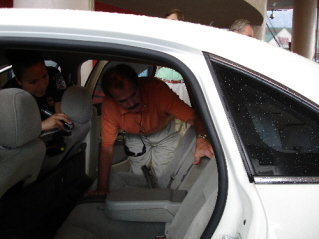
police searching accused drug traffickers' car
In a 3-2 decision, the Arizona Supreme Court threw out the evidence, saying that the post-arrest search of his car violated the Fourth Amendment's ban on unreasonable searches and seizures. With Gant handcuffed in the back of a squad car, police faced no danger from any weapons hidden in the vehicle, the majority said. Because police did not initiate contact with Gant before he got out of his vehicle, the search of his vehicle was not incidental arrest and thus unconstitutional. Police could have obtained a search warrant if they could convince a magistrate they had probable cause, the court noted.
Arizona Attorney General Terry Goddard appealed to the US Supreme Court last fall, arguing that the Arizona Supreme Court decision sets "an unworkable and dangerous test" that would confuse police, prosecutors, and judges. He was backed by other law enforcement agencies and associations, including the Los Angeles district attorney's office and the National Association of Police Organizations.
The case, Arizona v. Gant, will be argued this fall.
This work by StoptheDrugWar.org is licensed under Creative Commons Attribution-ShareAlike 4.0 International


Comments
Couldn't hack it
The purpose of law enforcement to deter and protect the public. A person with a valid warrant is caught driving. Then you can search his vehicle since the a crime was committed in the vehicle and was directly observed by law enforcement. I am tired of drug scum getting off because of lawyers playing the paper game like in this one.
Good for the cops, good for the public. He needs to man up and deal with what he got caught with.
From,
Current law enforcement, who could hack it.
In reply to Couldn't hack it by Anonymous (not verified)
ignorance
A lot of law enforcement, not all, personnel depend on citizens not knowing their rights and take advantage of it. A good attorney is only doing his job by letting the citizens know of improper situations, even prosecutors will tell an officer if the evidence will stand or not or if its enough to make a case. In the Gant case, there was no reason to search the car without a warrant, that was just sloppy work on the part of the officer. If we want to get them off the street, than we need to do whats right and leave no room for mistakes!
P.S.
there are way too many law enforcement personnel that is over zealous and like to bully people. Just remember, its more good cops than bad
In reply to Couldn't hack it by Anonymous (not verified)
not in amerikka
it is calledracialprofiling
Radical?
I really don't think that police officers are good or bad, they are, rather, both. You CAN have really good police officers, and you can have really crappy ones too. When it comes down to it they ARE just people. As for this case, this guy probably deserved his time, but they really do need to stick to the laws we have in place. Otherwise, what kind of precedent is set for someone who say accidentally runs a red light. On technicality, a crime was committed however minor it may be. Now say theoretically that this is a lower income minoritywho ran the light, and a single mother....she gets searched on principle that she committed a crime and "looks like a shady character" (which by the way that DOES still happen in some places) you've already made an example by allowing the search of this drug dealer/addict/distributor and set the standard that it is okay to search a car of someone you pull over who committed a crime. Now, this woman is innocent, except of running the light because maybe she was late for picking up her kid at school. Now her little kid is sitting in front of the school while you search her vehicle for no good reason but suspicion.You really can't judge whether it is good to have a law based on just one case. You have to look at all possible scenarios and decide what is a better rule for the general population to be happier and safer. Then you have to stick to that rule. The duty to prove anything about an incident deemed plausibly illegal rests on those who enforce the legalities of our nation, and not on those that live by it. That's the way the U.S. works. It isn't always perfect, it has some flaws, and it gets abused sometimes. But, our system is a lot better than many other governments' you could live under. So really, just chill out...and remember if you get "caught" for something you DIDN'T do, that because of how things are done, you won't be immediately carted off to a cell. Seems a fair trade to me that sometimes people get through the cracks. What say you?
knock it off
people want to bash police officers for doing there job wrong but in reality i don't see any of those who talk trash out there putting there lives on the line to protect and serve the people. i don't think the evidence should be thrown out. He had drugs and weapons in his car and he had an outstanding warrant. last time i checked that was jail time as it is.Any one who puts there life on the line to protect my family and friends is all good in my book.To all those people who talk trash knock it off because next time it might be your kids or friends who do drugs and over dose from them and then you will be like the police should have done there job but in reality they do but they have people like u who have to trash them all the time and its called karma
In reply to knock it off by kid (not verified)
I think your missing the
I think your missing the point "kid" no ones saying that he's not a criminal or probably deserves it. were just saying America is America because of our rights. the more rights that get taken away from us the easier it is for them to be taken away. Our fore fathers didn't mean for us to surrender under "authority" for a little safety, If we do were spitting on all they have done for us. " Those who would give up essential liberty to purchase a little temporary safety deserve neither liberty nor safety." Benjamin Franklin. Long live the 4th Amendment! God Bless America
Add new comment