President Bush Tuesday formally requested $550 million from Congress for anti-drug assistance to Mexico and Central America next year. The funding request is only the first installment in a two- or three-year aid package that is expected to total some $1.4 billion. The funding was included in the president's latest supplemental funding bill for the Iraq and Afghanistan wars, this one's overall tag set at $46 billion.
"It delivers vital assistance for our partners in Mexico and Central America who are working to break up drug cartels, and fight organized crime, and stop human trafficking," Bush said at the White House, shortly after calling Mexican President Felipe Calderón.
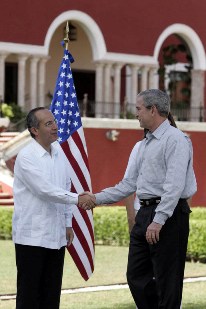
Bush and Calderón
"While I look forward to reviewing the counter-narcotics plan for Mexico and Central America, Congress was not consulted as the plan was developed. This is not a good way to kick off such an important effort to fight the increase in narco-trafficking and violence in the region," said Rep. Eliot Engel (D-NY) chairman of the House Subcommittee on the Western Hemisphere, which held a hearing on the proposal Thursday. "I hope that the administration will be more forthcoming with members of Congress now that they have announced the plan," he added tartly.
The anti-drug package faces the additional burden of being part of the appropriation for the highly unpopular war in Iraq. House Majority Leader Nancy Pelosi (D-CA) has signaled that the entire appropriations bill could have a tough time getting past the House. But then again, the House Democratic leadership has said that before, and the war continues to be funded.
Mexico is the leading producer of marijuana and methamphetamines imported into the US to feed insatiable North American markets. Along with Colombia, it produces most of the heroin consumed in the US. And it is the primary conduit for South American cocaine destined for the US.
Mexico is also the scene of a long-running, seemingly ever-escalating state of war among competing drug trafficking organizations -- the so-called cartels -- over control of the lucrative, multi-billion dollar a year business, as well as between the cartels and the Mexican state. More than 2,100 people, including around 200 law enforcement and military personnel, have died in Mexico's drug war so far this year, making 2007 on pace to be the bloodiest year yet.
Mexican President Felipe Calderón has won praise from US drug fighters for acting aggressively against the cartels since he took power in December. Since then, he has sent some 25,000 army troops into cities like Tijuana, Mazatlán, and Acapulco, as well as key drug-growing states. While the government claims mounting arrests and seizures, the drugs continue to flow and so does the blood. Calderon's government has announced it is preparing to spend $7 billion to prosecute the drug war in addition to the US offer of assistance.
In Central America, the problems are similar, although of smaller scale. While Mexico is plagued by the hyper-macho violence of groups like the Zetas, a unit of former elite anti-drug fighters who went over to the other side and who have engaged in spectacular, horrific exemplary killings, Central America faces the gangs, groups such as Mara Salvatrucha, originally composed of the children of Salvadoran refugees in the US who learned gangster ways up north before returning to their homelands to apply their newfound skills.
Mexico will get 90% of the US package, some $500 million, while $50 million will go to Central American countries. The Mexico aid package, which has been under negotiation between US and Mexican officials for months, will include funds for Mexican military helicopters, ships, surveillance aircraft, drug-sniffing dogs, and telecommunications equipment. It would also pay for training Mexican police and troops involved in intercepting drug shipments en route to the United States. But unlike Plan Colombia, the multi-year, multi-billion anti-drug cum counterinsurgency program to which it is often compared, the package does not call for additional US military personnel or contractors to work in Mexico.
Reaction from Latin America and drug policy analysts in Washington ranged from the critical to the concerned. "At first glance, a lot of this just looks like a waste of money," said Adam Isaacson, program director at the Center for International Policy. "There's about $200 million for boats and helicopters for interdiction. That's better than spending money on spraying crops, but it's really just a cat and mouse game. What we really need is demand reduction."
"The US has a moral obligation to help Mexico deal with drug violence because of US drug policies and use," said Maureen Meyer, Associate for Mexico and Central America for the Washington Office on Latin America (WOLA). "But we need to be clear that while this package may have a positive short-term impact on drug trafficking and violence in Mexico, there should be no expectations that it will stem the flow of drugs into the United States."
"This cooperation package reflects the Bush Administration's growing recognition of the United States' shared responsibility for drug trafficking and drug-related violence in Mexico," said WOLA's executive director, Joy Olson. "Addressing this problem is not something that it should face alone. But cooperation is a two-way street," Olson pointed out. "Although the package mentions an unspecified amount of money to reduce drug consumption in Mexico, it has not been accompanied by any new major federal initiative to cut drug demand in the United States."
"One of the reasons we're in this mess is because our politicians thought it was a great idea to help foreign governments to fight the drug war alongside us, so they trained elite Mexican units in counter-narcotics two decades ago," cautioned Sanho Tree, director of the Drug Policy Project at the Institute for Policy Studies.
"The problem is they had no way of guaranteeing the loyalty of the troops they trained and they forgot that drug prohibition is an equal opportunity corruptor," Tree continued. "An elite US-trained unit called the Zetas eventually switched sides and became enforcers for the Gulf Cartel. When you hear of machine gun and bazooka battles in Nuevo Laredo, that's our Frankestein coming back to haunt us. Now the Bush Administration -- never one to learn from history -- wants to repeat the calamity."
"President Bush's proposed 'surge' in the war on drugs will cost taxpayer's too much, won't work, and may increase violence in both Mexico and the United States," said Bill Piper, director of national affairs for the Drug Policy Alliance. "Supply-side strategies have failed for cocaine, heroin, marijuana and virtually every drug to which they have been applied (including alcohol during Prohibition). Fundamental economic principles demonstrate why: as long as a strong demand for drugs exists, there will be a supply to meet it. Even if successful, Bush's Mexico plan would merely succeed in making cocaine more valuable, boosting profits for major drug cartels and encouraging more criminal elements to enter the lucrative cocaine market."
Such concerns and critiques were echoed south of the border. "More helicopters won't make a difference because you are only dealing with the armed side of the cartels. You've got to go after their finances and find out where their banks accounts are. That is the way to weaken them," said Ernesto Mendieta, a security advisor and former Mexican anti-drugs prosecutor. "Tracking that money is time consuming and doesn't make headline news, but it has to be done," Mendieta told Reuters.
"The US-Mexican drug plan is not the magic solution. It will help, but you need intelligence, people on the inside, and money alone can't buy that," Jorge Chabat at Mexico's CIDE think-tank, told the same agency.
But that kind of talk make's CIP's Isaacson a bit nervous. "We're worried about the intelligence and surveillance aspects of this," he said. "Who will be getting this? How are they trained? How infiltrated by the traffickers are these agencies? What are their human rights records? We have a lot of concerns about this aspect of the package," he said.
WOLA, too, had concerns, especially about the lack of details on some aspects of the plan. The organization wants to ensure that the aid package not end up subverting democracy in the region. "If funds are sent directly to the receiving countries' military forces, the plan could undermine civilian control of the armed forces and weaken efforts to strengthen civilian public security institutions," the group noted.
Now, the measure goes to Congress, where the first hearings have already gotten underway. At least one observer, CIP's Isaacson, thinks it will make it through the process. "This Plan Mexico stuff is going to get very carefully scrutinized," he said. "It will pass, although it may be radically altered in the process," he said.
But it won't make much difference, he suggested. "Overlying all of this is the fact that there is a whole lot of money to be made, and it's the demand from our drug-using population that makes this an attractive career path for people in Mexico."
This work by StoptheDrugWar.org is licensed under Creative Commons Attribution-ShareAlike 4.0 International


Comments
No $ To Mexico Until Accountability on Human Rights!
we need to stop the defeatist attitude, like oh well, it will pass. Let's organoze for sensible uses of our taz money!
For immediate release October 25, 2007
No $ To Mexico Until Accountability on Human Rights!
Contact: Friends of Brad Will, Media Representative,
Harry Bubbins
h.bubbins(at) gmail (dot) com phone: 646 641 5788,
http://friendsofbradwill.org
Friends of Brad Will, Congressional Representative, Robert Jereski
mutualaid (at) earthlink (dot) net 212 973 1782,
http://friendsofbradwill.org
Friends of murdered journalist demand hold on military aid pending
investigation into his murder
The Friends of Brad Will, a network of friends and associates of Brad
Will, the U.S. journalist, have urged House Speaker Pelosi and Eliot
Engel, the Chair of the Western Hemispheric affairs subcommittee to
oppose U.S. support for Mexican military and police forces. Mr. Will,
the 36 year old reporter, was murdered in Oaxaca, Mexico a year ago,
on October 27th, 2006. Witnesses and photographic evidence implicate
members of the Mexican government, including a police chief.
On 10-21-07, President Bush announced a $1.5 billion dollar "security
cooperation initiative" proposal for Mexico that the President tucked
into the Iraq supplemental spending package submitted to Congress. The
initiative allows sharing of U.S. military intelligence information
with Mexican military counterparts and provides weaponry and training
with the notoriously corrupt and brutal Mexican military and police.
Brad Will's family and friends denounced plans to fund a "Plan Mexico"
that would be more costly than the controversial "Plan Colombia" while
in attendance at the 10-25-07 hearing. They pointed to the lack of any
credible investigation into the murder of the U.S. journalist, who was
in Mexico covering the protests of a popular movement of teachers and
their supporters facing paramilitary violence deployed by the Mexican
government and the governor of Oaxaca, Ulises Ruiz Ortiz.
"One year after the murder of Brad Will, no one has been arrested.
Under the guise of stopping drug trafficking, US taxpayers could be
funding human rights violations, corrupt local officials and
Blackwater-style mercenaries in Oaxaca and elsewhere. This is exactly
the wrong message to send at this time." said Harry Bubbins, a media
representative for Friends of Brad Will.
Friends of Brad Will drew attention to testimony from today's panelist
Jess T. Ford, Associate Director, International Relations and Trade
Issues, made over ten years ago on September 12, 1996. "Overall, U.S.
and Mexican interdiction efforts have had little, if any, impact on
the overall flow of drugs through Mexico into the United States.
According to U.S. officials, Mexican counter-narcotics efforts are
hampered by pervasive corruption of key institutions...". Since then
human right's abuses and the use of weaponry against civilians has
only increased, making this aid proposal inappropriate.
"We are confident that Congress will ask hard questions about the
murder of US reporter Brad Will, and not just rubber stamp this
military aid package that could lead to further human rights abuses."
stated Robert Jereski, a Congressional liaison for Friends of Brad
Will.
The human rights certification processes that have been an important
component to these military aid packages in order to gain support in
Congress have been entirely inadequate, Friends of Brad Will
maintained. According to Human Rights News , 'Plan Mexico' - Lessons
learned from the failure of 'Plan Colombia', President Bush signed
Public Law (P.L.) 107-115, which authorized $380.5 million in aid to
Colombia. The bulk of this aid was for Colombia's military. Support
for human rights motivated Congress to condition assistance on clear
progress in stopping abuses.
Before making a decision on Colombia's compliance with U.S. law, the
Secretary of State must consult with human rights organizations.
Amnesty International, Human Rights Watch, and the Washington Office
on Latin America (WOLA) (who testified today) met with State
Department officials on February 1, 2002 to present evidence that
Colombia had not met any of the conditions. Nevertheless, the U.S.
certified Colombia, thereby releasing funds. This sent a harmful
message to Colombia and particularly the armed forces that human
rights are not important. The U.S. would be making the same mistake
by approving "Plan Mexico" and sending a message of impunity without
first achieving substantial progress in the murder of Brad Will, and
other human rights violations.
Garry Leech, an independent journalist who has covered the effects of
Plan Colombia, declared that 'drug war' program an expensive failure.
"The Colombian state's direct role in human rights abuses such as
extra-judicial executions, arbitrary arrests and disappearances has
increased under Plan Colombia." What is needed, he added, is to
strengthen judicial institutions and respect for human rights in
Mexico, and cut drug demand in and weapons flow from the United
States.
____------______------_____--------______----
Activists with Friends of Brad Will were present at Sub-Committee on
the Western Hemisphere Hearing on October 25th and suggested questions
for the Representatives to ask the Administration and the panelists:
? What signal are you sending to the Mexican authorities who have
ignored those in their ranks who
were implicated in the shooting of US journalist Brad Will a year ago
Saturday and to those who have engaged in a cover-up which the Mexican
media labeled absurd?
? What makes you believe that a country whose police and military are
recognized every year in US
State Department country reports to be serial abusers of human rights
should be lavished with US
taxpayer-funded lethal weaponry and training?
? Why do you believe this lethal power will not be leveled against
activists and ordinary Mexican
citizens as has been the case in the past in Atenco, Chiapas,
Guerrero, and Oaxaca?
? What has been learned from 'Plan Colombia' which makes you think
that this aid package will have agood effect on human rights,
corruption, and narco-trafficking? What percentage of the Plan Mexico
funding will be for law enforcement and how much for social and
economic programs? For the past seven years, more than 70 percent of
Plan Colombia funding has gone to the military and police and there
has been little emphasis on addressing the social and economic
problems that have led many poor Colombians to participate in the drug
trade. This militaristic law enforcement approach has failed to
diminish the amount of cocaine reaching US shores. Furthermore,
according to the US government's figures, coca cultivation in Colombia
has increased each of the past three years. Given that the
eradication of coca is the principal stated objective of Plan
Colombia, these figures suggest that the militaristic law enforcement
approach is ineffective.
www.friendsofbradwill.org AND www.bradwill.org
"...Mexico was recently ranked as the second most dangerous country in the world for journalists, after only Iraq. For instance, I am aware of the killing of Brad Will, a U.S. journalist and documentary filmmaker, who was shot on October 27, 2006 in Mexico. I would like an update from U.S. and Mexican authorities on the investigation into his death."
http://foreignaffairs.house.gov/110/eng102507.htm
The full Committee on Foreign Affairs is meeting again soon on "Plan Mexico". This is THE opportunity to gain progress on the investigation. If US give $1.5 Billion with this outstanding, I will be less inclined to think we can achieve it in the short -term. With 20 people in that hearing, we will be able to have an impact, and contacting Reps in the run up to that.
MEXICO
Maybe I've been dreaming but I could swear I heard that Mexico made the possesion of small amounts of all drugs legal.Everything I've heard and read since seems to indicate the opposite.Can anyone at DRC check it out and let me know what the truth is?I still think it's true but I don't want to go around giving out false [email protected]
What are human rights organizations for?
We will beat this taxpayer-funded hand-out to security contractors, regardless of the defeatism of people mentioned in that article. There were 100 of us at the Mexican Embassy opposing Plan Mexico. We''re growing and will be contacting people who oppose the drug war FOR REAL. We will make sure that people sitting on the fence, unsure about whether it's worth angering democrats, ready to sacrifice mexican activists who will no doubt be targeted, and making excuses for not acting strongly in opposition are asked to explain their positions.
You idiot
There were more people killed on the border last year in the drug war than twice the number of Americans in Iraq. Congress no longer represents you but the people of the world. Americans wake up and arm yourself. If you dont you will be slaves to those who do..
Not Quite Right - "You Idiot"
" Congress no longer represents you but the people of the world."
No they represent the people of the "Third World". As illustrated by Osama Barak's legislation to take .7% of the US GDP and give it to the UN to "eliminate World poverty". Nice. Just what we need a new Global Tax making US taxpayers subserveint to the United Nations.
Add new comment