Drug War Issues
Politics & Advocacy
The Dutch government's tougher line on Holland's famous marijuana coffee shops is taking a toll. In Rotterdam, nearly half of the city's coffee shops will have to shut down because they are too near to secondary schools. Meanwhile, in the border city of Maastricht, where "drug tourists" from neighboring countries with more repressive pot laws flood into town to score, the local coffee shop association announced this week it will begin requiring fingerprint scans of all customers.
Holland currently has more than 700 coffee shops, down substantially from a peak of around 1,500. The coffee shops are much criticized by Holland's neighbors, and the current Dutch government would like to see them go away. Now, if a coffee shop shuts down it cannot be replaced by another. But the coffee shops retain popular support, at least in part because of the huge revenues they generate -- an estimated $1.5 billion per year.
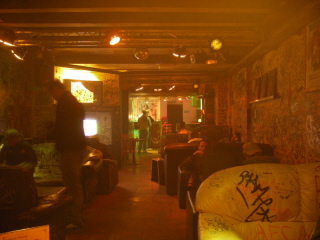
downstairs of a coffee shop, Maastricht (courtesy Wikimedia)
In Maastricht, coffee shop owners are self-regulating to avoid violating Holland's famed tolerance policy regarding marijuana. Under the measure announced this week, they will begin fingerprinting customers and scanning their IDs beginning late this summer.
"This is not something that we are doing willingly, but with pain in our hearts," said Marc Josemans, head of the Union of Maastricht's Coffee Shops. "We're very afraid we're going to lose customers over this, and to be honest we're even a little ashamed we're doing it, but the City of Maastricht has such harsh punishments that we don't feel we have any choice," he told the Associated Press.
Coffee shops are licensed to sell up to five grams of marijuana per customer per day. They may not sell to anyone under 18, nor may they permit drugs other than cannabis on the premises. Since Maastricht Mayor Gerd Leers took office in 2002, police have strictly enforced the rules, resulting in the closing of 11 of the city's 26 coffee shops.
According to Josemans, the fingerprinting and ID scan will be tested at his coffee shop in August and will be in place in all Maastricht coffee shops by September. Attempting to assuage privacy concerns, Josemans said the fingerprints would be coupled with a digital photo and a scan of the customer's ID card, with all information except date of birth removed. The fingerprints would not be of a quality to help police, he said.
The information would be stored at each coffee shop. "We're not going to give this information to anybody else, and we're not linked to each other or the Internet," Josemans said.
This work by StoptheDrugWar.org is licensed under Creative Commons Attribution-ShareAlike 4.0 International


Comments
New Restrictions on Some Dutch Cannabis Coffee Shops
I see tobacconists opposite schools, yet nothing said about the evil drug nicotine, double standards in play again.
W.Matthews LCA UK.
even in the Netherlands...
alcohol supremacist bigotry is alive and well. It's a useful exercise to imagine what alcohol users would say if everything was reversed: If cannabis was legal, and alcohol illegal, even though cannabis killed 100,000+ Americans a year, and it was very hard to find a death caused by alcohol. Just imagine how alcohol users would scream bloody murder about the way they are being discriminated against.
God damn thugs.
In reply to even in the Netherlands... by Anonymous (not verified)
Cannabis Killed
researchs found that cannabis killed 0 people in the whole world
Recent coffeeshop crackdowns in Holland (NL)!
Politics at issue- again! Once again, politicians are flexing their muscles by ordering crackdowns on a harmless, benign psychoactive (i.e., cannabis!) Looking at it logically, politicos are just trying to impress the countries, along with whom they signed anti-drug treaties, etc., etc., a long time ago! It's NOT fair or right, but this is what it looks like. Let's face it, politicians know on which side their slices of bread are buttered! The tobacco, alcohol, pharmaceutical corporations (and MANY, MANY more) all write HUGE payolla checks out to politicians to keep pot illegal, simply because pot sales would ruin their products' sales! Same ol' shit, different day!
Holland, I am ashamed of your ignorance.
"...move to restrict coffee shops in Rotterdam arose from concern about rising use of marijuana by school pupils and the problems caused by its sale and use."
So just a CONCERN can be enough to ruin people's businesses? And what PROBLEMS were there with the sale and use of cannabis?
"The coffee shops are much criticized by Holland's neighbors, and the current Dutch government would like to see them go away. "
Why are Holland's neighbors so pissed off about their citizens' traveling to another country? Why does the Dutch government hate cannabis coffee shops so much? Don't they get plenty in taxes from cannabis sales?
WHAT'S THE BIG DEAL, YO?
This article doesn't cover the "Why's" enough. We need to know what our opposition is upset about so that those "problems" can be corrected and we can all move on with LIFE.
Holland, get over it, get with it, and sell cannabis like alcohol. Teach your children about ALL the things in life that they will face that might hurt them, and lead them by good example. It's that simple.
In reply to Holland, I am ashamed of your ignorance. by Anonymous (not verified)
Where are you from?
So where are you from, that you can criticise the Dutch? Your government must have enlightened drug laws indeed.
www.glenstark.net
emad
good work
What are the fingerprints for?
So what is the purpose of the fingerprints exactly? Is it just to scare people off, or do they have to report people who purchase in certain quantities?
As for those who would criticise the Dutch, keep in mind they have gone their own way more than 50 years now, they are a tiny country surrounded by larger countries with strong economies. The Swiss also had more enlightened drug policies ten years ago, but had to buckle in to EU pressure, particularly because of the drug tourism.
If you want to criticise, attack the UN drug czar, or the U.S., which exerts a tremendous amount of pressure internationally regarding drug policy.
www.glenstark.net
Add new comment