Mexican Drug War

RSS Feed for this category

Mexico Drug Prohibition Baron Named 'World’s Most Wanted' After Osama's Death

Location: 
Mexico
Enriched by drug prohibition, Joaquin Guzman Loera reportedly possesses a personal fortune capable of rivalling Bill Gates and Warren Buffet. Loera is believed to be responsible for more deaths in the United States than bin Laden because of his drug transportation business and the inherent dangers associated with it created by prohibition.
Publication/Source: 
DailyIndia.com (FL)
URL: 
http://www.dailyindia.com/show/440356.php

Guatemala Attributes Drug Prohibition Massacre to Zetas, Declares State of Emergency

Location: 
Guatemala
The massacre due to drug prohibition in Guatemala that left 27 people dead at a cattle ranch – believed to be the work of Mexico's notorious drug trafficking organization, the Zetas – has forced a 30-day state of emergency. None of the victims had ties to drug trafficking organizations, authorities said. Rather they were innocent ranch workers and their families caught up in an increasingly bloody prohibition war.
Publication/Source: 
Fox News (US)
URL: 
http://latino.foxnews.com/latino/news/2011/05/17/guatemalan-massacre-possibly-carried-zetas-forces-state-emergency/

US Cattle Inspectors Leave Mexico Amid Drug Prohibition War

Location: 
Mexico
For years, these inspections have been conducted before cattle cross the border, but the drug prohibition war has prompted the U.S. to move some of its operations north. The change, instituted over the past year at three of the 11 ports along the U.S.-Mexico border, is drawing concern from some cattle raisers, who fear infections long eradicated in the U.S. but still showing up in Mexico will spread before inspection. The change is supposed to be temporary, although there are no immediate plans for the American inspectors to return to Mexico.
Publication/Source: 
The Associated Press
URL: 
http://www.google.com/hostednews/ap/article/ALeqM5idZkYEkvtry2zUF_gDH9ojmssENQ?docId=cb6535c7b06342aea72a47456c12c103

Border Region Lives in Fear Amid Mexico's Drug Prohibition War

Location: 
Mexico
Since Mexican President Felipe Calderon militarized his country's battle to continue drug prohibition in December 2006, more than 34,600 have died in prohibition violence. Along with the violence has grown a pervasive culture of corruption and fear. After the discovery of the most recent mass graves, 16 police officers were detained under suspicion of involvement. Despite the government's promises of security and increased aid, many remain unconvinced, and say that governmental control in the region is visible little, if at all.
Publication/Source: 
Agence France-Presse (France)
URL: 
http://www.google.com/hostednews/afp/article/ALeqM5gJSeWhHYrkS9tlD3etxVUsSV3KcQ?docId=CNG.38021bb0e4d3c022df44be1a7c4e619a.391

They Marched for Marijuana, Against the Drug War [FEATURE]

From Amsterdam to Arequipa to Auckland, from Anchorage to Albuquerque to Austin to Amherst, from one end of the country and the planet to the other, the worldwide cannabis nation took to the streets Saturday for the 2011 Global Marijuana March. At the same time, in Mexico, marchers trekked from Cuernavaca to Mexico City, and gathered in other Mexican cities as well, to plead for an end to the drug war violence that has killed more than 37,000 people in the past four years.

Jodie Emery addresses the crowd in Toronto (Image courtesy Jeremiah Vandemeer, Cannabis Culture)
Events were scheduled in some 262 cities around the world. They ranged from handfuls or dozens of people in small American and Canadian towns and remote global outposts, to hundreds or thousands in larger cities around the planet. A few places saw even more.

In Toronto, tens of thousands of people came out for the Freedom Fest. A haze of pot smoke hung over Queens Park as revelers were treated to an afternoon of bands and speakers, including Jodie Emery, wife of imprisoned Prince of Pot Marc Emery. The Toronto march may have been this year's largest.

An estimated 25,000 people marched in cities across Argentina, including at least 1,000 in Rosario and 15,000 in the capital, Buenos Aires. Marchers there demanded that the government move further down the path of decriminalization and harm reduction.

"The march in Rosario was great," said Silvia Inchaurraga of the Argentine Harm Reduction Association (ARDA). "In the first march we organized here in 2002, there were only a handful of people, and now we have more than 1,000," she told the Chronicle. "We don't need more speeches from politicians, even progressive speeches, we need a new drug law and a new drug policy. Despite the Supreme Court rulings of 2009 [decriminalizing marijuana possession], the old drug law is still in effect and drug users are still arrested and punished, and harm reduction is not the official policy of the National Secretary on Drugs."

In Jakarta, Indonesia, the number of marchers may have been small, but their audacity was great, and their action sparked preemptive warnings from police and Reefer Madness-style denunciations from people who should know better.

Police first warned that the march was illegal, but then announced they would only arrest people breaking the drug laws. The day before the march National Narcotics Agency spokesman Gen. Indradi Thanos said the group behind the march should "stop their campaign to legalize marijuana because the substance was defined as an illegal addictive drug in the narcotics law." Indradi added somewhat ominously that the agency would hold talks with the network activists to determine if there were "vested interests" backing them," according to the Jakarta Post.

But on Saturday, the Nusantara Marijuana Network (LGN) led some 50 or so people on a march to the Tugu Tani monument in central Jakarta. Unlike Western marchers, most were dressed uniformly in white t-shirts with green ribbons. But like Western marches, posters of Bob Marley bedecked a pick-up truck leading the parade.

"As a first step, we call on the government to provide objective information about marijuana," LGN chair Dhira Narayana said. "People need to be informed that marijuana can be used to cure cancer. Marijuana is also no more addictive than coffee or tea," he added.

In Tijuana, protestors call for drug legalization and US agents out of Mexico (Image courtesy Rocky Neptun via indybay.org)
One self-described non-smoker, Soraya Cassandra of the network's education team, hit the hemp angle. "There is a lot of biased information about marijuana and this is the reason why much of the public does not understand the substance," she said. "The cannabis plant can be used to produce paper. This will save a lot of trees because the cannabis plant can be harvested three times a year," she added.

The Jakarta march certainly sparked a reaction. The Indonesian Child Protection Commission announced it rejected pot legalization because it could have negative effects on children. "Children's brains will be damaged, as will their future, commission head Arist Merdeka Sirait told Tempo.

The National Narcotics Agency and University of Indonesia psychiatrist Dadang Hawari also rejected legalization. Dadang told Tempo that marijuana leaves don't kill, but have ill effects on the brain, including long-term mental and behavioral disorders. Marijuana was appropriately categorized as a narcotic, Dadang claimed.

And also reacting was former Vice President Jusuf Kalla. "We cannot legalize marijuana because at certain doses it is unbelievably dangerous to health," he told the Jakarta Post.

The work of cannabis education has clearly only just begun in Indonesia, but at least it has begun.

In Mexico City, where the work of cannabis education has been underway for some time, thanks to groups like the Mexican Association for Cannabis Studies, hundreds gathered Saturday downtown to demand decriminalization. They chanted and cheered for musical actors and speakers, including the association's Leopoldo Rivera.

"We consider it prudent to be informed on this topic. People who consume are not necessarily criminals or ill, it could be any regular person who is a productive, contributing member of society," Rivera said.

But in Mexico, it wasn't just about freeing the weed -- even at the Global Marijuana March. "We are lobbying for the decriminalization of marijuana as a way to reach peace. Currently, the number of dead in Mexico is 40,000, and it is due in big part to drug trafficking," said environmentalist Arnold Ricarde.

Rosario, Argentina (via Silvia Inchaurraga)
That the horrid violence of the Mexican drug war is overshadowing other drug reform issues there was made clear the next day, as more than 100,000 turned out in Mexico City to greet the hundreds of marchers who had set out from Cuernavaca, 60 miles to the south, on Thursday to demand "no more deaths, no more hate, no more blood."

Led by poet and essayist Javier Sicilia, whose son and six others were found murdered in Cuernavaca in late March, presumably at the hands of the Pacifico Sur cartel, by the time the march arrived at the Zocalo, Mexico's City's gigantic central plaza, it had morphed into a mass of humanity crying out for an end to endless cycle of violence.

"We don't want any more death because of this growing mess," said Sicilia, from a platform in Zocalo... "No more deaths, no more hate. We've come out to walk these streets with dignity and peace... violence will only bring us more violence," he added.

A manifesto for the march called for the government to solve the killings and disappearances, address social ills, fight corruption, impunity, and money-laundering, and drop its "war strategy" in favor of a focus on citizen safety.

Sicilia's crusade has brought a sharp focus to the growing disenchantment with President Felipe Calderon's decision to take the battle to the cartels in December 2006. Despite the deployment of some 45,000 federal troops, the violence has not diminished, but intensified. The government has to change its strategy, the protestors said.

"We've had it with this terrible government that goes unpunished. We want peace," said Araceli Vazquez, 60, as he held up an improvised placard with his demands.

On Monday, President Calderon offered to meet with protest leaders, a clear sign that their voice is being heard. But he was not backing away from his insistence on a military solution to the cartel problem. "We can agree to disagree," he said.

The somber multitudes of Mexico City are a world away from the happy tokers of Toronto, but whether it is marijuana legalization or ending the drug war paradigm that has produced the murderous Mexican madness, drug prohibition is the underlying cause that unites them.

Mexico Drug War Update

by Bernd Debusmann, Jr.

Mexican drug trafficking organizations make billions each year smuggling drugs into the United States, profiting enormously from the prohibitionist drug policies of the US government. Since Mexican president Felipe Calderon took office in December 2006 and called the armed forces into the fight against the so-called cartels, prohibition-related violence has killed more than 38,000 people, including more than 15,000 last year. The increasing militarization of the drug war and the arrest or killing of dozens of high-profile drug traffickers have failed to stem the flow of drugs -- or the violence -- whatsoever. The Merida initiative, which provides $1.4 billion over three years for the US to assist the Mexican government with training, equipment and intelligence, has so far failed to make a difference. Here are a few of the latest developments in Mexico's drug war:

Drug prohibition funds the bloody mayhem in Mexico (Image via Wikimedia.org)
Wednesday, May 4

At the border crossing between Ciudad Juarez and El Paso, a Juarez traffic cop was arrested after authorities discovered approximately 25 pounds of cocaine in a hidden compartment that had been built into the rear cargo area of his vehicle.

Thursday, May 5

In Hidalgo, 20 suspected Zetas were arrested when police discovered they were meeting in the small community of Pri Chacon. Among those captured were Raul Guerrero, who is alleged to be in charge of narcotics distribution in the city of Pachuca, and five municipal police officers from several locations.

Friday, May 6

In Escobedo, Nuevo Leon, at least four people were killed and 15 wounded after a ferocious fire fight between army personnel and suspected Zetas. The fighting began when a large group of up to 50 gunmen attacked an army convoy after having lured them to the ambush location with several vehicles. Several torture tools -- labeled with Z’s -- were recovered from a truck which was abandoned by the attackers, along with 60 magazines, three assault rifles and bulletproof vests.

Sunday, May 8

Across Mexico, tens of thousands of Mexicans took to the streets to protest the drug-related violence that has plagued the country. The main march began in the city of Cuernavaca, from where an estimated 150,000 protesters marched to Mexico City's Zocalo. The march was organized by poet and journalist Javier Sicilia, whose son was recently murdered by suspected cartel assassins.

On an island on Falcon Lake, 12 suspected Zetas were killed after a clash with Mexican marines. One marine was killed in the incident, which took place on the Mexican side of the reservoir. Authorities suspect that the island was used to transport marijuana to the United States via speedboats. The area became notorious in September 2010 when a US citizen, David Hartley, was shot and killed while riding a jet ski in the area.

Monday, May 9

In the city of Durango, gunmen left six headless bodies outside a high school. Threatening messages were left spray painted on a nearby wall, but were quickly painted over by police. The content of the message and the identity of the bodies have not been released.

In Guerrero, ten people were murdered across five municipalities. In one incident, two people were kidnapped and murdered just moments after the gunmen shot dead two other individuals outside a social security office.

In Tijuana, a suspected Sinaloa cartel cell leader was captured after being seriously wounded in a gunfight with state police forces. Hector Hernandez Guajardo, also known as "El Guicho" is thought by Mexican authorities to have been involved in 465 murders in the Baja California.

Tuesday, May 10

In Durango, authorities discovered eight more bodies buried in a network of mass graves near the city of Durango. These bodies bring the total number discovered buried in the area to 188. Some of the remains are said to be almost four years old, while some of the more recent ones may have been killed as recently as three months ago.

In the town of Guadalupe Distrito Bravos, near Ciudad Juarez, two severed heads were discovered atop a cement wall in the morning. Two other bodies -- that of a man and woman -- were found nearby with their throats slashed. The town has been without any local law enforcement officers since the town's only officer was kidnapped in December. She has not been heard from since.

In Mexico City, it was revealed that a Canadian citizen was murdered in Mexico City on May 3. Local media are reporting that the murder may be related to a double-homicide in the state of Jalisco, where the victim had been living for a time.

[Editor's Note: We cannot accurately tally the drug prohibition-related killings in Mexico at this time. El Universal, the only Mexican newspaper that was doing so on a regular basis, has stopped. We will have to rely on official pronouncements on the death toll, and will report them when they happen. Below are the numbers through the end of last year. With more than 1,400 reported dead in April alone, this year's toll could well exceed last years. As of this month, we believe the total death toll has surpassed 38,000.]

Total Body Count for 2010: 15,273

Total Body Count for 2009: (approx.) 9,600

Total Body Count for 2008 (approx.): 5,400

Total Body Count for 2007 (approx): 4,300

Total Body Count for Calderon's drug war through 2010: 34,883

Mexico

Mexican Protesters Demand an End to the Drug War

http://stopthedrugwar.org/files/Calderon.png

Frustrated beyond belief with the bloody consequences of President Calderon's aggressive drug war tactics, the people of Mexico are finally beginning to make some noise.

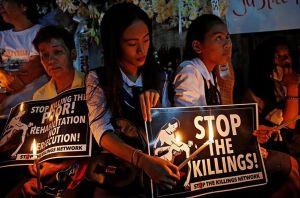
Bearing white balloons and fake bloodstains, tens of thousands of demonstrators crowded Mexico City's historic downtown Sunday to call for an end to the country's unrelenting drug violence.

The primary target of the protest was President Felipe Calderon, who has ruled during a period of extraordinary bloodshed. More than 34,000 people have been killed since Calderon declared an all-out assault on drug cartels after taking office four and a half years ago.

Demonstrators, holding placards saying "No more blood!" and "We're fed up!", urged the conservative Calderon to drop his military-led strategy. (LA Times)

Calderon has a very big problem here, and it's called the drug war doesn't work, dumbass. You can wait and wait some more, but there will be no redemption for the indignant drug warrior who just keeps doubling down as the bodies pile ever higher. He staked his legacy on a lot of money and bad advice from Washington, D.C., and now it's becoming clear to a hell of a lot of people that the reward for their sacrifice is something much uglier than they started with.

It will be interesting to watch as Calderon attempts to get re-elected on a platform of unrelenting urban warfare.

It will be interesting to see how future candidates for the Mexican Presidency grapple with the issue now that waiving the drug war battle flag will be instant political suicide. The question becomes how much reform is viable over U.S. objections, and how much influence will the drug lords themselves manage to exert over Mexican drug policy.

NYC Mayor Bloomberg Discusses Drug Legalization

In a radio interview on WOR-AM last week, New York City Mayor Michael Bloomberg unexpectedly brought up the subject of drug legalization. Responding to a question about medical marijuana tweeted by a listener, Bloomberg seemed to realize he was stumbling into a minefield. "I'm sort of reticent to bring it up," he said, "What's up with medical marijuana in NYC," he continued, reading the question aloud. "Is it going to be okay soon? Need to know by this weekend," he read, inspiring mayoral laughter.

Mike Bloomberg
"We don't allow medical marijuana in this state," he replied. "They do in California…"

Then, apparently very much in the moment, Bloomberg turned from medical marijuana to drug legalization: "The argument is that the only way you're going to end the drug trade is to legalize drugs and take away the profit motive," he said. "And that the corruption funds enormous dislocations, like Mexico, where thousands or tens of thousands of people have been killed in the wars where the government tried to crack down on the drug dealers..."

Good start! Mayor Bloomberg, uncharacteristically for a prominent mainstream US politician, had articulated two of the core arguments made by legalization advocates. But then, perhaps realizing where he had gone politically, Bloomberg fumbled. "There is no easy answer to these things... There are places where they've legalized drugs, and whether it destroyed society or didn't is open to debate."

Actually, no country has legalized drugs. There are countries, however, that have embraced drug policies less reliant on repression via law enforcement, such as the Netherlands, with its tolerance of cannabis coffee shops and personal possession, or Portugal, which decriminalized drug possession a decade ago.

Both countries still exist and seem to have actual few ill effects as a result of their liberal approaches. The Netherlands has marijuana use rates similar to other European countries and lower than in the US. There have been problems with organized crime involvement in cultivation and supplying the cannabis cafes, but those problems are artifacts of an incomplete legalization. The Dutch liberalization does not provide for a legal supply for the cannabis cafes, thus, the so-called back door problem -- partial prohibition.

As for Portugal, Glenn Greenwald has done a comprehensive review for the Cato Institute. Bloomberg might want to read it. Greenwald found that "judged by virtually every metric, the Portuguese decriminalization framework has been a resounding success."

The experiences of both countries could hold valuable lessons for a man who presides over a city that spends $75 million a year arresting marijuana users, according to a recent report from the Drug Policy Alliance. In fact, New York city accounts to close for 10% of all marijuana possession arrests nationwide, and this in a state that has decriminalized marijuana possession. [Editor's Note: That's only possible because the NYPD has a practice of stopping and frisking young men of color and ordering them to empty their pockets, then charging them with possession in public, a misdemeanor. You do not have to empty the contents of your pockets.]

While these NYPD practices originated under Bloomberg predecessor Mayor Giuliani, whose tenure saw a quick ten-fold increase in marijuana arrests -- primarily of African Americans and Latinos -- they have continued unabated under Mayor Bloomberg. Given the understanding the mayor evidently has of prohibition, he should act to end these costly and unjustifiable policies, especially in a city undergoing a fiscal crisis, not equivocate with uninformed commentaries.

Mexico Drug War Update

by Bernd Debusmann, Jr.

Mexican drug trafficking organizations make billions each year smuggling drugs into the United States, profiting enormously from the prohibitionist drug policies of the US government. Since Mexican president Felipe Calderon took office in December 2006 and called the armed forces into the fight against the so-called cartels, prohibition-related violence has killed more than 36,000 people, including more than 15,000 last year. The increasing militarization of the drug war and the arrest or killing of dozens of high-profile drug traffickers have failed to stem the flow of drugs -- or the violence -- whatsoever. The Merida initiative, which provides $1.4 billion over three years for the US to assist the Mexican government with training, equipment and intelligence, has so far failed to make a difference. Here are a few of the latest developments in Mexico's drug war:

Drug prohibition funds the mayhem in Mexico. (Image via Wikimedia.org)
Tuesday, April 26

In Tamaulipas, two gunmen were killed after shooting at an army convoy that was patrolling the highway between Nueva Ciudad Guerrero and Ciudad Mier.

Thursday, April 28

In Tamaulipas, six gunmen were killed during a fierce clash between suspected members of the Zetas and the Gulf Cartel in the towns of Aldabas and Arcabuz. According to some accounts over 40 SUVs full of gunmen participated in the clashes, in which the army eventually intervened.

In Sinaloa, seven people were killed in a series of fire fights which began after an attack on a police station in the town of Guamuchil. Nobody was killed or wounded in the initial attack, which was carried out by a convoy of five vehicles. The convoy later left the bodies of four men who had been abducted earlier on the road, but was then ambushed by a group of rival gunmen. Three members of the convoy were killed and several vehicles were later found abandoned.

Friday, April 29

In Toluca, Mexican authorities handed over former Tijuana-cartel kingpin Benjamin Arellano-Felix to US Marshals to be extradited to the United States. Arellano-Felix has been in prison in Mexico since 2002. His three brothers have all been captured or killed. The cartel is no under the leadership of his nephew Fernando, but is thought to pay the Sinaloa Cartel for the right to the points of entry into California.

In Ciudad Juarez, a massive arsenal was found hidden in a home gym in an upscale neighborhood. The stockpile included three anti-aircraft weapons, dozens of assault rifles and grenades, 50 military uniforms, bulletproof vests and 26,000 rounds of ammunition.

Monday, May 3

In San Antonio, Texas, former Mexican president Vicente Fox said that the only way to end the violence in Mexico is for the United States to legalize drugs. "As a country, we are going through problems due to the fact that the United States consumes too many drugs," he said.

In the Ciudad Juarez area, four people were murdered. Eight people have been murdered in the area in the first three days of May, and 808 have so far been murdered in 2011, according to statistics kept by researcher Molly Molloy.

Tuesday, May 4

In the city of Cuautitlan Izcalli, near Mexico City, five headless bodies were discovered on the backseat and in the trunk of an abandoned BMW.

In Guadalupe, Nuevo Leon, six men were gunned down by heavily armed gunmen. Among the victims were 56-year old Moises Chavez, his two sons, and an unidentified neighbor.

[Editor's Note: We believe our body count is seriously understating the actual number of people killed. Mexican officials this week put the number of dead in April alone at 1,402. We will continue to try to find an accurate way of compiling these numbers.]

Total Body Count for the Week: *34

Total Body Count for the Year: *2,308

Total Body Count for 2010: 15,273

Total Body Count for 2009: (approx.) 9,600

Total Body Count for 2008 (approx.): 5,400

Total Body Count for 2007 (approx): 4,300

Total Body Count for Calderon's drug war through 2010: 34,883

Mexico

1,400 Killed in Mexico Drug Prohibition War in April, New Record

Location: 
Mexico
Mexicans are paying a high cost for drug prohibition -- the death toll of its drug prohibition war in April was 1,400, the highest number of monthly killings since the campaign began in late 2006. The previous record of casualties was 1,322 killings in August 2010. Attorney General Arturo Chavez says more than 15,000 people died in 2010, making it the deadliest year ever.
Publication/Source: 
Tehran Times (Iran)
URL: 
http://www.tehrantimes.com/index_View.asp?code=239893

Drug War Issues

Criminal JusticeAsset Forfeiture, Collateral Sanctions (College Aid, Drug Taxes, Housing, Welfare), Court Rulings, Drug Courts, Due Process, Felony Disenfranchisement, Incarceration, Policing (2011 Drug War Killings, 2012 Drug War Killings, 2013 Drug War Killings, Arrests, Eradication, Informants, Interdiction, Lowest Priority Policies, Police Corruption, Police Raids, Profiling, Search and Seizure, SWAT/Paramilitarization, Task Forces, Undercover Work), Probation or Parole, Prosecution, Reentry/Rehabilitation, Sentencing (Alternatives to Incarceration, Clemency and Pardon, Crack/Powder Cocaine Disparity, Death Penalty, Decriminalization, Drug Free Zones, Mandatory Minimums, Rockefeller Drug Laws, Sentencing Guidelines)CultureArt, Celebrities, Counter-Culture, Music, Poetry/Literature, Television, TheaterDrug UseParaphernalia, ViolenceIntersecting IssuesCollateral Sanctions (College Aid, Drug Taxes, Housing, Welfare), Violence, Border, Budgets/Taxes/Economics, Business, Civil Rights, Driving, Economics, Education (College Aid), Employment, Environment, Families, Free Speech, Gun Policy, Human Rights, Immigration, Militarization, Money Laundering, Pregnancy, Privacy (Search and Seizure, Drug Testing), Race, Religion, Science, Sports, Women's IssuesMarijuana PolicyGateway Theory, Hemp, Marijuana -- Personal Use, Marijuana Industry, Medical MarijuanaMedicineMedical Marijuana, Science of Drugs, Under-treatment of PainPublic HealthAddiction, Addiction Treatment (Science of Drugs), Drug Education, Drug Prevention, Drug-Related AIDS/HIV or Hepatitis C, Harm Reduction (Methadone & Other Opiate Maintenance, Needle Exchange, Overdose Prevention, Safe Injection Sites)Source and Transit CountriesAndean Drug War, Coca, Hashish, Mexican Drug War, Opium ProductionSpecific DrugsAlcohol, Ayahuasca, Cocaine (Crack Cocaine), Ecstasy, Heroin, Ibogaine, ketamine, Khat, Marijuana (Gateway Theory, Marijuana -- Personal Use, Medical Marijuana, Hashish), Methamphetamine, Nicotine, Prescription Opiates (Fentanyl, Oxycontin), Psychedelics (LSD, Mescaline, Peyote, Salvia Divinorum), Synthetic Drugs (Mephedrone, Synthetic Cannabinoids)YouthGrade School, Post-Secondary School, Raves, Secondary School