The NATO and US forces battling Taliban and Al Qaeda insurgents in Afghanistan are on the verge of expanding their counterinsurgency efforts by getting more deeply involved in trying to suppress the country's booming opium trade. In so doing, they are stepping into tricky territory because they risk alienating large swathes of the population that are dependent on the trade to feed themselves and their families and driving them right into the tender embrace of the Taliban.
The new, more aggressive anti-drug stance will come in two forms. On one hand, NATO has committed for the first time to actively target and track down drug traffickers and heroin-processing laboratories. On the other hand, US military forces training the Afghan military will now begin accompanying Afghan soldiers as they provide force protection for Afghan government poppy eradication teams.
The more aggressive posture comes as the political and military situation in Afghanistan continues to worsen. Some 242 NATO and US troops have been killed in fighting there this year, 10 more than last year with two and a half months to go, and last year was the worst so far for the International Security Assistance Force (ISAF). Some 33,000 US troops, including 13,000 under the command of the ISAF and 20,000 under direct US command, and nearly 40,000 NATO soldiers, are now in Afghanistan, and the Bush administration is calling for an additional 20,000 US troops to be deployed there next year.
The Taliban and related insurgents have shown increased military capabilities, in part because they are able to supply themselves with funds generated by the opium trade. The United Nations estimates that the Taliban and Al Qaeda are making perhaps $100 million a year from taxing poppy farmers and providing protection to drug traffickers.
A leaked draft of an as yet unreleased US National Intelligence Estimate last week revealed that US intelligence agencies believe the war in Afghanistan is "on a downward spiral," with part of the problem resting with a corrupt government under President Hamid Karzai and part of the problem linked to the "destabilizing impact" of the opium trade.
That deteriorating situation impelled US Defense Secretary Robert Gates to head to Europe to try to bring reluctant NATO members on board for a more aggressive anti-drug strategy last week. European countries have been reluctant to step into the morass of anti-drug efforts there, citing the risk of alienating the population and arguing that law enforcement is the responsibility of the Afghan government.
"Part of the problem that we face is that the Taliban make somewhere between $60 million and $80 million or more a year from the drug trafficking," Gates said at the NATO meeting in Budapest. "If we have the opportunity to go after drug lords and drug laboratories and try to interrupt this flow of cash to the Taliban, that seems to me like a legitimate security endeavour."

Chronicle editor Phil Smith in formerly opium growing village near Jalalabad
By last Friday, NATO had signed on. According to a Saturday
NATO press release, "Based on the request of the Afghan government, consistent with the appropriate United Nations Security Council resolutions, under the existing operational plan, ISAF can act in concert with the Afghans against facilities and facilitators supporting the insurgency, in the context of counter-narcotics, subject to authorization of respective nations."
"At the request of the Afghan government, I am grateful that the North Atlantic Council has given me the authority to expand ISAF's role in counter-narcotics operations," added NATO Supreme Allied Commander US Gen. John Craddock in a statement the same day. "We now have the ability to move forward in an area that affects the security and stability of Afghanistan. It will allow us to reduce the funding and income to the insurgents, which will enhance the force protection of all ISAF and Afghan National Security Force personnel."
That's what Gates and the Bush administration wanted to hear. "It is just going to be part of regular military operations. This is not going to be a special mission," Gates said Saturday," adding that the counter-drug effort was likely to focus on the southern part of the country. "It starts with the commander of ISAF, and then it would be a question of what forces are available. Obviously the United States and the UK are interested in doing this. I think several others would but didn't speak out," he said. "I am fairly optimistic about the future," Gates said. "There is also an understanding that NATO can't fail in Afghanistan."
To that end, the US is taking another step deeper into the Afghan drug war: Using US ground troops to help eradicate poppy fields. The London Daily Mail, among other media, reported that a small number of US soldiers who are training the country's Poppy Eradication Force will accompany their charges as they head into the poppy fields around the beginning of the new year.
The idea is to target land owned by corrupt Afghan power brokers, especially in southern Helmand province, which accounts for the majority of Afghanistan's 93% share of global opium production. That is also an area where the Taliban presence is heavily felt. Some 75 Afghan eradicators were killed last year.
"There shouldn't be any no-go areas for eradication teams in Helmand, and in order to do that they are going to need more force protection," an unnamed British embassy counter-narcotics official told the Daily Mail. "Land that's controlled by major land owners, corrupt officials or major narco-figures is land that should be targeted. Having force protection is more likely to make that possible.'"

incised papaver specimens (opium poppies)
A US military spokesman told the Daily Mail there are 11 US soldiers training the Afghan Counter Narcotics Battalion in Kandahar. They will deploy along with Afghan soldiers on eradication missions, he said.
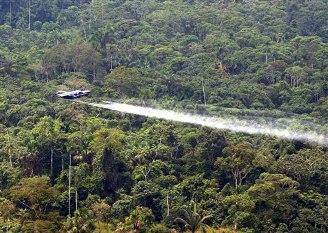
The US has long argued for stronger eradication efforts, but was rebuffed by the Karzai government when it floated the idea of aerial spraying earlier this year. But with manual eradication wiping out only 3.5% of the crop this year, pressure to do more is strong. The question is whether doing more to fight the drug trade will help or hinder the effort to build a strong, stable government in Kabul.
"This whole issue has been discussed in different forums in Afghanistan for some time now, said Sher Jah Ahmadzai, an associate at the Center for Afghanistan Studies at the University of Nebraska-Omaha. "The government rejected aerial eradication for various reasons, even though it was desired by the US. But this NATO move is being welcomed by the government and the international agencies because now they are targeting the drug lords, not the farmers themselves. If you go after the farmers, it could backfire on NATO and the Afghan government, so going after the big drug lords is the viable option now. Everyone knows who they are," he said.
But not all drug lords are equal, said Ahmadzai. "There are many drug lords who are involved in the government, there are high ministers who are believed to have been drug lords before they were appointed, there are a number of people in the provincial governments who are involved, but the government is not going to go after them because that could create a backlash," he said. "But the other drug lords, the ones who are openly supporting the Taliban and Al Qaeda, they will go after them."
Only with a stronger Afghan state sometime in the future would it be feasible to actually go after all drug traffickers, said Ahmadzai. "The next phase would be strengthening the Afghan government so it can purge itself," he said.
But Ahmadzai's view is much rosier than some. Critics of the move said it would only worsen the insurgency. "The NATO governments did say they will try to target drug trafficking operations that seem to be in league with the Taliban and Al Qaeda, which makes this policy shift merely unwise instead of egregiously unwise," said Ted Galen Carpenter, vice president for defense and foreign policy studies at the libertarian-leaning Cato Institute. "But pressuring NATO and the Karzai government on this simply guarantees that we will drive many people back into the arms of the Taliban, and that's a short-sighted strategy," he argued.
"The Americans have been training Afghan counter-narcotics forces, but they were creating problems for the government because they were aiming straight at the farmers, and the farmers would go straight to the Taliban," agreed Ahmadzai. "If you go after the farmers, you risk alienating them. If you don't, the Taliban and Al Qaeda profit. It's really a double-edged sword."
"The underlying problem is that the drug trade is such a huge part of the Afghan economy," said Carpenter. "The UN says there are some 509,000 families involved in growing or other aspects of the drug trade. If you just consider a standard nuclear family, that's about 15% of the population involved in the drug trade, but when you consider that Afghanistan is very much an extended family- and clan-based society, the real number is more like a third to 40% of the population earning a livelihood off the drug trade. There is no realistic way to shut that down."
There is an alternative, said Carpenter. "US policy-makers could just look the other way, ignore the drug commerce, and focus on trying to weaken the Taliban and Al Qaeda, our mortal adversaries," he said.
While that would leave the Taliban and Al Qaeda free to fund themselves from opium profits, that's a price we would have to pay, Carpenter said. "No doubt those groups derive revenue from the drug trade, but unfortunately for our strategy, so do Karzai's allies. Most major power brokers are involved in some way with the illegal drug trade. It's such a lucrative enterprise because of the black market premium that anyone who exercises power and influence in that society is tempted to get involved."
Noting that the NATO plan to go after only traffickers linked to the insurgency would in effect remove the competition for government-linked drug traffickers, Carpenter said the decision was no surprise. "I don't think that is a deliberate motive, but to the extent that the Karzai government is interested in cooperating, it will be precisely because it will eliminate the competition for those traffickers with backing in Kabul. Expecting the Kabul government to truly suppress the trade would be like asking Japan to eliminate its auto and high-tech industries. It isn't going to happen," he said.
And deeper into the morass we go.