Politics Outside US

RSS Feed for this category

Mexico's Drug War Version 2.0 [FEATURE]

Dismayed and horrified by the wave of prohibition-related violence unleashed on Mexico with President Calderon's deployment of the military to fight the country's wealthy and powerful drug trafficking organizations -- the so-called cartels -- Mexican voters on Sunday appear to have rejected Calderon's party, the PAN, instead harkening back to the past, choosing as president-elect Enrique Peña Nieto, candidate of the PRI, the party that dominated Mexico for most of the 20th Century.

Mexico's likely next president, Enrique Peña Nieto (wikimedia.org)
While Peña Nieto is virtually certain to be Mexico's next president, it's not quite official yet. Mexico election officials are recounting half the ballot boxes because of inconsistencies in the tallies and expect to release final results Sunday. But with Peña Nieto holding a five-point lead over second place finisher Andre Manuel Lopez Obrador, the recount is unlikely to change the outcome.

The election came amidst relentless and terrifying violence. At least 55,000 people have been killed in the internecine conflicts among the rival cartels and in the multisided fighting between the cartels, the police, and the military, with thousands more gone missing. Election week saw a new video of Gulf Cartel operatives beheading four Zetas, as well as the killing of three federal police officers at the Mexico City airport by other federal police officers being targeted in a drug trafficking investigation.

That is nothing unusual for Mexico these days, six years after Calderon sent 50,000 troops and federal police out to stop the cartels. The question is whether Peña Nieto is going to do anything substantially different once he takes power in December, and right now, the answer is unclear.

During the run-up to Sunday's election, the charismatic former governor of the state of Mexico attempted to create some distance between himself and Calderon's approach, but his policy prescriptions appear to be more in the nature of adjustments than a radical rethinking. He has made two direct proposals for retooling Mexico's drug war and one key appointment.

Peña Nieto has called for the creation of a paramilitary force of 40,000 ex-soldiers to take the burden of fighting the heavily-armed cartels from the military, which has seen an increasing number of human rights complaints filed against it. But that will take time to pull together, and he has said nothing about sending the military back to its barracks before then.

He is also calling for something like a single unified national police force, or what he calls the mando unico, the unified command. Calls for reforming Mexico's police, with its thousands of different municipal, state, and federal department, have been a constant for at least the last quarter-century, as those forces repeatedly expose themselves as hopelessly corrupt and inefficient. But reorganizations have been done before, only to create a new cadre of cops to be corrupted.

The US-Mexican border
In another sign of the direction he intends to take the country, Peña Nieto this week appointed as an internal security advisor the former chief of the Colombian national police, Oscar Naranjo. Working closely with the US, Naranjo vastly expanded the intelligence apparatus of the national police and is credited with helping to bring down the Medellin and Cali cartels. But Naranjo also ran the national police under the presidency of Alvaro Uribe, a period marked by shady dealings with rightist paramilitaries linked to the drug trade.

On Tuesday, Peña Nieto told PBS he would continue to use the military indefinitely.[Editor's Note: In that same interview, he had some words to say about discussing drug legalization; see our news brief on that here.]

"I will maintain the presence of a Mexican Army, and the Navy and police in the states of the Mexican Republic, where the problem of crime has increased," he said. "We will adjust the strategy so that we can focus on certain type of crimes, like kidnapping, homicide, extortion, which today, unfortunately, have worsened or increased, because we have a lot of impunity in some areas. The state's task is to achieve more efficiency, and to go back to the rule of law and enforce laws strictly in our country."

Raising eyebrows in Washington, Peña Nieto has previously hinted that he may refocus Mexico's anti-crime efforts, placing lesser emphasis on nailing cartel kingpins and eradicating illicit crops and placing more emphasis on reducing the violence.

"Violence is the most sensitive issue for Mexicans," he told the Financial Times in his first interview with an international newspaper. "Mexico cannot put up with this scenario of death and kidnapping."

Such comments have led many observers in both Mexico and the US to suggest that Peña Nieto may revert to the PRI's old ways. It is commonly believed -- although difficult to prove -- that during the latter part of its 70-year rule, that the PRI did not so much attempt to suppress the drug trade but to manage it, allowing itself to be bought off by the cartels. In return for non-interference from the state, the drug traffickers would keep a relatively low profile as they went about their business. What is certain is that the levels of violence around the drug trade and its repression have soared during the 12 years the PAN held power and moved aggressively against the cartels.

[Ed: Whether or not the government or individual officials made explicit deals with the cartels, it is generally understood among scholars that government's mostly manage illegal drug trades rather than seriously trying to undo them -- doing so enables them to keep crime within "normal" levels, as opposed to the kinds of bloodbaths seen in Mexico recently or Colombia during the time of Pablo Escobar.]

Sensitive to such charges, Peña Nieto took pains to say he was not going to make deals with the cartels. "There will be no pact or truce with organized crime," he said.

"What's really going on is that he's being very careful to assure the US that it will be business as usual, that they will continue fighting the drug war," said Nathan Jones, a fellow in drug policy at the Baker Institute in Houston. "There could be ways you could shift from counter-narcotics to counter-violence and have it be in line with US policies. With a counter-violence strategy, you would be consciously and publicly targeting the most violent cartels, but they're already doing that."

What drug prohibition brings Mexico (PGR Mexico)
"Much is up in the air in terms of what differences there will actually be once he comes to power in December," said Elise Dunn, a research associate at the Council on Hemispheric Affairs. "On the one hand, he has promised not to negotiate with the drug cartels, and on the other hand, he comes to power at a difficult time, but I don't think the strategy will change dramatically. No president is going to lose the appearance of taking a hard stand against the cartels, but there are many accusations that he will deal with them, and those accusations are based on the past behavior of the PRI."

Still, Dunn said, the PRI has traditionally had a close relationship with the US, and Peña Nieto will seek to keep it that way.

"I would anticipate that in public relations with the US, he will say they'll go after the capos, but that's very much up in the air," she said. "He has also suggested that putting the military back in its barracks is an option, but I consider that very unlikely given the pressures the US would exert."

It is also unlikely, at least in the near term, because there is no effective force in place to replace the military.

"This idea of the paramilitary force composed of former soldiers seems to be popular in Mexico because the military is the second most respected institution in the country behind the Catholic Church," said Jones, "but 40,000 men is a very large force and that will take time to build, so they continue to have to use the military at least for the short term."

"The one reform Mexico really needs is a complete overhaul of its police force," said Dunn. "Peña Nieto has suggested the shift, and his paramilitary plan could be the core of a national police force. We need a complete overhaul of the more than 2,000 different police forces that have been rife with corruption and lack of transparency, but what that overhaul will look like is up in the air."

Reforming law enforcement, though, is an old and so far failed game in Mexico. As each corrupted unit or department is disbanded and replaced, the new ones consistently fall prey to the same temptations.

"One problem is that Mexico has been readjusting its federal police forces since the 1980s, they've had an alphabet soup of federal drug enforcement agencies, so I'm a bit skeptical about a new one," she added.

One obstacle to reforming the Mexican police will be political. While Peña Nieto triumphed on Sunday, the PRI failed to achieve a majority in the congress. That means he will need the support of other parties to move forward on the idea, and that's by no means a given.

Peña Nieto has five months before he takes office in December. There is no sign of any let-up in the prohibition-related violence, nor any sign all the captures or killings of cartel higher-ups are having any impact on the violence or the drug trade. And there appears to be little sign that the new president will do anything radically different about it -- at least not out in the open.

Mexico

Two-Thirds of Canadians Say Decriminalize Marijuana

Nearly two out of three Canadians favor decriminalizing the possession of small amounts of marijuana, according to an Ipsos Reid poll released Sunday. Some 65% of those polled said they favored decriminalization, while only 34% opposed it.

The poll results continue a long-term trend in support of looser marijuana laws in Canada. In 1987, only 39% supported decriminalization. By 1997, that number had climbed to 51% and by 2003, it had climbed to 55%.

Support for decriminalization was strong around the country, but strongest in Atlantic Canada (71%), Ontario (69%), British Columbia (69%), and Saskatchewan and Manitoba (69%). Support was stronger among those with university degrees (71%) and those with some college (71%) than those with only a high school diploma (63%). And more affluent Canadians had the strongest support for decriminalization, at 77%.

The poll results come as the Conservative federal government of Prime Minister Stephen Harper attempts to crack down on marijuana with the omnibus crime bill, C-10, it passed in March. That bill created mandatory minimum sentences for growing as few as six marijuana plants.

A decade ago, before the Conservatives took power, the then ruling Liberals considered decriminalizing marijuana, but the proposal never moved out of Parliament.

Canada

Colombia High Court Okays Drug Decriminalization

Colombia's Constitutional Court has approved the government's proposal to decriminalize the possession of small amounts of drugs for personal use. The opinion (scroll down to item three, Expediente D-8842) issued last Sunday re-decriminalizes drug possession in Colombia, which had decriminalized by the courts in the 1990s, only to be recriminalized under former President Alvaro Uribe.

In Colombia, you can possess a gram of coke with no fear of arrest. (wikimedia.org)
The country's Supreme Court last year held that Uribe's recriminalization was unconstitutional. The government of President Juan Manuel Santos then moved to fill the legislative void by introducing decriminalization as part of a broad public safety bill, Law 1453. The Constitutional Court's ruling upholds the decriminalization portion of Law 1453.

Under the law, people caught with less than 22 grams of marijuana or one gram of cocaine for personal use may not be arrested or prosecuted, but could be referred to treatment. The law also decriminalizes the possession of other drugs, but it is unclear in what amounts.

The ruling was welcomed by Ethan Nadelmann, executive director of the Drug Policy Alliance.

"Today's judicial ruling in Colombia represents yet another important step in the growing political and judicial movement in Latin America and Europe to stop treating people who consume drugs as criminals worthy of incarceration," he said. "It is consistent with prior rulings by Colombian courts before former president Álvaro Uribe sought to undermine them, and also with rulings by the Supreme Court of Argentina in 2009 and other courts in the region. The Colombian Constitutional Court's decision is obviously most important in Colombia, where it represents both a powerful repudiation of former president Uribe's push to criminalize people who use drugs and a victory for President Juan Manuel Santos’ call for a new direction in drug policy."

"Most decriminalization initiatives in Latin America, however, are being proposed and enacted not by courts but by presidents and national legislatures," Nadelmann continued. "In addition to President Santos, Guatemala's new president, Otto Pérez Molina, is an advocate of decriminalization as are -- in various ways and to different degrees -- the presidents of Costa Rica, Uruguay, Ecuador and Argentina. Some Latin American countries, it should be pointed out, never criminalized drug possession in the first place. This trend follows in the footsteps of European reforms since the 1990s. Portugal, which decriminalized drug possession in 2001, stands out as a model."

"Decriminalizing drug possession appears to have little impact on levels of illicit drug use," Nadelmann argued. "Its principal impacts are reducing arrests of drug users, especially those who are young and/or members of minority groups; reducing opportunities for low level police corruption; allowing police to focus on more serious crimes; reducing criminal justice system costs; and better enabling individuals, families, communities and local governments to deal with addiction as a health rather than criminal issue."

"The United States clearly lags far behind Europe and Latin America in ending the criminalization of drug possession," Nadelmann noted. "Momentum for reform is growing with respect to decriminalization of marijuana possession, with Massachusetts reducing penalties in 2008, California in 2010, Connecticut in 2011 and Rhode Island earlier this year. All states, however, treat possession of other illegal drugs as a crime. Thirteen states, the District of Columbia, and the federal government currently treat possession of drugs for personal use as a misdemeanor, with penalties of up to a year in jail. The remaining thirty-seven states treat possession of cocaine, heroin and other drugs as a felony, with penalties than can include many years in prison."

Bogota
Colombia

Danish Parliament Okays Drug Consumption Rooms

As of next week, supervised injection (and other drug consumption) sites will be legal in Denmark. Earlier this month, the Danish Parliament voted 63-43 to allow the facilities to open, including language that instructs police and prosecutors to not search, seize, and prosecute users in possession of "small quantities" of drugs.

the supervised injection site in Vancouver (vch.ca)
Just what "small quantities" are is up in the air at the moment. Guidelines from the attorney general say the amount should be 0.2 grams of heroin or cocaine or less, but a Supreme District Court ruling held that a man caught in possession of 1.37 grams of heroin had it for personal use.

The new law not only allows for supervised injection sites, but also allows Danish municipalities to establish facilities for smoking or snorting heroin or crack cocaine.

The law was impelled by the activism of the Danish Street Lawyers, who describe themselves as "hard core harm reducers," and who published a legal paper and press release during last year's election campaign calling for drug consumption rooms and arguing that the only obstacles to them were political -- not legal. Then, just days before last September's election, the nonprofit group Social Entrepreneur opened a mobile drug consumption room in Copenhagen, drawing more attention to the issue.

After a left-wing minority government won the election, the Liberal Alliance, one of the governing coalition's members, pushed for movement on drug consumption rooms, and after six months of inaction, the government finally introduced a bill in April. But the Street Lawyers objected to provisions of that bill, including one that required drug consumption room staff to report to police on their clients' whereabouts, and the bill was amended to remove the language.

Denmark will now join a small but growing number of countries that allow supervised injection sites as a harm reduction measure. Those countries include Australia, Canada, Germany, the Netherlands, Spain, and Switzerland.

Copenhagen
Denmark

Japan to Ban New Synthetic Drugs

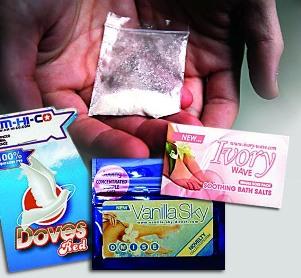
The Japanese government will ban four new synthetic drugs in August, according to Japanese press reports. The four drugs are the synthetic cannabinoids JWH-018 and cannabicyclohexanol and the synthetic stimulants mephedrone and MDPV.

mephedrone among new synthetic drugs to be banned in Japan
The synthetic cannabinoids are commonly sold as incense and marketed in the US under brand names like Spice and K2. The synthetic stimulants are commonly sold as plant fertilizer and marketed under names such as Ivory Wave. The two types of synthetic drugs are commonly referred to as "fake pot" and "bath salts," respectively.

The compounds have been banned in the European Union, and numerous states in the US have also taken action to prohibit them. Legislation is pending in the US Congress to ban them as well, and both sets of drugs are currently banned federally under emergency DEA edicts.

The Japanese Health, Labor and Welfare Ministry will designate the four synthetic drugs as "narcotics" under the Pharmaceutical Affairs Law and is working on a blanket regulation that would allow it to impose the same designation on new drugs with slightly differing chemical compositions but that have similar effects to the banned substances.

Japanese health authorities have reported 114 cases of "health problems" associated with the use of the synthetic drugs, but there is no reporting on how many of those cases were associated with synthetic cannabinoids or how many were associated with synthetic stimulants. The adverse reactions to synthetic stimulants are more severe than those associated with synthetic cannabinoids. Authorities in Japan have also reported a number of cases of people injuring others while driving under the influence of the new synthetics.

Tokyo
Japan

US/Mexico Drug War "Caravan of Peace" Gearing Up [FEATURE]

Aghast and appalled at the bloody results of Mexican President Felipe Calderon's war on drugs, which has resulted in at least 50,000 deaths since he deployed the military against the so-called drug cartels in December 2006 and possibly as many as 70,000, dozens of organizations in Mexico and the US announced Monday that they will take part in a "Caravan for Peace" that will journey across the US late this summer in a bid to change failed drug war policies on both sides of the border.

caravan launch at Museo Memoria y Tolerancia, Plaza Juárez, Mexico City (@CaravanaUSA @MxLaPazMx)
Led by Mexican poet Javier Sicilia, who was spurred to action by the murder of his son by cartel members in Cuernavaca in 2010, and the Movement for Peace with Justice and Dignity (MPJD) he heads, the caravan will depart from San Diego on August 12 and arrive in Washington on September 10 after traveling some 6,000 miles to bring to the American people and their elected officials the bi-national message that failed, murderous drug war policies must end.

The caravan will be underway in between presidential elections in the two countries. Mexico will choose a successor to Calderon on July 1, and whoever that successor is, will be re-tooling its fight against the drug cartels. By late summer, the US presidential campaign will be in full swing, and advocates hope to have at least some impact on that as well.

The caravan builds on similar efforts last year in Mexico. Led by Sicilia and other relatives of drug war victims, one caravan of more than 500 people left Cuernavaca and traveled north through 15 cities to Ciudad Juarez, one of the epicenters of prohibition-related violence in Mexico. A second caravan left Mexico City with 700 people traveling south through 21 cities. Those caravans helped turn what was an amorphous fear and dismay among Mexicans at the violence into a political movement that has put the issue of the drug wars and their victims squarely on the Mexican political agenda.

"The war on drugs has had painful consequences for our country, such as corruption and impunity," said Sicilia at a Mexico City press conference. "The proof of this is that Mexico has seen over 70,000 deaths and 10,000 disappearances, and this is closely linked to US regional security policies, which have sparked widespread areas of violence, human rights violations, and the loss of the rule of law. The drug war has failed," he said bluntly.

"On August 12, Mexicans will come to the US and cover a route of 25 cities in one month," Sicilia continued. "Our message is one of peace, and our journey will be peaceful with an open heart and the hope of speaking with each other. We believe the harm we live is linked to the failed policies we want to change."

"Regarding policies on the war on drugs, we propose the need to find a solution with a multidimensional and international approach that places the dignity of the individual at the center of drug policy," Sicilia said. "We call on both Mexican and US civil society to open and maintain a dialogue on evidence-based alternatives to prohibition and to consider various options for regulating drugs."

Javier Sicilia on CNNMéxico
For Sicilia and the caravan, drug policy is inextricably tied to other policies and issues that affect both sides of the border. The caravan is also calling for a ban on the importation of assault weapons to the US (because they then end up being exported to Mexican criminals), a higher priority for concentrating on money laundering, an end to US immigration policies that have resulted in the militarization of the border and the criminalization of immigrants, and a refocusing of US foreign policy to emphasize human rights while suspending US military aid to Mexico.

The broad range of interrelated issues is helping build a broad coalition around the caravan. Groups concerned with the border, immigrant rights, human rights, racial justice, and labor are all coming on board.

"Forty years ago, then President Nixon inaugurated the war on drugs, and we've not won the war on drugs -- the only thing we've achieved is being the world's leader in incarceration," said Dr. Niaz Kasravi, with the NAACP criminal justice program. "Through these policies, we've also promoted violence and death for those caught up in the drug war in the US and Mexico. In the US, those who have borne the brunt of it have been people of color. The war on drugs hasn't made our communities safer, healthier, or more stable, but has resulted in the mass incarceration of people of color, a de facto Jim Crow. We are in a violent state of emergency that must end, and we stand committed to ending the war on drugs."

"We emphasize the dignity and humanity of immigrants in the US," said Oscar Chacon of the National Alliance of Latin American and Caribbean Communities (NALACC), "and when we were invited to consider joining the caravan, we identified with it as a cause of our own. We see our issues reflected throughout the caravan. Policies that emphasize militarization and authoritarianism and enforcement and punishment have human rights violations as their natural results. We see in the caravan an opportunity to write a new chapter in our initiatives to highlight the value of respect for all human life and we will use our participation to further educate Latino and immigrant communities about the relationship between policy decisions made in Washington and the sad effects they can have -- in this case, particularly for our Mexican brothers and sisters."

"Prior to coming here, I did not know the extent of the pain, sorrow, and suffering of the families here in Mexico," said Neill Franklin, head of Law Enforcement Against Prohibition. "There are so many orphans, so many families being attacked. Families and future generations are also under attack in my country, with drive-by shootings and running gun battles in the streets of our big cities. Most of those targeted by the drug war here are blacks and Latinos; we have many broken families and communities because of these policies. This caravan will unite our people, our pain, and our solutions in an effort to save our sons and daughters."

"This is a historic moment and one of great necessity," said Ted Lewis of Global Exchange. "The caravan arrives between two presidential elections, and that's intentional, not because we have electoral ends, but because we want the message to be heard on both sides of the border. This is a truly binational effort, and it is very important that leaders on both sides of the border take this message deeply into account as they organize in Mexico a new administration and as they campaign here in the US. This issue must be dealt with now."

Also on board is Border Angels, a San Diego-based group best known for leaving caches of water in the desert to help save the lives of undocumented immigrants heading north. The group has long been critical of increased border enforcement efforts such as Operation Gatekeeper, which have pushed those immigrants away from urban areas and into harsh and unforgiving environments as they seek to make their way to a better life.

"Operation Gatekeeper has led to more than 10,000 deaths since 1994," said the group's Enrique Morones. "Two people die crossing the border every day, but they are also dying south of the border. Now, we see a new wave of migration to escape the terrible violence in Mexico, the country of my parents, and that's why we are joining this movement for peace in this historic caravan. We have told both Obama and Calderon that human rights, love, and peace have no borders. We demand peace, justice, and dignity."

"I think this will really have a significant impact," said Ethan Nadelmann, executive director of the Drug Policy Alliance. "It's going to be a pivotal moment, just a month after the Mexican elections and just a few months before the US elections. I don't think drugs will be a major issue, but it will be bubbling up from time to time."

The caravan will seek to raise awareness on both sides of the border, Nadelmann said.

"Americans need to be aware of the devastation in Mexico from the combination of US demand and our failed prohibitionist policies," he said. "It's also important that Mexicans understand the devastating consequences of the war on drugs in the US -- the arrests and incarceration, the evisceration of civil rights. This mutual understanding is a pivotal part of what we're trying to accomplish."

"I hope the message will come through that change is needed on both sides of the border," Nadelmann continued. "We've seen the failures of prohibition on both sides, but the biggest impetus has to come from the US through legal regulation of marijuana and more innovative policies to reduce demand -- not from locking up more people, but by providing effective drug treatment and allowing people addicted to drugs to get them from legal sources. We need a fundmentally different approach, and this caravan will be a leap forward in understanding the consequences of failed prohibition."

Mexico City
Mexico

NYPD Police Officer Indicted in Ramarley Graham Killing

Ramarley Graham
A New York City police officer has been indicted on manslaughter charges in the Bronx shooting death of 18-year-old Ramarley Graham. Graham, a young black man, was shot and killed in the bathroom of his own home after a team of NYPD narcotics officers followed him home, broke in, and confronted him.

When he was killed in February, Graham was the eighth person to die in drug law enforcement activities so far this year. That number is now up to 28. The indictment of NYPD Officer Richard Haste is the first of any officer in any of those deaths.

Although the indictment has not been officially unsealed, the New York Times reported that a grand jury has indicted Haste, 30, on charges of first- and second-degree manslaughter. More charges could be pending.

Graham was shot and killed after he and a pair of friends caught the attention of narcotics officers who had staked out a bodega on White Plains Road. They radioed their colleagues and said they believed he had a gun in his waistband as he walked toward his home. Officer Haste dashed to the scene, broke into Graham's apartment, and shot and killed him in his bathroom.

No weapon was found, but police did say they found marijuana in a plastic baggie in the toilet bowl, suggesting Graham may have been trying to get rid of the evidence to avoid becoming another New York City pot bust statistic.

The shooting has provoked anger in the community and led to numerous calls for justice for Graham and other victims of overzealous policing in the city. It has also focused attention on the aggressive tactics of the NYPD's Street Narcotics Enforcement Unit, teams of officers who surreptitiously surveil the streets looking for drug deals before bursting in to bust dealers and customers.

The Graham shooting has focused attention on the aggressive tactics of the Police Department’s Street Narcotics Enforcement Units -- teams of six or seven officers who hide on rooftops or in parked cars as they scan the streetscape for drug transactions before swooping in to arrest dealers and customers. Police Commissioner Ray Kelly ordered a review of the units' tactics, but the results of that review have not been released.

The last time NYPD officers were indicted for killing a resident was when three of them riddled Sean Bell's body with bullets as he attended his pre-wedding party in 2007. Those officers were eventually found not guilty.

New York, NY
United States

Kenya to Distribute Needles to Injection Drug Users

The Kenyan government will begin distributing needles to the country's estimated 50,000 injection drug users next month in a bid to slow the spread of HIV and other blood-borne diseases. The plan was announced last week in Mombasa, where the first pilot program will begin.

Mombasa, a port city, is reportedly a transit route for international drug trafficking. It also has the country's highest number of injecting heroin users.

"We are trying our best to address the entire problem of drug abuse amongst the youths. We had to identify an alternative of stopping the youths from sharing needles, our attention having been drawn by the rate at which these young people were contracting HIV and other diseases, such as hepatitis," said Dr. Anisa Omar, the Coast Provincial Director of Public Health and Sanitation. "In Mombasa alone, we have over 26,000 youths who use injection drugs, with at least one out of every four being found to be HIV-positive. In Nairobi, we have 20,000 youths who are IDUs."

The Kenyan government estimates that injection drug use accounts for 4% of HIV infections and 17% of new HIV infections in Coast Province, where Mombasa is located. The government moved in 2010 to shift from addressing drug use as a criminal issue to addressing it as a public health issue.

The government plans to distribute some eight million needles to injection drug users as the plan is rolled out. It will also encourage people to be tested for HIV and will provide antiretroviral drugs, condoms, and medicines for tuberculosis, which commonly co-infects with HIV.

While the government has shifted to a public health and harm reduction approach, not everybody is on board. Anti-drug activists and some religious leaders have criticized the move.

"We will file a petition in court… these children of ours don't even have any veins remaining in their bodies," said Amina Abdalla, secretary of the Coast Community Anti-Drugs Coalition. "Where do they expect them to inject themselves? Their bodies are ruptured and rotten as a result of constant use of the needles. Besides, drug peddlers and barons will have a field day, for they'll know their products will be on demand, and that's not acceptable."

Coast religious leaders also objected, saying the government should instead spend its resources on drug treatment.

But Dr. Omar said that needle sharing significantly reduced the risk of coming down with HIV and hepatitis, and that justified the program.

"The program, which will see every addict given three needles and syringes per day, will be supplied to specified private rehabilitation centers and hospitals by NGOs and qualified medical practitioners, in collaboration with anti-drug campaigners, whom we soon plan to train on how they'll best handle the addicts."

Mombasa
Kenya

Marijuana Discord on the French Left

Just days before the first round of French parliamentary elections, the Socialists and their probable junior partner in a new governing coalition, the Greens, were at odds over marijuana policy. While the spat is unlikely to undo the electoral pact between the two parties, it has pushed pot into the election campaign.

Champs de Elysee, Paris (wikipedia.org)
Newly-elected Socialist President Francoise Hollande appointed Green Party head Cecile Duflot Minister of Housing -- one of two Greens in the interim cabinet. This week, Duflot unleashed the controversy by saying she backed marijuana legalization.

That left Hollande's team with the task of reiterating the Socialists' opposition to such a move. During a Wednesday night television interview Prime Minister Jean-Marc Ayrault tried to put the matter to bed. When asked if Hollande supported legalization, Ayrault said that Hollande had opposed it during the campaign.

"The answer is very clear, and it's no," he told TF1.

If, as expected, the left wins the parliamentary election, Duflot would have to quit as head of the Greens and leave her legalization position behind in order to stay in the cabinet. She will do that, Ayrault said.

"Madame Duflot will do as she promised. From June 23, she will be a minister only, serving solely her mission as a member of the government," he said.

But even if Duflot backs away from legalization, there is little sign the rest of the Greens will.

Daniel Cohn-Bendit, known as "Danny the Red" for his role in the 1968 Paris student uprising, a Green Party veteran, said Thursday he hoped the party would press for a legalization bill in the National Assembly.

"It's time to ditch the hypocrisy and double-speak," he told RMC radio. "Today's repression simply plays into the hands of drug traffickers."

Polls this week show the Socialists poised on the verge of winning a parliamentary victory outright, but they will probably need the support of smaller parties on the left, most notably the Greens, but also the Left Front to achieve any sort of parliamentary comfort zone. The Assembly has 577 seats, while polls show the Socialists could take as many as 291, leaving them a razor-thin majority. Support from the Greens and the Left Front could add another 20 or so seats to what would then be a governing coalition led by the Socialists.

Paris
France

Indonesia Cuts Schapelle Corby's 20-Year Marijuana Sentence

Indonesian President Susilo Bambang Yudhoyono cut Australian Schapelle Corby's 20-year prison sentence for smuggling marijuana into the country by five years last Tuesday, meaning the former beauty school student will be eligible for parole this fall.

Schapelle Corby, November 2006 (Schapelle.net)
Corby's plight became something of a cause célèbre -- there is even a web site devoted to her release -- after she was arrested at an airport in Bali as she arrived on vacation in 2004. In her luggage was found nine pounds of marijuana. She always maintained her innocence, and the case strained relations between Australia and Indonesia.

Corby applied for a sentence reduction two years ago, with her attorney arguing that her mental health was slipping after years of confinement in the overcrowded Kerobokan Penitentiary.

Australia welcomed the cut in sentence.

"The Australian government has consistently supported Ms. Corby's application for clemency on humanitarian grounds," Foreign Minister Bob Carr said in a statement.

The 34-year-old's release is not, however, a done deal. She must be approved for parole, and Australia must guarantee her good behavior upon release. Corby and her team are asking the Australian government for its support in the parole bid.

Despite some criticism from hard-liners, Indonesian Justice Minister Amir Syamsuddin said Corby's conviction was "not related to heroin or other heavy drugs" and was not for major drug trafficking. "It was purely marijuana and the marijuana didn't weigh hundreds of kilograms," he said.

Jakarta
Indonesia

Drug War Issues

Criminal JusticeAsset Forfeiture, Collateral Sanctions (College Aid, Drug Taxes, Housing, Welfare), Court Rulings, Drug Courts, Due Process, Felony Disenfranchisement, Incarceration, Policing (2011 Drug War Killings, 2012 Drug War Killings, 2013 Drug War Killings, Arrests, Eradication, Informants, Interdiction, Lowest Priority Policies, Police Corruption, Police Raids, Profiling, Search and Seizure, SWAT/Paramilitarization, Task Forces, Undercover Work), Probation or Parole, Prosecution, Reentry/Rehabilitation, Sentencing (Alternatives to Incarceration, Clemency and Pardon, Crack/Powder Cocaine Disparity, Death Penalty, Decriminalization, Drug Free Zones, Mandatory Minimums, Rockefeller Drug Laws, Sentencing Guidelines)CultureArt, Celebrities, Counter-Culture, Music, Poetry/Literature, Television, TheaterDrug UseParaphernalia, ViolenceIntersecting IssuesCollateral Sanctions (College Aid, Drug Taxes, Housing, Welfare), Violence, Border, Budgets/Taxes/Economics, Business, Civil Rights, Driving, Economics, Education (College Aid), Employment, Environment, Families, Free Speech, Gun Policy, Human Rights, Immigration, Militarization, Money Laundering, Pregnancy, Privacy (Search and Seizure, Drug Testing), Race, Religion, Science, Sports, Women's IssuesMarijuana PolicyGateway Theory, Hemp, Marijuana -- Personal Use, Marijuana Industry, Medical MarijuanaMedicineMedical Marijuana, Science of Drugs, Under-treatment of PainPublic HealthAddiction, Addiction Treatment (Science of Drugs), Drug Education, Drug Prevention, Drug-Related AIDS/HIV or Hepatitis C, Harm Reduction (Methadone & Other Opiate Maintenance, Needle Exchange, Overdose Prevention, Safe Injection Sites)Source and Transit CountriesAndean Drug War, Coca, Hashish, Mexican Drug War, Opium ProductionSpecific DrugsAlcohol, Ayahuasca, Cocaine (Crack Cocaine), Ecstasy, Heroin, Ibogaine, ketamine, Khat, Marijuana (Gateway Theory, Marijuana -- Personal Use, Medical Marijuana, Hashish), Methamphetamine, Nicotine, Prescription Opiates (Fentanyl, Oxycontin), Psychedelics (LSD, Mescaline, Peyote, Salvia Divinorum), Synthetic Drugs (Mephedrone, Synthetic Cannabinoids)YouthGrade School, Post-Secondary School, Raves, Secondary School