Oregon Measure 80

RSS Feed for this category

At NORML, A Sharp Focus on the Marijuana Initiatives [FEATURE]

The 41st National NORML conference took place at a downtown Los Angeles hotel over the weekend under the theme of "The Final Days of Prohibition." With marijuana legalization initiatives on the ballot in three states and medical marijuana on the ballot in two others, the several hundred attendees could almost smell the scent of victory come election day -- or at least a historic first win for legalization.

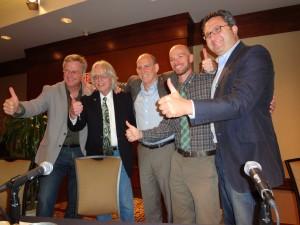
Rick Steves, Keith Stroup, Ethan Nadelmann, Brian Vicente for OR Amendment 64, Roy Kaufman for OR Measure 80 (radicalruss.com)
"This is a great movement, not because it's about marijuana, but because it's a movement about truth and freedom, the freedom to live our private lives as we wish," NORML board chairman Paul Kuhn told the crowd in his conference-opening remarks. "A White House that serves liquor, a president who smoked a lot of marijuana, and a speaker of the house who is addicted to nicotine -- they have no business demonizing us because we prefer a substance less dangerous than liquor or alcohol."

For Kuhn, as for many others at the conference, supporting the legalization initiatives was front and center. (While grumbling and gnashing of teeth was heard among some attendees, particularly over the Washington initiative's drugged driving provision, no initiative opponents were seen on any of the panels or presentations.)

"We're beyond the concept of legalization. Now, we're supporting real laws, and no law will satisfy everybody in this movement," Kuhn continued, implicitly acknowledging the dissension around the Washington initiative. "We have our differences, sometimes heated, and this is healthy and necessary if we are to evolve and craft the best laws and regulations, the best form of legalization. All of us in this movement are allies, we're friends, we share the same goals of truth and freedom and legal marijuana. We have worked too hard for too many years to let our opponents divide us, or worse, divide ourselves."

"These are the final days of prohibition. The data is clear," said NORML executive director Allen St. Pierre, pointing not only to public opinion polls but also to the political reality of the initiatives and the progress the movement has made in Congress and the states. "We have a cannabis caucus in our Congress and in the state houses, and we helped get them elected. There are 15 or 20 members of Congress who are genuine supporters of ending prohibition, most of them are Democrats. In the states, we now have sitting governors and representatives calling us and saying 'we want your support, your endorsement, your money.'"

 With the initiatives looming, much of the conference was devoted to the minutiae and arcana of legalization, regulation, and taxation models. Thursday afternoon saw extended discussions in panels on "Cannabis Legalization and Regulation: What it Might Look Like" and "Cannabis and the 'Demo' Gap: Who Doesn't Support Legalization and What We Can Do about It."

"How do we win the hearts and minds of non-smokers?" asked Patrick Oglesby of the Center for New Revenue. "The revenue card is one we can play. That gives people something to vote for. Every state in the union legalizes and taxes alcohol and tobacco. Revenue from marijuana isn't going to fix our economic problems, but let's start with the easy stuff, let's fix this and get some revenues."

"At least one state will tip in November, and others will follow," predicted Pepperdine University researcher and Marijuana Legalization: What Everyone Needs to Know coauthor Angela Hawken. "Parents will wake up and realize their children didn't turn into zombies."

Parents -- and mothers in particular -- are a key demographic that must be won over if marijuana legalization is to advance, and the way to win them over is to address their fears, panelists said.

"Women are more safety conscious and they tend to believe authority," noted NORML Women's Alliance coordinator Sabrina Fendrick. "They just need to be educated. Proposition 19 failed in large part because of women and seniors. Many were concerned over the driving issue and children being on the road with stoned drivers. The way to bring support up is to educate them about the difference between use and abuse, and to make women who support legalization feel safe about coming out."

The NORML Women's Alliance is working on that, and on increasing the number of female activists in a movement that has been male-dominated from the outset.

Law enforcement is another key bastion of opposition to legalization, and Law Enforcement Against Prohibition (LEAP) representative Steven Downing told the audience the key to swaying law enforcement was not in the rank and file, but at the pinnacle of the command structure.

"We have to influence change at the top," he said. "When that comes, the young officers on the street will do as they're told. Many of them already agree with legalizing marijuana. Don't treat the police as the enemy, but as people who can benefit from the education you can give them. Do it in a way that they're not defensive, then refer them to LEAP," the former LAPD officer suggested. "Tell them that if they support the war on drugs, they're not supporting public safety."

On Friday, longtime Seattle marijuana activist-turned-journalist Dominic Holden gave a spirited defense of Washington's I-502 initiative and ripped into its movement critics, including calling out NORML board member and Seattle defense attorney Jeff Steinborn, who has been a vocal foe of the initiative despite a unanimous board vote to support it.

"Who is opposing 502?" Holden asked. "The law enforcement opposition has been quiet and halfhearted. It's Steve Sarich, who runs CannaCare, it's cannabis doc Gil Mobley, and a whole passel of pot activists along with them. The ones opposing pot legalization right now are the ones making money hand over fist with prohibition. If they're profiting off it, I don't give a rat's ass what they think," he said.

"They don't like the DUID provision and its per se standard. They say that someone who uses marijuana regularly will test positive, but there is not a single scientific study to back them up. Their argument is fundamentally flawed because it is a lie," Holden countered, mincing no words.

"There is also concern that if we pass it, the federal government will challenge us on legalizing pot. That's the damned point!" he thundered.

"But marijuana is going to be taxed, they complain. Shut up, Teabaggers!" Holden jeered. "What planet do you live on where they're not going to tax a huge agricultural commodity?"

He pointed out that Steinborn and Sensible Washington, who are opposing I-502, had tried unsuccessfully to mount an initiative of their own.

"If you want to run a winning campaign, you need a bunch of money, credible spokespeople, campaign professionals, and the polling on your side," he said. "Part of that is compromise. You don't always get what you want, you don't always get the initiative of your dreams. What you want is a bill that can win."

"This is poll driven," said travel writer, TV host, and I-502 proponent Rick Steves. "It isn't a utopian fix. We need to win this. This doesn't feel pro-pot, but anti-prohibition."

"Regulate marijuana like alcohol is our message," said Sensible Colorado head and Amendment 80 proponent Brian Vicente. "We don't talk about legalization, but regulation. We've built support for this through two avenues, medical marijuana, where we've worked hard to make our state a model for how it can be taxed and regulated, but also through consistent earned media pushes and ballot initiatives to introduce the public to the idea that this isn’t the demon weed. We're consistently ahead five to ten points in the polls. We think this will be a damned close election."

When Vicente noted that the Colorado initiative had no drugged driving provision, he was met with loud applause. 

Drug Policy Alliance
head Ethan Nadelmann provided a primer on what major donors look for when it comes to supporting initiatives.

"We don't pick out a state in advance," he explained. "We want to know at the get-go if there is already a serious majority in favor of legalization. To think you can use a campaign to move the public is not true; the role of the ballot process is to transform majoritarian public opinion into law when the state legislature is unable or unwilling to do so. You want to go in with 57% or 58% on your side. Anything short of that, you're going to lose."

And watch out for October, he warned.

"In the final weeks, the opposition mobilizes," Nadelmann said. "You get the cops, the politicians, the feds speaking out and scaring people -- that's why these are hard to win, and that's why I'm still really nervous."

Still, the Drug Policy Alliance is deeply involved in Colorado and has put a lot of money into Washington, Nadelmann said, while noting that the Marijuana Policy Project had also put big bucks into Colorado.

"We have to win this year so we can figure out how to win a bunch more in 2016," Nadelmann said, adding that he was looking toward California. "We're going to try to put together the best and most winnable legalization initiative in California in 2016.

NORML 2012 wasn't all about the initiatives -- there were also panels on advances in medical marijuana, advances in the Northeast, and the role of women in the movement, among others, and a rousing speech from long-time anti-war activist Tom Hayden and a new-born movement star in Ann Lee, the mother of Richard Lee -- but with the marijuana legalization movement looking like it's about to step foot in the Promised Land after decades in the political wilderness, next month's elections dominated. The prospect of imminent victory really focuses the mind.

Los Angeles, CA
United States

Initiative Watch

Just over a month out, medical marijuana and marijuana legalization initiative campaigns are heating up.

Arkansas

See our feature article this week on the Arkansas initiative and its prospects here.

California

All was quiet on the Proposition 36 three-strikes initiative front.

Colorado

Last Thursday, a group of armed forces veterans came out for Amendment 64. The group, Veterans for 64, was formed after the state denied a plea to add post-traumatic stress disorder (PTSD) to its list of ailments for which medical marijuana can be used. "The state's failure to act is an effective denial of this compassionate petition," said Vietnam veteran Bob Wiley. "Our only option is to support Amendment 64, which will ensure that Coloradans 21 and older who suffer from PTSD will no longer be subject to arrest and prosecution for using marijuana."

Also last Thursday, a study found that one in 20 Colorado arrests are marijuana-related. The study, conducted by the Colorado Center on Law and Policy for the Drug Policy Alliance found that police forces in the state spend about 4.7% of their budgets enforcing marijuana prohibition, the courts spend 7%, and the corrections system spends 2%. All told, the study concludes that legalizing small amounts of marijuana will save Colorado taxpayers $12 million a year in the beginning and up to $40 million a year in later years.

On Tuesday, Republican state Sen. Shawn Mitchell endorsed Amendment 64. "It's clear the war on drugs isn't working, and we need to try different approaches to this in society," said Mitchell, who has long had a libertarian-style view of drug use, based in part on his own family's experience. "Watching a brother battle addiction has made me question the worth of legal penalties," he said. He joined former US Rep. Tom Tancredo and a handful of other Republican supporters organized by the Republican Liberty Caucus at a rally at the capitol that day.

On Wednesday, the Amendment 64 campaign released a new TV ad arguing that money from marijuana sales should go to Colorado schools, not Mexican drug cartels. "We all know where the money from non-medical marijuana sales is currently going," the narrator says as dollar signs cascade down from Colorado and into Mexico. "It doesn't need to be that way. If we pass Amendment 64, Colorado businesses would profit and tax revenues would pay for public services and the reconstruction of our schools. Let's vote for the good guys and against the bad guys -- let's have marijuana tax money go to our schools rather than criminals in Mexico."

Massachusetts

On Wednesday, opponents of Question 3 gathered in Somerville to discuss the measure. Some 20 people, including Somerville Police Chief Thomas Pasquarello, gathered for a talk by Cory Mashburn, Director of the Somerville Office of Prevention, part of the Somerville Health Department. Dispensaries will resemble "candy stores or a 7-11," he told the small crowd.

Montana

All was quiet on the I-124 front.

Oregon

Last Thursday, the Yes on 80 campaign criticized a raid on a major medical marijuana provider. The campaign addressed that day's raid on the Human Collective in Tigard, saying "prohibition is the problem, regulation is the solution."

On Wednesday, the Associated Press reported on money problems for Measure 80. The campaign had only $1,800 in the bank, the AP reported, citing potential large donors' doubts about the measure's ability to win and skepticism about the measure's main backer, Paul Stanford. The measure is trailing in the polls.

Washington

On Sunday, the Columbian (Vancouver, WA) endorsed I-502.

As of Monday, the I-502 campaign had raised $4 million, including $670,000 donated last week by Progressive Insurance founder Peter Lewis, who has now thrown in a total of $1.55 million. The campaign used some of that money for a $700,000 TV ad buy for use in the final week before the election.

Also on Monday, the campaign won the endorsement of King County Sheriff Steve Strachan, who is running for re-election. "I think the current situation is bad for the rule of law, bad for the criminal justice system and and it sends a bad message to our kids," he said. Strachan's opponent, longtime Sheriff's spokesman John Urquhart, previously endorsed I-502.

On Tuesday, the Spokane Spokesman-Review endorsed I-502.

On Wednesday, Republican US Senate hopeful Michael Baumgartner endorsed I-502, giving the campaign one of its highest-profile Republican supporters yet. He is running a long-shot bid to defeat Democratic US Sen. Maria Cantwell. I-502 is "taking a different approach to a very expensive drug war, and potentially a better approach," Baumgartner said. "They've checked all the boxes as far as what you would want to see happen in terms of provisions to keep it away from children and limiting access in the public space. I've just been impressed with the initiative and the people running it."

(This article was published by StoptheDrugWar.org's lobbying arm, the Drug Reform Coordination Network, which also shares the cost of maintaining this web site. DRCNet Foundation takes no positions on candidates for public office, in compliance with section 501(c)(3) of the Internal Revenue Code, and does not pay for reporting that could be interpreted or misinterpreted as doing so.)

TONIGHT: StoptheDrugWar.org Marijuana Legalization Initiatives Teleconference

[Please join us tonight! Updated agenda below]

StoptheDrugWar.org is pleased to announce our first teleconference, featuring the initiative campaigns in Colorado, Oregon, and Washington State to enact regulatory (legalization) systems for marijuana. Please join us by phone or Skype on Thursday, September 27, 6:00pm PST / 9:00pm EST -- call (805) 399-1200 and enter access code 135516. We will discuss what the initiatives do, what their prospects are for passage and for fueling further reform, and what people can do to get involved.

The following exciting speakers have agreed to join us:

  • Oscar Eason, Jr., NAACP Alaska/Oregon/Washington State Area Conference
  • Alison Holcomb, New Approach Washington
  • Paul Stanford, Oregon Cannabis Tax Act
  • Steve Fox, Marijuana Policy Project (coordinating Colorado efforts)
  • Tony Ryan, Law Enforcement Against Prohibition

Moderated by David Borden, executive director of StoptheDrugWar.org, and joined by Drug War Chronicle writer/editor Phillip S. Smith.

Please RVSP here on our Facebook event page or our evite, and please spread the word! We will accept questions by email, now and during the teleconference -- send them to borden@drcnet.org.

Please stay tuned also for announcements of additional teleconferences to discuss the upcoming state medical marijuana initiatives, prospects for reform in Congress next year, and other topics. If you are not already subscribed to the Drug War Chronicle newsletter, you can subscribe here -- follow us on Facebook and Twitter too.

Initiative Watch

We're a little more than a month from election day. Here's what's going on with the state-level initiatives.

California

Last Thursday, LA County DA candidates gave differing views on Proposition 36 during what is likely the final debate of their campaigns. Deputy District Attorney Alan Jackson opposes the measure, which would modify the state's draconian three-strikes law, while Chief Deputy District Attorney Jackie Lacey supports it.

Colorado

Last Friday, the Amendment 64 campaign demanded an apology from opponents for smearing a retired veteran Denver police officer as a "rent a cop." The description came from Roger Sherman, head of the No on 64 campaign, and was in response to a series of endorsements of Amendment 64 by law enforcement personnel and organizations. It was aimed at retired Lt. Tony Ryan, a Denver Police Medal of Honor recipient and Purple Heart holder. Sherman has yet to respond to the invitation to apologize.

Also last Friday, conservative former congressman Tom Tancredo endorsed Amendment 64. He sent a letter to some Republican state lawmakers outlining his support. "I have decided that it presents a responsible, effective and much-needed solution to a misguided policy," he said in the letter. "Eighty years ago, Colorado voters concerned about the health and safety of their families and communities approved a ballot initiative to repeal alcohol prohibition prior to it being done by the federal government. This November, we have the opportunity to end the equally problematic and ineffective policy of marijuana prohibition."

Massachusetts

On Monday, US Senate candidate Elizabeth Warren (D) said she supported medical marijuana. "You know, I held my father's hand while he died of cancer, and it's really painful when you do something like that up close and personal," she said in an interview. "My mother was already gone and I was very very close to my father. And it puts me in a position of saying, if there's something a physician can prescribe that can help someone who is suffering, I'm in favor of that. Now, I want to make sure they've got the right restrictions. It should be like any other prescription drug. That there's careful control over it. But I think it's really hard to watch somebody suffer that you love." That wasn't a direct endorsement of the initiative, Question 3, but pretty darned close.

Montana

A poll released last week showed I-124, the initiative to undo the legislature's gutting of the state's 2004 voter-approved medical marijuana law, at under 50%. That's a good thing, because a "yes" vote endorses the legislative gutting. Only 44% of those polled said they would vote "yes," but with 31% saying they would vote "no," that still leaves a large uncommitted bloc.

Oregon

Last Wednesday, former Oregon Secretary of State Bill Bradley endorsed Measure 80. "Our nation's war on drugs has really been, for decades now, a war on Americans of color and our poorest, most vulnerable citizens, and the ban on agricultural hemp has been the collateral damage" said Bradbury. "I urge my fellow Oregonians to vote yes on Measure 80, which is an historic opportunity to show our fellow Americans a way to end the failed drug war, begin a new, sensible approach to marijuana, and restore hemp to our farmers and hi-tech entrepreneurs for biofuel, textiles, and advanced manufacturing."

Washington

See our feature article this week on the state of play for Washington's I-502 initiative here.

Initiative Watch

Three marijuana legalization initiatives, two medical marijuana initiatives, and one sentencing reform initiative are on state ballots this year. We'll be running a feature story on one of them each week between now and election day, but we've created this short-term feature to keep up with all of them. Here's what's happening:

Arkansas

Last Wednesday, supporters and foes of the medical marijuana initiative sparred in court over ballot summary language. Opponents are attempting to knock the initiative off the ballot by challenging the language, but supporters say it is fair and want the state Supreme Court to block the move. If it stays on the ballot and passes, the Arkansas Medical Marijuana Act would be the first such initiative passed in the South.

Colorado

Last Wednesday, Gov. John Hickenlooper came out in opposition to Amendment 64, the tax and regulate marijuana legalization initiative. He said that making marijuana legal would send the wrong message about drug use. "Colorado is known for many great things -- marijuana should not be one of them," Hickenlooper wrote.

That provoked an immediate, tart response from Mason Tvert of the Campaign to Regulate Marijuana Like Alcohol. "Governor Hickenlooper's statement today ranks as one of the most hypocritical statements in the history of politics," said Tvert. "After building a personal fortune by selling alcohol to Coloradans, he is now basing his opposition to this measure on concerns about the health of his citizens and the message being sent to children. We certainly hope he is aware that alcohol actually kills people. Marijuana use does not. The public health costs of alcohol use overall are approximately eight times greater per person than those associated with marijuana. And alcohol use is associated with violent crime. Marijuana use is not."

Also last Wednesday, a Denver district judge allowed a state-issued voters' guide to proceed even though the Campaign had challenged it as grossly imbalanced after a legislative committee edited the wording. The voters' guide now contains 366 words opposing the measure and only 208 supporting it.

Also last Wednesday, the Colorado University Board of Regents formally opposed Amendment 64. "We are expressing to parents and future students that we oppose Amendment No. 64 because it's against state laws and federal laws and we're law abiding regents," regent Tillie Bishop explained. Following the vote, Bishop offered an open invitation to his fellow regents to attend the 21st annual Colorado Mountain Winefest, which began last Thursday in Palisade.

Last Saturday, the latest poll had Amendment 64 leading 51% to 40%, with 8% undecided. The average of all polls so far has Amendment 64 leading by 49.7% to 39.3%.

On Wednesday, the Colorado Education Association opposed Amendment 64, this after campaign organizers had included language directing funds to public school construction in a bid to at least have the group stay neutral.

"We're sorry to hear the Colorado Education Association has been convinced to embrace a position counter to the interests of students and parents," Mason Tvert responded. "In fact, it was CEA that suggested tax revenue raised through the initiative should benefit public school construction in Colorado. We agreed it would be a good use of new revenue, and we are proud to say that Amendment 64 would direct tens of millions of dollars per year toward improving Colorado schools. It's odd that our opponents are criticizing the idea of Amendment 64 directing new revenue toward public school construction, as it was embraced by the CEA when it contributed that very idea during the drafting process. In fact, when we consulted with CEA during the drafting of the initiative they indicated they would be remaining neutral on the issue, but that's politics for you. It's understandable that an organization like CEA would want to toe the line of the powers that be, but it's unfortunate that they are playing politics when the future of Colorado schools -- and the health and safety of our children -- are at stake."

Also on Wednesday, the campaign announced pending endorsements from national law enforcement groups and former law enforcement officials. The endorsing groups are the National Latino Officers Association and Blacks in Law Enforcement in America. They will hold a press conference Thursday.

Massachusetts

Last Tuesday, Progressive Insurance founder Peter Lewis announced he had given $465,000 to the Committee for Compassionate Medicine, the ballot committee behind Question 3, the medical marijuana initiative. The brings the total raised by the committee to $512,860, compared to $600 raised by the opposition Vote No on Question 3 committee.

Last Thursday, a spoof site ridiculing medical marijuana opponents grabbed the Vote No on Question 3 domain name, even though the opposition group had listed it on the state voters' guide. (They forgot to register it.) Now the address is home to a web page warning that medical marijuana is a gateway to "Twinkie addiction."

On Monday, the latest polling had Question 3 winning with 59% of the vote. The opposition was at 35%, with 6% undecided. The yes vote was a slight increase over the previous poll.

North Dakota

On Wednesday, the state Supreme Court ruled that the medical marijuana initiative will not be on the ballot. The secretary of state had blocked the initiative, saying there was ample evidence that University of North Dakota football players hired as signature gatherers had committed fraud by forging signatures. Proponents of the measure sought to get the court to overturn the secretary of state's decision, to no avail.

Oregon

On Monday, state Rep. Peter Buckley endorsed Measure 80, the state's tax and regulate marijuana legalization initiative. "Overall, legalization would take the black market out of Oregon," said Buckley (D-Ashland) who has served as co-chairman of the Legislature's Ways and Means Committee for the past two sessions.

On Monday, a new political action committee was formed to raise funds for Measure 80. Oregonians for Law Reform co-director Sam Chapman said, "Ending prohibition is an idea whose time has come, again. We will urge voters to rally behind Measure 80, not get bogged down in the typical pro and con rhetoric around the details of an initiative. We must show our support for this measure to help build momentum for victory, either in November or some time soon."

On Tuesday, a new poll had Measure 80 trailing 41% to 37%, with 22% undecided.

Washington

Last Monday, the Children's Alliance endorsed Initiative 502, the state's tax and regulate marijuana legalization initiative. The Children's Alliance is a Seattle-based advocacy group with more than 100 social-service agencies as members. "The status quo is not working for children, particularly children of color," said deputy director Don Gould. "Public policy ought to move us further toward racial equity and justice, and Initiative 502 is one step forward to that."

Last Wednesday, a new poll had I-502 winning with 57% of the vote and only 34% opposed. Support is up 3% over a June poll.

Oregon Marijuana Initiative Trailing Slightly in Poll

The campaign behind an initiative that would legalize marijuana in Oregon has an uphill battle ahead, according to a new SurveyUSA poll. That poll has the initiative, known as Measure 80 on the ballot, trailing by a margin of 41% to 37%.

But SurveyUSA reported a margin of error on the poll of +/-4%, meaning that the contest is a virtual dead heat and, as Portland's KATU-TV, which paid for the poll, put it, "it could go either way."

Campaign supporters can also take some solace in the high number of undecided voters. More than one out of five (22%) of those surveyed had yet to make up their minds, meaning the Amendment 80 campaign still has time to attempt to bring them over to its side.

Paralleling polling date from the other 2012 marijuana legalization initiative states, the poll found a significant gap in support between men (42%) and women (33%). Likewise, among age groups, support was strongest among the 18-to-34 group (47%), followed by 50-to-64 (39%), 35-to-49 (36%), and then those over 65 (24%).

As in the other initiative states, the data appears to suggest that parents -- and especially mothers -- with children at home will be a crucial demographic to be won over if the initiative is to succeed. Compared with its brethren in Colorado and Washington, the Oregon campaign has been a low-budget affair, but these polling numbers suggest a healthy cash injection could be critical, especially in swaying the large undecided vote.

StoptheDrugWar.org Teleconference on the Marijuana Legalization Initiatives

StoptheDrugWar.org is pleased to announce our first teleconference, featuring the initiative campaigns in Colorado, Oregon, and Washington State to enact regulatory (legalization) systems for marijuana. Please join us by phone or Skype on Thursday, September 27, 6:00pm PST / 9:00pm EST -- call (805) 399-1200 and enter access code 135516. We will discuss what the initiatives do, what their prospects are for passage and for fueling further reform, and what people can do to get involved.

The following exciting speakers have agreed to join us:

  • Oscar Eason, Jr., NAACP Alaska/Oregon/Washington State Area Conference
  • Alison Holcomb, New Approach Washington
  • Paul Stanford, Oregon Cannabis Tax Act
  • Brian Vicente, Sensible Colorado

Please RVSP here on our Facebook event page or our evite, and please spread the word! We will accept questions by email, now and during the teleconference -- send them to borden@drcnet.org.

Please stay tuned also for announcements of additional teleconferences to discuss the upcoming state medical marijuana initiatives, prospects for reform in Congress next year, and other topics. If you are not already subscribed to the Drug War Chronicle newsletter, you can subscribe here -- follow us on Facebook and Twitter too.

Drug War Issues

Criminal JusticeAsset Forfeiture, Collateral Sanctions (College Aid, Drug Taxes, Housing, Welfare), Court Rulings, Drug Courts, Due Process, Felony Disenfranchisement, Incarceration, Policing (2011 Drug War Killings, 2012 Drug War Killings, 2013 Drug War Killings, Arrests, Eradication, Informants, Interdiction, Lowest Priority Policies, Police Corruption, Police Raids, Profiling, Search and Seizure, SWAT/Paramilitarization, Task Forces, Undercover Work), Probation or Parole, Prosecution, Reentry/Rehabilitation, Sentencing (Alternatives to Incarceration, Clemency and Pardon, Crack/Powder Cocaine Disparity, Death Penalty, Decriminalization, Drug Free Zones, Mandatory Minimums, Rockefeller Drug Laws, Sentencing Guidelines)CultureArt, Celebrities, Counter-Culture, Music, Poetry/Literature, Television, TheaterDrug UseParaphernalia, ViolenceIntersecting IssuesCollateral Sanctions (College Aid, Drug Taxes, Housing, Welfare), Violence, Border, Budgets/Taxes/Economics, Business, Civil Rights, Driving, Economics, Education (College Aid), Employment, Environment, Families, Free Speech, Gun Policy, Human Rights, Immigration, Militarization, Money Laundering, Pregnancy, Privacy (Search and Seizure, Drug Testing), Race, Religion, Science, Sports, Women's IssuesMarijuana PolicyGateway Theory, Hemp, Marijuana -- Personal Use, Marijuana Industry, Medical MarijuanaMedicineMedical Marijuana, Science of Drugs, Under-treatment of PainPublic HealthAddiction, Addiction Treatment (Science of Drugs), Drug Education, Drug Prevention, Drug-Related AIDS/HIV or Hepatitis C, Harm Reduction (Methadone & Other Opiate Maintenance, Needle Exchange, Overdose Prevention, Safe Injection Sites)Source and Transit CountriesAndean Drug War, Coca, Hashish, Mexican Drug War, Opium ProductionSpecific DrugsAlcohol, Ayahuasca, Cocaine (Crack Cocaine), Ecstasy, Heroin, Ibogaine, ketamine, Khat, Marijuana (Gateway Theory, Marijuana -- Personal Use, Medical Marijuana, Hashish), Methamphetamine, Nicotine, Prescription Opiates (Fentanyl, Oxycontin), Psychedelics (LSD, Mescaline, Peyote, Salvia Divinorum), Synthetic Drugs (Mephedrone, Synthetic Cannabinoids)YouthGrade School, Post-Secondary School, Raves, Secondary School