Spending Priorities

RSS Feed for this category

Connecticut Legislature Passes Marijuana Decriminalization Bill

The Connecticut Senate Saturday narrowly approved a bill that would decriminalize the possession of small amounts of marijuana. The vote was an 18-18 tie until Lt. Gov. Nancy Wyman (D), in her position as president of the Senate, cast the tie-breaking vote to put the measure over the top.

Connecticut is about to join the ranks of the decrim states. (Image via Wikimedia.org)
On Tuesday, it passed the House. It is supported by Gov. Dan Malloy (D), who Saturday urged the House to pass it.

Under current law, the possession of "any usable amount" of marijuana is a misdemeanor punishable by up to a year in jail and a $1,000. The fine jumps to $3,000 for subsequent offenses.

The bill, Senate Bill 1014, would make possession of less than a half-ounce of pot a civil infraction punishable by a maximum fine of $150. Fines jump to from $200 to $500 for subsequent violations. People under 21 would see their drivers' licenses suspended for 60 days, similar to the punishment for minors in possession of alcohol. Under an amendment by marijuana foe Rep. Toni Boucher (R-Wilton) and accepted by Democrats, anyone thrice cited for small-time possession would be required to seek drug treatment.

Supporters of the bill argued that slapping people with a criminal record for small-time pot possession unfairly burdened them and the criminal justice system, but opponents said it sent the wrong message.

"It puts into jeopardy the future endeavors of such young people," said Sen. Eric Coleman (D-Bloomfield) co-chairman of the General Assembly's Judiciary Committee. "Decriminalizing the use and possession of small amounts of marijuana is a better course and in the best interest of young people whose judgment may not be fully matured."

Senate Majority Leader Martin Looney (D-New Haven) stressed that lawmakers were not legalizing marijuana. "We are not enforcing the use of illegal drugs. We strongly disapprove of their use, but we're trying to realign their punishment that is more appropriate," he said, adding that the state should be focusing its scarce criminal justice resources on dangerous offenders.

But Boucher had dire warnings for Connecticut if the bill passed. "When we do this, and it has been shown in other states that have gone down this path, there is both an increase in use and an increase in crime," said Boucher, who also opposes another bill that would fully legalize the medical use of marijuana.

Senate Minority Leader John McKinney (R-Fairfield) used a version of the discredited gateway theory to bolster his opposition. He told solons his old sister had started with marijuana, then went on to become addicted to cocaine and other drugs before getting clean after treatment.

"For me, a policy that lessens the severity of drug use is a bad one," he said. "I don't believe we should just give up."

After the bill passed the Senate, Gov. Malloy urged the House to approve "a commonsense" criminal justice reform. The state is "doing more harm than good when we prosecute people who are caught using marijuana -- needlessly stigmatizing them in a way they would not if they were caught drinking underage," he said.

Now, the legislature has done as the governor asked. Expect Malloy to sign the bill shortly.

Hartford, CT
United States

ACLU Sues Florida Governor on State Employee Drug Tests [FEATURE]

The ACLU of Florida Tuesday filed suit in federal court in Miami to block Gov. Rick Scott's (R) executive order mandating random, suspicionless drug testing of state employees. The lawsuit contends the drug testing amounts to an unlawful and unreasonable search and seizure, violating state employees' Fourth Amendment rights, and seeks an immediate halt to the practice.

Florida state workers, be prepared to submit one of these if Gov. Scott has his way. (Image via Wikimedia.org)
"We are taking this action to prevent Gov. Scott from trampling on your rights in Florida," said ACLU of Florida head Howard Simon during a Wednesday afternoon press call. "We don't have a system of government run only by the executive and the legislative branch. It's time for the courts to step up and defend the rights of Floridians. This is an abuse of government power."

The lawsuit was brought on behalf of the American Federation of State, County, and Municipal Employees (AFSCME) Council 79, which represents 50,000 state employees and an additional 200,000 county and municipal employees in Florida. Also joining the lawsuit is Florida Fish and Wildlife Conservation Commission research scientist Richard Flamm.

"AFSCME has for decades supported drug-free workplace policies while preserving the fundamental right of public servants to be free of extreme governmental intrusions," said Alma Gonzales, general counsel for AFSCME Council 79. "We negotiated objective standards for drug testing for reasonable suspicion or if there is a safety risk, but at no point has the governor's office ever contacted us to negotiate over this. We're talking about taking their bodily fluids without probable cause or consent," she pointed out. "It's surprising and disappointing that the chief executive of Florida is unaware or doesn't care that this is the law of the land."

"I've been a state employee for almost 18 years," said Flamm. "There is absolutely no suspicion based on my behavior at work that I am a drug user. I joined as a plaintiff in this lawsuit because I find this extremely costly and wasteful. There is no threat to society. As a Florida taxpayer, I find it outrageous that given our current economic climate, with the loss of services and public jobs, that we would be wasting millions with unnecessary drug tests. As a citizen of the United States, I find this executive order an egregious attack on the Constitution. I'm surprised more people haven't stepped up," the research scientist said.

Scott signed the executive order on March 22, and it called for state agencies to have devised drug testing regimes by May 21, but it is unclear whether any state employees have been subjected to drug testing at this point.

The US Supreme Court has held that suspicionless drug testing by the government is an unreasonable search under the Fourth Amendment. The only exceptions allowed by the high court are "special circumstances," such as employees who work in jobs where there is "concrete danger of real harm."

"This executive order is profoundly un-American," said Simon. "This is a governor who masquerades as a conservative, but who is a radical. We had a revolution in this country that led to the enactment of the Fourth Amendment and the bill of rights, and that was a reaction to warrantless searches by the troops of King George."

"When we were asked to look at this and represent AFSCME, we did a painstaking analysis of constitutional law precedents dealing with employee drug testing," said Peter Walsh, an ACLU of Florida attorney working on the case. "This isn't a case of a governor arguably acting within the bounds of the US Constitution or even pushing the envelope to test the limits; the governor has ripped the envelope apart and jumped way over the line of what is permissible. He has violated the Fourth Amendment's search and seizure clause and done so in a big way."

There is also precedent from the Sunshine State itself. The city of Hollywood, Florida, enacted a municipal employee drug testing law little more than a decade ago, only to have it thrown out by the Florida courts in 2000. Four years later, the state Department of Juvenile Justice's effort to conduct suspicionless drug tests on employees was also thrown out. The department is a state agency covered by the governor's executive order.

"I'm not surprised but a little bit shocked that the governor would go ahead with issuing an executive order when this is about as close to settled law as possible," said Simon. "Federal judges have struck such programs down as searches without probable cause and without reasonable suspicion."

"Employee drug testing by urinalysis is particularly destructive of privacy, offensive to personal dignity, demeaning and an affront to dignity," said Walsh. "Those are the words of Justice Antonin Scalia from his dissenting opinion in a seminal case on employee drug testing."

In that case, the high court upheld suspicionless drug testing by private employers. US law provides few worker protections from employer drug testing. But drug testing by the government is a different matter, and constitutional protections unavailable to private sector workers come into play.

"People say this is so widespread in the private sector that what's the big deal," said Simon. "But just because it's widespread doesn't make it right. Public sector employees are protected by the Fourth Amendment; they have more protection of their rights to privacy. We are proud to be filing this lawsuit on their behalf."

Simon also hinted strongly that the ACLU of Florida would soon be filing another lawsuit, this one aimed at the welfare drug testing bill Gov. Scott signed this week. Like state worker drug testing, the courts have frowned on the suspicionless drug testing of welfare recipients. The last state to try to implement such a plan, Michigan, had its law thrown out as unconstitutional by a US district court in 2003.

Gov. Scott ran on a platform of reducing needless spending in the public sector. But he's about to spend big bucks on defending an executive order that is constitutionally indefensible and likely to spend even more defending the welfare drug testing law that is just as constitutionally indefensible.

Miami, FL
United States

Drugs Prohibition War Ignites Mexican Fury at U.S. Indifference

Location: 
Mexico
The United States has spent over $1 trillion promoting democracy in far-flung Iraq and Afghanistan while friendly neighbor Mexico gets a fraction of that in its prohibitionist fight against drug trafficking organizations. Mexico's frustration with Washington's priorities has plunged ties between the two allies to their lowest ebb in years. Last year alone, the U.S.-backed campaign claimed the lives of over 15,000 people in Mexico -- that is more than double the combined civilian deaths reported in Afghanistan and Iraq, where the United States has spent over $1.2 trillion in the past decade.
Publication/Source: 
Reuters
URL: 
http://www.reuters.com/article/2011/04/29/us-mexico-usa-idUSTRE73S3TY20110429

Californians Favor Lessening Drug Possession Penalties [FEATURE]

California voters strongly approve of reducing penalties for simple drug possession, according to a poll released Monday by number of groups seeking drug law reforms. Nearly three-quarters (72%) surveyed favored reducing the penalties for drug possession, including strong majorities of Democrats (79%), independents (72%), and Republicans (66%).

Californians appear ready to reduce drug possession to misdemeanor. (Image courtesy Aaron Logan via Wikimedia.org)
The poll was conducted by Lake Research and can be viewed here. There is also an accompanying press release. It was commissioned by the Drug Policy Alliance, the ACLU of Northern California and the Ella Baker Center for Human Rights. It surveyed 800 likely voters in the 2012 general election between March 21 and March 24. The margin of error is +/- 3.5%.

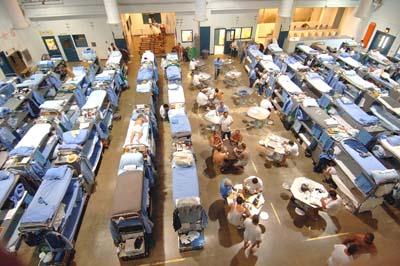
Possession of drugs like cocaine and heroin is a felony in California and is punishable by up to three years in state prison. The state's overcrowded prison system currently holds 9,000 drug possession offenders at a cost of $4.5 million dollars a year. The state faces a budget deficit of more than $20 billion.

The polling results will help lay the groundwork for an effort to move legislation that would drop drug possession from a misdemeanor to a felony, advocates said during a Monday teleconference.

Not only did respondents want to see penalties for drug possession lowered, a majority wanted to see them dramatically lowered, if not removed altogether. Some 51% said either that drug possession sentences should not exceed three months (27%) or that drug possession should not be punished with jail time at all (24%).

A majority (56%) said California sends too many people to prison, and three-quarters said the state should instead use the millions spent to imprison drug users for schools, law enforcement, and health care.

Support for drastically reducing sentences for drug possession cut across all demographic, regional, and ethnic lines. And that support would translate into votes during an election, the poll found. More than 40% said they would be more likely to support a candidate who reduced the penalty to a misdemeanor, while only 15% said they would be less likely.

"We found a widely, and intensely, held belief among voters that California imprisons too many people and can no longer afford to spend billions on prisons amid massive cuts to education and social services," said Daniel Gotoff of Lake Research. "This is a voting issue now. Politicians stand in the way of this popular reform at their own risk."

Support for cutting drug possession sentences held up even after respondents were treated to opposing messages, Gotoff said. "It holds up under attack, and voters don't need to be argued into this," he said. "There is a strongly held perception that the state imprisons too many people and that current penalties are too harsh. The voters are pretty solid on this."

"Support for reducing drug possession penalties crosses all the partisan, regional, and demographic lines that normally divide California voters," said Allen Hopper, police practices director with the ACLU of Northern California. "Solid majorities of Republicans, Democrats and independents from every corner of the state overwhelmingly agree that it’s time for a new approach. We need to stop wasting precious tax dollars on unnecessary, expensive jail and prison sentences."

Last week, Gov. Jerry Brown (D) signed a bill that would "realign" the state's overburdened corrections system by diverting nonviolent offenders from the state prison system to county jails. But that measure has yet to be funded, and it does not reduce sentences, but instead merely shuffles inmates from the state to county lock-ups.

"Sacramento's plan to keep people convicted of personal drug possession at the county level doesn't address the belief of a majority of Californians that drug possession shouldn't be a felony and that people shouldn't be locked up for longer than three months for this offense," said Margaret Dooley-Sammuli, deputy state director in Southern California for the Drug Policy Alliance.

"Californians aren't just interested in saving money. They're also interested in seeing people contribute to their families and communities," said Kris Lev-Twombly, director of programs at the Ella Baker Center for Human Rights. "California voters want to see that people are not burdened with a life-long felony record for drug possession that makes it tough to find a job or support a family. Current penalties work against individual, family and community well-being and public safety."


Also addressing the teleconference was Maria Alexander of the Center for Living and Learning, a reentry services provider. "Many people we serve have successfully overcome drug problems, but now they can't find jobs because they have felony convictions," she said. "The fact that some people can overcome this barrier is a testament to their dedication and hard work, but we don't have to make it so hard. Giving these people felony records is counterproductive and anti-recovery."

"Californians clearly and strongly reject the state's misplaced priorities that have pushed funding toward jails and prisons and away from schools," said Alice Huffman, president of the California State Conference of the NAACP. "The California NAACP urges the state legislature and the governor to listen to voters and reduce the penalty for drug possession for personal use from a felony to a misdemeanor."

This poll suggests strong public support for de-felonizing drug possession in California and lesser, but still substantial support for decriminalizing it. Now, it's time to lean on the legislature to bring it into line with enlightened public sentiment.

CA
United States

California Corrections "Realignment" Not Nearly Enough [FEATURE]

Faced with a staggering budget deficit and a prison overcrowding crisis, California Gov. Jerry Brown (D) and the state legislature have approved legislation that would shift responsibility for low-level, nonviolent offenders and parole violators from the state Department of Corrections and Rehabilitation (CDCR) to the state's counties. But sentencing and drug reform advocates say the measure merely shifts the burden of the state's corrections overcrowding from the state to the counties, fails to fund crime prevention services like drug treatment, and fails to include real sentencing reforms.

California Gov. Jerry Brown takes a tiny step toward corrections reform.
On Monday, Gov. Brown signed  Assembly Bill 109, the law shifting responsibility for many low-level offenders to the counties.  The law is designed to stop the "revolving door" of low-level offenders cycling and recycling through the prison system, Brown said in a signing statement.

"For too long, the state’s prison system has been a revolving door for lower-level offenders and parole violators who are released within months -- often before they are even transferred out of a reception center," Brown said. "Cycling these offenders through state prisons wastes money, aggravates crowded conditions, thwarts rehabilitation, and impedes local law enforcement supervision."

But the law will not go into effect unless and until the legislature approves and funds a community corrections grant program, something Republicans in the legislature have opposed.

"I will not sign any legislation that would seek to implement this legislation without the necessary funding," Brown said. "In the coming weeks, and for as long as it takes, I will vigorously pursue my plan to balance the state's budget and prevent reductions to public safety through a constitutional guarantee."

The cost of corrections in California is staggering. Gov. Brown's proposed Fiscal Year 2011-2012 budget funds the prison system to the tune of $9.19 billion, nearly 7.2% of the entire state budget. And the war on drugs is responsible for a hefty portion of it.

The state prison system holds a whopping 144,000 inmates, including more than 28,000 drug offenders and more than 1,500 marijuana offenders. Of those 28,000 drug offenders, 9,000 are there for simple drug possession at a cost of $450 million a year, or about $4.5 billion over the past decade. That figure doesn't include the cost of re-incarcerating parole violators who have been returned to prison for administrative violations, such as failing drug tests, so the actual cost of drug law enforcement to the prison system is even higher.

Not only does the prison system face a budgetary crisis, it also faces a looming US Supreme Court decision that, by most predictions, will result in the state being ordered to reduce the prison population to 110,000, which is still about 30,000 over official capacity. The lawsuit before the Supreme Court alleges that California does not provide adequate medical and mental health services to its prisoners.

Gov. Brown's and the legislature's plan to shift low-level offenders out of CDCR and into county facilities does not address the core of the problem, advocates said.

"This plan is a shell game that would simply shift corrections costs from the state to the counties without addressing the real problem: California is locking up too many people for low-level offenses for too long," said Allen Hopper, police practices director with the ACLU of Northern California. "The cost of mass incarceration is robbing the people of California of vitally needed services, including education and healthcare. What we need is real sentencing reform, such as shortening the sentences for simple possession drug crimes. It's time for California to stop wasting hundreds of millions of dollars incarcerating people who pose no threat to public safety."

"This plan would allow people to be locked up in local jails for up to three years, triple the current limit. Research consistently shows that longer sentences do not produce better outcomes. In fact, shorter sentences coupled with re-entry and prevention tactics are both more effective and more cost-effective," said Margaret Dooley-Sammuli, deputy state director in Southern California for the Drug Policy Alliance. "We're talking about people convicted of low-level offenses, like drug possession, prostitution and petty theft, often related to a drug problem. But the plan doesn't include a dime for drug treatment or mental health care. In fact, the governor has proposed reducing funds for those services."

"Any California corrections reform must include sentencing reform," said Kris Lev-Twombly, director of programs at the Ella Baker Center for Human Rights. "A felony conviction is a life-long sentence that should not be applied to low-level offenses. No matter how old the conviction, people with a felony on their record will face significantly diminished employment opportunities and much lower lifetime earnings. They may also be prohibited from accessing student loans, food stamps and other public assistance. This works against individual, family and community well-being and public safety."

San Quentin Prison -- no room at the inn. (Image via Wikimedia.org)
The bill signed into law by Gov. Brown is not sentencing reform, but sentencing reform is what is needed, said Dooley-Sammuli. Decriminalization of drug possession is the goal, but legislators aren't ready to embrace that yet, she said. In the meantime, there are other options.

"We want the legislature to reduce the penalty from a felony to a misdemeanor," she said. "We don't think the legislators are at the point where they understand the real harms that come to drug users, their families, and their communities because of the criminal penalties for drug use, but we think they do understand there is no reason why the penalties should be as severe as they are. The common ground is that they cost too much money and they do damage because of the burden of a felony conviction."

Advocates are continuing to push for real sentencing reform in California, said Dooley-Sammuli. "This would be a very good year for it," she said. "The critical thing is for the legislature to understand that there are additional cost savings to be had by reducing these low-level felony offenses to misdemeanors, with no threat to public safety, but with positive advantages for reentry success. They think that this realignment solves the problem, but this is not sentencing reform. Incarcerating people in county jails instead of state prisons is not sentencing reform."

But even as reformers continue to fight for sentencing reform, Gov. Brown and the legislature still have to figure out how to pay for the shift from state prisons to county jails. Brown has been pushing for a special election in June to give voters the chance to approve tax increase extensions, but he needs support from Republicans, and that doesn’t appear to be there. If that doesn't happen, it may appear on the November ballot as an initiative, but the tax extensions expire July 1, and a November vote would require voters to increase taxes, not a popular notion these days.

"Funding is not imminent," said Dooley-Sammuli. "But the deal has been struck. If they can get the Republicans or the voters to agree to tax extensions, this is the plan Democrats want for realignment.

And speaking of funding not being imminent, Gov. Brown has proposed zero increases for community-based drug treatment and actual cuts to drug treatment programs within the CDCR. That would affect treatment for both prisoners and parolees.

"He is talking about reducing access to services even as we face a major shift in how corrections works in this state," said Dooley-Sammuli. "That's really stupid."

It has become increasingly evident that California can't afford its drug war. Gov. Brown and the legislature have attempted to craft a fix, but the fix will leave the system just as broken as ever. Now, the state's political elite has to understand that half-measures won't solve the problem. If they're not ready for decriminalization or legalization, it is at least time for de-felonization.

Mass Marijuana Arrest Policy Costs NYC Big Bucks

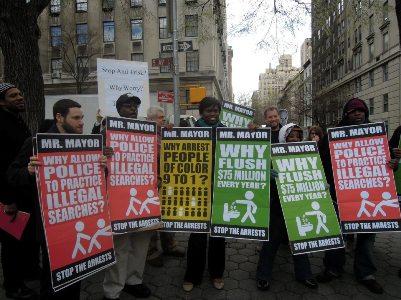
In a report released Tuesday, the Drug Policy Alliance charged that New York City's unwritten policy of mass arrests of pot smokers -- overwhelmingly young and minority -- is costing the city $75 million a year. The report, bluntly titled $75 Million a Year: The Cost of New York City's Marijuana Arrests, was co-authored by City University of New York professor and marijuana arrest expert Harry Levine.

drug arrest scene, "10 Rules for Dealing with Police," flexyourrights.org
Although New York state decriminalized marijuana possession in the 1970s, the NYPD has made it a practice to stop and frisk people by the hundreds of thousands a year and demand that they empty their pockets. When they produce marijuana from their pockets, they are then charged with public possession -- possession in plain view -- a misdemeanor.

The NYPD is arresting about a thousand pot smokers a week and has busted more than 350,000 of them during Mayor Michael Bloomberg's tenure in office. This is the same Mayor Bloomberg who once said he smoked marijuana and like it.

Bloomberg's and the NYPD's mass arrest policies cost the city big bucks in a time of economic difficulty. With Levine and his co-author Loren Siegel estimating the cost of arresting and prosecuting each pot possession offender at between $1,000 and $2,000, New York City has spent somewhere between $350 million and $700 million to persecute pot people since Bloomberg has been in office.

"More people have been arrested for marijuana possession under Mayor Bloomberg than under Mayors Koch, Dinkins, and Guiliani combined," said Levine at a City Hall news conference Tuesday. "These arrests are wildly expensive, do not improve public safety, and create permanent criminal records which seriously damage the life chances of the young people targeted and jailed," Levine said.

"Upwards of $75 million have been used to arrest NYC residents for marijuana possession that could have legally been handled with a summons and not a criminal offense," said City Council Member Jumaane Willimas. "This, as we are debating closing our senior centers. In addition, 86% of those arrests are young children of more color. I don't believe that this represents the percentage of people who take the occasional 'pull.'  It does however better reflect the communities abused by the current stop and frisk policies. Had this been 86% of our young children of a lighter shade, there would be uproar. I believe there still should be. All of our children are gifts to be nurtured; yet we are losing them to the system at an alarming rate. There must be a better way to deal with drugs in New York City. These arrests are simply about boosting arrest numbers and aren't the answer to our problems," said Williams.

"It is clear that the NYPD's current policy of giving high arrest priority to marijuana enforcement is fiscally wasteful, and has a greater impact on low-income communities where the 'war-on-drugs' has been primarily focused," said Council Member Letitia James. "Although African-Americans only constitute 13% of national of drug users, they make up 38% of those arrested for drug offenses, and 59% of those convicted of drug offenses. It is fair to say that the high priority given to marijuana enforcement directly relates to racial profiling in New York."

"The consequences of an arrest are severe, especially for young people of color who are already disproportionately arrested and incarcerated in juvenile facilities," said Kyung Ji Rhee, Director of the Institute for Juvenile Justice Reform and Alternatives. "Young people of color are targeted, illegally searched and being put through the criminal justice system for possessing or smoking marijuana. Whatever your opinion may be on marijuana, this is no way to treat or teach young people about the choices they make."

"It is beyond hypocritical for the Mayor, who once said he smoked marijuana and enjoyed it, to make arresting young people of color for marijuana possession his top law enforcement priority," said Gabriel Sayegh, New York State Director for the Drug Policy Alliance. "While cutting services for seniors, youth, housing, transportation, teachers, education, and more, the Mayor spent S75 million last year to arrest over 50,000 people for marijuana possession -- which isn’t even a crime under NY State law. It's just outrageous."

Will Mayor Bloomberg and the NYPD see the light? Not without some political heat -- stay tuned.

New York, NY
United States

Florida Taxpayers Spent Hundreds of Millions Jailing Nonviolent Drug Abusers, Treatment a Less Expensive and More Effective Method

Location: 
FL
United States
Officials across Florida are realizing that in situations where drug offenders are non-violent it would be a better use of limited resources to send them to treatment instead of prison. But, there aren't enough treatment programs and Florida currently houses 19,414 inmates for non-violent drug offenses costing taxpayers $377,971,166 a year. Mary Lynn Ulray, the executive director of a Drug Treatment Program DACCO, says she thinks the legislature is starting to understand there is a cost benefit from drug treatment. Ulray says the agency's 6 month residential program has close to a 70 percent success rate in six months at a cost of $10,000 compare that to the average 6.4 year sentence costing taxpayer $124,601 per offender.
Publication/Source: 
WTSP (FL)
URL: 
http://www.wtsp.com/news/local/story.aspx?storyid=176960&catid=34

Bill to Lessen Penalties for Some Drug Offenders Clears Kentucky Senate Panel

Location: 
KY
United States
A Kentucky Senate committee has approved legislation aimed at reducing the state’s fast-rising prison population by bolstering drug treatment and alternative sentences for non-violent offenders. The bill cleared the Senate Judiciary Committee without opposition. Supporters say the bill would produce net savings of $147 million over 10 years.
Publication/Source: 
The Gleaner (KY)
URL: 
http://www.courierpress.com/news/2011/feb/24/bill-lessen-penalties-some-drug-offenders-clears-k/

Keep the Pressure On (Action Alert)

We Are the Drug Policy Alliance.

Tell your Senators to approve spending cuts to the drug war!

Take Action!

Email the Senate

Dear Friends,

Thanks to the overwhelming response Congress received from supporters like you, huge drug war spending cuts have been approved by the House! Hundreds of millions of dollars used by state and local law enforcement agencies for ineffective drug war policies will be cut, and the ridiculous and ineffective national anti-marijuana ad campaign has been cut completely. Now we need to do the same for the Senate!

Tell your Senators to approve the House's spending cuts to failed drug war programs!

The new budget is still not set. The Senate has generally been unsupportive of scaling back the drug war in years past, so they need to hear from you! Now is the time to let your Senators know we cannot afford to wait any longer to end the drug war!

Please take a minute to write your Senators and tell them to approve these necessary spending cuts immediately!

Sincerely,

Bill Piper
Director, Office of National Affairs
Drug Policy Alliance

Neither Treatment Nor Jail for California Drug Offenders [FEATURE]

California voters opted for treatment over prison for drug possession offenders when they passed Proposition 36 with 61% of the vote in 2000. But now, five years after voter-mandated funding for treatment expired, the deficit-wracked state government is refusing to ante up, equally cash-starved counties are refusing to fund treatment locally, and drug offenders are ending up with neither treatment nor jail.

California State Capitol, Sacramento
When Prop 36 was fully funded by voter mandate, people who were convicted of first- or second-time drug possession offenses and decided to opt in were placed on probation with the requirement that they enter treatment. Treatment was funded by the state. But after that initial five-year mandate, and as California's budget crisis worsened, state funding has shrunk each year, and waiting lists for treatment for Prop 36 offenders began to grow.

That's even as the program has proven a success. According to research conducted by UCLA, Prop 36 has reduced the number of people imprisoned for drug possession by 40%, or 8,000 people, saving taxpayers $400 million in corrections costs this year alone. Overall, Prop 36 has saved the state more than $2 billion in corrections costs.

Perversely, Prop 36 treatment didn't get a penny of it. Once the mandated funding of around $120 million a year expired, treatment funding fell from a high of $145 million in 2007-2008 to $118 million in 2008-2009, $18 million in 2009-2010, and zero last year. Gov. Jerry Brown (D) has proposed zero funding for Prop 36 treatment again this year.

"Prop 36 has helped reduce the number of people incarcerated for drug possession by nearly half, but there are still 9,000 of them in prison," said Margaret Dooley-Sammuli, deputy state director for Southern California for the Drug Policy Alliance, the group that sponsored Prop 36. "Most were never convicted of any serious or violent offense, but are there because they have a drug problem and multiple offenses. This is the same population that we've successfully been diverting from prison in huge numbers with no negative impact on public safety or on the taxpayers."

Prop 36's mandates are still in effect even if no one is allocating money to fund them. The court must still offer probation with the requirement that the offender goes to treatment, but now, instead of going to treatment, offenders go on a waiting list, which has grown weeks- and months-long as funding shrank, and which now may become endless.

"If you don't really need drug treatment, that's not a problem," said Dooley-Sammuli, "but if you have a drug problem, you are being put at a serious disadvantage. You're not getting the treatment you're entitled to under Prop 36 and you're at greater risk of being found in violation of probation and incarcerated."

With the prospect of help from the state legislature grim, counties are scrambling to figure out what to do. None of the options look very good.

"Long before we had financial support, long before there were funds to subsidize persons involved in the criminal justice system in our treatment services, we were seeing people ordered into treatment by the courts. We have just reverted back to those days," Haven Fearn, director of the Contra Costa County Health Services Department's Alcohol and Other Drug Services Division, told the Oakland Tribune. "We still offer treatment services to those individuals, but if the treatment slots are unavailable at the time the court orders it, many of them will have to go onto a waiting list."

Santa Cruz County announced that will "phase out" Prop 36 by no longer monitoring its participants, and other counties have suggested they will send offenders to Narcotics Anonymous. But counties that do not provide Prop 36 treatment could face lawsuits from Prop 36 offenders facing incarceration after failing three drug tests, if those those counties did not provide the treatment required by Prop 36.

"The counties can't opt out," said Dooley-Sammuli. "This is a sentencing statute. No county can end Prop 36. What they are choosing to end is the providing of treatment."

If legislators were smart, they would pay for treatment, said Dooley-Sammuli. "We hope they will realize that the state is crazy to not provide counties the resources to deal more effectively and more cost-effectively with people convicted of drug possession. Probation and treatment are both cheaper than jail. Not only should treatment be funded," she said, "but we know where to find it: In the $450 million currently locked up in the prison budget to incarcerate drug possessors."

Dooley-Sammuli also suggested California make possession a misdemeanor, not a felony. "The legislature recognizes that drug possession isn’t an offense that warrants incarceration in state prison, and we're asking that they follow through with what that really means," she said.

"Not only do we save money by making that a misdemeanor, we're also talking about making an important difference in the lives of people convicted of drug possession," she continued. "Having a felony on your record makes a huge difference in employment opportunities, lifetime earnings, being able to vote or adopt children, having custody of your own children, and other damaging collateral consequences."

If California isn't going to imprison drug possessors and it isn't going to provide them treatment, then perhaps it should just go ahead and decriminalize drug possession. Until it does, though, drug possession remains a felony in the Golden State. It's just that the state by law can't send offenders to prison and by choice won't pay to send them to treatment.

CA
United States

Drug War Issues

Criminal JusticeAsset Forfeiture, Collateral Sanctions (College Aid, Drug Taxes, Housing, Welfare), Court Rulings, Drug Courts, Due Process, Felony Disenfranchisement, Incarceration, Policing (2011 Drug War Killings, 2012 Drug War Killings, 2013 Drug War Killings, Arrests, Eradication, Informants, Interdiction, Lowest Priority Policies, Police Corruption, Police Raids, Profiling, Search and Seizure, SWAT/Paramilitarization, Task Forces, Undercover Work), Probation or Parole, Prosecution, Reentry/Rehabilitation, Sentencing (Alternatives to Incarceration, Clemency and Pardon, Crack/Powder Cocaine Disparity, Death Penalty, Decriminalization, Drug Free Zones, Mandatory Minimums, Rockefeller Drug Laws, Sentencing Guidelines)CultureArt, Celebrities, Counter-Culture, Music, Poetry/Literature, Television, TheaterDrug UseParaphernalia, ViolenceIntersecting IssuesCollateral Sanctions (College Aid, Drug Taxes, Housing, Welfare), Violence, Border, Budgets/Taxes/Economics, Business, Civil Rights, Driving, Economics, Education (College Aid), Employment, Environment, Families, Free Speech, Gun Policy, Human Rights, Immigration, Militarization, Money Laundering, Pregnancy, Privacy (Search and Seizure, Drug Testing), Race, Religion, Science, Sports, Women's IssuesMarijuana PolicyGateway Theory, Hemp, Marijuana -- Personal Use, Marijuana Industry, Medical MarijuanaMedicineMedical Marijuana, Science of Drugs, Under-treatment of PainPublic HealthAddiction, Addiction Treatment (Science of Drugs), Drug Education, Drug Prevention, Drug-Related AIDS/HIV or Hepatitis C, Harm Reduction (Methadone & Other Opiate Maintenance, Needle Exchange, Overdose Prevention, Safe Injection Sites)Source and Transit CountriesAndean Drug War, Coca, Hashish, Mexican Drug War, Opium ProductionSpecific DrugsAlcohol, Ayahuasca, Cocaine (Crack Cocaine), Ecstasy, Heroin, Ibogaine, ketamine, Khat, Marijuana (Gateway Theory, Marijuana -- Personal Use, Medical Marijuana, Hashish), Methamphetamine, Nicotine, Prescription Opiates (Fentanyl, Oxycontin), Psychedelics (LSD, Mescaline, Peyote, Salvia Divinorum), Synthetic Drugs (Mephedrone, Synthetic Cannabinoids)YouthGrade School, Post-Secondary School, Raves, Secondary School