In a new report released Friday, the Drug Policy Alliance (DPA) and the California NAACP charged that African-Americans have been disproportionately targeted in low-level marijuana possession arrests. The report, Arresting Blacks for Marijuana Possession in California: Possession Arrests in 25 Cities, 2006-2008, found that despite lower use rates, African-Americans were three, four, six, or even 13 times more likely to be arrested for pot possession than whites.
The report's release is timed to give Proposition 19, the marijuana legalization initiative, a boost in the few remaining days until election day. It was released at a press conference where California NAACP and DPA representatives were joined by Prop 19 campaign head Richard Lee, Law Enforcement Against Prohibition (LEAP) executive director Neill Franklin, Hollywood actor Danny Glover, and former US Surgeon General Dr. Joycelyn Elders.
The report found that in Los Angeles, with 10% of the state's black population, blacks were seven times more likely to get busted than whites. In San Diego, the state's second largest city, blacks were six times more likely to get busted. Ditto for Sacramento. In Torrance, blacks were 13 times more likely to be busted than whites.
"This report documents enormous, widespread race-based disparities in the arrests of nonviolent, low-level marijuana possession offenders," said Stephen Gutwillig, California state director for the Drug Policy Alliance. "The context is an enormous increase in the number of arrests for low-level possession in the past 20 years. Arrest rates for all other crimes have plummeted, from rape and murder to all other drug possession crimes, but marijuana possession arrests have tripled since 1990, from around 20,000 then to 61,000 last year. This was made possible by the targeting of communities of color, specifically African-Americans and Latinos, and more specifically, young African-Americans and Latinos."
It's not just that blacks are arrested disproportionately to whites. They are also arrested at rates far exceeding their percentage of the population. In Los Angeles, blacks make up 10% of the population, but 35% of all marijuana possession arrests. In Sacramento, it's 14% and 50%.
"These disparities were built from routine, pervasive, system-wide police practices," said Gutwillig. "This is not the result of a few racist cops; this is the way the system works."
"I don't think there is any question this is a civil rights issue," said California NAACP executive director Alice Huffman. "If you don't believe that, you don't believe in justice in America."
"We're spending billions of dollars each year on the war on drugs," said Dr. Elders. "It's been a war on young black males. Wars are supposed to end sometime. It's time to end this war. Proposition 19 is an opportunity to take drugs out of the hands of the drug cartels and put them where they can be controlled and taxed."
"This is not about a right to get high, it's an issue of a policy that does not work and is damaging to our society and most importantly, specifically damaging to people of color," said LEAP's Neill Franklin. "Marijuana prohibition is the most dysfunctional public policy in this country since slavery. The violence generated in our communities is unbelievable and it's because of the criminal market this policy creates. The lives of young African-Americans are being lost every day, and whether they lose their lives to violence or to a prison sentence, both are devastating," he said.
"This is an opportunity for law enforcement to get it right," said the former Maryland narcotics officer. "We spend a majority of our time dealing with low-level drug offenders, mainly marijuana," Franklin said. "In the 1960s, we solved nine out of 10 murders; now it's six out of 10. When you apprehend a murderer, murders go down. But when you take someone off the streets for selling marijuana, sales don't go down, and the violence increases because people are fighting for market share."
"I want to say publicly that I support Proposition 19," said film star Danny Glover. "The current laws do not work; they have failed us," he said. "We know we are arrested disproportionately. This is a civil rights issue," he maintained.
"I'm not a marijuana smoker, although I have tried it in the past, but I don't want to stand in the way of people who want to use marijuana recreationally," Glover continued. "This is a long battle, and we're on the right side."
"I've always seen cannabis prohibition as causing a war between police and citizens," said Lee. "Police are supposed to serve and protect, not wage war on the populace. We need police back protecting us from real criminals, not ourselves."
The Prop 19 campaign and DPA did it again this week, this time with Latino marijuana possession arrest rates. But it's already clear that racial disparities in the enforcement of California's pot laws exist, and simply decriminalizing marijuana possession, as Gov. Schwarzenegger did last month, will not change anything in that regard, at least not directly. Minority youths can still be hassled, harassed, and searched for an infraction, just as they were for a misdemeanor. It will take legalization to end such practices.
Oregon High Court to Decide Concealed Handgun/Medical Marijuana Issue
Michigan Woman with Fibromyalgia Evicted from Federally Subsidized Apartment for Using Medical Marijuana
Police Can Kick Down Doors in Drug Searches, Some Justices Say
Drug Trade Among Whites More Open in NYC?
'False Positives' Suggest Police Exploit Canines to Justify Searches
Advocates, Scholars and Activists to Gather in Washington, DC on January 14 to Demand Exit Strategy from 40-Year-Long War on Drugs (Press Release)
For Immediate Release: January 6, 2011
CONTACT: Tony Newman at (646) 335-5384 or Yolande Cadore at (646) 508-1790
Civil Rights, Criminal Justice and Drug Policy Reformers to Hold Town Hall Forum to Commemorate Dr. Martin Luther King’s Legacy
Advocates, Scholars and Activists to Gather in Washington, DC on January 14 to Demand Exit Strategy from 40-Year-Long War On Drugs
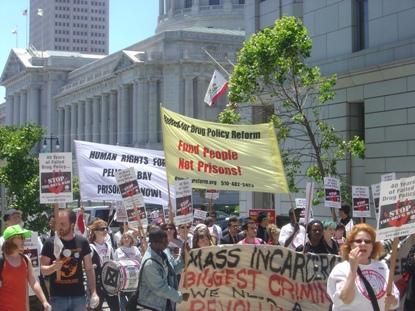
Participants to Address Racial Profiling, Mass Incarceration, Prohibition-Related Violence, and Their Impact on Black Communities
WASHINGTON, DC— Is the disparate impact of the war on drugs on black communities the next big civil rights struggle? Why are black men imprisoned for drug offenses at 13 times the rate of white men despite equal rates of drug use and selling across races? How do we begin to address the connections between astronomical rates of incarceration, disintegration of black families, and the war on drugs?
These questions and many more will be addressed at a town hall gathering to commemorate Dr. King’s birthday in Washington, D.C, on Friday, January 14 at First Baptist Church (712 Randolph St. N.W., Washington, DC) from 6:30-9p.m. The town hall is organized by the Drug Policy Alliance, the Institute of the Black World 21st Century / Black Family Summit, the National Conference of Black Lawyers, and the Black Leadership Commission on AIDS of DC and Vicinity.
The town hall meeting – “Ending the 40 Year Drug War: Promoting Policies That Rebuild/Reclaim Our Families and Communities” – will bring together a diverse group of scholars, community activists, social service providers, and religious and political leaders. They will discuss viable alternatives to the quagmire of the misdirected war on drugs, which has torn apart the fabric of many communities.
Speakers and panelists include:
*Dr. Tricia Bent-Goodley, Professor, Howard University, School of Social Work
*Dr. Annelle Primm, Director of Minority and National Affairs, American Psychiatric Association
*Ethan Nadelmann, Executive Director, Drug Policy Alliance
*Judge Arthur Burnett, Executive Director, National African American Drug Policy Coalition, Howard University School of Law
*Dr. Ron Daniels, President, Institute of the Black World 21st Century
*Dr. Divine Pryor, Executive Director, Center for NuLeadership on Urban Solutions
*Rev. Frank D. Tucker, Senior Pastor, First Baptist Church
*Asha Bandele, Director, Advocacy Grants Program, Drug Policy Alliance
*Nkechi Taifa, Esq., Senior Policy Analyst, Open Society Institute
This year marks the 40th anniversary of the failed war on drugs. The casualties of this war have come from low-income and communities of color. High rates of incarceration, fueled in large part by the war on drugs, have led to a breakdown in trust between law enforcement and the communities that they strive to serve and protect. The war on drugs is also responsible for premature deaths from preventable diseases such as Hepatitis C and HIV among injecting drug users.
The collateral damage of the drug war has resulted in overwhelming barriers to the creation of vibrant, sustainable and healthy communities. Today, civil rights advocates are honoring Dr. King’s legacy by standing up against the “new Jim Crow” – mass incarceration and the racially disproportionate war on drugs.