Weekly: Blogging @ the Speakeasy
Along with our weekly in-depth Chronicle reporting, DRCNet also provides daily content in the way of blogging in the Stop the Drug War Speakeasy -- huge numbers of people have been reading it recently -- as well as Latest News links (upper right-hand corner of most web pages), event listings (lower right-hand corner) and other info. Check out DRCNet every day to stay on top of the drug reform game! Check out the Speakeasy main page at http://stopthedrugwar.org/speakeasy.
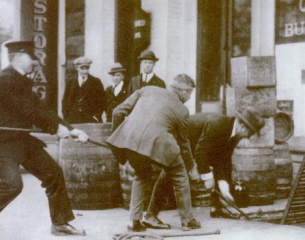
prohibition-era beer raid, Washington, DC (Library of Congress)
Since last issue:
Scott Morgan offers: "If Obama Supports Medical Marijuana, What About Hemp?," "Field Tests for Identifying Drugs Are Proven Wildly Inaccurate," "SWAT Raids on Innocent People are Bad," "How Come the Dutch Smoke Less Marijuana Than Americans?," "California DMV Agrees to Let Medical Marijuana Patients Drive," "Maybe a Quirky Folk Song Will Lead to Marijuana Legalization...," "Mexican President Surprised to Learn That the Drug War is Super Violent," "Man Uses Fake Money to Buy Fake Drugs," "Former Drug Warrior Now Lives With his Parents."
David Guard posts numerous press releases, action alerts and other organizational announcements in the In the Trenches blog.
Please join us in the Reader Blogs too.
Again, http://stopthedrugwar.org/speakeasy is the online place to stay in the loop for the fight to stop the war on drugs. Thanks for reading, and writing...
Drug Policy in Afghanistan
Comment posted by Anonymous on Fri, 03/06/2009 - 2:42pm*Steven Card - short bio_born 1950, Crawford, NE_ Glenrock HS, WY 1970_1971-72 Vietnam ASA, B.S. Alcohol and Drug Abuse Studies, University of South Dakota 2000.
“Soft Power” for a Kinder, Gentler Afghanistan
by Steven Card*
When I think of Afghanistan I think of “Ali Baba and the Forty Thieves”. Afghanistan has been a central locus for the black market economy throughout its history. What contributes to such a condition? It is a country of paupers and families living in abject poverty. Afghanistan is one of the poorest countries in the world today. Afghanistan is a landlocked desert plateau, home to the Hindu Kush, some of the highest mountains in the world.
In Afghanistan, there is virtually no infrastructure of any kind. Most of the people live in isolated villages within geographically hazardous mountainous and desert regions or as nomads. Agriculture is the main economy and relatively meager in the production of wheat, fruits, and nuts, goats and sheep. Opium is the number one cash crop and accounts for $3-billion-dollars-a-year in illegal trade. The proceeds go largely to regional warlords, the Taliban, and Al Qaeda.
Applying a “soft power” military strategy is essential to enhancing our effectiveness in the region and winning the “hearts and minds” of the people of Afghanistan This means addressing issues of economic, political and social development. In other words, the United States and its allies can build roads, schools, improve agriculture and deliver numerous other services to the people of Afghanistan in an effort to win over the region and gain greater cooperation. This is a valuable contribution to stabilizing the country and its government.
However, the most cost-effective military “soft power” option could be to change our drug interdiction policy in Afghanistan. A cursory cost-benefits analysis shows how ineffective the current policy is. There are Primary interdiction costs. This includes casualties; both military and civilian. There are logistics costs with elements of the army, the Drug Enforcement Agency's cadre training program, and Blackwater employees essentially using a “slash and burn” policy for opium poppies. There are secondary interdiction costs associated with police enforcement in the countries of the Middle-East, Europe and the United States where opium-now-heroin hits the streets. Tertiary costs are medical, drug treatment and family counseling costs associated with addiction and attending diseases. Overseas, the psychosocial costs are in losing the cooperation of the Afghan people, the good will of other Muslim countries and perpetuating anti-American sentiment throughout the Middle-East.
Here is a bold and unusual idea for Afghanistan. Try a “harm reduction” approach. How hard would it be for NATO forces or the Afghan government to buy the opium crop and sell it to pharmaceutical companies and laboratories within the global marketplace? World-wide research facilities, and universities are possible options for recouping some of the initial costs as well. Economically this would deprive the insurgents of a major source of income, leaving them fewer bullets to shoot at our troops. The government could pay the poor, unfortunate farmers, in part, with new farm equipment, water capture and purification apparatus, solar and wind technologies, livestock and food seeds.
Destroying farmers crops, killing and arresting civilians does nothing to win the “hearts and minds” of
the people of Afghanistan. If the United States and Europe purchased the 3-billion-dollar-a-year opium
crop in Afghanistan and destroyed it, I believe it would be a cheaper-per-year alternative than the associated costs of the current policy. Even Iran might be willing to contribute because of a rising addiction problem in its country. What is 3-billion-dollars split between the affected countries? A final metaphor comes to mind from the science fiction book, “Dune” by Frank Herbert. The one who controlled the “spice” controlled the planet “Arrakis” and controlled the Universe.
REFERENCES
1. http://www.newsweek.com/id/76306 - Inside 'People Smuggling' , It Isn't Hard To Get Yourself Out Of Afghanistan. A Firsthand Account , By Melinda Liu | NEWSWEEK , From the magazine issue dated Nov 5, 2001. [“no country has a deeper history of smuggling of all sorts than Afghanistan. Contraband televisions, gasoline, opium, AK-47s, as well as illegal migrants: all are ferried along remote trade routes that date back centuries.”]
2. http://en.wikipedia.org/wiki/Geography_of_Afghanistan – Wikipedia, Geography of Afghanistan.
3.http://www.monstersandcritics.com/news/southasia/news/article_1271519.php/Taliban_beneficiary_of_Afghan_opium_trade_Iran_role_positive_US - Taliban beneficiary of Afghan opium trade; Iran role positive: US, South Asia News, Mar 1, 2007, 19:27 GMT
3. http://www.popline.org/docs/0587/016982.html - Title: Regional variations in the distribution of population and levels of urbanization in the Democratic Republic of Afghanistan 1979-80. POPLINE Document Number: 016982. Author(s): Khalidi NA, Source citation: IIPS Newsletter, 1982 Apr;23(2):15-26. Abstract.
4. http://www.radioaustralia.net.au/programguide/stories/200808/s2321316.ht... – Australian Broadcasting Corp., US military shifts to "soft power" strategy, Updated Fri Aug 1, 2008 11:35am AEST.
5. http://www.classbrain.com/art_cr/publish/afghanistan_economy1.shtml - Afghanistan – Economy , By The CIA Factbook , May 8, 2008, 15:46.
6.'Harm Reductiion: Pragmatic strategies for managing high-risk behaviors ', ed. G. Alan Marlatt, ©1998, Guilford Press.
7. http://www.whitehousedrugpolicy.gov/international/afghanistan.html – Office of National Drug Control Policy, Source Countries and Drug Transit Zones: Afghanistan.
8. http://www.guardian.co.uk/world/2008/sep/11/iran.afghanistan - The Guardian UK, Failed Afghan drug policy harming us, says Iran. Heroin addiction on rise, Tehran official warns. Britain points to decrease in land used for cultivation. by Julian Borger, diplomatic editor, Thursday 11 September 2008.
9. http://www.serviammagazine.com/mag/MarApr2008/0408_Cover_Story.htm - Serviam Magazine, Partnership Against Heroin: Contractors Help U.S. Combat Narcoterrorists in Afghanistan.
10. http://www.metimes.com/International/2008/06/11/training_afghan_narcotic... Training Afghan Narcotics Officers Published: June 11, 2008 By JAMES EMERY (Special to the Middle East Times)
11. http://74.125.95.132/custom?q=cache:XKvlFCBuuM8J:www.defenselink.mil/com... - Counter Narcotics, Global War On Terror (GWOT)/Regional War on Terror (RWOT) , Drug Interdiction and Counterdrug Activities , Budget Activity 04, Administrative and Service-Wide Activities.
12. http://www.iranfocus.com/en/index.php?option=com_content&task=view&id=38... - Iran tops world drug addiction-rate list - report Saturday, 24 September 2005, Iran Focus Thursday, 26th February 2009.
Drugs in Iran
Comment posted by Anonymous on Sun, 03/08/2009 - 3:29am"Iran tops world drug addiction rate"
The mullahs' execution of drug-takers makes America look mild.
The head of the UN's INCB is an Irani.
Go figure.


digg
reddit


Just out of the Gulag-an early activist is gearing up..
Comment posted by Anonymous on Fri, 03/06/2009 - 1:13pmI have just gotten out of prison after 4 years for MDMA and hemp. I have been active in legalization for almost 40 years and was a founder of the libertarian movement. I want to get in touch with old friends like Jack Herer and Ben Mazel so if you know them tell them to contact me at freedonnow@yahoo.com I have plenty of ideas and energy to make the final push for legalization. Anyone from Kentucky around?